Introduction
Legal risk no longer lives in the legal department. Data breaches trigger class actions. Missed regulatory updates result in fines. Contract gaps surface during M&A due diligence, often at the worst possible moment. Boards and executive teams are increasingly the ones answering for these failures.
Most organizations are still managing legal risk with manual processes, reactive reviews, and siloed reporting — tools built for a slower world. As regulatory complexity and business velocity increase, that gap widens.
Securities class action filings reached 225 in 2024, up from 215 the year before. AI-related filings more than doubled. The pace of legal exposure is accelerating, and traditional oversight structures aren't keeping up.
This guide is not written for lawyers. It's for boards, CEOs, COOs, General Counsel, and risk leaders who need to understand what AI can realistically do: provide earlier visibility, cleaner reporting, and better decision-making around legal exposure — before incidents force the issue.
Key Takeaways
- The U.S. Federal Register published 3,248 final rules in 2024 alone — manual monitoring can't keep pace
- AI's highest-value use cases are contract risk identification, regulatory monitoring, privacy exposure mapping, and early-warning pattern detection
- Boards should set escalation thresholds before AI flags something — not after
- Stanford found legal AI hallucinations in more than 17% of benchmark queries, making human verification non-negotiable
- AI improves what gets seen; humans decide what to do about it
Why Traditional Legal Risk Management Is Breaking Down
Legal risk has expanded well beyond contract disputes and litigation. Privacy law, cyber liability, employment regulation, ESG obligations, supply chain compliance — the scope has grown substantially. Most organizations are still responding with periodic outside counsel reviews and manual contract tracking.
The Regulatory Volume Problem
The Federal Register published 3,248 final rules and 1,769 proposed rules in 2024. Nineteen U.S. states had enacted comprehensive privacy laws by 2025, with seven enacted in 2024 alone. NCSL reports that 49 states and D.C. introduced or considered 800+ consumer privacy bills in 2025.
No legal team using manual monitoring processes can triage that volume effectively, especially across multi-jurisdictional obligations in financial services, healthcare, and retail — sectors where regulatory requirements compound quickly.
The Board-Level Visibility Gap
Executives rarely see legal risk data in a structured, trend-based format. Risk appears as incidents: a lawsuit filed, a regulatory inquiry received, a contract dispute escalated to the CFO. There's no inspectable posture — just surprises.
In Tyson Martin's board advisory work, one of the most consistent gaps he encounters is the absence of pre-defined escalation thresholds. Organizations typically can't answer three basic governance questions:
- When does the board get involved?
- When does outside counsel engage?
- Who owns the decision?
The Cost of Late Detection
The financial stakes make earlier identification worth pursuing. IBM's 2024 Cost of a Data Breach Report puts the average breach cost at $4.88M globally and $9.36M in the U.S. — and that's before factoring in litigation exposure. The SEC obtained $8.2 billion in financial remedies across 583 enforcement actions in FY2024. FINRA imposed $59.8M in fines in the same year.
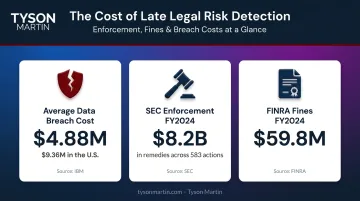
Each of those figures reflects the same underlying failure: detection came too late. That's exactly where AI-assisted legal risk monitoring is changing the calculus.
Where AI Makes the Biggest Difference in Legal Risk Management
AI doesn't eliminate legal risk. What it does is surface risk faster, at greater scale, and with more consistency than manual processes allow. These are the four areas where the difference is most material.
Contract Risk Identification at Scale
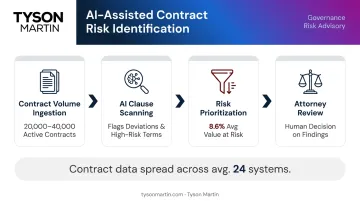
A typical Fortune 1000 company manages 20,000–40,000 active contracts. Manual clause-by-clause review for indemnification gaps, missing force majeure language, unfavorable termination terms, or auto-renewal traps is practically impossible at that volume.
Poor contract management erodes an average of 8.6% of contract value, according to World Commerce & Contracting — with worst performers losing 15% or more. Contract-related data is scattered across an average of 24 systems in most enterprises.
AI contract review tools can scan large volumes simultaneously, flagging deviations from standard terms and surfacing high-risk clauses for attorney review. This is especially valuable during M&A due diligence, where Tyson Martin's engagements have surfaced issues like lax encryption across customer PII, findings that shaped deal structure and saved millions in post-close costs.
Regulatory and Compliance Monitoring
Manual tracking of regulatory change across multiple jurisdictions is one of the clearest AI substitution opportunities in legal risk management. AI tools can continuously monitor applicable regulations and flag gaps between current practices and new requirements.
For regulated industries — financial services, healthcare, retail — this matters particularly. The SEC, FINRA, and HHS Office for Civil Rights (OCR) are active enforcers. OCR has received more than 374,000 HIPAA complaints since 2003 and imposed nearly $145 million in civil penalties. Continuous monitoring provides a more defensible posture than periodic reviews.
Data Privacy and Cyber Liability Exposure
A cyber incident triggers legal exposure immediately: breach notification obligations, regulatory penalties, and class action risk all flow from the same event. Legal and cyber risk functions need shared data structures and reporting lines, not separate workflows that reconcile after the fact.
AI can support this integration in several concrete ways:
- Maps personal data flows across systems to identify where exposure concentrates
- Flags gaps against GDPR, CCPA, and HIPAA requirements before an incident surfaces them
- Surfaces breach notification obligations and timelines specific to each applicable jurisdiction
In Tyson Martin's board reporting work, this translation — from technical vulnerability to legal exposure — is built directly into the reporting framework. A weak identity control in the cloud admin layer gets reported as potential regulatory exposure and litigation risk, not a technical finding.
Early Warning Through Pattern Detection
Pattern detection across litigation trends, regulatory enforcement actions, and contract dispute history can help leadership see where legal risk is concentrating before it materializes as a claim or penalty.
AI-related securities class action filings doubled from 7 in 2023 to 15 in 2024. Organizations that track these trends can adjust governance postures proactively, rather than reacting once a filing arrives.
Reporting and Board Communication
AI can translate complex legal risk data into structured dashboards and plain-language summaries. This gives boards the trend visibility they need to ask sharper questions without getting buried in legal detail.
Tyson Martin's board reporting methodology centers on one-page dashboards that show exposure, trend, and decision points — mapped to business impact categories (financial, operational, legal, reputational) rather than compliance checklists. The output boards need isn't a status report; it's a clear view of what decisions are pending and what the cost of inaction looks like.
The Governance Layer: How Boards Should Oversee AI-Assisted Legal Risk
AI improves the quality of information available for decisions. It does not make the decisions. Boards and executives must retain clear decision rights and accountability — and the governance structure needs to reflect that distinction explicitly.
The Human-in-the-Loop Distinction
The Thomson Reuters/NCSC framework provides a useful model. For lower-risk AI applications, a "human-on-the-loop" monitor — someone who oversees processes and outcomes with authority to intervene — may be sufficient. For high-risk applications (regulatory response, litigation strategy support, disclosure decisions), a "human-in-the-loop" with active involvement and direct oversight is required.
Matching oversight intensity to legal risk severity is a structural requirement, not a policy preference.
Defining Escalation Thresholds
Without pre-defined thresholds, organizations either over-escalate (creating noise) or under-escalate (missing real exposure). Boards need explicit answers to:
- What level of AI-identified risk requires management action only?
- What triggers board-level awareness?
- What requires external counsel engagement?
Tyson Martin's escalation framework uses tiered business-impact triggers: low-impact findings stay at the management level; anything touching regulated exposure or material financial risk escalates to the CEO and board committee chair quickly. Define those thresholds before pressure hits. Incident conditions are the wrong time to negotiate the rules.
Assigning Ownership of AI Outputs
Who owns AI-assisted legal risk findings? Without clarity here, accountability gaps form fast.
A functional structure:
- General Counsel — owns legal exposure, privilege strategy, and notifications
- Chief Risk Officer — owns enterprise risk aggregation and escalation
- CISO — covers cyber-legal overlap: breach notification triggers, regulatory cyber requirements, and incident classification
- Audit/Risk Committee — sets escalation thresholds, receives structured reporting, and holds management accountable for remediation evidence
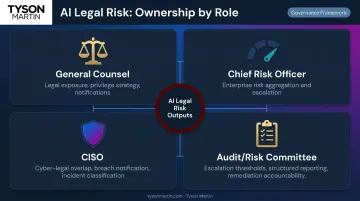
When these roles overlap without defined boundaries, AI outputs either sit unreviewed or flood every inbox at once. Neither outcome produces action.
Validation Protocols
Boards should not rely on vendor accuracy claims. Establish independent validation protocols: spot-check AI-generated risk assessments against expert legal review on a regular cadence, and monitor for model drift as regulations and business contexts change. The NIST AI Risk Management Framework's test, evaluation, verification, and validation (TEVV) practices provide a useful starting structure.
The Limits of AI: What Human Judgment Still Owns
AI cannot provide legal advice. It cannot make judgment calls on ambiguous legal strategy. It cannot account for the full context of a business relationship the way an experienced attorney can. Surfacing risk is AI's role. Deciding what to do with it remains squarely with humans.
The Hallucination Problem Is Real
Stanford researchers found that leading legal AI tools produced false information in more than 17% of benchmark queries. General-purpose LLMs show hallucination rates of 58%–82% on legal queries. The ABA's Formal Opinion 512 and California State Bar guidance both require lawyers to independently review and verify AI outputs before acting on them.
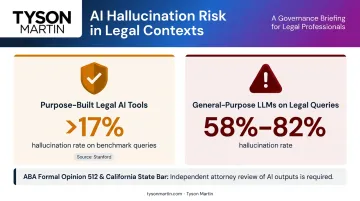
In high-stakes legal contexts, treat AI outputs as a first draft that requires expert review before any action is taken.
Where Human Judgment Is Non-Negotiable
These categories require human decision-making regardless of what AI surfaces:
- Regulatory enforcement negotiations — strategy, tone, and precedent involve judgment AI cannot replicate
- Litigation strategy — case assessment, settlement posture, and risk/reward analysis require experienced legal counsel
- Board-level governance decisions — accountability, fiduciary duty, and reputational judgment belong to humans
- Fundamental rights determinations — any decision with direct impact on individuals or organizational reputation requires human accountability
Boards and executives who treat AI outputs as conclusions rather than inputs are taking on governance risk that no tool can absorb for them.
Frequently Asked Questions
What types of legal risks can AI help organizations manage most effectively?
The highest-value AI applications are contract risk identification (clause-level flagging at scale), regulatory and compliance monitoring across jurisdictions, data privacy exposure mapping against GDPR/CCPA/HIPAA, and early-warning pattern detection across litigation and enforcement trends. These are high-volume, pattern-dependent tasks where AI outperforms manual processes reliably.
How should a board oversee AI-assisted legal risk management without getting lost in the detail?
Boards should set escalation thresholds in advance, review structured dashboards rather than raw AI outputs, and demand clear ownership for who acts on findings. The board's role is to ask sharper questions and make defensible decisions — not to evaluate individual AI findings line by line.
Can AI replace in-house counsel or outside legal advisors?
No. AI surfaces information faster and at greater scale than manual processes. Human legal judgment, strategic decision-making, privilege strategy, and accountability cannot be replicated or delegated to AI. The right model is augmentation, not replacement.
How do organizations ensure AI legal risk assessments are accurate and trustworthy?
Run independent validation that benchmarks AI outputs against expert legal review on a regular cadence. Monitor for model drift as regulations and business contexts shift. Don't accept vendor accuracy claims at face value — Stanford research shows even purpose-built legal AI tools hallucinate meaningfully under benchmark conditions.
What is the first step for an executive team that wants to start using AI to manage legal risks?
Start with a data and document governance audit. AI is only as useful as the data it can access — fragmented records and poor classification produce incomplete, potentially misleading risk pictures. Identify your highest-priority legal risk categories, then deploy AI in lower-stakes applications before expanding to high-stakes functions.
How does AI for legal risk management intersect with cybersecurity governance?
Cyber incidents create immediate legal liability — breach notification obligations, regulatory penalties, and litigation exposure. Organizations benefit most when AI-assisted legal risk and cybersecurity governance programs share data and reporting structures, not operate in separate silos. When a security incident hits, legal risk assessment should activate automatically — not as an afterthought.