This is a leadership problem, not an IT problem. And it shows up worst at the worst possible moment — during an active incident, when no one is sure who owns which decision.
This article isn't a glossary of resilience planning. It's focused on one specific relationship: how IR fits inside a BCP, how it enables BCP outcomes, and what breaks when it doesn't.
Key Takeaways
- A BCP covers people, processes, facilities, and communications — IR is its primary response mechanism for cyber incidents
- IR creates the conditions under which the rest of the BCP can function; they run in parallel, not in sequence
- Siloed IR and BCP teams produce decision rights failures, communication breakdowns, and missed regulatory deadlines
- Integration requires shared language, defined escalation thresholds, and documented decision authority — validated through joint exercises, not just documented in plans
- Boards should ask when IR and BCP teams last ran a joint exercise; an inability to answer signals the integration exists only on paper
What a Business Continuity Plan Actually Covers
A BCP is the organization's strategy for keeping critical functions running — or resuming them quickly — during and after any significant disruption. It is broader than technology. It covers people, processes, communications, facilities, and third-party dependencies.
The five core components:
- Risk assessment and business impact analysis (BIA) — identifies what matters most and what it costs when it stops
- Critical function identification and recovery priorities — determines which operations must resume first and in what order
- Alternate operating procedures — defines how the business runs when primary systems or facilities are unavailable
- Communication and escalation protocols — specifies who says what to whom, when, and through which channels
- Testing and maintenance schedules — ensures the plan reflects current reality and has been practiced
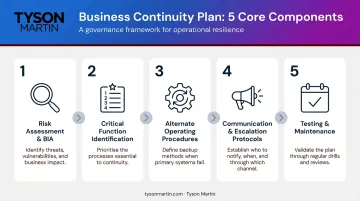
Together, these components define how the organization survives disruption. IR is where that plan meets its most likely trigger.
Where IR Lives Within the BCP
IR is not a parallel strategy running alongside the BCP — it is the BCP's first-response mechanism when the disruption is a cybersecurity incident. Without a functioning IR capability embedded in the plan, organizations have a dangerous gap precisely where they're most exposed.
Cyber incidents ranked as the number one global business risk in 2024 — ahead of natural catastrophes, regulatory changes, and supply chain disruptions. Yet many BCPs were written around facility outages and natural disasters, with cyber incidents treated as an afterthought.
The Role Incident Response Plays in Your BCP
IR serves as the BCP's detection and containment engine. When a cyber incident occurs, the BCP cannot execute recovery, alternate operations, or stakeholder communication until the threat is understood and controlled. IR creates the conditions under which the rest of the BCP can function.
Mapping IR Phases to BCP Outcomes
The six IR phases don't operate in isolation — each one connects directly to a BCP outcome:
| IR Phase | BCP Connection |
|---|---|
| Preparation | Feeds BIA readiness; ensures playbooks align with recovery priorities |
| Identification | Determines scope of disruption; triggers BCP escalation thresholds |
| Containment | Determines which alternate operating procedures must activate |
| Eradication | Confirms when it is safe to begin BCP recovery steps |
| Recovery | Must align with BCP's stated RTOs and RPOs for critical systems |
| Lessons Learned | Feeds directly into BCP updates and risk reassessment |
The Escalation Handoff
At a defined point in the IR lifecycle, the IR team must hand off to BCP-level leadership. Operational continuity decisions — communicating with customers, activating alternate facilities, managing vendor relationships — require executive authority, not just technical judgment.
Without a clear escalation threshold defined in advance, this handoff is chaotic. The IR team is still triaging while the COO is making operational calls without complete threat information. Or worse, leadership waits for IR to "finish" before the BCP activates at all.
Timing: These Plans Overlap, They Don't Sequence
IR activates immediately when a cyber incident is detected. The BCP's operational continuity provisions activate in parallel — or shortly after, depending on severity. IR does not finish before BCP begins. They overlap, and that overlap requires coordination baked into both documents.
The IBM data shows exactly why. According to IBM's 2024 Cost of a Data Breach Report, the mean time to identify and contain a breach was 258 days. Only 12% of breached organizations had fully recovered at the time of study — and of those who did fully recover, 35% took more than 150 days. Meanwhile, 70% experienced significant or very significant operational disruption.
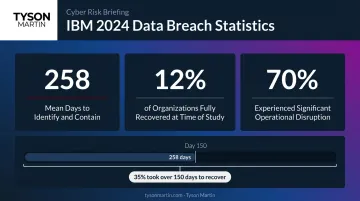
These are not short technical outages. They are BCP-level continuity events — and they demand coordinated governance starting at detection, not after containment.
What Breaks When IR and BCP Are Siloed
The organizational structure that creates the silo is familiar: security owns IR, operations or risk management owns the BCP, and these teams report to different executives, train separately, and use different language. When an incident hits, no one is quite sure who is in charge of what decision.
Three specific failures follow.
Decision Rights Failure
IR teams make containment decisions (taking systems offline, isolating network segments) that directly disrupt business operations. If IR hasn't coordinated with the BCP, those decisions get made without understanding their operational impact.
The reverse is equally dangerous: BCP leaders may try to restore operations before IR has confirmed the threat is contained, potentially reintroducing the attacker into a recovering environment. Both failures trace back to the same gap — no pre-agreed decision authority across the two functions.
Communication Breakdown
IR teams communicate in technical language. Boards and executive leadership need operational and reputational context. When IR and BCP are siloed, the communication chain from technical responders to leadership to external stakeholders has gaps — and that's when damaging public missteps happen.
The SEC enforcement record shows exactly how this plays out. In its action against First American Financial Corporation, security personnel identified a significant vulnerability — but no one escalated it to the executives responsible for disclosure decisions, resulting in a $487,616 penalty. Blackbaud's failure followed the same pattern: personnel knew the attacker had accessed sensitive data, but senior management never received that information before the public disclosure window closed — resulting in a $3 million penalty. Neither case required a sophisticated attacker. The failure was internal escalation.
Regulatory and Liability Exposure
In regulated industries, missed notification windows have direct consequences:
- SEC rules (adopted 2023): Public companies must file an Item 1.05 Form 8-K disclosure generally within four business days after determining a cybersecurity incident is material
- HIPAA: Covered entities must notify affected individuals no later than 60 calendar days after breach discovery; breaches affecting 500 or more individuals require simultaneous HHS notice
- Colorado: Notice to affected residents and the state AG required within 30 days after breach determination
- Illinois: HIPAA/HITECH covered entities must notify the Illinois AG within 5 business days of notifying HHS
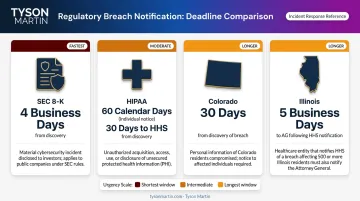
With all 50 states carrying their own breach notification laws, multi-state organizations face layered deadlines that compound fast. The only way to meet them is to have IR and BCP communication workflows coordinated in advance — because the middle of an active incident is the worst time to figure out who notifies whom.
How to Integrate IR Into Your BCP
Integration is not a document exercise. It's a governance structure. Five components make it functional.
1. Shared Language
IR teams and BCP owners must define common terminology before an incident. That means agreeing in advance on three things: what constitutes a "declared incident" that triggers BCP provisions, what severity threshold escalates from IR to BCP-level response, and who holds decision authority at each stage.
This language should appear in both documents — not just the IR playbook or just the BCP. If the two plans use different definitions for the same event, coordination breaks down immediately.
2. Defined Decision Rights
Document in writing:
- Who holds authority to make containment decisions (including taking systems offline)
- Who holds authority to activate alternate operations
- At what point the CISO, COO, CEO, or board must be engaged
- Who can declare materiality for SEC disclosure purposes
- Who approves ransom payment posture, and under what conditions
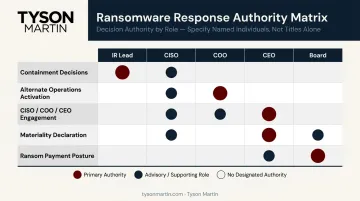
This is the single most common gap in IR-BCP integration. A plain-language RACI that names specific roles and triggers — not just job titles — ensures authority is clear under pressure, not just in planning sessions.
3. Unified Communication Protocol
Define:
- How IR findings translate into plain-language executive updates
- Who delivers those updates, on what cadence, through what channels
- Backup communication channels for when primary systems are compromised
- Pre-drafted notification templates for customers, regulators, and partners
Templates built before an incident are worth far more than templates drafted at 2 a.m. during one.
4. Aligned Recovery Objectives
The IR plan's recovery phase and the BCP's alternate-operations provisions must reference the same Recovery Time Objectives (RTOs) and Recovery Point Objectives (RPOs) for critical systems. A mismatch here creates an operational gap that turns a managed incident into a prolonged crisis — for example, IR assuming 24-hour system restoration while the BCP's manual workarounds were designed for a 4-hour outage.
5. Cross-Functional Plan Ownership
BCP should not be written without CISO or IR lead input on cyber threat scenarios. IR playbooks should not be written without BCP owner input on operational impact thresholds. Shared authorship, not just shared review, is what closes the gaps that surface during actual incidents.
What Boards and Executives Need to Inspect
Boards are not responsible for executing either plan. They are responsible for ensuring both plans exist, are integrated, and have been tested. That requires asking specific questions, not accepting "we have a plan" as a complete answer.
Questions That Reveal Integration Health
- When did the IR team and BCP team last run a joint exercise?
- What gaps did that exercise expose, and what changed afterward?
- Who is authorized to declare a material incident, and what triggers that declaration?
- What is our current detection-to-escalation time for cyber incidents?
- Do our IR recovery timelines align with the RTOs in the BCP?
If leadership cannot answer these questions with specifics, the integration likely does not exist in practice.
Metrics Worth Tracking
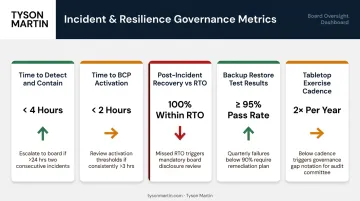
A governance dashboard for IR-BCP integration should show trends, not point-in-time snapshots. Relevant metrics include:
- Time to detect and contain high-severity incidents (with targets and trend direction)
- Time to BCP activation for cyber incidents — how long before alternate operations engage
- Post-incident recovery time versus the BCP's stated RTOs
- Backup restore test results for critical systems
- Tabletop exercise cadence with documented outputs and action item closure rates
Mandiant's M-Trends 2025 report found a global median dwell time of 11 days for 2024 investigations. That dropped to 10 days when organizations detected threats internally, compared to 26 days when an external party first identified the compromise.
Detection speed is a board-inspectable metric with direct BCP implications. The faster a threat is identified internally, the sooner the BCP can activate with accurate information.
The governance dashboards Tyson Martin builds for boards follow a one-page format: three to four metrics per outcome area, each with a target, a trend, and a trigger that drives a decision. The goal is inspectable execution — evidence that the organization's readiness is improving, not just documented.
The Compliance Illusion
Having an IR plan and a BCP checked off a compliance list does not mean they are integrated. Among organizations surveyed in 2024, only 46% reported having an enterprise-wide cybersecurity incident response plan applied consistently. Of that group, only 50% considered it effective.
A plan that has never been tested with the people who need to execute it under pressure will not hold when it matters. That gap shows up in the post-incident review — when it's too late to fix it.
Testing the Integration Before You Need It
Joint Tabletop Exercises
A tabletop that only tests IR — "how do we contain this ransomware attack?" — is insufficient. The exercise must extend into BCP territory. When does the COO activate alternate operations? How does the CISO brief the board? What do we tell customers at hour four? Who approves the external communication?
Tyson's tabletop methodology brings the full cross-functional team into the room: CISO, CIO, COO, Legal, Communications, HR, and whoever owns the affected business process. The scenarios are chosen to force real tradeoffs — ransomware with partial backups, cloud identity compromise, third-party outage that stops revenue — because realistic pressure is where siloed plans are exposed.
Each exercise produces concrete outputs:
- Updated decision authority documentation
- Communication templates with approval paths
- After-action action list with owners and due dates
- Identified gaps requiring plan updates
Frequency and Update Triggers
NIST SP 800-34 establishes yearly tabletop exercises as a baseline for low-impact systems, with functional exercises for moderate and high-impact systems. Testing frequency should also respond to organizational change. Triggers that warrant an unscheduled review include:
- New executive leadership or board composition
- M&A activity (pre- or post-close)
- Significant technology changes or platform migrations
- Any real incident, regardless of severity
After-action reviews from actual incidents are the highest-value input for BCP-IR integration improvements. Organizations that make after-action reviews a standing process — capturing what worked, what failed, and what changed in both plans — build genuine resilience. Those that file the incident report and move on will face the same gaps in the next one.
Technical Validation
Separately from the human coordination exercises, organizations should periodically confirm that backup restoration and system failover actually perform as the BCP assumes. If the RTO says critical systems recover in four hours but backups haven't been tested in 18 months, the plan is fiction. The technical infrastructure needs to confirm the governance assumptions, not the other way around.
Frequently Asked Questions
Why is having an incident response plan important within a BCP?
IR is the BCP's primary response mechanism for cyber incidents — currently the most frequent and damaging type of business disruption. Without IR embedded in the BCP, the plan cannot execute effectively when a cyberattack triggers it, leaving containment decisions, communications, and recovery actions uncoordinated at the moment they matter most.
How does cybersecurity ensure business continuity?
Cybersecurity measures reduce the likelihood and severity of incidents that disrupt operations. A strong IR capability ensures that when incidents occur, they are contained quickly enough that the BCP's alternate operating procedures can minimize downtime. The two functions reinforce each other: cybersecurity reduces the probability of disruption; IR limits its duration when prevention falls short.
What are the five key components of a business continuity plan?
The five components are risk assessment and business impact analysis, identification of critical functions and recovery priorities, alternate operating procedures, communication and escalation protocols, and testing and maintenance schedules. IR integrates primarily through components one, four, and five.
What is the difference between an incident response plan and a business continuity plan?
An IR plan is the structured approach for detecting, containing, and eliminating active cybersecurity threats. A BCP is the broader organizational strategy for keeping critical functions running through any disruption. IR is a component within — and an enabler of — a comprehensive BCP, not a separate strategy running in parallel.
Who is responsible for integrating incident response with business continuity planning?
Integration requires joint ownership between the CISO or IR lead and the BCP owner — typically the COO or risk management leadership. Executive leadership is accountable for ensuring both teams have aligned on shared decision rights and escalation thresholds. Neither function can own integration alone.