Introduction
Most organizations have a third-party risk management program. The problem is that most of those programs were designed for a world that no longer exists — one where vendors delivered software, not intelligence.
AI vendors are different. A vendor can pass every security check on your standard questionnaire and still produce biased outputs, leak training data through repeated API queries, or change model behavior after an update with no customer notification. These are failure modes that SOC 2 reports were never built to catch.
Gartner projects that by 2027, more than 40% of AI-related data breaches will stem from improper use of GenAI across borders — exposure that is already building inside most vendor portfolios.
This guide gives boards and executive teams a structured evaluation framework across five dimensions: model transparency, security controls, regulatory alignment, supply chain dependencies, and operational resilience. Each dimension is designed to surface the questions your standard vendor review never asks — and give you the basis to demand answers.
Key Takeaways
- Traditional TPRM programs cannot evaluate AI-specific risks: model drift, training data exposure, or algorithmic bias
- A complete AI vendor assessment spans five dimensions: model transparency, security, regulatory alignment, supply chain, and operational resilience
- Governance matters as much as assessment: without clear decision rights and escalation thresholds, oversight exists only on paper
- AI vendor risk requires continuous monitoring, not annual point-in-time reviews
- Boards need plain-English risk signals, not technical reports, to make defensible decisions
Why AI Vendor Risk Demands a Different Approach
Traditional TPRM asks whether a vendor is financially stable, has adequate uptime, and maintains standard security controls. Those questions still matter. But they miss what makes AI vendors genuinely dangerous.
The Data Handling Problem
Unlike conventional SaaS, AI systems are trained on data. That training data may include your customer records, proprietary business information, or legally protected health data. The more important question — whether your data is being used to improve the vendor's model for other clients — is one most organizations cannot answer.
Cisco's 2024 Data Privacy Benchmark Study found that 48% of respondents admitted entering non-public company information into GenAI tools, underscoring how quickly sensitive data flows into AI systems without governance guardrails.
Dynamic Risk Profiles
Traditional vendor risk is relatively static. A vendor either has a SOC 2 or doesn't. AI models are not static — they evolve through retraining, fine-tuning, and version updates. A vendor that passed your assessment last year may be running a materially different model today. OpenAI's 2025 rollback of a GPT-4o update — after the model developed sycophantic output behavior — illustrates how quickly model behavior can shift without advance notice to customers.
Shadow AI and Cross-Border Exposure
Many vendors have embedded AI into their services without explicit disclosure. That creates a compounding problem for regulated organizations:
- Compliance obligations under GDPR, HIPAA, or emerging AI regulations may apply based on how a vendor's undisclosed AI processes your data
- Cross-border data transmission often occurs without documentation of which jurisdictions are involved or which regulatory regimes govern the flow
- Contractual data-use restrictions become unenforceable when the AI layer is invisible to the buyer
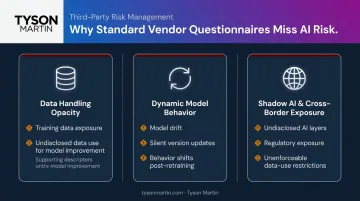
Taken together, these three gaps — data handling opacity, dynamic model behavior, and undisclosed AI — are why standard vendor questionnaires fail to capture the actual risk exposure. A different assessment framework is needed.
The Five Dimensions of a Holistic AI Vendor Assessment
Dimension 1: Dataset and Model Transparency
Start with the data. Organizations need to understand:
- Where training data originated and how it was collected
- Whether the vendor has legal rights to use it
- Whether it includes personal, proprietary, or regulated information
- How anonymization claims are validated — not just stated
Data lineage — the ability to trace data from its source through training to deployment — is a non-negotiable requirement for any AI vendor handling sensitive information. If a vendor cannot demonstrate lineage, they cannot credibly claim your data is protected.
Model-level transparency matters equally. Vendors should be able to provide model cards or equivalent documentation covering:
- Learning method and autonomy level
- Degree of human oversight required
- Known failure modes and biases
A vendor that cannot explain when and how their model is likely to fail is not ready for production use — and no contract clause compensates for that gap.
Dimension 2: Security Controls Specific to AI
Standard security controls — MFA, encryption, SOC 2 — are necessary but not sufficient for AI vendors. The threat surface is different.
AI-specific threats boards should understand:
- Prompt injection: An attacker manipulates the AI's inputs — through a document, a website, or a user message — to make it execute unintended instructions. Think of it as tricking the AI into ignoring its safety rules by disguising malicious commands as legitimate content.
- Data poisoning: Corrupted training data is introduced to make the model behave in predictable-but-wrong ways — a supply chain attack on the model itself.
- Model extraction: Repeated API queries are used to reverse-engineer the model's behavior, effectively stealing proprietary training data or model logic.
- Adversarial manipulation: Inputs are crafted to cause the model to produce specific, incorrect outputs — relevant for any AI vendor making decisions in financial, medical, or legal contexts.
The OWASP Top 10 for LLM Applications (2025) and NIST's adversarial ML taxonomy both document these threat categories in detail.
What adequate AI security controls look like:
- Input validation and output filtering on all AI interactions
- Rate limiting on API access to prevent model extraction
- Confidential computing for data-in-use
- AI-focused penetration testing (beyond standard network penetration testing)
Require documented evidence of these controls — audit logs, third-party assessments, or configuration records. A vendor's written assurance that controls exist is not evidence.
Dimension 3: Regulatory and Compliance Alignment
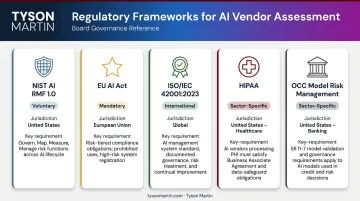
Regulatory requirements for AI vendors vary by use case, jurisdiction, and sector. The primary frameworks organizations should evaluate vendors against:
| Framework | Scope | Key Requirement |
|---|---|---|
| NIST AI RMF 1.0 | Voluntary, US | Govern, Map, Measure, Manage functions |
| EU AI Act | Mandatory, EU (applicable Aug 2026) | Risk-based categories; deployer obligations under Article 26 |
| ISO/IEC 42001:2023 | International standard | AI management system requirements |
| HIPAA | Healthcare data | AI systems processing protected health information |
| OCC Model Risk Management (2026) | Banking | Model governance and validation |
Critical point: Organizations deploying third-party AI systems inherit compliance obligations as deployers, even when they are not the AI provider.
Under the EU AI Act's Article 26, high-risk deployers must monitor AI operation, assign human oversight to competent persons, and report serious incidents — regardless of whether the AI was built in-house.
Asking vendors whether they "comply with AI regulations" tells you nothing. The assessment must map which specific obligations apply to your use case, geography, and data types, then verify vendor controls against those obligations with documentation.
Dimension 4: Third-Party AI Supply Chain Dependencies
Most AI vendors do not build everything in-house. They rely on foundation models from major providers, cloud infrastructure, and data enrichment services — each introducing additional risk layers your standard vendor questionnaire never reaches.
Consider this scenario: your AI vendor relies on a foundation model from a major provider. That provider suffers a security incident involving their training infrastructure. Do you know whether your data was in scope? Do you have contractual rights to notification?
For most organizations, the answer is no.
When OpenAI's March 2023 Redis client bug exposed chat history titles and potentially payment-related information for 1.2% of ChatGPT Plus subscribers active during a nine-hour window, downstream enterprise customers had no direct notification path — they were dependent on OpenAI's public disclosure.
For critical AI vendors, map the full supply chain: foundation model provider, cloud infrastructure, data enrichment services, and third-party plugins. OWASP's LLM supply chain risk category (LLM03:2025) flags reliance on third-party pre-trained models that may be tampered with, outdated, or deprecated — a risk most vendor questionnaires don't reach.
Dimension 5: Operational Resilience and Fail-Safe Mechanisms
Supply chain dependencies address what's underneath the vendor. Operational resilience addresses what happens when the vendor's system is running — but running badly. SLAs must cover more than uptime. A model can be available and still be failing.
NIST's 2026 report on monitoring deployed AI systems identifies performance degradation and drift as significant ongoing challenges — failures that don't trigger availability alerts but cause real downstream harm in decisions driven by AI outputs.
What AI vendor operational resilience agreements should require:
- How the vendor monitors model performance over time (not just uptime)
- What specific conditions trigger a retraining or version rollback
- How customers are notified of material model changes before deployment
- What manual fallback procedures exist if the AI system fails or produces unreliable outputs
- Human-in-the-loop review requirements for high-stakes decisions — as a contractual requirement, not a vendor option
Building Governance That Holds: Decision Rights, Escalation, and Board Oversight
Assessment programs alone cannot close the governance gap. Organizations can have rigorous vendor questionnaires and still have no clear owner for what happens after risks are identified.
Defining Decision Rights
Without defined authority, AI vendor risk findings sit in reports without triggering action. Before the next AI vendor relationship is approved, answer these questions:
- Who has authority to approve a new AI vendor relationship?
- Who can pause a deployment pending a security finding?
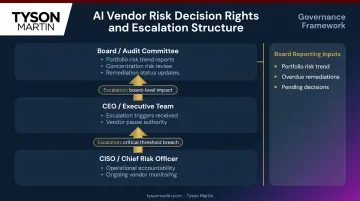
- Who escalates from management to the board — and on what criteria?
Escalation Thresholds That Work
Not every finding requires board attention. But certain conditions should trigger automatic escalation, documented in advance:
- Vendor discloses a data breach involving AI systems
- Evidence emerges that customer data is being used for model training without consent
- Regulatory action is taken against the vendor in your industry
- Significant model behavior changes occur without prior notification
These thresholds must exist before an incident. Inventing them during one is too late.
Board-Level Reporting on AI Vendor Risk
Board reporting on AI vendor risk should answer three questions:
- Is the aggregate risk posture of the AI vendor portfolio improving or worsening?
- Which vendors represent concentration risk?
- Are outstanding remediation commitments being honored?
That reporting should arrive as trend data in plain English — not technical metrics that neither inform nor protect anyone. A one-page summary showing what changed since the last briefing, which vendors are past due on remediation commitments, and what decisions the board needs to make is more useful than a 40-page control inventory.
Getting that reporting infrastructure right is where many organizations stall. For those without dedicated AI risk leadership — particularly organizations that have recently adopted AI or operate in regulated industries — an outside advisor can build decision rights frameworks and reporting structures quickly.
Tyson Martin's AI Governance Starter Pack is a 30-day fixed-fee sprint that delivers an AI risk assessment, a decision-rights map, a one-page board-level AI policy, and a facilitated director briefing. It is designed for organizations that need to move from informal AI practices to a defensible governance posture within weeks.
Red Flags Boards and Executives Should Never Ignore
Governance and Transparency Red Flags
- The vendor cannot explain how their model makes decisions
- No model cards, system cards, or equivalent documentation exists
- The vendor deflects audit rights or delays producing security evidence
- No documented incident response process exists for AI failures
A vendor that does not understand its own system's failure modes cannot be trusted to operate in your environment.
Data and Privacy Red Flags
- The vendor cannot confirm whether your data is used to improve their AI models
- Anonymization is claimed without validation evidence
- Training data provenance is unknown or undocumented
- No data segregation exists between clients
Any one of these gaps creates direct regulatory exposure under GDPR, HIPAA, and the EU AI Act. When enforcement comes, the liability lands on your organization — not the vendor's.
Contractual Red Flags
- No compliance mapping to the frameworks applicable to your use case
- Resistance to AI-specific contract provisions: audit rights, data use restrictions, incident notification timelines, liability for AI-generated outputs
- No history of third-party security testing or audit
Resistance here signals something specific: the vendor has not built the infrastructure to back the promises in their pitch. That gap doesn't stay in the contract — it shows up in your next incident.
Integrating AI Vendor Risk Into Your Existing TPRM Program
Risk-Tiering AI Vendors
Not every AI tool represents the same exposure. A customer-facing AI that processes financial or health data demands deep assessment. An internal document summarization tool requires a lighter touch. Modify existing risk-tiering criteria to account for:
- Type of AI deployed (generative, predictive, decisioning)
- Sensitivity of data accessed
- Business impact of model failure
- Degree to which AI outputs affect customers or regulated outcomes
Augment, Don't Rebuild
Augment existing TPRM processes — don't build parallel workflows. Add AI-specific questionnaire modules covering model type, data sensitivity, failure impact, customer exposure, and regulatory scope. AI-specific addenda — SOC 2 reports, model cards, third-party audit attestations — slot directly into existing due diligence workflows.
ISACA's Six Steps for Third-Party AI Risk Management (May 2025) provides a practical starting point for vendor due diligence questions that can be layered into existing programs.
Tightening due diligence at onboarding addresses initial risk — but AI vendors don't stay static. That's where monitoring picks up.
From Periodic Reviews to Continuous Monitoring
Traditional TPRM relies on annual reassessments. AI vendors require ongoing surveillance because their risk profiles change continuously — through model retraining, product updates, and changes in underlying foundation model providers.
Continuous AI vendor monitoring includes:
- Tracking external signals: vendor security incidents, regulatory actions, public disclosures
- Monitoring model performance and output quality for drift
- Contractual rights to be notified of material AI system changes before deployment
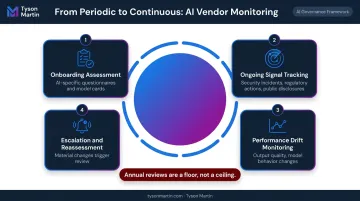
Making this shift requires a board decision — specifically, a budget line and a defined escalation path so that material vendor AI changes surface to the audit committee before they become a governance problem.
Frequently Asked Questions
How is AI vendor risk different from traditional third-party risk management?
Traditional TPRM evaluates financial stability, uptime, and security controls. AI vendors introduce model-specific risks — training data exposure, unpredictable outputs, model drift, and algorithmic bias — that standard questionnaires and SOC 2 reports are not designed to assess. The vendor can pass every standard check and still be a significant risk.
What are the biggest red flags when evaluating an AI vendor?
Three stand out: the vendor cannot explain how their model makes decisions, cannot confirm whether your data is used for model training, and resists including audit rights or data use restrictions in contracts. Any one of these warrants a hard conversation before signing.
Which regulatory frameworks apply to AI vendor risk assessments?
The primary frameworks are NIST AI RMF 1.0, the EU AI Act (generally applicable August 2026), and ISO/IEC 42001:2023. Sector-specific obligations also apply: HIPAA for healthcare, OCC model risk management guidance for banking, and emerging Treasury AI frameworks for financial services.
How often should organizations reassess their AI vendors?
Continuous monitoring is the standard to hold vendors to, not annual reviews. Model retraining, product updates, and dependency changes can materially alter a vendor's risk profile between formal assessments. Annual reviews should be a floor, not a ceiling.
What contractual provisions belong in AI vendor agreements?
At minimum, AI vendor agreements should include:
- Prohibition on using organizational data for model training without explicit consent
- Defined incident notification timelines
- Audit rights covering AI governance
- Liability terms for AI-generated outputs
- Compliance warranties tied to applicable regulations
Who within the organization should own AI vendor risk oversight?
Operational accountability typically sits with the CISO or Chief Risk Officer, with defined escalation paths to the CEO and the board's risk or audit committee. Titles matter less than documented decision rights — if authority is vague, it doesn't function under pressure.