Introduction: The Supply Chain Has Become the Attack Surface
The most well-defended enterprises are discovering an uncomfortable truth: attackers don't need to breach your perimeter when they can walk in through a vendor's door.
Supply chain cyber risk has moved from a procurement concern to a board-level priority — and the data makes clear why. The 2025 Verizon Data Breach Investigations Report found third-party involvement in 30% of all breaches — and that share has been climbing sharply year over year. The exposure isn't a trend line. It's a structural shift in how attacks are designed.
This piece covers what's driving that escalation, the specific threat vectors executives need to understand, why governance keeps failing at the board level, and the concrete steps leadership can take before the next incident.
Key Takeaways
- Third-party breaches now account for nearly half of all breaches
- The top threats: compromised software updates, AI-enhanced social engineering, long-tail vendor blind spots, and geopolitical concentration risk
- Only 15% of businesses formally review immediate supplier cyber risks — adversaries move faster than annual questionnaires
- Supply chain risk sits between procurement, IT, and operations — and the ownership gap is where breaches take hold
Why Supply Chain Cyber Risk Has Escalated
The Architecture of Modern Risk
Supply chains aren't logistics networks anymore. They're interconnected digital ecosystems built on shared APIs, cloud infrastructure, and automated decision systems. Every integration is a potential entry point — and the number of integrations has exploded.
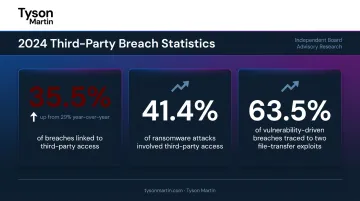
SecurityScorecard's 2025 Global Third-Party Breach Report found 35.5% of 2024 breaches were linked to third-party access, up from 29% the year prior. Among those, 41.4% of ransomware attacks involved third-party access. Two exploited file-transfer vulnerabilities alone accounted for 63.5% of third-party vulnerability-driven breaches — concentration of a different kind.
Nation-State Actors and Critical Infrastructure
Geopolitical risk has changed the stakes. CISA's advisories on PRC state-sponsored actors — the Volt Typhoon campaigns — document persistent access to U.S. critical infrastructure across:
- Water treatment plants
- Electrical grids
- Oil and gas pipelines
- Transportation systems
The strategy isn't immediate disruption — it's pre-positioning for a future moment when access can cause maximum damage. For boards, that reframes third-party vendor risk as a national security question, not just a procurement checklist.
Recent Incidents as Proof Points
Two confirmed 2025-2026 supply chain attacks illustrate how quickly a single compromised component cascades:
- Axios npm package compromise (2026): CISA confirmed malicious dependency
plain-crypto-jswas injected into Axios npm package versions, distributing malware to downstream users through a trusted, widely-used package - Salesloft Drift integration breach (2025): Compromised OAuth tokens allowed threat actor UNC6395 to access Salesforce customer instances, with Google confirming exposure across integrated Workspace accounts
The Blind Spot That Makes It Worse
The UK Cyber Security Breaches Survey 2025/2026 found only 15% of businesses reviewed risks posed by immediate suppliers — and just 6% reviewed their wider supply chain. Smaller, under-resourced suppliers are targeted precisely because they carry trusted access into larger organizations, and almost no one audits the exposure.
The Major Threat Vectors Targeting Supply Chains Today
Third-Party Software and Update Compromise
SolarWinds established the template: compromise a trusted vendor's update mechanism, and you get simultaneous access to thousands of downstream customers. The attack works because it exploits trust that's built into the architecture.
The open-source software ecosystem has made the attack surface enormous. Sonatype's 2025 data puts the scale in sharp relief:
- 454,600+ new malicious packages identified in 2025 — npm accounted for more than 99% of open-source malware
- 9.8 trillion open-source downloads in 2025, up 67% year-over-year
- 65% of open-source CVEs in 2025 lacked an NVD-assigned CVSS score
- 95% of vulnerable component downloads had a fix available that simply wasn't applied
Software Bills of Materials (SBOMs) are the emerging governance response. CISA published its 2025 Minimum Elements for a Software Bill of Materials to guide implementation. Organizations that cannot enumerate what software components they're running — including open-source dependencies — cannot identify when a component is compromised.
Vendor Fraud and AI-Enhanced Social Engineering
Phishing remained the most prevalent attack type in the UK Cyber Security Breaches Survey, affecting 93% of businesses that experienced cyber crime. But AI has changed what phishing looks like.
Recent data shows how quickly the threat has escalated:
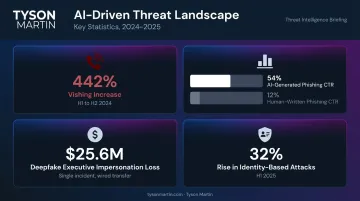
- Vishing (voice phishing) rose 442% from H1 to H2 2024, per CrowdStrike
- AI-generated phishing emails achieved a 54% click-through rate versus 12% for likely human-written attempts
- A 2024 deepfake executive impersonation resulted in a $25.6 million loss
- Identity-based attacks rose 32% in H1 2025, according to Microsoft
Those numbers reflect a structural shift in economics. Attacks that previously required significant coordination can now be automated and personalized at scale — targeting procurement officers, finance staff, and logistics managers simultaneously.
Long-Tail Vendor Concentration and Hidden Dependencies
Most third-party risk programs focus scrutiny on top-tier strategic suppliers while ignoring hundreds of smaller vendors — SaaS tools, software libraries, logistics platforms — that carry deep system access but receive almost no oversight.
The WEF Global Cybersecurity Outlook 2026 found only 33% of organizations comprehensively map their supply chain ecosystems — meaning two-thirds are making risk decisions without knowing what they actually depend on.
Vendor concentration adds a second layer of risk. When critical operations depend on a narrow set of vendors from a single geopolitical region, a coordinated disruption — a compromised update, withheld support, or a kill switch — can cascade across an entire sector simultaneously. This is where operational risk crosses into strategic risk.
The Governance Gap: Why Boards Struggle to Own This Risk
The Accountability Problem
Supply chain cyber risk falls between three functions in most organizations:
- Procurement owns vendor relationships
- IT owns security policy
- Operations owns uptime
Nobody fully owns the question of whether the components running the business introduce systemic or sovereign risk. Boards are left with no clear owner to hold accountable — and no obvious escalation path when something goes wrong.
What Immature Governance Looks Like
Annual vendor questionnaires. Document-driven due diligence. Compliance checklists that reflect a supplier's posture at a single point in time.
Passing an audit is not the same as being able to withstand an attack. Adversaries move in real time; annual snapshots don't.
65% of large companies now identify third-party and supply chain vulnerabilities as their greatest barrier to cyber resilience, up from 54% in 2024, according to the WEF Global Cybersecurity Outlook. Despite that awareness, only 27% of organizations simulate cyber incidents or conduct recovery exercises with ecosystem partners.
What Mature Governance Looks Like
Mature supply chain governance has several distinguishing features:
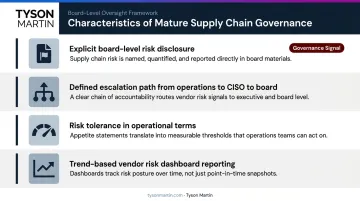
- Supply chain risk is named explicitly in board-level risk disclosures — not bundled under "technology risk" in a way that makes it invisible
- A defined escalation path runs from operations to the CISO or risk leader to the board, with decision thresholds established in advance
- Risk tolerance is expressed in operational terms: which vendor failures are recoverable, which ones stop revenue, and what level of third-party exposure is acceptable given the criticality of each function
- Vendor risk reporting reaches the board as a stable dashboard showing trend over time — not a one-time compliance snapshot
The Reporting Gap
Many boards receive technical security updates that don't translate to decisions. What's needed is a consistent format: plain-English risk posture, what changed since the last briefing, a stable dashboard showing trend rather than trivia, and decision rights that are clear before an incident — not improvised during one.
Organizations that lack internal capacity for this governance infrastructure often work with a board-level security advisor to establish decision rights, reporting cadence, and vendor oversight frameworks — without a full-time hire. Tyson Martin's advisory work focuses precisely here: translating vendor exposure into business terms and building oversight structures that boards can actually use when incidents occur.
AI's Dual Role: Amplifier and Defender
AI operates on both sides of supply chain cyber risk simultaneously. Most organizations haven't built governance to handle either role.
As a threat multiplier:
- Automates vulnerability reconnaissance across vendor ecosystems
- Enables polymorphic malware that evades signature-based detection
- Personalizes social engineering campaigns at scale targeting procurement and finance staff
- Vishing attacks spiked 442% in one six-month period as AI lowered the operational cost
As a defensive capability:
- Real-time anomaly detection across supplier networks
- Behavioral modeling that flags unusual access patterns
- Automated validation of software components against SBOM data
- Microsoft reported blocking 1.6 million bot-driven fake account signup attempts every hour
The problem: 36% of organizations have no process to assess the security of AI tools before deployment, according to WEF. Shadow AI compounds this — Verizon's 2026 DBIR found 67% of users accessed unauthorized GenAI services using non-corporate accounts on corporate devices, with shadow AI becoming the third most common non-malicious insider action in DLP datasets — a fourfold increase from the prior year.
When AI enters procurement and logistics workflows without board-level visibility, it creates third-party access points that bypass existing vendor risk controls entirely. AI governance belongs inside supply chain risk governance — with defined oversight owners, escalation thresholds, and periodic review built in.
Five Actions Executives and Boards Should Take Now
1. Map Critical Dependencies Before the Next Incident
Identify which vendors, software components, and data flows would cause the greatest operational disruption if compromised. Focus the analysis on human touchpoints — procurement officers, finance staff, logistics managers — who are highest-risk decision points under pressure. Most organizations can't answer this question quickly; that gap is itself a risk.
Tyson Martin's cybersecurity program assessments produce a vendor criticality ranking tied directly to business services. Boards get a clear view of what could actually stop revenue, not just a list of vendor names.
2. Move from Annual Assessments to Continuous Monitoring
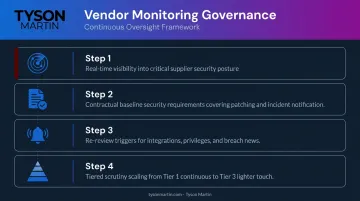
Annual questionnaires reflect a vendor's posture on one day. Vendor risk is dynamic. The governance model should:
- Require real-time or near-real-time visibility into supplier security posture for critical vendors
- Enforce baseline security expectations contractually — access controls, patching cadence, incident notification requirements
- Set re-review triggers for meaningful changes: new integrations, data type changes, privilege increases, breach news, major subcontractor changes
- Scale scrutiny proportionally — Tier 1 vendors need continuous attention; Tier 3 doesn't
3. Define Decision Rights and Escalation Thresholds Before an Incident
Under pressure, improvised decisions lead to inconsistent outcomes and delayed response. Organizations need to establish in advance:
- Who has authority to isolate a vendor connection
- Who activates backup systems or workarounds
- Who notifies the board — and at what threshold
- Who makes the call on SEC disclosure if a material incident involves a third party
Rehearse these decisions through tabletop exercises that simulate supply chain breach scenarios specifically. CISA's Tabletop Exercise Packages provide structured scenario modules.
A 60-minute board tabletop focused on a third-party outage that stops revenue is one of the highest-return governance investments available. Yet most organizations still haven't done one — making it a straightforward gap to close.
Frequently Asked Questions
What are the biggest cyber threats to supply chains?
Four categories dominate current threat reporting:
- Compromised software updates distributed through trusted vendor channels
- AI-enhanced phishing and voice fraud targeting supplier relationships
- Long-tail vendor blind spots where small suppliers hold deep system access without scrutiny
- Vendor concentration risk in geopolitically sensitive regions, where a single disruption can cascade across a sector
What are some recent supply chain cyber attacks making news?
In 2026, CISA confirmed the Axios npm package compromise, where malicious code was injected into a widely used JavaScript library and distributed to downstream users. The 2025 Salesloft Drift breach exposed Salesforce customer instances through compromised OAuth tokens. Third-party breach involvement has nearly doubled in consecutive years across industry data.
What is supply chain cyber risk?
Supply chain cyber risk refers to threats that enter an organization through third-party vendors, suppliers, software providers, and service partners — not through a direct attack — making it especially difficult to manage because the systems and decisions involved sit outside the organization's direct control.
Who is responsible for supply chain cyber risk in an organization?
In mature organizations, the CISO or a designated risk owner holds clear accountability with a direct board reporting line — and escalation thresholds are defined before an incident, not during one. In practice, most companies haven't gotten there yet: ownership drifts across procurement, IT security, and operations, meaning no single function fully owns it.
How does AI change supply chain cyber risk?
AI operates on both sides. Attackers use it to automate target profiling and personalize social engineering at scale — vishing attacks rose 442% in six months. Defenders use it for real-time anomaly detection and vendor monitoring. The overlooked governance risk: organizations adopting AI in procurement or logistics without a security framework, creating new unmonitored entry points.