Introduction: The 2026 Threat Intelligence Brief Every Board Should Read
Most boards are having a cybersecurity conversation that's roughly 18 months behind the threat landscape their security teams are actually navigating. The reporting boards receive tends to describe what was done, not what the risk looks like now.
That structural gap becomes expensive when conditions shift and leadership finds out late.
This report is written for CEOs, board directors, audit and risk committee members, and senior executives who need to act on threat intelligence. The goal: translate the four most consequential threat signals heading into 2026 into the language of governance decisions, oversight questions, and defensible action.
Each signal is covered on its own terms — what it means for the business, what a board should be asking, and where the decision points sit.
Key Takeaways
- Ransomware attack volume is up nearly 50% year-over-year despite law enforcement takedowns — group fragmentation has produced more active operators, not less activity.
- AI has made phishing and voice fraud faster, cheaper, and nearly indistinguishable from legitimate communication, including executive impersonation attacks.
- Stolen credentials bypass perimeter defenses entirely; nearly 2 billion credential exposures were detected in 2025 alone.
- State-sponsored actors are actively exploiting CVEs from 2017 and 2018 — old vulnerabilities are live threats.
- Boards are receiving status updates where decision-ready intelligence is required.
Key Threat Signals for 2026: What Executives Need to Know Right Now
Four threat patterns define the risk environment heading into 2026. Each carries direct implications for board-level governance decisions.
Ransomware Is Fragmenting — More Actors, Less Predictability
Law enforcement disruptions took down major ransomware operators. Attack volume went up anyway. Google Threat Intelligence/Mandiant reported that 2025 ransomware data-leak-site posts exceeded 2024 levels by nearly 50%. Disruption dispersed affiliates into smaller, harder-to-attribute groups: the criminal ecosystem fragmented, it didn't shrink.
Board implication: Threat attribution is harder. Incident response plans built around known actor playbooks need to account for unpredictable, emerging groups.
AI-Powered Social Engineering Has Changed the Target
Phishing campaigns are no longer high-volume, easily-detected generic attempts. They're personalized, contextually accurate, and crafted using harvested data about specific individuals. CrowdStrike reported a 442% increase in voice phishing (vishing) connected to AI-driven social engineering. Executives and board members are the intended targets.
Board implication: Directors and C-suite leaders should assume they are individually profiled. Executive communication protocols and verification procedures need updating.
Credential Theft Is Bypassing Perimeter Defenses
Infostealer malware harvests credentials and session tokens, packages them into logs, and sells them to ransomware affiliates who authenticate directly into VPNs and remote systems. No vulnerability exploitation required. Recorded Future detected 1.95 billion malware combo-list credential exposures in 2025.
Board implication: Perimeter controls alone are insufficient governance. Identity security and session-token management should be explicit agenda items in program reviews.
Unpatched Systems Remain the Most Reliable Entry Point
State-sponsored actors are exploiting vulnerabilities years old. An August 2025 FBI warning confirmed Russian FSB actors were actively targeting unpatched Cisco infrastructure using CVE-2018-0171 — a vulnerability disclosed in 2018. Patch cadence and remediation accountability belong on the board's oversight agenda, not just the security team's backlog.
Ransomware Is Fragmenting — And That Makes It More Dangerous, Not Less
The Counterintuitive Effect of Takedowns
The conventional assumption is that law enforcement actions against major ransomware groups reduce enterprise risk. The data says otherwise. Operations against Hive, LockBit, and ALPHV/BlackCat displaced affiliates but didn't remove them from the market — those affiliates moved to new groups, launched independent operations, or joined emerging platforms.
RansomHub is the clearest example. CISA reported it had attracted high-profile affiliates from both LockBit and ALPHV and encrypted and exfiltrated data from at least 210 victims as of August 2024 — just six months after beginning operations in February 2024.
The practical consequence: your threat model from 18 months ago is likely inaccurate. Attribution is harder, attack patterns are less predictable, and the kill chains used by newly formed groups are unlikely to match the playbooks your security team has calibrated against.
Cloud and Hybrid Environments Are the New Frontier
Ransomware groups aren't only targeting on-premises endpoints anymore. Threat actors are actively shifting tactics toward cloud infrastructure and hybrid environments — a direct exposure for organizations mid-way through digital transformation. If your cloud migration is partially complete, you may have reduced on-premises defenses before cloud governance is fully in place. That transition window is an attack surface.
Specific gaps that open during that window include:
- Misconfigured storage and object permissions with overly broad public access
- Incomplete identity federation controls between on-premises Active Directory and cloud IAM
- Logging and monitoring coverage that doesn't yet extend to cloud workloads
- Unfinished privileged access governance for cloud administrative roles
The Defenses That Hold Regardless of the Group
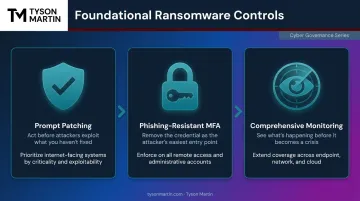
The specific group behind an attack matters less than whether your foundational controls are in place. Three controls reduce exposure across virtually every ransomware scenario:
- Prompt patching of internet-facing systems — prioritized by criticality and exploitability
- Phishing-resistant MFA on all remote access and administrative accounts
- Comprehensive monitoring across endpoint, network, and cloud environments
The board-level question: Can management confirm that your incident response plan has been tested against a scenario involving a threat actor your security team has never seen before — one without a known signature?
AI Is Now Weaponized Against Your People
The Economics of Precision Attacks Have Collapsed
Crafting a convincing, personalized phishing email used to require time and skill. Generative AI eliminated both requirements. The FBI's Internet Crime Complaint Center warned in December 2024 that criminals are using AI-generated text, audio, and video to make financial fraud and social engineering attacks far more believable. Campaigns are now built using data harvested about specific individuals — their role, their recent communications, their colleagues, their organization's language.
The result: employees can no longer rely on spotting poor grammar or unusual phrasing as a detection signal. Neither can executives.
Voice Fraud, BEC, and Deepfakes Are Converging
Business email compromise, vishing, and AI-generated synthetic media are merging into hybrid attacks. CrowdStrike reported a 442% increase in vishing in its 2025 Global Threat Report — tied directly to AI-enhanced social engineering. The FBI separately documented that BEC and email account compromise fraud produced $2.77 billion in losses in 2024 alone, with more than $55 billion in exposed global losses tracked from 2013 to 2023.
C-suite impersonation, synthetic voice fraud, and deepfake-assisted wire transfer authorization are documented attack methods — and executives are the primary targets by design. That reality shapes what controls actually matter.
What Phishing-Resistant MFA Actually Means
Not all MFA is equal:
- Standard MFA (push notifications, one-time codes) can be defeated through real-time phishing proxies and prompt bombing
- Phishing-resistant MFA uses cryptographic keys bound to a physical device — the credential cannot be intercepted or replayed even if an attacker controls the communication channel
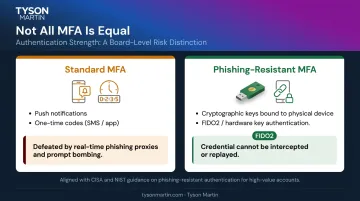
CISA identifies FIDO-based authentication as the standard for phishing resistance. NIST SP 800-63B requires hardware-backed, non-exportable private keys for its highest authentication assurance level.
For high-value targets — executives, finance personnel, administrators with privileged access — hardware-backed authentication represents a meaningful control upgrade.
The governance question for boards: Has security awareness training been updated to address AI-enhanced attacks? Do executive protection protocols specifically cover C-suite impersonation and synthetic voice fraud scenarios?
Stolen Credentials Are Still Opening Doors You Think Are Locked
The Infostealer Pipeline Boards Need to Understand
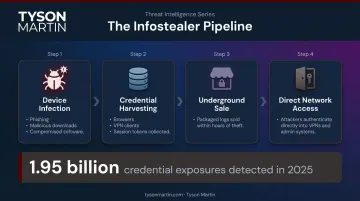
The attack sequence is straightforward and increasingly automated:
- Infostealer malware infects a device — through phishing, malicious downloads, or compromised software
- Credentials and session tokens are harvested from browsers, applications, and VPN clients
- Packaged logs are sold on underground marketplaces, often within hours of theft
- Ransomware affiliates or state actors purchase the logs and authenticate directly into VPNs, RDP sessions, and administrative systems
No exploit required. Valid credentials bypass perimeter defenses entirely.
Recorded Future detected 1.95 billion malware combo-list credential exposures and 892 million malware-log credential exposures in 2025. Mandiant's M-Trends 2025 report identified stolen credentials as the second-highest initial infection vector, accounting for 16% of intrusions.
The Gap Patch Management Doesn't Close
A fully patched VPN appliance is still vulnerable if attackers have valid credentials and MFA is absent. This is one of the most frequently misunderstood gaps at the executive level. Patch management and credential security are separate controls addressing separate risks — both necessary, neither a substitute for the other.
Third-Party Exposure Expands the Perimeter Beyond Your Control
Credentials compromised at a vendor, contractor, or technology partner can serve as the entry point into your environment. The 2024 Snowflake-related campaign is the documented example: credentials compromised outside Snowflake's infrastructure were used to access enterprise customer environments, affecting companies including Advanced Auto Parts and LendingTree.
Your credential risk perimeter extends to every organization whose systems authenticate into yours. That makes third-party credential hygiene a board-level concern, not just a vendor management task.
The board-level action: Confirm with management that MFA is enforced on all internet-facing services and administrative accounts — not most, not almost all — and ask for evidence of regular credential exposure monitoring that includes your third-party ecosystem.
Unpatched Systems: The Attack Vector That Never Goes Away
State Actors Are Exploiting 2017 CVEs Right Now
The FBI's August 2025 advisory confirmed that Russian FSB Center 16 actors were actively exploiting SNMP weaknesses and end-of-life networking devices running unpatched Cisco Smart Install — including CVE-2018-0171, a vulnerability disclosed seven years ago.
A separate 2025 joint advisory documented that PRC state-sponsored actors were having "considerable success" using publicly known CVEs to gain network access. Aged vulnerabilities are not retired threats — they remain active attack paths against enterprise and critical infrastructure targets.
Why Unpatched Devices Persist — And Why It's a Governance Issue
Security teams don't leave systems unpatched out of negligence. The friction is organizational:
- Budgetary constraints limit the tools and personnel available for continuous patching
- Operational risk makes patching business-critical systems during production hours genuinely dangerous
- End-of-life hardware has no vendor support and no patch path — it must be replaced or compensating controls must be applied
- Understaffing compounds each of these constraints: ISACA reported that 47% of cybersecurity professionals said their teams were understaffed in 2025
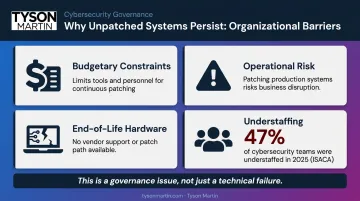
This is a risk prioritization and governance issue, not just a technical failure. Boards have an oversight role here.
Board oversight questions for the patching program:
- Does a risk-based patching program exist with documented prioritization criteria?
- Are internet-facing devices prioritized in that program?
- Is there an inventory of end-of-life systems, and do compensating controls or replacement timelines exist for each?
What Boards and Executive Teams Should Do Differently in 2026
Require Decision-Ready Intelligence, Not Activity Reports
The most common gap in board cyber governance isn't a lack of information — it's that the information boards receive doesn't support decisions. Patch counts, training completion rates, and color-coded dashboards describe effort. They don't describe whether risk went up or down for the systems that generate revenue, maintain operations, or hold regulated data.
What boards actually need from every cybersecurity briefing:
- What changed since last quarter — in exposure terms, not activity terms
- What the business risk is — mapped to revenue, operations, legal liability, or customer trust
- What decision or approval is required — a specific ask, not a general update
The NACD's 2026 Director's Handbook on Cyber-Risk Oversight recommends cyber-risk reporting occur at least quarterly and immediately following any material event. The SEC's cybersecurity disclosure rules (in effect since July 2023) require public companies to disclose material incidents within four business days of determining materiality. Both standards assume boards know their escalation thresholds before an incident begins, not during one.
Define Decision Authority Before the Incident Happens
The single most consequential governance action a board can take before 2026 is confirming that the following are written down, assigned, and tested:
- Who declares a cybersecurity incident material
- Who can authorize system shutdowns that disrupt operations
- Who approves emergency spend
- Who speaks to regulators, customers, and the press
- Who briefs the board chair in the first hour, and in what format
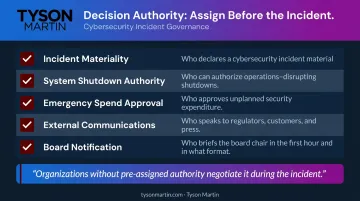
When ransomware hits at 2 a.m., organizations that haven't answered these questions in advance spend incident time negotiating authority. The cost of that negotiation shows up in response time, ransom exposure, and regulatory standing.
Closing the Governance Gap Quickly
For organizations without a dedicated CISO, navigating a leadership transition, or working to strengthen board-level oversight before a material event, the gap between threat landscape and governance structure is a near-term risk. Tyson Martin works directly with boards and executive teams to close that gap: translating threat intelligence into governance structure, establishing decision rights, and building inspectable reporting. He also steps in as interim CISO when organizations need credible security leadership during a transition. The outcome is a board that understands its exposure, asks the right questions, and makes defensible decisions before an incident forces the conversation.
Frequently Asked Questions
What is a threat intelligence executive report?
It's a periodic briefing that translates the current threat landscape into plain-English findings and governance-relevant guidance for executives and board members. Unlike technical reports written for security practitioners, this format is built for leadership — the outputs are decisions, not configurations.
What are the biggest cybersecurity threats boards should know about in 2026?
Four: ransomware ecosystem fragmentation producing more groups and less predictable attacks; AI-powered phishing and social engineering targeting executives specifically; credential theft through infostealer malware bypassing perimeter defenses; and persistent exploitation of unpatched legacy systems by state-sponsored actors.
How should a board of directors respond to a ransomware threat?
Confirm that management can answer yes to three things:
- Incident response plans are tested and current, not just documented
- Decision authority is pre-assigned with named individuals and alternates
- Recovery capability is demonstrated from tested backups, not policy statements alone
What questions should a board ask their CISO about the threat landscape?
Start with four:
- What changed since last quarter?
- What is our biggest unmitigated risk right now?
- Is MFA enforced on every internet-facing system and administrative account?
- When did we last run a tabletop exercise, and what changed as a result?
How is AI changing cybersecurity threats for enterprises in 2026?
AI enables attackers to craft highly personalized phishing and social engineering attacks at scale, including C-suite impersonation and synthetic voice fraud. Boards should confirm that verification protocols — not just awareness training — are in place for any high-stakes request involving wire transfers, credentials, or sensitive data.
What is the board's role in cybersecurity governance?
Oversight, not management. That means asking the right questions, confirming decision rights are clear and tested, ensuring cyber risk is reported in terms the board can act on, and holding management accountable for execution — not approving firewall rules.