
How Do I Find a Cyber Risk Advisor I Can Actually Trust?
Boards are under pressure, cyber claims are piling up, and you need a cyber risk advisor you can trust to turn noise into clear decisions.


Use judgment, authority, and plain-English evidence instead of polished theater.
Boards and executive teams are under pressure from every side. Cyber risk is rising, vendor claims are multiplying, and the board wants clearer answers faster than most teams can give them.
Buying another tool will not fix that. You are not hiring knowledge alone. You are hiring judgment, honesty, and the ability to turn noise into decisions you can defend.
TLDR: what trust looks like
A real cyber risk advisor helps you govern risk, improve reporting, and pressure-test management. They do not run your daily security operation.
Trust shows up when they connect cyber risk to revenue, downtime, legal exposure, trust, and recovery, not jargon.
The best filter is simple, can they decide, can they explain, and can they stay independent?
If the person has hidden sales motives or weak boundaries, the advice is already compromised.
Match the help to the problem. Board advisory, interim leadership, and project work are not the same thing.
What a trustworthy cyber risk advisor actually does
A trustworthy advisor helps you see what matters, what can wait, and what needs a decision now. That means clearer reporting, cleaner ownership, and stronger escalation. It does not mean they take over your security team or hide behind a stack of acronyms.
If they cannot translate the risk into business terms, you are not getting advice. You are getting noise.
Advisor, operator, auditor, or vendor, why the lane matters
Different problems need different people. An operator runs the work. An auditor checks the work. A vendor sells the work. An advisor helps you decide what the work means.
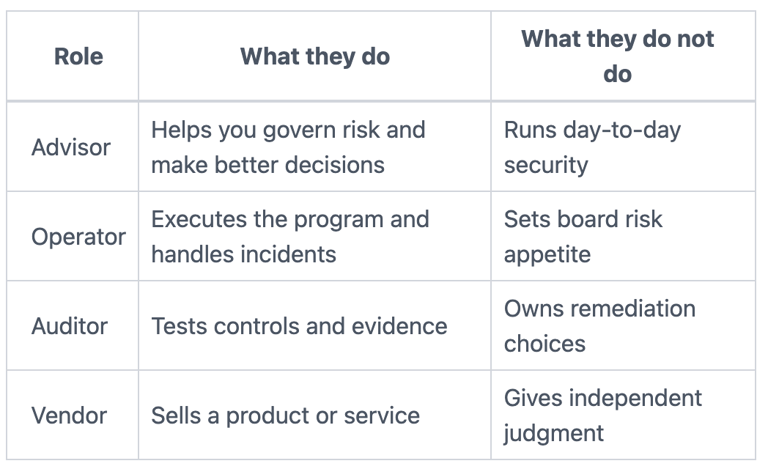
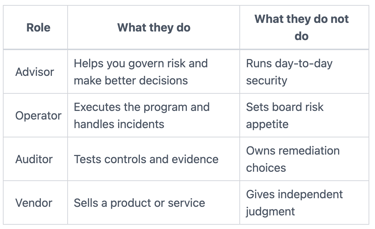
If you need board-level cybersecurity guidance, start by asking whether you need oversight, execution, or both. A lot of bad hires happen because nobody named the lane.
The trust test, can they turn risk into business decisions?
A trustworthy advisor connects cyber risk to revenue, downtime, legal exposure, customer trust, and recovery time. They can say what changed, what it means, who owns it, and what decision you need now.
That matters because boards do not need a risk lecture. They need a path. If the advisor cannot name the owner, the tradeoff, and the next step, the room is still stuck.
How to screen for real judgment, not just a strong resume
Start with three filters. Can this person make a clear recommendation? Can they explain it in plain English? Can they stay independent when the pressure gets messy?
You are looking for someone who can reason in public, stay calm under pressure, and tell you the truth when the answer is awkward.
Ask for proof, not promises
Do not settle for titles and stories. Ask for artifacts.
Board materials that led to a decision
Incident updates that changed executive behavior
Reporting samples that show risk, trend, and owner
A decision log that shows what got fixed, accepted, or escalated
Examples of measured improvement, not vague confidence
If they cannot show how their advice changed a decision, keep looking. A polished resume is not evidence.
Use interview questions that expose how they think
Ask questions that force a real answer.
"How would you explain our top cyber risk to a non-technical board member?"
"A vendor breach hits tomorrow. What do you need to know in the first hour?"
"Our reporting looks clean, but the board still feels blind. What do you change?"
"When do you push, when do you accept risk, and when do you say no?"
Listen for clarity, humility, and tradeoffs. If you hear buzzwords instead of decisions, that is your answer.
Trust breaks down fast when independence, fit, or incentives are wrong
Even a smart advisor can be the wrong advisor. If they are trying to sell tools, protect a framework, or defend their own reputation, the relationship goes sideways fast.
Watch for hidden agendas and blurred boundaries
You want truth, not comfort. A trusted advisor should be willing to say when evidence is thin, when controls are weak, or when a plan is mostly theater. If they soften every hard edge, they are not helping you.
This is where board-level cyber risk expertise matters. You need someone who can challenge management without turning into shadow management.
Make sure they fit your board, team, and pace
Trust also depends on fit. A good advisor respects management lines, communicates at your speed, and knows how to work with the chair, CEO, audit committee, and executive team.
You also need the right tempo. Some situations need steady board guidance. Others need a faster hand because the work is already behind.
Choose the right level of help before you sign
Not every gap calls for the same fix. If you buy the wrong level of support, you slow things down and still miss the point.
When board advisory is enough
Board advisory works when execution exists, but judgment is fuzzy. It fits when you need better reporting, stronger decision rights, and a clearer view of what the board should approve versus what management should run.
If your main issue is oversight, not headcount, board advisory is the cleaner move. A good what a board cyber risk advisor helps your board do resource can help you pressure-test that fit.
When you need interim or fractional leadership instead
If risk is active, execution is weak, or leadership just changed, you may need someone who can make hard calls and keep the work moving. That is not the same job as board guidance.
Use interim or fractional leadership when you need daily direction, fast stabilization, or a person who can own the program while the dust settles. If the room needs a decision-maker, not just an advisor, say that out loud.
Conclusion
The real goal is simple. You want someone who tells you the truth, helps you decide faster, and keeps risk from drifting while everyone else argues about symptoms.
Use five filters, clear role, proven judgment, strong communication, independence, and fit. If one of those is missing, the trust problem is already in the room.
If you are not sure whether your current oversight is real or just symbolic, See Where Your Board Actually Stands.
FAQ
What is the first thing to check in a cyber risk advisor?
Ask what role they think they are playing. If they cannot explain whether they are advising, executing, auditing, or selling, the fit is already unclear.
How do you know if they are truly independent?
Look for clean boundaries. They should not be steering you toward a tool purchase or protecting their own prior work.
What should a good advisor show you?
They should show board materials, decision logs, reporting samples, and examples where their advice changed the outcome.
When should you choose interim leadership instead?
Choose interim leadership when the work is stuck, the risk is active, or nobody is clearly accountable for results.
Related reading
If you want a steadier way to turn cyber noise into board-ready decisions, start with the conversation that names the gap clearly.
Tyson Martin is the executive public and pre-IPO companies in financial services, AI/data, SaaS, and cloud hire to make trust a measurable asset, one accountable answer to Is it secure? Is it resilient? Is the AI governed?
© 2026. All rights reserved.
Navigation
Free Resources
Contact
Stay ahead of your next board agenda
Sign up for Reports & Learnings From the Boardroom. Plain-English AI and cyber governance insights, biweekly. No pitch.
No spam. Unsubscribe anytime. · Or download the Director's AI Question Pack — 25 questions free