
Interim CISO Benefits: Faster Strategy, Lower Risk (Without Waiting Months)
Bring in an Interim CISO to get a 90-day security plan, board-ready reporting, and quick risk reduction while you hire or transform, in weeks, not months.


When cyber risk rises, you don't always have the luxury of a perfect hiring cycle. Maybe your business is scaling, you're mid-transformation, or a recent audit left uncomfortable gaps. Maybe your security posture isn't failing, but it's stuck, lots of activity, not enough control.
That's where an Interim CISO (Chief Information Security Officer) can make sense. You get experienced cybersecurity leadership fast, with a clear mandate and a short runway to prove value. The goal isn't magic. It's speed, clarity, and tighter oversight, so you can make defensible decisions and reduce exposure while the business keeps moving. Replace any generic references with your Information Security Program for precision.
If you're a CEO, founder, or board member, think of an interim leader like bringing in a steady captain during rough water. You still own the destination. You just stop guessing about the next safest move.
Key takeaways you can use right now
You can get to a decision-ready cybersecurity strategy in weeks, not quarters.
You can ask for a clear 90-day plan with owners, dates, and costs.
You can improve board confidence with clean reporting that supports action.
You can reduce "unknowns" fast, focusing on data protection and what could hurt revenue or trust.
You can tighten Incident Response before the next event forces your hand.
You can lower transition risk while you hire, restructure, or integrate systems.
Why an Interim CISO often moves faster than a full-time hire
Speed happens for a simple reason: an Interim CISO shows up to deliver outcomes, not to audition for internal alignment. They're hired to make calls, set priorities, and create a plan your leadership team can inspect.
You also avoid the slow drag of executive search, recruiting, negotiating, onboarding, and waiting for a new executive to learn your environment. If you need rapid impact, you can start with an experienced CISO for hire or a virtual CISO and move from uncertainty to execution without a long runway.
Here's a quick way to think about the timing difference:
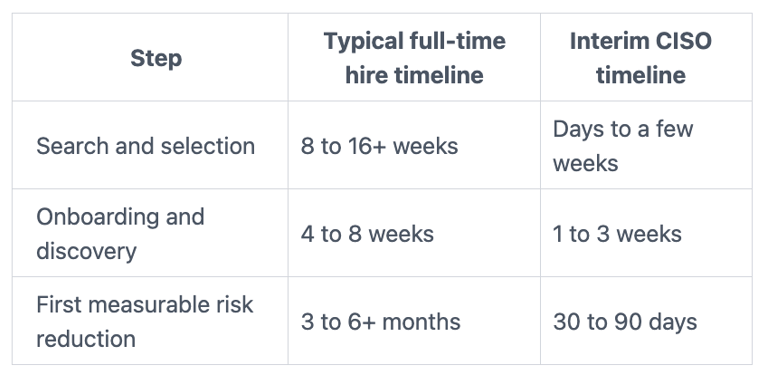
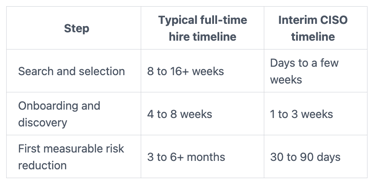
The point isn't that full-time leaders move slowly. It's that the process around them often does.
You get an experienced operator with a clear mandate
A "mandate" is just clarity about decision rights and success. You define what the Interim CISO can decide, what they must escalate, and what outcomes matter most.
That matters because security work can turn into endless debate. Meanwhile, your business needs crisp tradeoffs. Should you focus first on identity controls, backups, or third-party access? What risks can you accept for 90 days while you modernize?
When the mandate is clear, the Interim CISO can connect security to business priorities you already track, such as uptime, customer trust, revenue protection, M&A activity, and audit readiness. They'll also set a cadence, so decisions don't stall in email threads. This provides the strategic guidance your team needs to align security with business goals.
If your security leader can't say what "good" looks like in plain language, you'll get motion instead of progress.
You skip months of recruiting risk and opportunity cost
Waiting has a cost, even if nothing "bad" happens. Projects stall because nobody can approve the safest path forward. Teams burn out because priorities keep changing. Audit findings age into repeat findings. Customer security reviews slow sales because answers aren't consistent.
This is where interim leadership earns its keep. You stop paying the hidden tax of indecision.
An Interim CISO can also reduce the risk of a bad permanent hire, especially compared to a fractional CISO model. Instead of guessing what profile you need, you learn it. After 60 to 90 days, you'll know if you need a builder, a transformer, a governance-heavy leader, or a hands-on incident veteran. That makes the eventual full-time search more precise, and less emotional.
How an Interim CISO lowers risk in the first 30 to 90 days
In the early phase, risk drops because uncertainty drops. You get a fast read on what's real, what's noise, and what's dangerously assumed. Then you stabilize the basics, prioritize the top risks, and report progress in a way leadership can trust.
A strong interim approach follows a simple rhythm for Risk Management: assess, stabilize, prioritize, report. Board-level expectations for Governance Risk and Compliance matter here, because unclear oversight is where "we assumed" grows. That's why board engagement on readiness and decision rights is so important, including board incident response oversight.
You get a clear risk picture, without a long assessment cycle
You don't need a six-month Cyber Maturity Assessment to take smart action. You need a "good enough to act" view that highlights where business impact is most likely.
In the first few weeks, an Interim CISO will usually pressure test areas that drive real incidents:
Identity and Access Management (especially admin access and service accounts)
Logging and Threat Detection coverage (what you can and can't see)
Backups and restore reality (proof, not hope)
Critical systems and data flows (your crown jewels)
Third-party Risk Management and outsourced IT (where ownership gets blurry)
Active incidents, near misses, and repeat issues
You should expect a short, ranked list of top risks in plain language. You should also expect clarity on scope, what's included, what's not, and what evidence supports the conclusions. That's how you avoid funding opinions.
You harden the basics that stop most real-world incidents
Most damaging events still follow familiar paths. Attackers steal credentials, use excessive privileges, move laterally, and break recovery. So the fastest risk reduction often comes from strengthening fundamentals and closing obvious gaps.
An Interim CISO typically pushes for practical improvements like:
Expanding MFA coverage, including privileged accounts
Tightening privileged access and removing stale admin rights
Focusing patching on high-risk assets through Vulnerability Management, not averages
Confirming endpoint coverage and response workflows
Improving email protections and phishing resistance
Testing backups with real restores for critical systems
Running a tabletop exercise that forces executive decisions
None of this is glamorous. It's effective because it reduces common failure modes. You also get better decision-making under stress, because your leaders practice the hard calls before they're forced to make them at 2 a.m.
What to look for so your Interim CISO delivers strategy, not just activity
The wrong interim leader can look busy and still leave you exposed. You'll get documents, meetings, and tool talk, but no real reduction in risk. So your evaluation has to focus on outcomes, communication, and leadership under pressure.
If you want a clear model for how to evaluate the person, not just the resume, use this guide on how CEOs vet a CISO. It frames what "good" looks like in business terms, even if you're not a security specialist.
Ask for a simple 90-day plan tied to business goals
A real plan fits on a few pages. It doesn't hide behind templates. It should make it obvious what you're buying and what decisions you must make, aligned with goals like regulatory compliance.
Ask for outputs like:
A ranked top-risk list, with business impact stated plainly
Named owners for each major fix (not "the security team")
Dates and milestones, with what "done" means
Cost ranges and resourcing needs
A short list of decisions leadership must make this month (such as approving a Cloud Security Architecture)
A weekly operating cadence, with measurable progress
You're looking for someone who can say, "Here's what we're doing, here's why it matters, here's what you need to decide." That's strategy you can run.
Make sure Board Reporting is board-ready and decision-focused
If reporting doesn't drive decisions, it becomes theater. Good reporting helps you see trends, validate reality, and approve tradeoffs without drowning in tool output.
Board-ready reporting usually includes a stable set of measures, such as:
Top enterprise risks and whether exposure is rising or falling
Incident readiness signals (restore tests, exercises, response time targets)
Control health on critical assets in the Information Security Program (identity, logging, patching)
Third-party exceptions that could impact operations
Clear asks (funding, risk acceptance, priority changes)
For a deeper model that helps committees get the truth without turning meetings into technical debates, use this resource on risk committee cybersecurity reporting. Your goal is simple: fewer surprises, clearer choices.
FAQs about Interim CISO benefits
How long do you need an Interim CISO?
Most interim engagements run 60 to 180 days. You keep the role until the program stabilizes, reporting is consistent, and a longer-term leader can take over cleanly.
What does it cost compared to full-time?
Costs vary by scope, but interim often reduces total risk cost quickly. You also avoid paying months of exposure while you search, plus the cost of a wrong hire.
Interim vs fractional vs consultant, what's the difference?
An interim leader usually owns the role day-to-day for a defined period. A fractional leader provides ongoing executive ownership at a lower time commitment. This overview of a fractional CISO is a helpful way to compare models.
How quickly can you start?
Interim starts can be fast, sometimes within days. The real limiter is access: systems, people, and the authority to prioritize work.
Will your team accept an interim leader?
They will if the mandate is clear and the leader earns trust. Teams tend to like interim leadership when it reduces thrash in security vendor management, protects focus, and removes politics from priorities.
How do you measure success in 90 days?
You measure fewer unknowns, a ranked risk plan with owners, improved incident readiness, a security awareness program, and reporting that drives leadership decisions. You also look for closed gaps on the most likely attack paths.
What if you're in the middle of an incident?
An Interim CISO can help bring structure fast: roles, decision rights, communications rhythm, and recovery priorities focused on business continuity. You want calm execution, not extra noise.
Can an Interim CISO help with audits and insurance questions?
Yes, if they can translate evidence like penetration testing into defensible answers for audits, Cyber Liability Insurance, and HIPAA compliance. You want proof of control health, not optimistic narratives.
Conclusion
An Interim CISO makes the most sense when risk is rising, the business is changing, or your current security program can't break through the clutter. In 90 days, you're not buying perfection. You're buying momentum you can verify: a clear mandate, a prioritized plan, measurable fixes on the basics like a Zero Trust Framework, and reporting that supports decisions.
To get the outcome you want, start simple. Define the mandate (what they can decide), define success metrics (what must improve), and set a reporting cadence you'll actually use. Then hold the work to business impact, not security activity.
If you want to explore support options and move quickly without adding confusion, start with engaging a CISO advisor for Strategic Guidance. Your next step should feel calm: clearer choices, lower exposure, and Cybersecurity Leadership that delivers a defensible strategy.
Tyson Martin is the executive public and pre-IPO companies in financial services, AI/data, SaaS, and cloud hire to make trust a measurable asset, one accountable answer to Is it secure? Is it resilient? Is the AI governed?
© 2026. All rights reserved.
Navigation
Free Resources
Contact
Stay ahead of your next board agenda
Sign up for Reports & Learnings From the Boardroom. Plain-English AI and cyber governance insights, biweekly. No pitch.
No spam. Unsubscribe anytime. · Or download the Director's AI Question Pack — 25 questions free