What Do Interim CISO Services Cost in 2026?
Interim CISO Services cost in 2026 varies, you'll see real U.S. ranges, day rates vs retainers, plus how scope, urgency, and board needs set price.

When your cyber risk spikes, time becomes a billable item. Not because people want it that way, but because the cost of delay shows up fast: missed audit dates, stalled deals, noisy board meetings, and late nights spent guessing.
That's why Interim CISO Services exist. "Interim" means time-bound Chief Information Security Officer leadership with clear authority for a defined window. It's not a long-term hire, and it's not a part-time advisor who checks in once a month. You're bringing in someone to lead, decide, and create traction when the stakes are high.
In 2026, pricing for this information security leadership is all over the map because the job is all over the map. Scope, urgency, and expected outcomes move the number more than titles do. This matters right now because regulators keep raising expectations, cyber threats don't slow down, third-party risk keeps expanding, and M&A plus AI-driven change adds pressure to already stretched teams. You don't need one magic number, you need realistic ranges and the factors that shape them.
Key takeaways you can use before you ask for a quote
You'll see three pricing models most often: day rate (short bursts), Virtual CISO or monthly retainer (steady leadership), and fixed-scope (specific outcomes with clear boundaries).
Crisis and deadlines raise cost fast: active incidents, board scrutiny, audit findings, regulatory compliance timelines, and M&A close dates typically push rates up.
Clear scope lowers cost: when you can name deliverables, decision rights, and meeting load, you reduce rework and avoid "figure it out as we go" pricing.
Your internal team strength changes the quote: a capable IT and security team means the interim CISO can lead and steer, not personally execute everything like information security policy.
Board communication is part of the value: if you need board-ready updates on security posture, expect it to be priced in (it saves time and prevents panic spending).
The fastest way to compare bids is to standardize inputs: ask each candidate to price the same deliverables and the same time commitment.
Fit beats credentials when time is short: use a simple traits-based filter to choose well, for example this guide on choosing the right interim CISO for stabilization and outcomes.
What interim CISO services cost in 2026 and why the ranges are so wide
Most interim CISO engagements price like executive leadership, not like staff augmentation. You're paying for judgment, prioritization, and the ability to run a clean operating rhythm across IT, product, legal, finance, and the board.
Here are common market ranges you may see in 2026 for U.S.-based interim leadership. Your industry, location, and urgency can move these up or down.
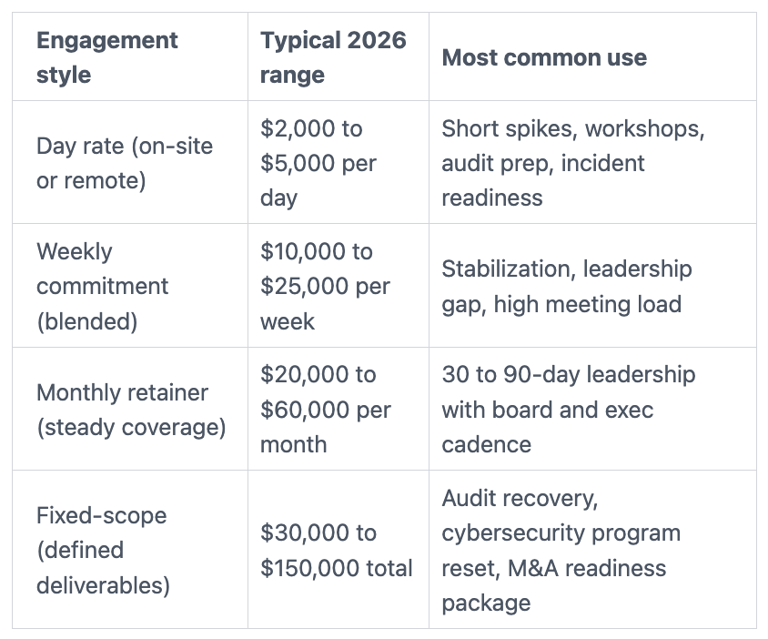
The takeaway: the price is mostly a proxy for intensity and responsibility, not just hours.
Minimum engagement lengths matter, too. You'll often see 30, 60, or 90-day terms because week one is heavy on discovery and decision setup. A 30-day engagement can feel expensive on a per-month basis because you're paying for rapid ramp-up. Meanwhile, a 90-day engagement often produces a lower effective monthly cost because the leader has time to stabilize governance risk and compliance, build momentum, and hand off cleanly.
If you want a clearer sense of what executive-level "interim" work looks like in practice, this perspective on interim security executive leadership for fast stabilization can help you sanity-check scope.
The three common pricing models you will see (and when each is a good deal)
Day rate (short bursts) tends to include leadership meetings, targeted risk triage, and quick decisions. You'll usually get a written summary and next actions. It often excludes ongoing program management, deep execution, and tool implementation.
Best for: a tight problem with a tight timeline.
Monthly retainer (steady leadership) usually includes a predictable time commitment, an executive cadence, stakeholder management, and ownership of prioritization. It often includes board support, incident readiness, and vendor oversight. It usually excludes new tool costs, outside legal, and third-party incident response firm fees.
Best for: a 30 to 90-day leadership gap where you need steady control.
Fixed-scope (defined outcomes) typically includes specific deliverables such as an audit remediation plan using the NIST framework, a board-ready roadmap, or an M&A security readiness package. It's often priced around assumptions (available staff, access to systems, timely decisions). It usually excludes any surprise incident work unless you add a change order.
Best for: a clear outcome when you can hold the scope line.
If your scope is fuzzy, a fixed-scope deal can become a dispute. If your scope is clear, it can be the cleanest way to buy outcomes.
Typical 2026 price drivers that move your quote up or down
A quote moves for practical reasons, not mysterious ones.
Crisis mode: if you have an active incident, you're buying calm leadership under pressure, often with nights and weekends.
Audit or regulator timelines: hard dates compress work and raise intensity.
Org complexity: more business units, more sites, and more legacy systems raise coordination time.
Cloud security and identity sprawl: messy access, multiple clouds, and weak logging increase risk and effort.
Third-party risk management: lots of vendors with data access expands the blast radius.
Team maturity: a strong internal team lowers cost because execution doesn't bottleneck on the interim leader.
Board communication needs: if you need board materials, committee briefings, and decision support, price goes up (and waste usually goes down).
Travel and time zones: on-site expectations and global coverage increase cost quickly.
Hands-on execution vs oversight: if you expect the interim CISO to also be the doer, you'll pay for that.
What you should expect to get for the money (deliverables, time, and outcomes)
If you measure value by tasks, Interim CISO Services can look expensive. If you measure value by outcomes, it often looks like insurance you can actually use.
A good interim CISO makes risk easier to run. That means fewer unknowns, fewer "urgent" surprises, and faster decisions with less drama. You should see progress in weeks, not quarters.
In the first 2 weeks, "good" looks like clarity and control:
A confirmed scope and decision rights (who can approve what, and when).
A short ranked risk list from a risk assessment tied to business impact.
Immediate stabilization actions on the highest blast-radius items (often identity, access, backups, logging).
By day 30, you should feel operational lift:
A working security operations incident response cadence with named roles and escalation paths.
A short roadmap with owners and dates, not themes and hopes.
A vendor and monitoring reality check (what coverage you truly have, and what's assumed).
By day 90, you should be in a different place:
A board-ready security strategy with milestones, cost bands, and clear trade-offs.
A cleaner operating rhythm that your team can keep running.
A handoff package that reduces dependency on the interim leader.
You'll also want measurable progress that executives can track without jargon. That's where board-friendly metrics help, especially if you anchor them in CISO performance metrics the board can understand.
Your first 30 days with an interim CISO, the work that usually happens fast
Speed doesn't come from rushing. It comes from not starting from scratch.
In week one, you'll usually see rapid intake and gap analysis across IT, engineering, and the business. The interim leader confirms your critical systems, your sensitive data paths for data protection, and your biggest "single points of failure." They'll also map decision rights, because a leader without authority becomes a document generator.
Next, risk triage turns scattered issues into a short list you can act on. Then the interim CISO targets quick wins that reduce real exposure without slowing the business. Common examples include tightening privileged access, implementing vulnerability management, removing stale accounts, validating backup recovery, and setting minimum logging for critical systems.
By the end of the month, you should have a simple executive update rhythm, a realistic plan, and fewer unanswered questions. The best part is psychological: your team stops guessing what "matters most" this week.
Board and executive support, the hidden cost saver
When the board lacks clear board reporting, you pay for it in indirect ways. People panic-buy tools, teams chase the loudest concern, and executives burn time translating technical noise into business decisions.
An interim CISO who can brief clearly helps you avoid those traps. You get a steady cadence, consistent definitions, and decision-focused updates. Instead of "we're red," you hear "here's the risk, here are options, here's the cost, and here's what we need you to decide."
That kind of communication also helps during incidents, when speed and clarity matter more than perfect information. If you want a sense of what "clear and calming" looks like, this guidance on leading cyber conversations that build confidence is a useful reference point.
How to budget and compare proposals without getting surprised later
Interim CISO pricing problems usually come from scope problems. If you don't define what success looks like, you can't tell whether a quote is fair. You also can't compare two proposals that price different realities.
Start with a one-page scope. Keep it simple. Name the outcomes you need, the deadlines you face, and the decisions you expect the interim leader to own. Then require each bidder to respond in the same format: time commitment, deliverables, assumptions, and exclusions.
It also helps to separate "leadership cost" from "program spend." An interim CISO fee is the information security leadership layer. Your security program may still need audits, tooling, identity work, or third-party testing. When you blend those into one number, you lose control of trade-offs.
Before you sign, make sure you're evaluating leadership fit as a CEO, not just technical depth. This guide on how to vet a CISO as a CEO can help you ask better questions early.
A simple scoping checklist that makes pricing fair and comparable
You don't need a 20-page RFP. You need a shared definition of "done."
Include these items in your scope:
Your primary goal (stabilize after a gap, pass an audit, rebuild incident readiness, develop a transition plan, prepare for a sale).
Your current state (security maturity, team size, known gaps, key tools, major pain points).
Deadlines (audit dates, board meetings, customer commitments, deal milestones).
Stakeholders and meeting load (exec updates, committee meetings, vendor calls).
Decision rights (what the interim CISO can decide, what requires you).
Ownership lines (what they own vs what they advise).
Then ask each candidate to price the same structure: deliverables, hours or days per week, timeline, and assumptions. When bids match in shape, you can compare substance.
Common extras that change total cost (incident response, audits, tools, and travel)
Even a well-scoped engagement can spike if you hit an incident or discover a hidden compliance gap. Plan for add-ons so they don't surprise you.
Common extras include breach counsel, forensics, PR support, pen tests, compliance audits, GRC tooling, MDR services, identity projects, security awareness training, incident response, and travel costs.
A practical budgeting trick is to keep two buckets:
Leadership cost (the interim CISO fee)
Program spend (tools, services, and one-time projects)
That separation keeps your choices clear. You can decide to spend more on monitoring, for example, while holding leadership steady. Or you can keep tools stable while buying higher-intensity leadership through a deadline.
FAQs about interim CISO services cost in 2026
Is an interim CISO more expensive than hiring a full-time CISO?
On a monthly view, an interim CISO can look higher. However, a full-time Chief Information Security Officer hire carries salary, bonus, benefits, equity, recruiting fees, and months of ramp time. You also carry the cost of a wrong hire, which can set you back a year.
Interim CISO Services often cost less when you need leadership for a short, high-stakes window. You're paying for speed and reduced uncertainty, not long-term retention.
How long do you usually need interim coverage to see real results?
You can see meaningful change in 30 days if the scope is tight and you have access. That window usually stabilizes the basics and creates a working cadence.
At 60 days, you often build momentum and close more systemic gaps, such as HIPAA compliance. By 90 days, you can reset reporting, incident readiness, regulatory compliance, and priorities in a way that sticks. Clear decision rights and a focused scope reduce time, and therefore cost.
What is the difference between interim and fractional CISO pricing?
Interim is time-bound and usually high-intensity. Fractional CISO or Virtual CISO is ongoing part-time leadership, often with a steadier cadence and lower intensity per week.
Choose interim when you're in a transition, a crisis, an audit deadline, or an M&A window. Choose fractional when you need consistent governance and program guidance, such as information security policy, over time. If you want a direct comparison, this overview of interim versus fractional CISO support lays out where each fits.
Conclusion
You don't buy interim leadership to "do security," you buy it for cyber risk management, to reduce risk fast and regain control. Start by naming your trigger (leadership gap, audit pressure, incident readiness, acquisition). Next, write a one-page scope with outcomes, time commitment, and decision rights. Then ask for pricing in the same format so you can compare proposals without guesswork.
If you want fast clarity on scope and next steps, consider engaging a Chief Information Security Officer (CISO) advisor for scoping and a practical plan. The right interim leader should leave you with momentum in security governance and business resilience, not dependency.
Tyson Martin is the executive public and pre-IPO companies in financial services, AI/data, SaaS, and cloud hire to make trust a measurable asset, one accountable answer to Is it secure? Is it resilient? Is the AI governed?
© 2026. All rights reserved.
Navigation
Free Resources
Contact
Stay ahead of your next board agenda
Sign up for Reports & Learnings From the Boardroom. Plain-English AI and cyber governance insights, biweekly. No pitch.
No spam. Unsubscribe anytime. · Or download the Director's AI Question Pack — 25 questions free