
What Should a CEO Know About Cybersecurity Without Being Technical?
What should a CEO know about cybersecurity without being technical? Get plain-English board-level answers on risk, ownership, and decisions.


Plain-English oversight for CEOs, founders, and executive teams who need better answers, not more jargon.
You already feel the pressure. Growth is moving, the board wants cleaner answers, customers are asking harder questions, and one bad cyber event can turn into a business problem fast.
You do not need to know how to run security tools. You do need to know what good oversight looks like, which questions cut through jargon, and which decisions you cannot hand off.
That matters for you as the CEO, and it matters for the leaders supporting you. When ownership is fuzzy or reporting is vague, risk drifts. When the company is moving fast, it drifts even faster.
TLDR
Cybersecurity is a business risk issue. It can hit revenue, operations, trust, legal exposure, and deal flow.
You do not need tool fluency. You need oversight fluency, meaning clear owners, clear evidence, and clear escalation.
Ask for the few answers that matter, not a flood of dashboards and technical detail.
If a report does not end with a decision, it is not board-ready.
When pressure rises, clear decision rights matter more than perfect controls.
Why cybersecurity is now a CEO issue, not just an IT issue
Cybersecurity is not a pile of alerts. It is part of protecting revenue, uptime, customer trust, and legal standing. You see it in board meetings, customer reviews, vendor contracts, cyber insurance, and the first hour of a crisis.
It is also not your job to patch servers or tune firewalls. Your job is to know whether the company is prepared, who is accountable, and what happens when a key control fails.
A weak view treats cyber as a quarterly IT update. A strong view treats it as an enterprise risk with named owners and clear decisions.
What changes when the risk becomes yours
Once cyber can stop orders, lock up data, or trigger public questions, it is your problem. You are not expected to fix the controls yourself, but you are expected to know whether the business is ready.
That means you should know who can make the call, who gets pulled in, and how fast the company can respond without making the damage worse.
The business outcomes you should care about first
Start with business outcomes, not technical terms. Ask what a cyber event would do to sales, operations, legal obligations, reputation, and recovery time.
If invoicing stops for two days, that is a cash problem. If customer data is exposed, that is a trust problem with legal fallout attached. If a key vendor goes down, that is a continuity problem, not a software problem.
The four things you should always know about your security posture
If you want a quick self-check, the Cyber Oversight Scorecard is a simple way to see whether your current view is complete.
You do not need a wall of data. You need four answers you can repeat in plain English. If you cannot answer these cleanly, your oversight is still fuzzy.
What are your crown jewels, and what would failure cost?
You cannot protect everything equally. Know the few systems, data sets, vendors, and processes that would hurt the company most if they failed or leaked.
That list usually includes:
Revenue systems, billing, ordering, and collections.
Sensitive data, such as PII, IP, health data, payroll, or board materials.
Single points of failure, such as one cloud, one identity provider, or one managed service provider.
External dependencies that can stop the business, including a key SaaS tool or logistics vendor.
If you do not know the crown jewels, every risk sounds urgent and every budget request sounds equal.
Who is accountable when something goes wrong?
You need one clear executive owner for cyber risk. You also need named owners for major areas like identity, cloud, data, third parties, and incident response.
Shared responsibility without real ownership usually turns into delay and handoff games. The board sees motion, but the business gets slow follow-through.
How do you know the controls actually work?
" We have the tools" is not the same as "the controls work." Ask for proof through drills, sampling, restore tests, and trend data.
You want evidence that risk is moving in the right direction. Testing shows that controls hold under stress, not just on paper.
What happens in the first hour if a real incident starts?
You should know the escalation path, the first decision-maker, the first executive update, and the order of actions. If the team has to improvise the first hour, it is already behind.
The point is not technical detail. The point is whether the company can move fast without creating more damage.
The questions you should ask your security leader in every board or executive review
Board and executive reviews should end with decisions. If they do not, you are watching a status report, not leadership.
For a fuller board version, the questions every director should ask the CISO are useful because they force business answers, not technical theater.
What changed since last quarter, and why does it matter?
Ask what got better, what got worse, and what decision is needed now. A static update is a missed opportunity.
You are not looking for a victory lap. You are looking for movement, trend, and judgment.
Where are we still exposed in ways that could hurt the business?
Focus on active risk, weak recovery, vendor concentration, and unresolved ownership. Ask for business impact, not just a score.
If the answer sounds like a technical inventory, push again. You need to know what can hurt sales, operations, or trust.
What decision do you need from me right now?
Good reporting ends with an ask. Approve, defer, fund, accept, or change priority.
If there is no decision on the table, the update probably was not built for leadership.
How to tell the difference between useful reporting and busy reporting
A good report helps you decide. A busy report helps people say they presented something.
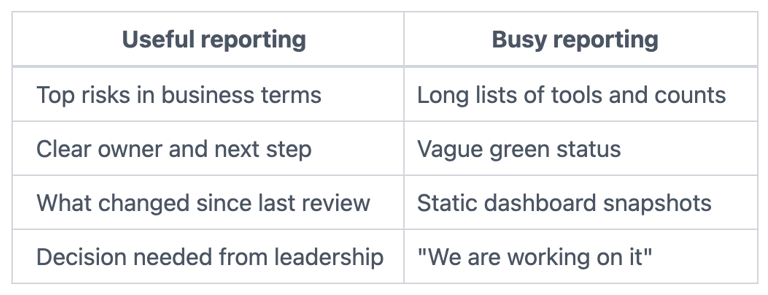
If your board packet feels thick but not useful, that is a reporting problem.
What a CEO should expect in a strong update
A strong update is short, clear, and decision-ready. It should cover the top risks, what changed, what is being fixed, what remains open, and what needs leadership attention.
It should also show whether risk is improving or sliding backward. You do not need 40 slides to see that.
What weak reporting usually hides
Weak reporting often hides unclear ownership, repeated problems, missing evidence, and slow recovery. It also hides the gaps nobody wants to name.
If every slide is green, every date is met, and every trend points up, ask what is missing.
That is where the real story usually sits.
What good CEO oversight looks like when the pressure rises
Your job gets sharper when the company is under strain. During an incident, audit, acquisition, vendor issue, or rapid growth phase, you need to keep decisions clean and roles clear.
You are not there to run the response. You are there to keep the business from guessing.
What to do in the first 24 hours of a cyber event
Set one command structure. Start a daily update rhythm. Keep a decision log. Pull legal, communications, and business leadership into the same room.
You also want evidence preserved, facts separated from rumors, and one person responsible for each major workstream. That keeps the response from turning into a group chat with a budget.
What to avoid when the room gets tense
Do not guess in public. Do not let vague ownership continue. Do not push people so hard that they break evidence or confuse the response.
Speed matters, but sloppy speed costs more. Calm questions and clear decisions beat panic every time.
If your current reporting still leaves you guessing, Get Board-Ready on AI and Cyber Risk is the cleanest next step when you need outside judgment.
FAQ
What should a CEO know about cybersecurity without being technical?
You should know what matters most, who owns it, how it is tested, and what happens if it fails. That gives you enough to ask better questions and make better calls.
How often should I get a cyber update?
You should get a regular update rhythm, not a random one. Quarterly works for most boards, but major changes, incidents, and vendor risks may need faster review.
What if my security leader keeps using jargon?
Ask them to translate every risk into business impact. If they cannot explain it in plain English, they probably do not have a board-ready answer yet.
Do I need to understand incident response details?
No. You need to know the escalation path, the decision owner, the first update, and the order of actions. That is enough to lead without pretending to be the technical lead.
What is the biggest mistake CEOs make?
They accept reporting that sounds busy but does not drive decisions. If the update does not show what changed, who owns it, and what you need to do, it is not helping you govern.
Conclusion
You do not need to become the technical person in the room. You need to know what matters, who owns it, how it is measured, and what happens if it fails.
That is the CEO job now. Cybersecurity sits inside business leadership because it touches revenue, trust, and operating control.
If the picture still feels foggy, tighten the reporting, check the ownership map, and ask for a clearer view before the next surprise does it for you.
Tyson Martin is the executive public and pre-IPO companies in financial services, AI/data, SaaS, and cloud hire to make trust a measurable asset, one accountable answer to Is it secure? Is it resilient? Is the AI governed?
© 2026. All rights reserved.
Navigation
Free Resources
Contact
Stay ahead of your next board agenda
Sign up for Reports & Learnings From the Boardroom. Plain-English AI and cyber governance insights, biweekly. No pitch.
No spam. Unsubscribe anytime. · Or download the Director's AI Question Pack — 25 questions free