
Your Practical Guide to Setting Technology Risk Appetite
Set your technology risk appetite with clear thresholds, board oversight, and practical metrics, so you can move faster without avoidable surprises.


You face a key choice as a board member or CEO. Technology risk appetite defines how much loss or disruption from tech failures your company accepts. Without clear boundaries, you make poor calls on cyber threats, AI tools, and vendor choices. Growth stalls. Incidents surprise everyone. Governance looks weak.
Blurry lines lead to real costs. A cloud outage hits revenue hard. An unvetted AI pilot leaks data. Vendor breaches spread fast. You miss opportunities because caution turns to paralysis. Or you chase speed and invite chaos.
The fix starts with you. Set explicit statements linked to strategy. Use metrics like downtime caps or cost limits. Build oversight that spots drift early. This guide shows you how. You gain confident decisions. Management executes within bounds you control.
Key takeaways you can apply now:
Define appetite before AI or vendor deals scale.
Tie it to revenue hits, not vague terms.
Quantify thresholds like 4-hour outages.
Review quarterly to match business shifts.
Own escalation so surprises drop.
Link it to strategy for real alignment.
Test with scenarios to prove it works.
Why Technology Risk Appetite Hits Your Leadership Agenda Now
Technology moves fast in 2026. AI pilots launch weekly. Supply chains face more attacks. Regulators demand proof of oversight. Growth adds strain. You feel it in stalled deals and board questions.
Boards ignore this at their peril. Weak appetite means vague tolerance. You approve projects without bounds. Then a vendor outage costs millions. Trust erodes. Personal liability rises because choices lack records.
Consider a CEO caught by a partner breach. No clear limits meant late response. Revenue dropped 15%. Stock fell. The board scrambled.
Strong appetite changes that. You set quantified lines. Management reports against them. Decisions speed up.
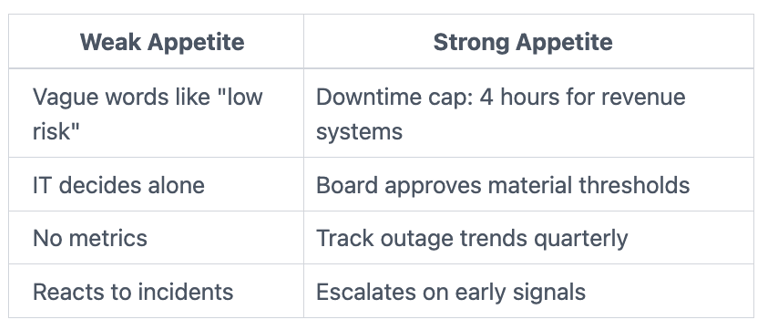
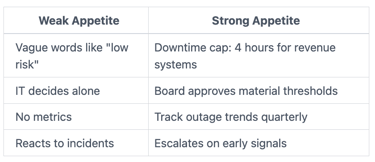
You lead here. Growth demands it. AI speed requires it. Cyber hits make it urgent. Tie appetite to resilience and trust. Start with your crown jewels: systems that drive revenue or operations. Without this, you risk more than tech. You risk the business.
What Technology Risk Appetite Really Means for Your Organization
Technology risk appetite is your stated limit on losses from tech issues. It covers outages, data errors, access failures, and vendor gaps. You tie it to strategy so every choice fits goals.
This is not IT policy. You decide boundaries. Management operates inside them. For example, you cap cloud downtime at 6 hours for customer portals. Or limit breach costs to $2 million per event. Qualitative guides help too, like "vet all AI tools before production."
Focus on business terms. Ask: How much revenue loss from an outage? What customer harm from bad data? This avoids tech theater. You get practical oversight.
Use a framework to build it. Compare your state to mature ones.
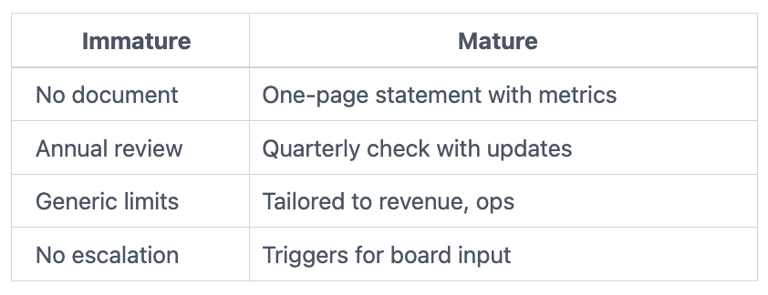
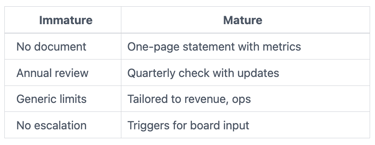
You own this. It shapes daily calls. Clear appetite means fewer debates. Better growth.
The Key Components Every Appetite Statement Needs
Build yours with these essentials. They make it actionable.
Risk categories: Cyber breaches, AI errors, vendor outages, change failures.
Metrics: Financial ($1M max loss), operational (99% uptime), recovery (restore in 4 hours).
Review cadence: Quarterly board check, annual refresh.
Escalation triggers: Trend worsens, exception expires, incident nears limit.
Strategic tie: Align to goals like 20% growth without ops risk.
Examples: "$500K max fraud per quarter from digital channels." Or "AI vetted by risk team before scaling." Keep it one page. You approve it. Management reports compliance.
How It Differs from Overall Enterprise Risk Appetite
Tech appetite is a focused subset. Enterprise covers all risks like market or legal. Tech changes faster with AI and vendors.
Enterprise might accept 2% revenue loss yearly. Tech caps vendor outage at 4 hours. Boards own tech because it hits ops daily. You set specific thresholds. This prevents drift in fast areas.
Where Boards and CEOs Usually Get Technology Risk Appetite Wrong
You often treat this as IT's job. Or copy generic templates. Tech velocity outpaces old policies. Metrics stay weak. Failures follow.
Overly tight limits stifle innovation. You block AI pilots needed for growth. Loose ones invite breaches. A recent outage at a mid-size firm cost $10M because no downtime cap existed.
Spot your gaps. Do you have one explicit statement? Does it quantify? Boards delegate too much. You can't fully hand it off.
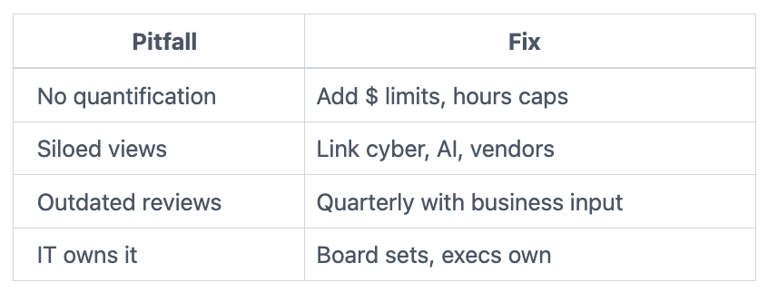
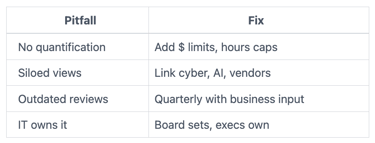
Common table of pitfalls:
Direct action cuts surprises. You lead the fix.
Blind Spots That Lead to Costly Surprises
You miss quantification first. Vague words hide real exposure. Growth blocks follow.
Siloed views ignore vendor ties to cyber. A partner failure becomes yours.
Outdated reviews fail as AI scales. No refresh means drift.
Stakes rise: revenue lost, trust gone. For board cyber governance best practices, see how boards set technology risk appetite. Spot these now.
Steps to Build and Own a Strong Technology Risk Appetite
You build it in five steps. First, assess current state. Map crown jewels and past incidents.
Second, align to strategy. Link to revenue goals or ops needs.
Third, quantify. Set downtime, cost, recovery limits.
Fourth, integrate oversight. Dashboards track trends. Escalate breaches.
Fifth, test and update. Run scenarios. Review quarterly.
Good looks like a one-page doc. Dashboard shows green or red. Board questions drive it.
Sample framework:
Crown jewels: List top 5.
Thresholds: Ops (4h downtime), financial ($1M).
Owners: CEO for material.
Triggers: Two misses = escalate.
You lead the talk. Schedule a workshop. Draft fast. For clarifying risk appetite and escalation for boards, check board cyber risk advisor expertise.
Questions Your Board Should Ask Management Today
Use these to test now:
What tech risks hit $X revenue?
How do we cap AI pilot outages?
Who's accountable for vendor thresholds?
What trends show drift from appetite?
When do we escalate to board?
Prove last review changed ops.
What's our downtime for key systems?
Sharp questions yield evidence. Act on answers.
Act on Technology Risk Appetite Today
Clear appetite drives confident calls. You reduce surprises. Growth accelerates safely.
Schedule a 30-minute board huddle. Draft your statement. Assign owners.
FAQs
How often review? Quarterly, or after big changes like AI rollout.
CEO wants aggressive growth? Balance with quantified limits; document tradeoffs.
Metrics for dashboard? Trends in downtime, costs; 8 max.
Link to cyber? Tech includes cyber; use cybersecurity governance advisor for boards.
Start small? One page, three thresholds first.
You start here. Momentum builds.
Tyson Martin is the executive public and pre-IPO companies in financial services, AI/data, SaaS, and cloud hire to make trust a measurable asset, one accountable answer to Is it secure? Is it resilient? Is the AI governed?
© 2026. All rights reserved.
Navigation
Free Resources
Contact


Stay ahead of your next board agenda
Sign up for Reports & Learnings From the Boardroom. Plain-English AI and cyber governance insights, biweekly. No pitch.
No spam. Unsubscribe anytime. · Or download the Director's AI Question Pack — 25 questions free