
Board Cybersecurity Metrics: Which Numbers Actually Help Directors Make Better Decisions
You're under pressure to cut cyber noise fast, and Best Board Cybersecurity Metrics show what changed, what matters, and what to decide next.


What to track, what to ignore, and how to turn cyber reporting into real board decisions.
Directors today are getting hit from every side. Alerts keep piling up, the board wants clearer answers, and management still needs a defensible next move. More data does not solve that problem if the data does not help you decide.
That is the real issue. You do not need another wall of numbers. You need board cybersecurity metrics that show what changed, what it means, who owns it, and what happens next. That is the difference between reporting and oversight.
TLDR
The best board metrics show movement, not noise. You want trends, thresholds, owners, and a clear trigger for action.
Activity counts can help, but they are not the whole story. A large patch total means little if critical systems stay exposed.
Directors should focus on a small set of measures tied to business impact, resilience, third-party dependence, and identity control.
A metric only matters if it can lead to a decision. If it cannot drive approve, defer, fund, accept, or escalate, it belongs lower in the stack.
Good board reporting is built on cadence and follow-through. If the same issues return every quarter, the problem is governance, not a dashboard.
What makes a metric useful to the board, and what does not
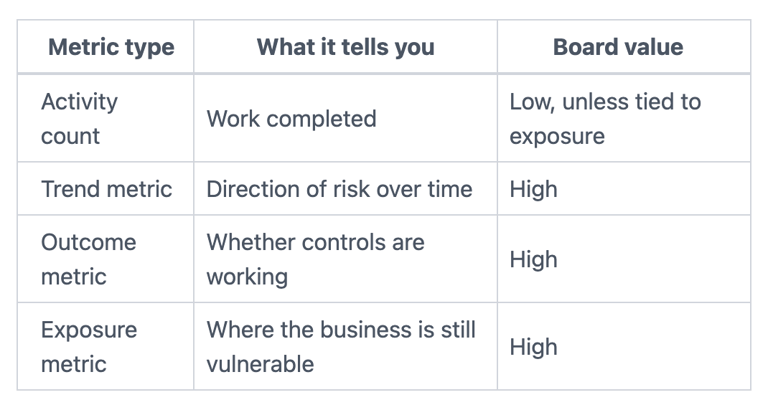
A useful metric helps you decide whether to accept risk, fund work, change priority, or escalate. A weak metric only tells you that people stayed busy.
That distinction matters. Many teams report counts because they are easy to gather. But counts do not always show exposure, control strength, or business impact. Ten more training completions do not matter much if the same vendor can still reach sensitive data.
If you want a fast test, ask four questions:
Does this show a trend?
Does it tie to business impact?
Is there a named owner?
Does it point to a decision?
If the answer is no, the metric may still matter to management. It just does not belong at the board level.
If a metric cannot change a decision, it belongs lower in the stack.
Numbers that measure activity instead of risk
Patches applied, alerts closed, and training completed are not useless. They just need context.
A high patch count can hide the fact that critical issues are still open on systems that matter most. A low incident count can mean good control, or it can mean weak detection. A full training completion rate can still leave you exposed if access control is weak or vendor access is too broad.
Activity data is the first layer. It tells you work happened. It does not tell you whether the business is safer.
Numbers that help directors decide
Decision-useful metrics have four traits. They show direction, not just a snapshot. They connect to the business, not just the tool. They name the owner. They include a threshold or trigger.
That is what directors can work with. It lets you approve more funding, call for a reset, or accept a known gap with eyes open. If you want a quick way to check whether your board sees the right signals, see where your board actually stands.
The metrics that actually help you oversee cyber risk
The best board packet stays narrow. It does not try to cover everything. It covers the few measures that tell you whether the business is safer, more resilient, and better prepared.
Risk reduction and remediation speed
This is one of the most useful metrics on the page. If critical issues stay open for too long, your exposure grows. If the same problems keep coming back, the program is fixing symptoms, not causes.
Watch for:
Age of open critical issues
Overdue remediation on important systems
Repeat findings across quarters
Critical issues without a named owner
If the age of critical issues is falling, you are probably moving in the right direction. If it is flat or rising, the board should ask why. This is also where a reporting rhythm matters. Good board reporting for cybersecurity programs shows the issue, the owner, the due date, and the evidence of closure.
Recovery and resilience
A company does not earn trust by saying it has backups. It earns trust by proving it can recover.
Directors should care about:
Backup test success rates
Recovery time versus target
Results from tabletop drills
Whether key business processes were tested, not just IT systems
These metrics tell you whether the business can keep operating during pressure. If recovery takes too long, the issue is not only technical. It is continuity risk, revenue risk, and customer risk.
Vendor and third-party exposure
Third-party risk is where many boards get surprised. The vendor list may look manageable on paper. The business dependence tells a different story.
Focus on:
Concentration in a few key vendors
Open security issues at strategic suppliers
Vendor controls that have not been validated
Exit constraints that would slow recovery
You do not need procurement theater here. You need to know which suppliers could stop the business, expose data, or delay recovery. That is why board oversight of third parties belongs in the same conversation as business continuity.
Identity, access, and control coverage
Identity is one of the cleanest indicators of control strength. If the wrong people can get into key systems, the rest of the stack matters less than it should.
Directors should ask whether the most important systems have:
Strong authentication
Least-privilege access
Logging that supports review and investigation
Basic data protection and governance
Chronic gaps in identity or data governance are not just IT problems. They are leadership gaps. If nobody owns the fix, the board should ask why.
How to read the metrics without getting lost in technical noise
A good dashboard is a map. A bad dashboard is a pile of road signs.
You do not need to read every control detail. You do need to know whether the story fits the business. If management says risk is improving, the trend lines should show it. If they say a gap is contained, the exposure should be narrow and owned. If they say a system is under control, they should be able to prove it.
A useful board packet usually starts with a one-page summary, then gives deeper detail only where needed. That keeps directors focused on decisions, not data dumps. If your current packet feels symbolic instead of useful, a short self-check like board cybersecurity governance essentials can help you spot the gaps.
Ask what changed since last quarter
Snapshots are easy. Trend lines are harder, and more useful.
Ask three simple questions every time:
Is the risk picture better, worse, or flat?
What changed to cause that movement?
Is the change real, or just a reporting shift?
That keeps the conversation honest. It also stops the board from applauding a green chart that only looks green because the metric changed shape.
Look for the decision behind the metric
Every board metric should lead to a possible action. If it does not, it belongs in management reporting.
The board should be able to do one of four things:
Approve the spend or plan
Defer it with a reason
Accept the risk on purpose
Escalate because the exposure is too large
If a metric cannot support one of those choices, it is noise. And noise is expensive.
Build a board rhythm that turns numbers into action
Metrics only matter when they show up on a steady cadence. Without follow-through, the packet becomes theater. Everyone nods, nobody moves.
A solid rhythm has three parts. First, the board sees the same core measures every cycle. Second, management names the owner and due date. Third, the board gets evidence that the item closed, not just a promise that it will close.
That is where decision rights matter. If the board is expected to approve exceptions, management should know the trigger before the meeting starts. If the CEO, CISO, audit chair, or committee chair needs to be looped in, the escalation path should already be clear. If you want a clean model for that, defining decision rights is the right place to start.
Set thresholds before the meeting starts
Boards work better when they know the lines in advance.
Decide ahead of time what counts as:
Acceptable
Needs discussion
Needs escalation
That way, the meeting is about choices, not surprise. It also keeps management from hiding behind color codes. A red metric means something only when the threshold is clear.
Track actions until they close
A metric without closure is just a worry with a chart attached.
Ask for the open-item list every time. Ask who owns each item. Ask for milestone dates and proof of completion. If the same issue shows up quarter after quarter, you do not have a metrics problem. You have an accountability problem.
Frequently asked questions
What are the best board cybersecurity metrics?
The best ones show risk movement, recovery strength, third-party exposure, identity coverage, and time to fix critical issues. They help you make a decision, not just admire a report.
Should the board track activity metrics?
Yes, but only as context. Training counts and patch counts matter less than whether the business is safer and more prepared.
How many cyber metrics should directors see?
Usually fewer than they expect. A small set of trend-based measures is better than a long list of operational detail.
What makes a cyber metric board-ready?
It needs an owner, a trend, a threshold, and a clear business consequence. If those are missing, the metric is probably not board-ready.
How often should the board review cyber metrics?
On a regular cadence that fits the risk. Quarterly works for many boards, but active incidents, major transformation, or vendor concentration may call for more frequent review.
Related blogs
Conclusion
The best board cybersecurity metrics are the ones that help you decide faster. They show whether risk is moving, whether recovery is real, whether third-party exposure is under control, and whether someone is clearly accountable.
You do not need perfect visibility. You need visible control, clean ownership, and a defensible next move. If your current reporting feels noisy or unclear, Move Past Technical Noise and Strengthen Board Oversight and reset the conversation around decisions, not decoration.
Tyson Martin is the executive public and pre-IPO companies in financial services, AI/data, SaaS, and cloud hire to make trust a measurable asset, one accountable answer to Is it secure? Is it resilient? Is the AI governed?
© 2026. All rights reserved.
Navigation
Free Resources
Contact


Stay ahead of your next board agenda
Sign up for Reports & Learnings From the Boardroom. Plain-English AI and cyber governance insights, biweekly. No pitch.
No spam. Unsubscribe anytime. · Or download the Director's AI Question Pack — 25 questions free