Board Technology Advisory: What Every Director Should Know
Board technology advisory helps you see risk clearly, ask better questions, and set decision rights that hold when growth, trust, and compliance collide.


You are not in the boardroom to review server settings or debate security tools. You are there to make sound decisions when risk, growth, reputation, and compliance collide. That is the point of board technology advisory.
At its best, it helps you ask better questions, see exposure in plain English, and hold management to a standard that stands up under pressure. Technology now touches revenue, customer trust, continuity, regulatory scrutiny, and deal value. As a result, weak oversight can become expensive fast.
What matters most is not technical depth. It is whether you have enough clarity to govern well. If you want a practical model for board-ready oversight, this board cyber oversight guidance is a useful companion. Start with the line between oversight and operations, because most board confusion starts there.
What board technology advisory actually covers
Board technology advisory is not a narrow cyber function. It is the discipline of helping you govern technology as a business risk and a business asset. That includes cyber risk, major technology investments, data governance, third-party exposure, business continuity, AI use, major system change, and who gets to decide what when pressure rises.
In plain terms, the work helps you see three things clearly. First, what could hurt the business. Second, what management is doing about it. Third, what decisions belong with you.
A simple split helps keep roles clear:
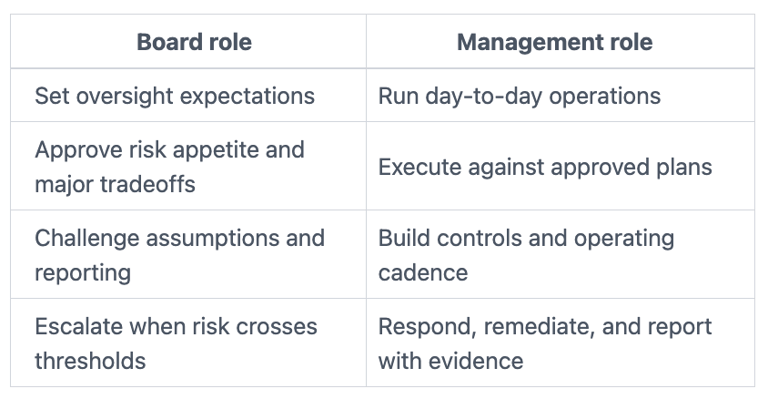
That distinction matters because good governance starts where operational detail stops. If you cross the line, management can hide behind complexity. If you stay too high-level, risk can grow without challenge.
The board's job is to govern technology risk, not run the IT team
Your role is oversight, challenge, and accountability. It is not ticket review, tool selection, or project management.
So, your questions should stay sharp and simple. What changed since last quarter? Where is risk rising? Which choices need escalation? Can management support its claims with evidence, not confidence?
You should also expect reporting in plain English. If a director needs translation after every update, the briefing has failed. Trend visibility matters more than technical volume. You need to see movement, direction, and business impact.
If you can't tell what changed, you can't tell whether management is in control.
That is the practical value of board technology advisory. It gives you a way to govern without drifting into operations.
Technology issues that belong in the boardroom
Some topics rise to board level because they can change enterprise value fast. The common ones are clear:
Cyber incidents and ransomware readiness: These affect uptime, disclosure, customer trust, and legal exposure.
Cloud concentration and vendor dependence: A few external providers can become single points of failure.
AI governance: New tools can create risk in data use, decision quality, and public trust.
Digital transformation risk: Big programs often fail through poor controls, weak ownership, or bad sequencing.
Business continuity and recovery: You need proof that critical operations can recover under stress.
Major system changes: ERP shifts, identity changes, and platform moves can raise exposure quickly.
M&A integration risk: Acquired systems, vendors, and data often bring hidden liabilities.
These issues belong in the boardroom because they shape outcomes the board already owns.
The key questions every director should ask management
Good board questions do not require technical depth. They require discipline. When you ask the right questions, jargon falls away and ownership becomes visible.
Strong questions also expose a hard truth. Is management in control, or is management reacting? That difference shows up in how people report, how they explain tradeoffs, and how clearly they assign ownership.
Can you see what changed, what matters now, and who owns the response?
Start with reporting quality. You should expect a short, stable set of metrics that stays consistent over time. The goal is not to see more data. The goal is to see what moved, why it moved, and what action follows.
Ask management to show you changes since the last meeting, not a fresh pile of disconnected updates. Ask for the current top risks, the impact on the business, and the executive owner for each one. If a risk has no owner, it is not being managed.
You should also ask about thresholds. What triggers escalation to the CEO? What triggers escalation to the board chair or committee lead? Which events require legal review, customer communication, or outside support?
Dashboards need the same discipline. A dashboard that shows activity without movement is not useful. Patch counts, alert volumes, or vendor tickets may matter to operators. They do not help you govern unless they tie to exposure, recovery, or decision points.
This is also where leadership quality becomes visible. Strong leaders can explain bad news clearly, defend priorities, and say what they need from the board. Weak leaders hide behind detail, tool names, and vague progress. If your team lacks that level of clarity, it helps to understand what effective interim executive cyber guidance looks like in practice.
Are we too dependent on vendors to define the story?
Many boards hear a risk story shaped mostly by outside firms. The managed service provider says one thing. The software vendor says another. The consultant adds a framework. Soon, you have motion without ownership.
That is a weak position. Vendors can support execution, but they should not define your posture for you.
So ask who inside the company owns the judgment. Who validates vendor claims? Who decides priority when two firms recommend different paths? Can management explain the plan without naming products first?
This matters because outsourced work can still create internal accountability gaps. If a major provider fails, you still answer for the outcome. If a consultant writes the roadmap, you still need leadership that can defend it.
In other words, board technology advisory helps you separate support from responsibility. You want management to use vendors, not hide behind them.
How strong boards turn technology oversight into clear decisions
Strong oversight does not depend on perfect forecasts. It depends on structure, cadence, and decision rights that hold when events move fast.
That means clear committee ownership, a regular reporting rhythm, defined crisis escalation rules, and briefings that end with a choice, an owner, and a date. When those habits are in place, surprises drop. At the same time, management can move faster because expectations are already set.
Use simple reporting that shows trend, impact, and business exposure
Good reporting is usually shorter than bad reporting. It uses fewer metrics, clearer trend lines, and direct language about business exposure.
You should see a small number of indicators over time, not a new set each quarter. You should see open issues, what changed, what remains exposed, and what management needs from you. If a top risk has stayed flat for three meetings, the board should know why.
The strongest reports also tie technology issues to business consequences. For example, a cloud identity gap is not only a technical problem. It may affect customer access, regulatory exposure, and recovery speed. That is the board-level view.
Long technical decks often hide the real message. They create the impression of control while making comparison harder. A more useful model is the one-page, trend-based briefing described in this digital trust expert perspective on board oversight.
Board oversight starts when the update leads to a decision, an owner, and a date.
Set decision rights before a crisis forces confusion
A crisis is a bad time to discover that nobody agrees on authority. Boards need clear escalation points before an event happens.
That includes approval boundaries, incident communication rules, and who briefs the board first. It also includes hard topics that people often avoid until too late, such as ransom decisions, disclosure timing, customer impact, insurer contact, and when outside counsel takes the lead.
The point is not to script every future event. The point is to remove basic confusion. If the board knows what triggers notice, who owns first-hour decisions, and when approval is needed, the company wastes less time when pressure peaks.
Strong board technology advisory brings discipline to those decisions before the headlines arrive.
Warning signs your board needs stronger technology advisory now
Some boards know they have a gap. Others sense it but cannot name it. Usually, the warning signs show up in reporting quality, leadership depth, and how the company handles change.
The test is simple. Do you feel clearer after the update, or only busier?
You get lots of updates, but little real visibility
High volume is not the same as strong oversight. You may get thick decks, dense dashboards, and frequent briefings, yet still leave unsure what matters most.
That usually means the material is tracking activity, not exposure. You see projects, tasks, and tool output. You do not see the top risks, the trend, the owner, or the decision that follows.
Repeated surprises are another sign. So are board materials that shift format every quarter, priorities that keep changing, or unresolved issues that never seem to move.
If the board cannot explain the top risks in plain terms, visibility is weak.
A major change has raised the stakes
Pressure events expose weak governance fast. M&A, leadership turnover, rapid growth, a cyber incident, an AI rollout, regulatory scrutiny, or a major system change can all raise the stakes at once.
These moments compress time and widen consequences. They also reveal whether the company has enough executive depth to convert noise into decisions. In many cases, that is when boards consider fractional CISO support without a full-time hire or a stronger interim model.
The point is not title shopping. It is recognizing when complexity has outgrown the current structure. When a major change hits, weak oversight stops being theoretical.
Board technology advisory gives you a practical way to respond before confusion becomes cost.
Technology risk becomes a board problem the moment it affects growth, trust, or continuity. Your job is not to master every technical detail. Your job is to demand clarity, clean reporting, and decision rights that hold under pressure.
That is why board technology advisory matters. It helps you govern technology with the same discipline you apply to finance, legal risk, and strategy.
If you want your next meeting to produce fewer updates and better decisions, start with the briefing format, the escalation rules, and the ownership model. Then use these resources for boards and executives to turn oversight into a repeatable practice.
Tyson Martin is the executive public and pre-IPO companies in financial services, AI/data, SaaS, and cloud hire to make trust a measurable asset, one accountable answer to Is it secure? Is it resilient? Is the AI governed?
© 2026. All rights reserved.
Navigation
Free Resources
Contact
Stay ahead of your next board agenda
Sign up for Reports & Learnings From the Boardroom. Plain-English AI and cyber governance insights, biweekly. No pitch.
No spam. Unsubscribe anytime. · Or download the Director's AI Question Pack — 25 questions free