
CISO for Small Business: Do You Need One (and When)?
CISO for small business: learn when you need executive security leadership, and whether full-time, fractional, or interim support fits best.


Many small business leaders assume a CISO is a big-company role. It sounds expensive, formal, and far removed from the day-to-day work of running a growing business.
That belief breaks down once your risk gets harder to explain, harder to assign, and harder to control. You may not need a full-time security executive yet. Still, you may already need CISO-level leadership before an incident, failed audit, lost customer, or board concern forces the issue.
If you are a CEO, founder, COO, or board member, the real question is practical. At what point does your business need executive judgment for security, and what form should that take?
What a CISO for small business actually does
A CISO for small business is not only a senior security technician. The role is broader and more useful than that. A CISO translates cyber risk into business decisions, priorities, reporting, and accountability.
That matters because small businesses rarely fail from a lack of activity. They fail from unclear ownership. Work is happening. Tools are in place. Vendors are talking. Yet no one can say what matters most, what can wait, or who makes the hard calls.
In a smaller company, a CISO often brings direction more than headcount. You may need fractional CISO for quick security leadership or interim CISO services for cyber risk, not a permanent executive on day one. The point is not the title. The point is having someone who can make security decisions at the right level.
A CISO helps you decide what matters most
Security can turn into a pile of disconnected tasks. A CISO cuts through that noise. You get a clear view of the risks that can hurt revenue, stop operations, damage customer trust, or create legal exposure.
That is why the role is about prioritization, not tool volume. One vendor says email is the top issue. Another says cloud posture is weak. Your IT lead says identity needs work first. Without a senior risk owner, every claim sounds urgent.
A strong CISO brings order. You stop funding fear. You start ranking risk by business impact.
A CISO gives leadership and the board clearer visibility
Leaders do not need another technical dashboard. They need plain-English reporting, simple metrics, and clear escalation paths.
A CISO builds that reporting rhythm. What changed this month? What remains exposed? What decision needs executive approval? Those answers make security easier to govern.
If your company has an active board or audit committee, this becomes even more important. Good reporting turns cyber from a vague worry into a managed business issue. For boards that need a stronger oversight frame, cybersecurity governance for boards adds useful context.
How to tell when your small business needs a CISO
Most small businesses do not wake up one morning and decide to hire a CISO because they reached a maturity score. The trigger is usually simpler. Something changed, pressure rose, or the cost of ambiguity got harder to ignore.
A practical rule helps here.
If no executive can explain your top risks, who owns them, and what the next 90 days should look like, you already have a leadership gap.
You are growing faster than your security decisions
Growth creates complexity. New cloud apps, remote staff, outside vendors, customer data, acquisitions, and new workflows all add moving parts.
At first, you can carry that informally. Then the business reaches a point where nobody owns the full picture. IT handles systems. Legal reviews contracts. Operations manages vendors. Product moves fast. Sales signs bigger customers. Risk spreads across all of it.
That is when a CISO becomes useful. You need someone who can connect the pieces, set priorities, and keep growth from outpacing control.
Customers, insurers, or regulators are asking harder questions
Outside pressure often reveals the gap before leadership does. A customer sends a long security questionnaire. A contract demands stronger controls. Your cyber insurer wants proof, not promises. An audit asks for evidence, ownership, and repeatable process.
That is the moment when "our IT team handles security" may stop being enough. IT can manage tools. A CISO manages accountability, reporting, and business tradeoffs.
Once external parties start testing your answers, you need more than effort. You need a clear story, named owners, and decisions that hold up under scrutiny.
You have had a scare, a near miss, or a leadership gap
Sometimes the trigger is blunt. You had a ransomware scare. A finance employee almost wired money to the wrong account. A vendor incident exposed how little visibility you had. A board member asked a simple question, and nobody could answer it cleanly.
Leadership gaps create the same problem. Maybe your security lead left. Maybe you never had one. Maybe your current team is solid, but no one has authority across departments.
In those moments, time matters. You may need fast stabilization, not a long search. This is where interim CISO risk reduction in the first 30 days becomes a practical model, because the first need is control, not polish.
Do you need a full-time, fractional, or interim CISO?
You do not solve every security leadership problem the same way. The right model depends on your size, urgency, and how permanent the need has become.
This comparison makes the choice easier to scan.
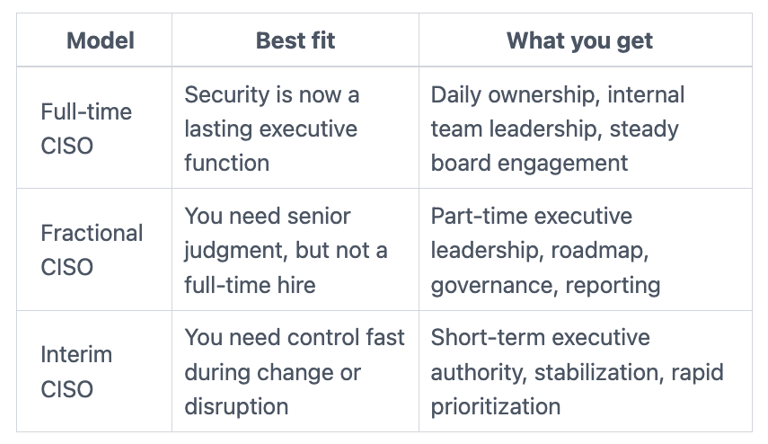
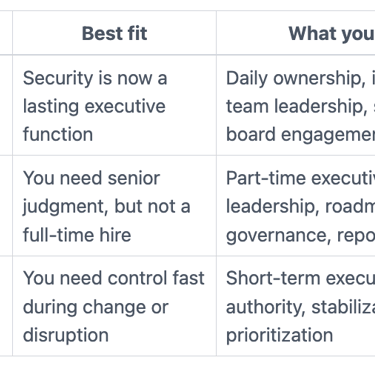
The pattern is simple. Full-time supports permanence. Fractional supports steady oversight. Interim supports urgent change.
A full-time CISO makes sense when security is now a permanent executive function
A full-time hire fits when security has become a lasting part of how your business operates. That usually means sustained regulatory pressure, complex customer demands, board scrutiny, or a business model built on trust and uptime.
At that stage, security is no longer a periodic leadership need. It is a standing executive function. Some small businesses reach that point. Many do not, at least not yet.
A fractional CISO works when you need senior judgment without a full-time salary
This is often the best fit for growing firms. You need strategy, governance, and executive reporting. You do not need a 40-hour-a-week security leader.
Fractional support works well when your internal operators are capable but overloaded, or when vendor advice is shaping too much of the roadmap. If you are weighing that path, fractional leadership for part-time CISO support is often the most efficient step.
An interim CISO is the right move when you need fast control during change
Interim support is different. It is built for urgency. A departure, incident, audit hit, acquisition, or stalled program can create a short, intense need for executive control.
In those cases, speed matters more than organizational design. You need someone who can step in, set decision rights, reduce exposure, and restore reporting quickly. That is where interim leadership for post-incident stabilization makes sense.
How to decide if now is the right time to bring in CISO leadership
You do not need a complex model to make this call. You need a clear view of risk, reporting, and ownership.
Ask whether risk, reporting, and decision ownership are under control
Start with a short self-check. If you cannot answer most of these clearly, you are probably past the point of handling security as an informal side duty.
Top risks: Can you name your biggest security risks in plain English?
Ownership: Does each major risk have a named business owner?
Reporting: Do leaders get updates that show change, not only activity?
Escalation: Do people know when to raise a serious issue, and to whom?
Next 90 days: Can you explain what matters now, next, and later?
If those answers are weak, the issue is not only technical. It is executive. You need someone to make the work coherent.
Choose the smallest leadership step that gives you real control
The answer is not always a full-time CISO. In fact, it often is not. The better move is to match the level of leadership to the problem in front of you.
If you need outside judgment and board-ready reporting, an advisor may be enough. If you need steady direction and accountability, fractional support may fit. If you need fast stabilization after disruption, interim leadership is the stronger move.
Your goal is not to hire the biggest title. Your goal is to get the right decision-maker in place before risk outruns ownership.
The bottom line on a CISO for small business
Most companies do not start by needing a full-time CISO. Still, many small businesses reach a point where they need CISO-level leadership long before they are ready for a permanent executive hire.
The pressure usually shows up in familiar ways, growth that adds complexity, outside demands that test your answers, incidents that expose weak ownership, or leadership gaps that leave no one in charge.
The best time to act is usually earlier than feels comfortable. Waiting costs more once customer trust, board confidence, or business momentum is already under strain.
If security feels busy but not controlled, that is your signal. The next step is not more noise. It is clearer leadership.
Tyson Martin is the executive public and pre-IPO companies in financial services, AI/data, SaaS, and cloud hire to make trust a measurable asset, one accountable answer to Is it secure? Is it resilient? Is the AI governed?
© 2026. All rights reserved.
Navigation
Free Resources
Contact
Stay ahead of your next board agenda
Sign up for Reports & Learnings From the Boardroom. Plain-English AI and cyber governance insights, biweekly. No pitch.
No spam. Unsubscribe anytime. · Or download the Director's AI Question Pack — 25 questions free