
Cybersecurity Program Maturity Assessment: Levels, Scoring, and Next Steps You Can Fund
Get a cybersecurity program assessment that scores maturity with evidence, adds confidence ratings, then turns gaps into a 90-day plan you can fund.n.


If you're like most senior leaders, your information security team looks busy all the time. Tickets move, tools alert, vendors meet, and policies get updated. Yet when you ask a simple question, "Are we safer this quarter, and where are we still exposed?", you often get answers that feel vague or technical.
A cybersecurity program assessment fixes that. In plain terms, it's a structured way to measure your security program maturity, not just whether you own certain tools or wrote certain policies. You gather evidence, score maturity by area, and turn the results into a short plan you can fund and track.
Done well, this supports CEO and board decisions. It helps you decide what to fix first, what can wait, and what risks you're accepting (on purpose, not by accident). In the next few minutes, you'll learn practical maturity levels, a defensible scoring method, and how to convert findings into a 90-day plan and a 12-month roadmap to strengthen your security posture.
Key best practices you can use right away
A maturity assessment measures reliability, not effort, and not tool counts.
Score each domain by level, then add a confidence rating based on evidence quality.
Treat "we have a policy" as a hypothesis in your risk assessment until you see tickets, logs, tests, and outcomes.
Choose next steps by risk management and business goals, not by what's easiest for IT.
Your first plan should fit on one page: owners, dates, cost range, and a measurable result.
Give executives a board-ready story from your security assessment: what changed, what's still risky, and what you need funded.
What you are really measuring in a cybersecurity program assessment
A cybersecurity program assessment serves as a vital risk assessment, less like a report card and more like a building inspection. You're not judging intent. You're checking whether the structure holds under stress, and whether the basics are repeatable.
Most programs should measure a small set of domains that map cleanly to common industry standards and cybersecurity frameworks (NIST and ISO both cover them). You don't need to turn your assessment into a compliance project. Instead, focus on two questions:
Do you get the security outcome you expect?
Can you repeat it across the business, even when people are busy?
That's why evidence matters more than polished documents when evaluating security controls. A policy that says "patch critical systems in seven days" is not maturity by itself. Maturity shows up when you can prove coverage (which systems), consistency in security controls (how often you meet the target), and exception handling (what happens when you miss) through rigorous risk assessment.
If you want the assessment to land with executives, tie each domain to business impact through effective risk management: uptime, revenue protection, customer trust, and legal exposure. A helpful way to frame this is to report a small set of outcomes that leadership already cares about, such as time to detect, time to contain, and recovery performance. You'll find practical guidance on connecting information security work to leadership-grade outcomes in measuring security's business impact with executive KPIs.
If you can't show evidence, you're not measuring maturity. You're measuring optimism.
Outcomes first, then controls: the difference between activity and maturity
Activity is motion. Maturity is dependable performance.
For example, you might "do patching" because engineers occasionally apply updates. That's activity. In a mature program, patching looks different: you have an accurate asset list, clear owners, a defined SLA by risk, and weekly reporting that shows exceptions. You also know why exceptions exist (business constraints, vendor limits), and you track them until they close or you formally accept the risk as part of your information security risk assessment.
The same pattern applies to detection, access reviews, vendor checks, and backups. Mature programs don't just do work, they learn from it. They detect issues, respond, and then improve so the next incident costs less and ends faster, strengthening overall information security.
The core areas most leaders should include (and what good looks like)
Most leadership teams get strong results when they assess these areas and keep the scoring evidence-based as part of broader risk management and risk assessment practices:
Governance and decision rights: named owners, funding rules, clear risk acceptance, and documented internal controls.
Asset and data inventory: you can list critical information systems and where key data lives.
Identity and access: strong MFA, role clarity, fast offboarding, and reviewed privileges.
Vulnerability and patching: measurable SLAs, vulnerability scanning, trend reporting, and tracked exceptions.
Detection and logging: coverage on crown-jewel information systems, retention, and tested alerting paths.
Incident response: practiced playbooks, clear escalation, and documented lessons learned.
Third-party risk: tiered vendors, contract requirements, and tracked remediation.
Resilience and backups: restore tests, recovery priorities, and real recovery time evidence.
Maturity levels that make sense to a CEO and a board
Maturity levels help you tell a clear story about your security posture: how predictable your security outcomes are, and how much operational risk you're carrying because execution is inconsistent. They also prevent a common boardroom failure mode where security is described as either "fine" or "terrible," with nothing in between.
The trick is to keep maturity levels simple and observable. You want language that lets a CEO, GC, CFO, and audit committee align quickly on a risk-based approach. You also want a scale that maps loosely to well-known models without forcing you into a single template.
This is where many assessments go wrong: they grade paperwork for compliance and call it maturity. A better approach is to rate operational capability and then show what would move you up one level. Over time, that shift supports the move from checkbox compliance to confidence you can stand behind. If you're working to make that transition real, moving from checklists to confidence is a useful framing for how leaders inspect execution.
A simple five-level scale, from reactive to recovery-ready
Use a five-level scale because it's easy to explain, and it gives you enough separation to show progress.
Level 1, Reactive: surprises are common, fixes are rushed, and ownership is unclear.
Level 2, Basic: you have some repeatable tasks, but coverage is spotty across teams.
Level 3, Defined: standards exist, roles are clear, and critical systems follow consistent processes.
Level 4, Managed: you measure performance against targets, and you address exceptions quickly.
Level 5, Optimized: you improve based on trend data and lessons learned, and security enables business pace instead of slowing it.
You don't need perfect precision. You need shared understanding. In board terms, Level 1 to 2 often means risk depends on heroics. Level 3 means you've built a dependable baseline. Level 4 to 5 means you can forecast outcomes and recover faster when things break.
How to avoid the common trap: calling policy maturity the same as real capability
Policies often race ahead of reality because they're easier to write than to operate, especially when focused on regulatory compliance. Two quick checks keep you honest:
Evidence of execution: tickets, change records, access reviews, restore logs, and metrics over time.
Proof under stress: tabletop exercises, real incident timelines, and documented after-action fixes.
When you can show both, you build trust. When you can't, operational continuity is exposed, even if the binder looks great.
A practical scoring method, plus how to turn results into next steps
You don't need a complex scoring model to get executive value from your security assessment. You need one that is consistent, evidence-based, and tied to decisions in the risk assessment. A simple assessment tool works well:
Score maturity level per domain (1 to 5) as part of the security assessment.
Add a confidence rating (Low, Medium, High) in your risk assessment.
Summarize top risks and top "next best" improvements from the security assessment.
This structure does something important in the risk assessment. It separates "we are weak here" from "we think we're strong, but we haven't verified it." That second category often hides the biggest surprises.
It also sets you up to pick metrics that leaders will actually use in the security assessment. If your scorecard produces 40 operational stats, it won't change decisions. If it produces 8 to 12 outcome signals with trends and targets, it becomes part of leadership rhythm. For help choosing the right set, cyber metrics executives understand and value offers a practical way to avoid noise.
Score the level, then score your confidence (so you do not fool yourself)
For each domain, pick the level that best matches what you can prove in the security assessment. Then add confidence based on evidence quality from the risk assessment.
Here's a compact way to define confidence in your assessment tool:
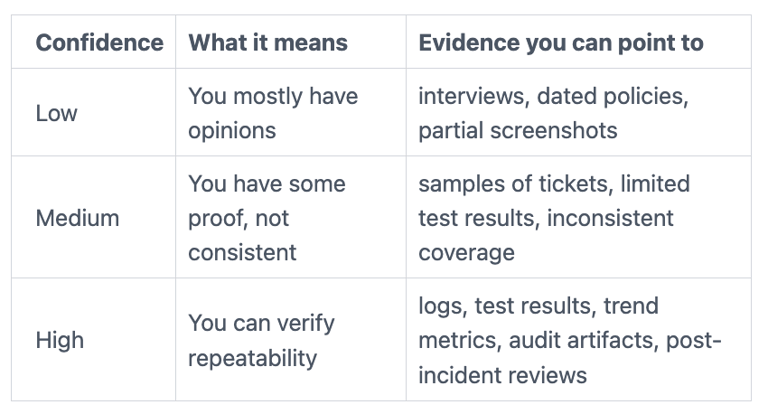
Evidence types that tend to raise confidence fast include restore tests, phishing test outcomes, logging coverage reports, incident postmortems, and independent audit results with technical findings.
Low confidence should change your next step in the risk assessment. Instead of funding a major new platform, you might fund validation first: asset discovery, log coverage mapping, or a restore-test sprint based on technical findings. Validate, then invest.
From scores to action: your 90-day priorities and your 12-month roadmap
Your scorecard isn't the deliverable from the security assessment. The plan is.
Perform a gap analysis on your security assessment results to convert them into action, then pick six initiatives and sequence them:
Top 3 risk reducers: close the exposures most likely to drive a material incident in risk management.
Top 2 resilience builders: improve backup restores, recovery priorities, and incident readiness through the risk assessment.
Top 1 trust enabler: strengthen customer assurance, vendor due diligence, or board reporting from the security assessment.
Conduct another gap analysis to ensure your risk assessment informs these priorities. Write each initiative as a mini business case with: one owner, a due date, a cost range, key dependencies, and one metric that tells you if it worked (not just that you "did work").
Sequence matters with a risk-based approach. First, stabilize basics (identity, inventory, patching; internal controls). Next, improve detection and response (logging, triage, escalation) per the risk assessment. Then, tune and automate where it reduces errors and speeds recovery in risk management.
If incident response is part of your top gaps from the security assessment, treat board visibility as a feature, not an extra. Clear decision rights and practiced oversight reduce chaos when pressure is high in incident response. A practical reference point is board oversight for incident response, especially if you want to remove "we assumed" from your next crisis review.
Your roadmap should reduce risk you can explain, with owners who can deliver, on dates you can track.
FAQs leaders ask about cybersecurity maturity assessments
How long does a cybersecurity program assessment take?
Most cybersecurity program assessments take 2 to 6 weeks. The biggest driver is scope and evidence access. If you focus on your most critical information systems, key data, and top vendors, you can move fast.
Speed comes from clear domains, targeted interviews, and sampling evidence. You don't need to inventory every control across every team or information system to get a leadership-grade answer. You do need enough proof to score honestly and set priorities.
Do you need a formal framework like NIST CSF or ISO 27001 to do this well?
No. You can run a strong assessment without adopting a formal framework like NIST CSF, FISMA, or ISO 27001 on day one. What matters most is that you stay outcome-based and evidence-based for compliance.
That said, mapping your domains to NIST CSF or FISMA helps with consistency, compliance reporting, and reporting later. Many organizations start lightweight, then mature into a standards-driven program once owners, metrics, and funding rhythm are in place.
What should you show the board, and what should stay in the working papers?
Give the board a view that supports decisions on governance risk and compliance:
a simple heat map by domain,
the top technology-related risks tied to business impact,
trend direction (improving or slipping),
and a funded plan with owners and dates.
Keep deep technical detail, such as penetration testing results and audit findings on technology-related risks, in management working papers. Boards don't need a list of tools, alert counts, raw vulnerability data, or governance risk and compliance penetration testing specifics. They need clarity on exposure, preparedness, and whether the plan matches stated risk tolerance.
Conclusion
A cybersecurity program assessment gives you a shared language for information security performance. You get clear maturity levels, defensible scoring, and a plan that turns concern into execution with effective risk management. Most importantly, you stop relying on vibes, and start using evidence in your information security practices.
Start with a focused scope: your top systems, key data, and top vendors. Then score each domain by maturity and confidence, so you can separate real strength from untested assumptions. From there, build a 90-day plan that fixes the biggest gaps using vulnerability scanning, and a 12-month roadmap that strengthens security controls to improve reliability and recovery.
If you want help driving that plan across leaders, budgets, and delivery, consider getting fractional CISO support to drive the plan so your security assessment becomes action, not another slide deck.
Tyson Martin is the executive public and pre-IPO companies in financial services, AI/data, SaaS, and cloud hire to make trust a measurable asset, one accountable answer to Is it secure? Is it resilient? Is the AI governed?
© 2026. All rights reserved.
Navigation
Free Resources
Contact

Stay ahead of your next board agenda
Sign up for Reports & Learnings From the Boardroom. Plain-English AI and cyber governance insights, biweekly. No pitch.
No spam. Unsubscribe anytime. · Or download the Director's AI Question Pack — 25 questions free