
How to Build an IT Roadmap That Actually Gets Funded
Build an IT strategy and roadmap leaders fund, tie work to outcomes, cost of delay, and clear A/B/C tradeoffs, so approval sticks.


If your IT roadmap for digital transformation keeps getting trimmed, delayed, or "revisited next quarter," it's usually not because your ideas are bad. It's because the roadmap reads like a tech wish list, not aligned with business goals.
Leaders don't fund projects, they fund outcomes. They fund speed, reliability, customer trust, and lower risk. When your roadmap starts with systems and tools, it forces the CEO and CFO to do translation work they don't have time for. As a result, your best items get treated like "nice to have."
In this post, you'll build an IT strategy and roadmap that feels easy to approve and shapes your IT vision. You'll tie work to growth, efficiency, and risk reduction, show tradeoffs, and make decisions clear. Done right, your roadmap becomes a decision tool for CEOs and boards, not a status report.
Key takeaways you can use before your next budget meeting
These tips will help shape your IT roadmap:
Define outcomes first for strategic alignment (faster close rates, fewer outages, audit readiness), then map projects underneath.
Quantify the cost of delay in simple terms, lost revenue, downtime, or extra labor hours.
Rank work by value and risk for resource allocation, not by who asked loudest or who escalated last.
Timebox discovery to 2 to 4 weeks, so "research" doesn't become a hiding place.
Show options (A, B, C) and the "not doing" list, so tradeoffs are visible.
Build a 12 to 18-month view with a firm 90-day commitment you can deliver.
Attach owners and key performance indicators to every major item, so progress can be inspected.
Pre-wire approval with finance, risk, and key business owners before the big meeting.
Start with business outcomes, not projects, so funding feels obvious
A funded IT roadmap starts with a short list of outcomes aligned with your leadership's strategic objectives. Think of outcomes as the "why" that survives budget pressure.
Start by translating executive business goals into 4 to 6 outcome statements you can say in one breath, without acronyms. For example:
"Reduce customer onboarding time from 10 days to 3."
"Cut unplanned downtime for revenue IT infrastructure in half."
"Ship new features weekly without raising production incidents."
"Pass audits without heroics and last-minute evidence hunts."
"Lower cybersecurity risk on our top systems, with proof we can recover fast."
Now you've created the top of your IT strategy and roadmap. Projects become supporting evidence, not the headline.
A strong outcome statement has three parts:
A business result (speed, cost, reliability, trust).
A target (a number, a time window, or a clear "before/after").
A scope (which process, product, or system matters most).
Keep the language CEO-repeatable. If you find yourself saying "zero trust," "SIEM," or "SD-WAN," you're probably too deep. You can still do that work, you just shouldn't sell it that way.
Also, limit yourself. If you list 14 outcomes, you've listed none. Scarcity creates focus, and focus makes funding easier.
If you want a useful benchmark for what "business-first" technology and security leadership looks like in practice, review how an https://tysonmartin.com/experienced-ciso-for-hire frames strategy around trust, risk, and measurable outcomes.
Ask five questions that reveal what leadership will actually pay for
Before you build slides, get answers to bridge the current state and future vision. Ask these five questions in short 30-minute sessions with the CEO, CFO, COO, and key stakeholders:
What must be true in 12 months for this year to feel like a win?
You're hunting for measurable outcomes, not projects.What's breaking today that you're tired of paying for?
Look for recurring outages, manual work automation could address, or slow cycle times impacting operational efficiency.What cybersecurity risks keep you up at night, and what's the "nightmare headline"?
This surfaces priorities around trust, fraud, privacy, and continuity.What could block growth this year if we don't fix it?
Think customer onboarding, product delivery, vendor bottlenecks, or data quality.What would you stop doing to fund this?
This forces real tradeoffs and exposes low-value work.
As you capture answers, document decision rights. Write down who approves spend, who accepts risk, and who breaks ties when priorities conflict. If you can't name the signer, your roadmap will stall later.
Turn cybersecurity and reliability work into trust, uptime, and risk language
Security and reliability work often dies in budgeting because it sounds like "maintenance." Your job is to connect it to business protection and confidence.
Instead of "implement MFA," say "reduce account takeover risk for payroll, finance, and admin access." Instead of "upgrade backups," say "prove we can restore billing and customer portals within X hours." Instead of "improve logging," say "cut investigation time from days to hours, so incidents don't drag on."
Boards and CEOs also care about how you'll behave under pressure. They expect clarity on who decides, who communicates, and how fast you can contain damage. When you frame cybersecurity work as predictable operations and fewer surprises, it stops sounding optional.
For board-level expectations and oversight signals that make security discussions more decision-focused, see https://tysonmartin.com/cybersecurity-board-advisor.
Build the roadmap like an investment portfolio with clear tradeoffs
An IT roadmap gets funded when it looks like an investment portfolio using project portfolio management principles, not a backlog. A simple model that leaders understand quickly includes four buckets, which you can identify using tools like SWOT analysis:
Run the business: keep critical services stable with initiatives like cloud computing (ops, support, lifecycle, renewals).
Grow the business: enable revenue and product expansion with efforts such as artificial intelligence (speed, scale, data).
Reduce risk: security, resilience, and control improvements tied to top risks through risk management.
Mandatory commitments: contracts, regulatory obligations, end-of-life deadlines.
Once you bucket initiatives, score each one with a few factors your CFO will recognize:
Value: revenue protected or enabled with clear ROI, cost removed, time saved.
Risk reduction: likelihood and impact reduced on critical systems.
Urgency: deadline-driven or compounding pain.
Effort: rough size, people, time, vendors.
Dependencies: what must happen first.
Keep scoring lightweight. The point is not math perfection, it's consistency.
Then, show options as part of your strategic planning process. Leaders fund clearer choices faster than they fund arguments. Present:
Option A (Minimum viable): covers must-do items, accepts more risk.
Option B (Balanced): matches current growth and risk appetite.
Option C (Accelerated): buys speed and risk reduction, costs more.
Every option must include what you will not do. That "not doing" list is where credibility lives.
When you discuss tradeoffs and risk appetite in your IT strategy and roadmap, it helps to think in board language, what's acceptable, what triggers escalation, and what requires fast action. That mindset is central to https://tysonmartin.com/board-cyber-risk-advisor.
Use a cost of delay story so priorities stop being a debate
Cost of delay doesn't need heavy formulas. You just need a plain story with simple numbers and clear assumptions.
Here are practical examples you can calculate in minutes:
Lost revenue: "This sales workflow delay costs us 5 deals per month. Average deal is $40k. That's $200k per month we're choosing to lose."
Productivity drag: "We waste 20 minutes per employee per day due to system friction. With 300 staff, that's 100 hours per day. Even at $60 per hour, that's $6k per day."
Outage impact: "A two-hour outage during peak traffic costs $X in refunds, support load, and churn risk."
Compliance pressure: "If we miss this deadline, we pay penalties, plus we pay consultants to clean it up later."
Breach likelihood: "If privileged access stays wide open, the chance of a serious incident rises. The cost isn't just IT work, it's downtime, legal time, customer trust, and executive distraction."
Capture assumptions on one page. State what you know, what you guessed, and what would change the estimate.
If you can't explain the cost of doing nothing, you're asking leadership to fund faith.
Make room for risk and governance without turning it into a compliance exercise
IT governance belongs in the IT roadmap because leaders need proof that risk is being managed, not just discussed.
Connect risk items to oversight routines instead of paperwork. For example:
Tie incident readiness work to a scheduled tabletop exercise and follow-up actions.
Tie third-party risk work to a vendor inventory and clear owner for exceptions.
Tie access and recovery work to metrics you report the same way every month.
Most importantly, define what the board or a committee needs to see, and when. That keeps governance predictable and calm.
If you want a board-friendly way to ask questions that expose ownership gaps and reporting weaknesses, use https://tysonmartin.com/cybersecurity-governance-advisor-for-boards.
Get it approved by showing execution certainty, not perfect plans
You don't get funded because your plan is detailed. You get funded because leadership believes you can deliver without drama.
Present your IT roadmap in two time horizons:
12 to 18 months: direction, sequencing, and investment options.
Next 90 days: firm commitments with named owners and measurable outcomes on your implementation roadmap.
This reduces fear. Leaders can approve direction while only "locking" the next slice.
Capacity-based planning helps, too. Instead of promising 40 projects, show your true capacity: people, vendor support, and change windows. Then match the IT roadmap to reality.
Here's a simple one-page format you can use in the meeting. It keeps attention on outcomes, owners, and proof.
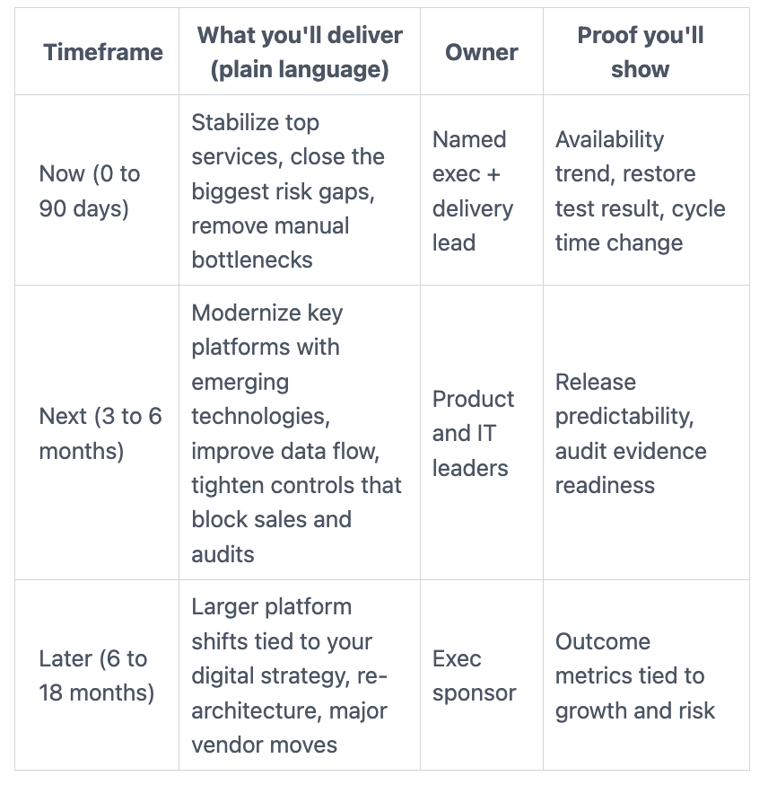
After the table, bring a "decision slide" with Options A, B, and C, each with technology investments cost range, what changes, and what risk remains. Then stop talking and ask for the decision.
To avoid surprises, pre-wire the meeting for strategic alignment with stakeholders. Walk finance through cost ranges and assumptions. Align legal and risk leaders on the top risk statements. Brief the CEO one-on-one so there's no first-time debate in the room. If you want a clean path for that kind of alignment with an executive advisor, start at https://tysonmartin.com/engage-ciso-advisor.
Use metrics leaders trust, and report them the same way every month
Pick a small set of metrics tied to outcomes. Keep them stable for at least two quarters, so trends mean something.
Good executive-friendly performance metrics often include:
Delivery predictability (planned vs delivered, with reasons for misses)
Service availability for revenue and mission-critical systems
Time to restore after an incident or major outage
Security coverage on what matters (MFA for privileged access, backup restore tests)
Control milestones that map to audit readiness and customer assurance
Business adoption (are teams actually using the new process or platform)
Also, report the same way every month: what changed, why it changed, and what decision you need. If you want a reference point for board-facing cybersecurity reporting that avoids noise, see https://tysonmartin.com/board-cybersecurity-advisor.
Know when you need a fractional or interim leader to push it through
Sometimes the IT roadmap is fine, but the organization doesn't believe it will happen. Credibility gaps kill funding.
Consider experienced help when you see these signals:
You have a leadership gap revealed by gap analysis in IT or security, and decisions keep floating.
A recent incident exposed weak ownership, unclear reporting, or shaky recovery.
You're in fast growth and teams keep missing commitments.
A merger or acquisition is coming, and diligence needs a defensible plan.
The roadmap gets approved, but execution slips every quarter.
In those moments, a senior fractional leader can turn uncertainty into decisions, then decisions into delivery. If security and trust risk are part of your roadmap, a https://tysonmartin.com/fractional-ciso can help you set priorities, tighten governance, and create board-ready reporting without waiting months for a full-time hire.
FAQs about building an IT roadmap that gets funded
How long should an IT roadmap be?
A 12 to 18-month IT roadmap is usually the sweet spot for strategic planning. Pair it with a firm 90-day commitment so it doesn't feel like a guess.
What's the difference between IT strategy and roadmap?
Your IT strategy explains the strategic objectives you'll pursue and the principles you'll follow. Your IT roadmap shows the sequence of work and investment choices that deliver those outcomes.
How do you estimate costs when there's uncertainty?
Use ranges, not single numbers, and write down assumptions. Separate one-time costs (projects, IT infrastructure setup) from run-rate costs (licenses, support, staffing).
How do you handle security work that has no direct revenue?
Tie it to business outcomes leadership funds anyway: uptime, loss avoidance, customer trust, and audit readiness. Then quantify the cost of delay using downtime, labor, and incident impact.
How do you prioritize when everyone says "top priority"?
Force tradeoffs by asking what you'll stop doing, and who signs the decision. Then rank work using consistent factors like value to business goals, risk reduction, urgency, effort, and dependencies.
What do boards expect to see in an IT roadmap?
They expect clarity on top risks, who owns them, what changed, and what decisions you need. They also expect proof of readiness, especially incident roles, escalation paths, and recovery ability.
How often should you update the IT roadmap?
Update monthly at the delivery level, and refresh the 12 to 18-month view each quarter. Keep outcome metrics stable so leadership can trust trend lines.
Conclusion
An IT roadmap gets funded when you shift from "projects we want" to outcomes leadership already wants. Put outcomes first, structure work as a portfolio with real tradeoffs, and present execution certainty with a 90-day commitment.
This week, you can make meaningful progress in strategic planning with three moves:
Write 4 to 6 CEO-repeatable outcome statements, then map projects under each.
Build three funding options (A, B, C) with a clear "not doing" list.
Define your 90-day commitments with named owners and 5 to 7 stable metrics.
When you need stronger governance, board-ready reporting, or experienced interim leadership to make your IT strategy and roadmap stick, explore the TysonMartin.com articles and guidance already linked above.
Tyson Martin is the executive public and pre-IPO companies in financial services, AI/data, SaaS, and cloud hire to make trust a measurable asset, one accountable answer to Is it secure? Is it resilient? Is the AI governed?
© 2026. All rights reserved.
Navigation
Free Resources
Contact


Stay ahead of your next board agenda
Sign up for Reports & Learnings From the Boardroom. Plain-English AI and cyber governance insights, biweekly. No pitch.
No spam. Unsubscribe anytime. · Or download the Director's AI Question Pack — 25 questions free