
How to Measure Cybersecurity Program Effectiveness: Common Pitfalls
Learn how to measure cybersecurity program effectiveness, avoid vanity metrics, tie results to business risk, and give your board proof you're safer.


You don't need more security activity. You need cybersecurity metrics that prove security is improving risk management by lowering real business risk.
That's harder than it sounds. Many teams report pages of charts, yet leaders still can't answer basic questions: Is your security posture safer than last quarter, where are you exposed, and what decision should you make next? Measuring cybersecurity program effectiveness often goes wrong because of bad metric choices, missing context, and unclear ownership.
If you're trying to figure out how to measure cybersecurity program effectiveness, your goal should be simple: build a measurement system your CEO and board can inspect without translating jargon. You're looking for signals that stand up in a tough conversation, not a dashboard that looks "busy."
Key takeaways you can use to measure cybersecurity program effectiveness
Focus your cybersecurity metrics on these key takeaways:
Tie every metric to a top business risk (ransomware downtime, data loss, vendor failure).
Track trends, not snapshots, so you can see direction and momentum.
Pair speed with quality (fast fixes that stick beat fast fixes that bounce back).
Set targets and thresholds in plain language (On track, Watch, Off track).
Assign one owner per key performance indicator, so action doesn't get stuck in meetings.
Validate your numbers with real tests of security controls (restore tests, tabletop drills, attack simulations).
Don't report vanity metrics that only show activity, they can hide rising exposure.
Make at least one view board-ready, focused on decisions and risk tradeoffs, not tools.
If your metrics still feel "technical," start with the hidden value of executive-friendly cyber metrics and use it as a reset for what leadership can actually use.
Start with what you are trying to protect, and how you will know you are safer
A good cybersecurity metrics program starts the same way a good strategy starts: with what matters most. Think of it like a smoke alarm. You don't buy one to measure how many times it beeped. You buy it to reduce the chance your house burns down, and to catch problems early enough to act.
So begin with three questions you can say out loud in a boardroom:
What are your "crown jewels" (revenue systems, patient care workflows, customer data, IP)?
What could realistically break them (ransomware, a vendor breach, an insider mistake)?
What would "better" look like in outcomes, not effort?
Here are simple examples:
Ransomware: Effective means you can contain spread quickly and restore critical services within your tolerance for downtime and data loss. If restore has never been tested, "we have backups" is not a measure, it's an assumption. A practical reference point is the set of board-level choices in a ransomware readiness briefing for directors.
Vendor breach (third-party risk): Effective means you can spot exposure fast, limit data sharing, and force timely notice through contract terms. If you can't name your most critical vendors, you can't measure coverage.
Insider mistake: Effective means fewer high-impact errors reach sensitive systems through access control, and you can detect and contain misuse quickly. Training completion is not the outcome, changed behavior is.
Once you name the outcomes, measurement gets easier because you stop counting "security stuff" and start tracking risk movement.
Pick a small set of outcome metrics that match your top risks
You'll hear two words a lot: output and outcome.
Output metrics show work (tickets closed, patches applied, alerts reviewed).
Outcome metrics show risk reduction (less exposure, faster containment, proven recovery).
Executives can understand outcome metrics because they describe business reality and the performance of security controls. A tight set also reduces gaming. When you track 40 measures, people learn how to "look green." When you track 8, it's harder to hide.
Outcome metrics you can use without heavy translation include cybersecurity metrics such as:
Mean time to detect and mean time to respond to high-severity incidents (measured by tier, not averaged across everything).
Percent of crown jewel systems with a tested restore in the last 90 days.
Percent of critical vendors with verified incident-notice SLAs (and the percent that actually met them in drills or real events).
Mean time to resolve high-risk findings past due (especially those tied to internet-facing systems or privileged access).
Percent of critical access paths protected with phishing-resistant MFA (or an equivalent control you can test).
Keep the list short, then make it hard to fake. Ask for evidence, not confidence.
Make every metric answer three questions: so what, compared to what, and who owns it
A metric that doesn't drive a decision becomes a decoration. Before you adopt any measure, force it through three questions:
So what: What decision does this support (funding, priority, risk acceptance, timing)?
Compared to what: What's the baseline and the target, and what time window matters?
Who owns it: Who is accountable for moving the number, and what action happens when it's off track?
You can capture that in a simple "metric card" definition:
Decision it supports
Baseline (and date)
Target (and why it's realistic)
Thresholds (On track, Watch, Off track)
Time window (weekly, monthly, quarterly)
Single owner
Data source (and how it's checked)
Triggered action when off track
Trend lines matter more than one month's number. A spike might mean better detection, not worse security. Still, a flat line for six months may signal stalled execution. If you want a practical bridge from cybersecurity metrics to business outcomes, use the approach in measuring security's business impact with KPIs.
Common pitfalls that make security dashboards look good while risk stays high
Most dashboard failures aren't malicious. They come from pressure. Security teams feel they must show progress, leaders want simple answers, and tools generate endless cybersecurity metrics. The result is a dashboard that looks healthy while the organization stays exposed.
If your metrics don't change a decision, they aren't management tools, they're status theater.
Below are the traps that show up most often, and what to do instead.
Vanity metrics, activity counts, and averages that hide the real story
Some measures are tempting because they're easy to collect: operational metrics like number of alerts, training completion, patches installed, tickets closed, scans run. Those can help manage work, but they don't prove effectiveness.
Here's why they fail leaders:
Alert volume can rise because detection improved, or because noise increased from cyber threats. "More alerts" isn't a win or a loss by itself.
Security awareness training completion doesn't tell you if people changed behavior when it counts, such as lowering phishing click rate.
Patches installed in vulnerability management doesn't tell you if the most exposed systems were fixed within the needed window or if your patching cadence is effective.
Average time to close hides extremes, and extremes are where incidents live.
A simple example: You close 9 low-risk tickets in 2 days, and 1 critical ticket in 80 days. Your average close time is about 10 days. That sounds fine, until you realize the critical weakness sat open for almost three months.
What to do instead: report cybersecurity metrics by severity tier, show percentiles (like 80th or 90th percentile time to remediate), and add an exposure view (internet-facing, privileged, crown jewel). If you're a board member, you can anchor expectations using board-level risk oversight and CISO performance metrics so the conversation stays on outcomes and accountability.
Measuring speed without measuring quality, and creating perverse incentives
Speed metrics can backfire. If you reward "time to close vulnerabilities," teams may close them by:
Downgrading severity
Tuning detections so fewer things get logged
Pushing risk into exceptions that never expire
Fixing the easy items while hard ones sit open
The dashboard improves, but your exposure doesn't.
What to do instead: pair every speed measure with a quality measure. For example:
Time to remediate critical vulnerabilities, paired with re-open rate (or recurrence).
Time to contain high-severity incidents, paired with repeat incident rate for the same root cause.
Percent of exceptions past expiration, paired with percent approved by the right risk owner.
Quality also needs governance. Someone must have the right to accept risk, and the rule must be consistent. Without that, exceptions become a back door for bad news. A solid reference point for decision rights and oversight expectations is cybersecurity governance guidance for boards.
Build a board-ready scorecard that drives decisions, not debates
Your board doesn't need a tour of your tool stack. They need a small scorecard of cybersecurity metrics that shows whether your security posture and risk is moving, and what help you need.
A practical structure is 6 to 10 cybersecurity metrics grouped into four capabilities drawn from the NIST Cybersecurity Framework, plus one explicit area for risk acceptance:
Prevent: reducing exposure before an attacker arrives
Detect: finding real issues fast, with low noise
Respond: containing and coordinating incident response under pressure
Recover: restoring what matters to build cyber resilience within business tolerance
Risk acceptance: what you're choosing not to fix, and why
To make this concrete, use a simple table of key performance indicators like this.
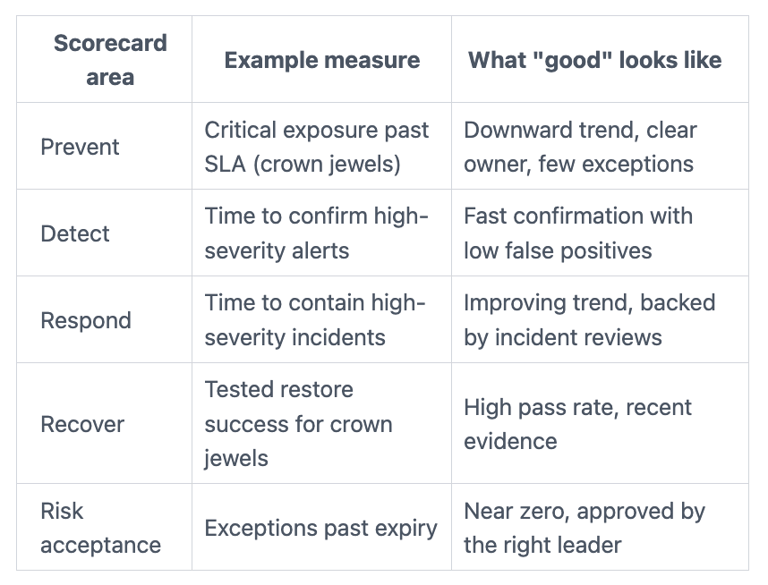
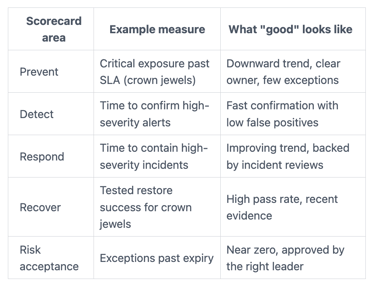
Keep the numbers stable over time. Then add a short note: what changed since last month, why it changed, and what decision is needed.
For cadence, a monthly executive review keeps execution honest. A quarterly board view keeps oversight focused. Escalate off-cycle when you have a major incident, a material audit finding, a merger, or a high-risk vendor event.
A simple framework: outcomes, controls that matter, and proof from testing
The most trustworthy scorecards use three layers:
Outcomes: the risk results you care about (downtime avoided, faster containment, proven recovery)
Control health: whether key controls work (identity protections, logging, backups, vendor notice terms)
Validation: proof from testing, not opinion
Validation can be plain and practical: tabletop exercises, restore tests, phishing simulations that show behavior change, and red-team style testing that checks detection and incident response. When the board asks, "How do you know?" you can point to evidence. If you want a clear way to align board oversight with incident readiness proof, anchor your approach to board incident response oversight metrics and expectations.
How to present cybersecurity metrics so leaders can act fast
A good metrics page reads like an operating update, not a research paper. You can keep it to one page with four blocks:
Top 3 business risks (one sentence each, plain language)
Top 3 metric movements (what changed, and why it changed)
Decisions needed (funding, policy, risk acceptance, staffing, vendor action)
Investments blocked or enabled (what security slowed down, and what it sped up)
Use simple labels: On track, Watch, Off track. Then add a short narrative for each Off track item: impact, owner, and next milestone date. This is also where tone matters. Calm, clear reporting builds confidence even when the news is bad. For help shaping that kind of executive conversation, use the guidance on leading board-level cyber risk conversations with confidence.
FAQs leaders ask about cybersecurity program effectiveness metrics
How many cybersecurity metrics should you track at the executive level?
Keep it tight, usually 6 to 10 cybersecurity metrics. You can let teams track dozens of operational measures. Executives need a small set that shows risk movement and decision points, or you'll spend the meeting arguing about definitions.
What is the difference between security compliance metrics and effectiveness metrics?
Compliance metrics, often tied to compliance and governance, show coverage, like whether you completed required controls or training. Effectiveness metrics show reduced exposure and proven readiness, like tested restores and faster containment of severe incidents. Compliance helps, but it doesn't prove you can handle real threats.
How do you measure cybersecurity program effectiveness if you outsource security operations?
Treat it as shared execution with internal accountability. Ask your provider for outcome-based reporting including security ratings (time to detect, time to contain, false positive rate, escalation quality), not only activity logs. Also require proof through drills and post-incident reviews, because vendors can look "busy" without lowering your risk.
What should you report to the board versus what should stay in the security team dashboard?
Bring the board quantitative data on risk trends like data breach costs, return on investment, and key decisions, supported by qualitative descriptions. Keep operational noise (raw alerts, tool health, long ticket lists) in the team dashboard. If you want a clean way to separate oversight from operations, use CISO performance metrics for board oversight as your guidepost.
How often should you review cybersecurity metrics?
Review executive metrics monthly, and review board metrics quarterly. Trigger an off-cycle review after major incidents such as incident response tests, acquisitions, major vendor changes, or large platform shifts (like a cloud migration). When the business changes fast, your measurement cadence must keep up.
Wrap-up: measure what actually reduces risk
You can't manage cybersecurity with a pile of activity counts. Effective risk management demands measures tied to top risks, clear targets, and single owners. You also need to avoid vanity metrics like mean time between failures, pair speed with quality, and use testing as proof.
Your next step is straightforward: audit your current dashboard, including security awareness training, against three questions (so what, compared to what, who owns it). Then build a one-page scorecard with 6 to 10 cybersecurity metrics that your leadership team can run monthly and your board can inspect quarterly. If you want help tightening ownership, choosing metrics that hold up under scrutiny amid cyber threats, and turning reporting into action, consider working with a fractional CISO for board-ready metrics and execution.
Tyson Martin is the executive public and pre-IPO companies in financial services, AI/data, SaaS, and cloud hire to make trust a measurable asset, one accountable answer to Is it secure? Is it resilient? Is the AI governed?
© 2026. All rights reserved.
Navigation
Free Resources
Contact


Stay ahead of your next board agenda
Sign up for Reports & Learnings From the Boardroom. Plain-English AI and cyber governance insights, biweekly. No pitch.
No spam. Unsubscribe anytime. · Or download the Director's AI Question Pack — 25 questions free