
How to Measure Cybersecurity Program Effectiveness With a Maturity Model
Learn how to measure cybersecurity program effectiveness with a simple maturity model, evidence-based scores, and trend reports you can show the board.


If you're leading a business, you already know security work is never "done." New vendors show up, teams ship faster, and cyber threats keep testing your weak spots. Still, you get asked the same hard question: is your security posture safer than last quarter, and can you prove it?
That's where many leaders get stuck. They can count basic cybersecurity metrics like tools, tickets, and audit findings, yet those numbers don't explain risk, uptime, or customer trust. Even worse, they don't help you decide what to fund next.
A maturity model fixes that. It gives you a clear, repeatable way to measure progress across the capabilities that matter most. Instead of arguing about opinions, you score based on evidence, then track movement over time. In other words, you get a practical answer to how to measure cybersecurity program effectiveness without turning your board updates into a technical report. You can start with a lightweight version this quarter, then improve it as your program grows.
Key takeaways on how to measure cybersecurity program effectiveness
Define "effective" in business terms (loss avoided, uptime protected, trust maintained), then measure security against that.
Choose outcome areas first (compliance and governance, protect, detect, incident response, recover, third-party risk), because tools change but outcomes don't.
Pick a simple maturity scale (4 to 5 levels), and keep the definitions plain so leaders can use them.
Score using evidence (tests, tickets, logs, reviews), not confidence, because confidence collapses during an incident.
Report trends, not snapshots, so the board sees direction and momentum instead of one-time numbers.
Turn scores into a funded roadmap with owners and exit criteria, so maturity becomes execution, not a slide.
Use executive-friendly cybersecurity metrics to explain what changed and why it matters, for example, cyber metrics executives understand.
Start with what "effective" means for your business, not your tool stack
Effectiveness is not "we bought the right platform." It's "we reduced the chances of a bad day, and cyber resilience enables us to recover when one still happens." You're measuring whether security helps the business make better tradeoffs, faster, with fewer surprises.
A practical definition usually includes five things:
First, you achieve risk reduction. That can mean less chance of ransomware impact, less chance of data exposure, or lower fraud risk. Second, you protect uptime and mean time between failures. If customer-facing services fail, security becomes a revenue problem. Third, you improve recovery. When things break, the clock starts, and your reputation is on the line. Fourth, you meet obligations. Regulators, customers, and contracts all carry expectations you can't ignore. Finally, you support growth. Security should help you launch, integrate, and scale without taking reckless bets.
To measure that, you need to separate activity metrics from outcome signals. Activity metrics tell you what your team did (patches applied, alerts triaged, training completed). Those are useful for running operations. Outcome signals tell you what changed in exposure or readiness (reduced time-to-patch for critical systems, improved detection coverage for crown jewels, successful restore tests against targets).
Pick a small set of outcome areas you'll score every quarter. Keep them stable, even as tools change:
Governance and decision rights
Protect (identity, hardening, data safeguards)
Detect (coverage and speed)
Respond (mean time to respond, coordination and containment)
Recover (restore performance and continuity)
Third-party risk (vendors that can hurt you)
Think of it like a smoke alarm. The brand doesn't matter. What matters is whether it detects cyber threats in time, and whether people know what to do next.
Pick a few measurable outcomes leaders actually care about
You don't need dozens of outcomes. You need a handful that connect to business impact.
You can restore core services within your target time. This protects revenue and customer confidence during outages.
You can detect high-severity threats with low mean time to detect, in minutes or hours, not days. Shorter dwell time usually means less damage.
Your vulnerability management keeps exposures below an agreed window. That reduces the odds that a known weakness becomes an incident.
You can prove proper access control for crown-jewel systems, showing who has access and why. That lowers insider risk and limits blast radius.
Your top vendors meet your security requirements, and you verify it. This reduces supply-chain surprises that still become your problem.
Each statement is simple on purpose. If you can't explain an outcome in one sentence, you'll struggle to govern it.
Decide who will use the score and what decisions it should drive
A maturity score is only useful if it drives decisions. So, decide upfront who uses it and what choices it unlocks.
For your executive team, the score should support budget tradeoffs and priority calls. If "Recover" is weak, you fund restore testing before you buy another tool. For your risk owners, the score helps with risk acceptance. If a domain stays low and you choose not to fix it, you document that choice with eyes open. For M&A teams, the score helps you judge integration readiness and hidden exposure. For procurement, it shapes vendor approvals and contract terms. For incident readiness, it tells you whether you're relying on hope.
If you want a helpful way to frame results in leadership language, use guidance that helps you measure security in business terms so the score connects to money, uptime, and trust.
Build a simple maturity model that you can defend in a boardroom
A maturity model should feel like a ruler, not a report card. You're not trying to "win security." You're creating a consistent way to describe security controls capability, prove it, and improve it.
Start with a 5-level scale. Five levels is enough to show progress without creating fake precision. Then define what separates levels in terms leaders can inspect: ownership, repeatability, evidence, testing, and how consistently the work happens.
Keep your scoring rules tight:
Score a domain based on the lowest critical weak point, not the best example.
Require evidence for each score, even if it's lightweight.
Don't score everything at once. Pick 6 to 10 domains and expand later.
Re-score on a schedule (quarterly works for most organizations).
If you can't show proof for a score, treat it as a risk, not a win.
Also, avoid building a model that only security people can understand. If your COO can't read it, it won't survive board review.
Use clear maturity levels with plain language definitions
Here's a simple set of levels you can reuse across domains:
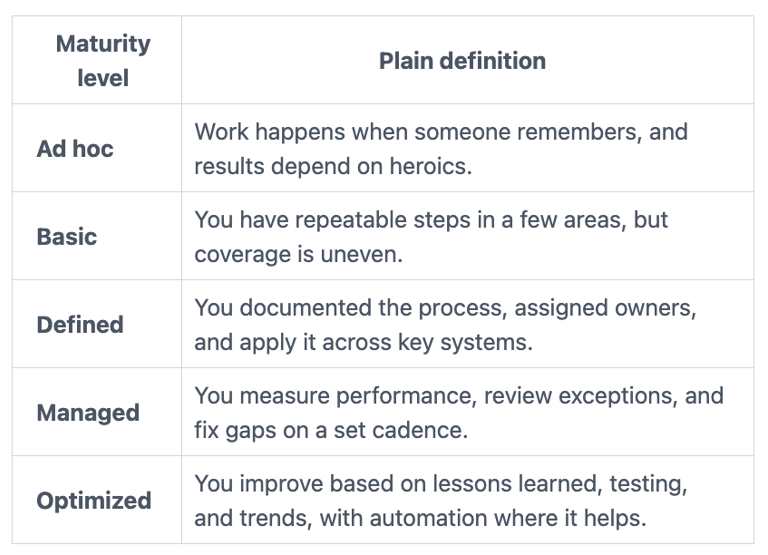
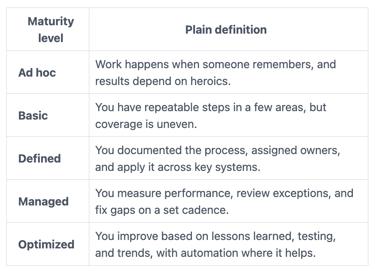
Levels aren't grades. They're a planning tool that makes tradeoffs visible. These levels provide qualitative descriptions you can adapt easily.
Score by evidence, not opinions, here is what "proof" looks like
When you score, ask a simple question: "What would you show a skeptical director, backed by quantitative data?" Evidence can be messy, and that's fine, as long as it's real.
Acceptable proof often includes:
Approved policies and standards, plus last review date
Ticket data that shows completion and aging (patching cadence, access requests, exceptions)
Privileged access reviews with sign-off and remediation results
Backup and restore test results for crown-jewel systems (not just "backup success")
Incident response tabletop exercise outputs, after-action notes, and closed action items
Detection coverage reports for key assets (what's monitored, what's not)
Incident timelines with time-to-detect, contain, and recover
Vendor assessments, contract clauses, and remediation tracking for high-risk suppliers
Asset inventories tied to business services (what you actually run)
Security awareness training completion plus a simple effectiveness signal (phishing click rate, reporting rate, repeat failures)
For response readiness, board members often want proof that oversight is real, not assumed. That's where incident oversight evidence for directors can help you set expectations for exercises, decision rights, and documentation.
Turn maturity scores into a dashboard, a roadmap, and fewer surprises
Once you've scored a few domains, the next step is packaging your results as key performance indicators for the board. Your goal is not to impress. Your goal is to make decisions easier.
A board-ready view usually includes:
Current maturity level by domain
Target level (12 to 18 months is a practical horizon)
Gap size and why it matters (risk and business impact, including data breach costs)
Top risk themes (the few that could hurt you most)
Next 90-day actions with owners
Show trends whenever you can. A "3.2" number alone invites debate. A trend line that moves your security posture from Basic to Defined, backed by evidence, builds confidence. At the same time, avoid vanity metrics that reward activity without reducing exposure. "Alerts processed" is not a win if important systems still lack detection coverage.
Set a cadence that matches how your business runs, contrasting high-level maturity trends with operational metrics. Monthly is right for executive review and delivery tracking. Quarterly is right for the board, because it aligns with strategy and risk oversight rhythms.
You're trying to reduce surprises. A simple trend beats a thick deck.
Report the story: where you are, what you are fixing, and what could still hurt you
Here's a copyable template you can use as a one-page dashboard:
Tile 1: Overall maturity trend (last 4 quarters, plus target band)
Tile 2: Crown-jewel coverage (protect, detect, recover coverage for critical services)
Tile 3: Incident readiness (exercise completed, key gaps, mean time to contain, mean time to resolve, time-to-restore test status)
Tile 4: Third-party exposure (percent of critical vendors assessed, high-risk count)
Tile 5: Top 3 risks (plain language, impact, owner, next action)
Then add a short narrative paragraph:
What improved this quarter, and why it matters
What is still weak, and what you're doing next
What decision you need from leadership (funding, risk acceptance, policy change)
If you want to align that story to what directors expect to see, map it to CISO performance metrics for boards so oversight stays consistent quarter to quarter.
Use the maturity gaps to fund the right work in the next 90 days
Maturity scoring is only valuable if it becomes a roadmap. The trick is turning gaps into initiatives that have owners, budgets, and clear exit criteria.
Start by picking the few gaps that reduce the most risk per unit of effort. Then write each initiative like this:
Owner: the executive accountable (not just the project manager)
Rough cost range: small (time only), medium (tens of thousands), large (six figures plus)
Exit criteria: what "done" looks like, with evidence (test passed, review complete, coverage achieved)
Risk change: what gets less likely, or what recovers faster
Be careful with the "buy a tool" reflex. Tools can help, but they don't create maturity by themselves. Many programs improve faster by tightening decision rights, testing restores, fixing identity basics, and enforcing vendor terms. If you want a strong framing for investment conversations, use guidance on security ROI beyond tools, tying return on investment to outcomes, not product lists.
FAQs about maturity models and cybersecurity program effectiveness
Q: How often should you score maturity?
Quarterly is a strong baseline for cybersecurity metrics. Monthly scoring can work for fast-moving programs, but it can turn into noise. Keep monthly for delivery tracking, and quarterly for formal maturity scoring.
Q: How do you prevent teams from gaming the score?
Require evidence, and rotate who reviews it. Also, keep the scoring rubric stable for at least two quarters. When the rules change every time, the score stops meaning anything.
Q: Do you need to map the model to NIST or ISO?
Not at first. You can start business-first, then map domains later to the NIST Cybersecurity Framework or ISO for audit or customer needs. The mapping helps with structure, but your leaders still need plain outcomes.
Q: What if you score low across the board?
That's still useful because it gives you an honest baseline for risk management. Pick two domains that reduce high-impact risk fast, then show progress in 90 days. Early wins build trust.
Q: Can you benchmark your maturity against peers?
You can, but be careful. Industry benchmarks and security ratings often hide context, like business model and threat profile. Your best benchmark is your own trend, plus whether you meet your risk targets.
Q: How should you handle third parties in the model?
Score them as a domain, and focus on your ability to assess, contract, and monitor. A vendor's controls matter, but your governance matters more.
Q: How do you use maturity during M&A?
Score both sides on a small set of domains, then plan integration around the biggest gaps. For more on making that practical, see guidance on security in mergers.
Conclusion
You don't need a complex program to prove progress. You need a simple flow you can repeat: define what "effective" means for your business, build a small maturity model, score with evidence, report trends, then convert gaps into a funded roadmap. When you do that, security stops being a cost you defend and becomes a capability, tracked by key performance indicators, that you can manage.
If you're a CEO or director, set a near-term deadline. Run a lightweight maturity scoring workshop in the next 30 days, and insist on evidence for each score. Then ask for a 90-day plan that closes the most important gaps, such as security awareness training.
If you want a steady partner to facilitate the scoring, pressure-test incident response readiness, and help you brief leadership, you can engage a CISO advisor and turn maturity into decisions you can stand behind.
Tyson Martin is the executive public and pre-IPO companies in financial services, AI/data, SaaS, and cloud hire to make trust a measurable asset, one accountable answer to Is it secure? Is it resilient? Is the AI governed?
© 2026. All rights reserved.
Navigation
Free Resources
Contact


Stay ahead of your next board agenda
Sign up for Reports & Learnings From the Boardroom. Plain-English AI and cyber governance insights, biweekly. No pitch.
No spam. Unsubscribe anytime. · Or download the Director's AI Question Pack — 25 questions free