
The $10M Valuation Haircut: Why Vague Cyber Risk Kills M&A Deals
The Invisible Cost of Vague Risk can cut 15-30% from your deal. Learn how clear cyber metrics protect valuation and speed M&A diligence.


You line up a $100M acquisition. Buyers spot fuzzy cyber details in diligence. They slash the price by 15-30%. That's $15M to $30M gone. Deals like this stall because the invisible cost of vague risk hides threats buyers must price. You can't sell what you don't measure.
In April 2026, cyber incidents hit records. AI-driven attacks rise. Regulators push maturity proof. Buyers walk or escrow balloons when risks stay unknown. A vague posture signals control gaps. Clear metrics hold value.
One mid-market firm lost $12M last year. Diligence revealed unquantified vendor gaps and no breach history scores. Buyers cut deep. You avoid this by tying risks to dollar impacts. Quantify threats. Build board-ready reports. Deals close faster.
Key Takeaways on the Invisible Cost of Vague Risk
Vague cyber risk triggers 15-30% valuation drops; buyers add escrows or walk when threats lack dollar tags.
Clear metrics protect deal value; score risks against appetite to show control.
Patchy diligence kills trust; unknown incidents become $10M+ liabilities.
Board oversight spots gaps early; demand quantified reporting to cut the invisible cost.
Strong posture speeds closes; dashboards and simulations build buyer confidence.
Quantify now for M&A readiness; tie risks to revenue hits or downtime.
Why Vague Cyber Risk Is a Deal-Killer for Boards and CEOs Right Now
You lead growth through M&A. Vague cyber risk stalls that. Buyers demand proof amid rising threats. Ransomware surges. AI exploits multiply. SEC rules require cyber maturity disclosures.
This erodes trust fast. Insurance costs climb without clear posture. Post-deal surprises trigger lawsuits. You face board pressure for visibility. Deals drag. Growth slows.
In 2026, buyers prioritize resilience. PwC surveys show 68% of deals cite cyber as top diligence issue. Vague answers inflate perceived exposure.
Consider outcomes side by side.
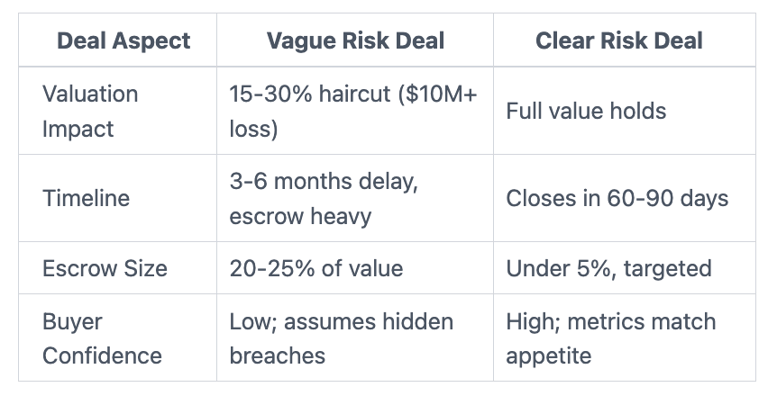
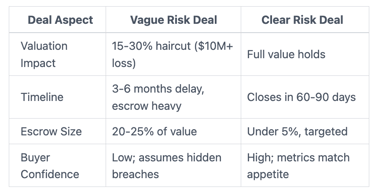
Clear reporting cuts the invisible cost of vague risk. You set faster deals. Boards gain oversight. For board cyber risk advisor help, see how to clarify cyber risk appetite and escalation.
Spotting Vague Cyber Risk Before It Tanks Your Valuation
You enter diligence. Buyers probe cyber gaps. Vague answers scream liability. Patchy reports hide vendor risks. Unscored incidents loom large. No tie to risk appetite means unknowns multiply.
Deloitte M&A reports note buyers flag 40% of targets for cyber vagueness. You see this in weak third-party maps or absent breach quantifications. Buyers price $10M+ buffers.
The Red Flags Buyers Hunt For
Missing breach history scores: No dollar impact or frequency data costs millions in assumed fines.
Weak vendor oversight: Unmapped risks from top suppliers lead to 20% escrows.
No risk appetite link: Untied threats signal poor governance; buyers demand fixes.
Patchy incident logs: Unquantified events hint at repeats; erodes trust.
Siloed reporting: IT hides gaps from finance; buyers see divided control.
Real Deals That Got Haircuts
SolarWinds fallout rippled into M&A. A supplier hit exposed targets. One $80M deal dropped to $65M. Buyers cited unknown supply chain risks.
A PwC-cited case: Healthcare firm faced $18M cut on $120M sale. Vague ransomware history lacked recovery proofs. Buyers escrowed for breach odds.
You spot these early. Demand metrics. Cut the invisible cost of vague risk.
Why Even Smart Leaders Miss These Blind Spots
You run a tight ship. Compliance checks pass. Yet cyber vagueness persists. You over-rely on checklists. They miss business ties.
Silos hurt too. IT reports metrics. Security skips dollars. No news feels like good news. But threats brew unseen.
Board reporting stays weak. Dashboards lack trends. You assume coverage equals control. Growth strains expose gaps. Vendor dependence grows unchecked.
You might think your program stands solid. However, diligence reveals otherwise. Buyers demand proof beyond audits.
Structural fixes help. Link risks to appetite. Test simulations. For cybersecurity governance advisor insights on board questions exposing cyber blind spots, check practical steps.
What Clear Cyber Risk Looks Like in a Winning M&A
You show buyers control. Quantify risks against appetite. Use board-ready dashboards. Run incident simulations.
Top risks score in dollars: $5M revenue hit from downtime. Gaps close with timelines. Coverage hits 95%.
This builds confidence. Deals hold value. Buyers see maturity.
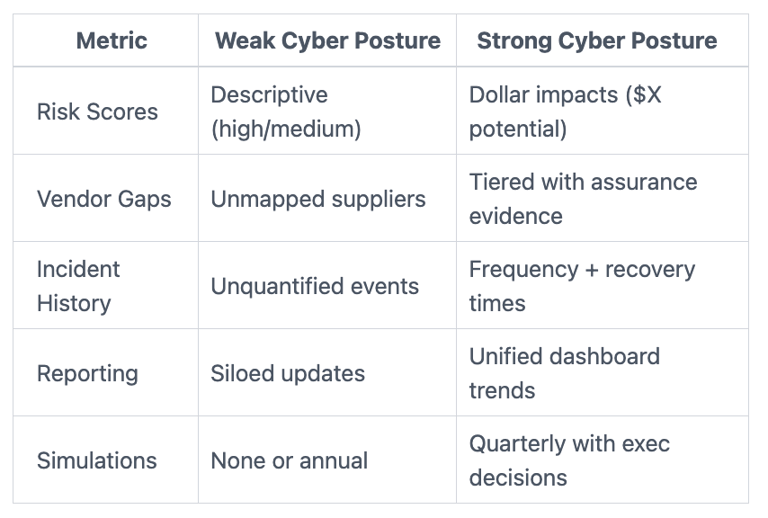
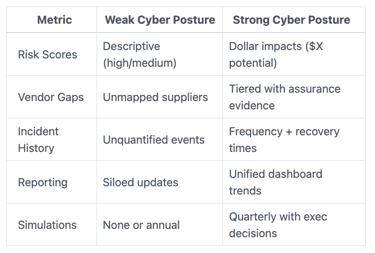
You tie posture to business. Revenue protects first. For board cybersecurity advisor tips on turning cyber updates into decisions, apply now. Deals close smooth.
Questions Your Team Should Ask to Fix This Now
You need action. Start with these for boards and CEOs.
How do we score top cyber risks in dollar terms?
What vendor gaps could hit revenue in 24 hours?
When did we last simulate a material incident?
Does reporting tie risks to our appetite statement?
Who owns post-diligence fixes?
What metrics show buyer-ready maturity?
How often do we refresh risk quantifications?
Short FAQ on M&A Cyber Specifics
Q: How much does vague risk cost deals? A: 15-30% haircuts common; $10M average on $100M targets.
Q: What fixes escrow bloat? A: Quantified histories and simulations; cap at 5%.
Q: When to start diligence prep? A: Quarterly; align with board reporting.
Q: Best metrics for buyers? A: Downtime tolerance, vendor coverage, recovery proofs.
Tie to boards setting technology risk appetite.
Bottom Line: Cut the $10M Risk with Quantified Clarity
Vague cyber risk costs you $10M+ in M&A. The invisible cost of vague risk vanishes when you quantify threats. Deals hold firm.
Next moves: Run mock diligence this quarter. Score top risks in dollars. Build a one-page posture dashboard.
Tyson Martin helps boards quantify cyber for transactions. You decide with proof.
Tyson Martin is the executive public and pre-IPO companies in financial services, AI/data, SaaS, and cloud hire to make trust a measurable asset, one accountable answer to Is it secure? Is it resilient? Is the AI governed?
© 2026. All rights reserved.
Navigation
Free Resources
Contact


Stay ahead of your next board agenda
Sign up for Reports & Learnings From the Boardroom. Plain-English AI and cyber governance insights, biweekly. No pitch.
No spam. Unsubscribe anytime. · Or download the Director's AI Question Pack — 25 questions free