Board Technology Advisor vs. Fractional CTO: Which Gap Do You Need to Fix?
Choosing a board technology advisor or fractional CTO? You'll see which gap you need to fix, governance and oversight, or delivery and execution.


If you're deciding between a board technology advisor and a fractional CTO, the short answer is simple. These roles solve different problems.
A board technology advisor helps you improve oversight, judgment, risk visibility, governance, and executive decision quality. A fractional CTO helps you build, run, and improve the technology function inside the business. One sharpens leadership and board choices. The other drives operating execution.
That distinction matters because pressure often shows up as a vague "technology problem." A missed launch, weak cyber posture, board frustration, vendor sprawl, or messy AI use can all look related. Still, the real issue may be weak governance, poor reporting, fuzzy ownership, delivery drift, or a true leadership gap. If you hire by title instead of by problem, you usually get motion without relief.
Key takeaways: how to tell which role you actually need
You likely need a board technology advisor when the board lacks visibility, reporting is weak, or decision rights are unclear.
You likely need a board technology advisor when cyber, AI, vendor risk, or major tech choices need stronger oversight.
You likely need a board technology advisor when the CEO or board wants an independent view, not another operator.
You likely need a fractional CTO when product, platform, engineering, architecture, or vendor execution is slipping.
You likely need a fractional CTO when no senior technology leader is driving priorities, accountability, and delivery inside management.
Some companies need both, but for different reasons.
The real difference is oversight versus execution
The cleanest way to compare these roles is not by title. It is by the problem each role exists to solve.
A board technology advisor improves decision quality at the board and executive level. You bring that person in when the company needs better visibility, sharper challenge, clearer ownership, and stronger governance. A fractional CTO, by contrast, works inside management. You bring that person in when the company needs leadership over technology delivery, architecture, teams, vendors, and roadmap progress.
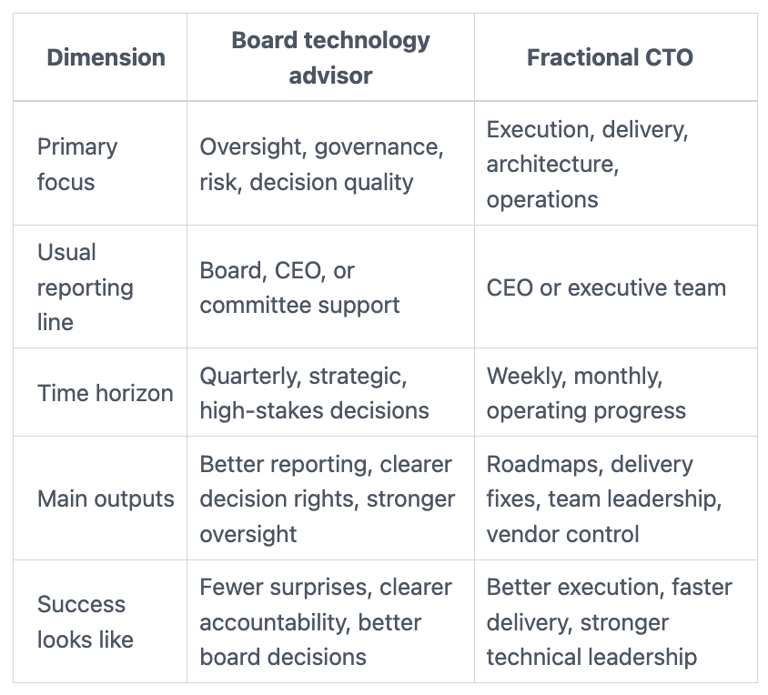
This quick comparison makes the split easier to see:
A title can sound close to the need, while the actual gap sits somewhere else.
What a board technology advisor helps you do
A board technology advisor does not run your engineers, rewrite your stack, or own day-to-day output. That role helps you see where risk is rising, where governance is thin, and where management assumptions need pressure.
You use this role to improve board reporting, clarify who decides what, and make sure cyber, AI, resilience, and major technology bets are being governed with plain language and clear thresholds. If your board is getting noise instead of answers, better board reporting that translates cyber to business impact is often part of the fix.
In other words, this role improves your judgment system.
What a fractional CTO is usually hired to fix
A fractional CTO is usually hired to stabilize or lead the technology function itself. That can mean setting architecture direction, managing vendors, improving engineering discipline, driving a roadmap, or filling a senior leadership gap during growth or transition.
This person is closer to delivery than to oversight. You expect hands-on leadership, operating cadence, and measurable progress. If product releases keep slipping, platform work keeps stalling, or your vendors are effectively running your technology choices, a fractional CTO is often the right answer.
In other words, this role improves your operating system.
Start with the problem, not the title
Many companies mis-hire because the symptoms overlap. A board that doesn't trust the technology story and a team that can't ship on time can both describe the situation as "we have a technology issue." That's too broad to be useful.
You need to diagnose where the break is happening. Is the main failure in visibility, ownership, and governance? Or is it in delivery, leadership, and execution inside the function?
Signs you need a board technology advisor
You likely need a board technology advisor when the board is hearing activity but not getting decision-useful reporting. You may see a lot of slides, but still lack clarity on what changed, what matters now, and what decision is needed.
You also need this role when ownership of cyber, AI, vendor risk, or recovery readiness is blurry. If major technology decisions are being made without clear guardrails, you likely need stronger governance, not more operating work. Good board cyber governance practices help you separate oversight from management without creating drag.
Other signs are harder to ignore. The CEO may need an independent translator between management and the board. A recent incident, acquisition, leadership exit, or financing event may raise the stakes. Your board may also need clearer technology risk appetite so everyone knows what falls within management authority and what must come up for review.
The business consequence is simple. If you can't see the risk clearly, you can't govern it well.
Signs you need a fractional CTO
You likely need a fractional CTO when product or platform delivery keeps slipping, yet nobody inside management truly owns the fix. You may also need one when there is no senior technical leader in place, or when the current leader can't create focus, discipline, and follow-through.
Watch for too much vendor dependence, architecture debt that slows growth, weak engineering priorities, or a roadmap that changes every few weeks without clear tradeoffs. Those are operating problems. So are teams that stay busy but don't move core business outcomes.
The business cost shows up fast, slower execution, wasted spend, weak accountability, and growing frustration across the executive team.
Why leaders often choose the wrong role
Under pressure, you tend to hire for the loudest symptom. That is where confusion starts.
If the board feels blind, a new operator will not fix board visibility by default. If delivery is failing, an advisor will not replace operating leadership. You can improve the conversation and still leave the function unmanaged.
When execution problems are mistaken for governance problems
Recurring misses, weak roadmaps, poor vendor control, and team drift usually point to a missing or ineffective technology leader. Yes, the board should surface the issue. Still, board-level discussion cannot run the function for you.
If nobody is setting priorities, holding teams accountable, and making technical tradeoffs inside management, you need a fractional CTO more than an advisor.
When governance gaps are mistaken for execution problems
Weak reporting, fuzzy escalation, board confusion, and unclear cyber or AI oversight often need independent guidance, not just a stronger operator. More activity inside the tech team does not create better oversight.
If your company would struggle to explain who owns incident decisions, what risk thresholds matter, or when the board gets pulled in, you may need stronger board incident response oversight and governance support.
How to make the right call before the next board meeting
Before you hire either role, ask where accountability is breaking, where decisions are getting stuck, and what kind of capability is missing.
Ask these questions to decide which role fits
Use a short set of questions and keep them sharp:
Is the main problem visibility or execution?
Do you need independent judgment or day-to-day leadership?
Is the board asking for clearer oversight, or is the team missing delivery targets?
Who owns cyber, AI, architecture, and vendor risk today?
What decision is harder to make because this role is missing?
Will success look like better board decisions, or better operating progress?
Those questions usually expose the gap faster than a long org-chart debate.
When it makes sense to use both roles at the same time
Sometimes you need both. That is common during rapid growth, M&A, post-incident recovery, CEO transition, or a period where the board needs stronger oversight while management also needs hands-on technology leadership.
If you do this, keep the boundary clean. The board technology advisor should improve visibility, governance, and decision quality. The fractional CTO should own execution, delivery discipline, and operating progress. When those lines blur, both roles become less useful.
Frequently asked questions leaders ask about these roles
Can a fractional CTO advise the board? Yes, to a point. However, that advice comes from inside management. If you need independent challenge and governance support, that is a different role.
Can a board technology advisor replace a CTO? No. A board technology advisor can improve oversight and decision quality, but won't run the technology function for you.
Which role should report to the CEO? A fractional CTO usually reports into the CEO or executive team. A board technology advisor may support the CEO, but the real value is independence and board-level usefulness.
What if your issue includes cyber, AI, and delivery at the same time? Split the problem. Put oversight, risk framing, and decision rights with the advisor. Put delivery, architecture, and team accountability with the fractional CTO.
The right choice is not about prestige or trend. It is about fit.
A board technology advisor helps you improve oversight, judgment, governance, and visibility. A fractional CTO helps you lead execution inside the business. Those are related needs, but they are not the same job.
Before you hire, name your biggest gap plainly. Is it board visibility, leadership accountability, or operating execution? Once you answer that honestly, the right role becomes much easier to choose.
Sources referenced: Internal TysonMartin.com resources only.
Tyson Martin is the executive public and pre-IPO companies in financial services, AI/data, SaaS, and cloud hire to make trust a measurable asset, one accountable answer to Is it secure? Is it resilient? Is the AI governed?
© 2026. All rights reserved.
Navigation
Free Resources
Contact
Stay ahead of your next board agenda
Sign up for Reports & Learnings From the Boardroom. Plain-English AI and cyber governance insights, biweekly. No pitch.
No spam. Unsubscribe anytime. · Or download the Director's AI Question Pack — 25 questions free