
M&A Due Technology Diligence: The 5 questions buyers ask about your tech stack.
Prepare for M&A Due Diligence with 5 tech stack questions buyers ask you, from cyber risk and scale to tech debt, vendors, and integration.


Buyers in M&A due diligence zero in on your tech stack fast. They ask five questions that reveal risks. First, how secure is it from cyber threats? Second, can it scale for the merged company? Third, what hidden costs and tech debt exist? Fourth, how much do you rely on vendors? Fifth, how ready is it for integration?
You prepare answers now because weak spots kill deals. They raise prices or create post-merger chaos. Buyers want proof your stack supports growth and resilience. Vague responses signal poor oversight. That erodes trust and stalls transactions.
As a CEO or board leader, you face high stakes. Cyber surprises spike insurance costs. Scalability gaps slow momentum. Tech debt drains cash post-close. Vendor locks trap value. Integration fails breed tension.
Strong answers build confidence. You show metrics, tests, and roadmaps. That positions you for better terms. Buyers see a stack that drives the combined business, not drags it.
You read on to learn what buyers probe. Then you craft responses that close deals smoothly.
Why Tech Stack Scrutiny Hits Leaders Hardest in M&A
M&A due diligence exposes tech stack flaws under bright lights. You feel the pressure as growth strains operations. Buyers demand visibility into risks you manage daily.
Cyber threats top their list. A breach history or weak controls can halt talks. You risk higher premiums or lost buyers. Boards face questions on oversight. That creates tension if reporting lacks depth.
Scalability tests reveal limits. Your stack works now. But merged volumes crash rigid systems. Integration fails cost millions in rework. You lose momentum while fixing gaps.
Hidden costs surprise everyone. Tech debt from legacy code balloons budgets. Buyers slash offers to cover refactoring. You explain overruns to shareholders.
Vendor reliance flags dependencies. Single points of failure threaten the deal. Contracts with poor exits lock you in. You inherit risks from unvetted partners.
You prepare because deals demand readiness. Weak stacks signal poor governance. Strong ones prove resilience. For board-level cyber guidance, see a board cyber risk advisor.
Busy leaders assume IT handles it. That blind spot kills value. Clear oversight separates winners from regrets.
The 5 Questions Buyers Ask - And What Strong Answers Look Like
Buyers probe your tech stack methodically. They seek evidence of risks managed. Weak answers raise flags. Strong ones close gaps fast.
You answer with data, not claims. Show metrics and tests. That builds trust.
How Secure Is Your Tech Stack from Cyber Threats?
Buyers start with security. They check breach history, controls, and audits. Gaps mean post-deal liabilities.
Weak answer: "We have firewalls and training." No metrics or incidents shared.
Strong answer: "Zero material breaches in three years. Board-reviewed posture shows 95% critical patch compliance. Quarterly tabletop tests response."
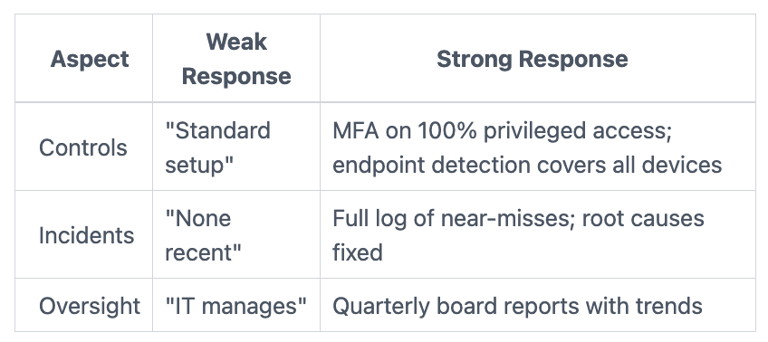
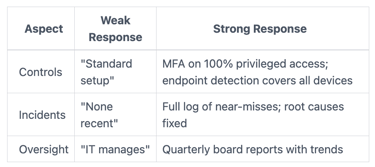
Red flags include no recent audits or insurance gaps. Buyers walk or demand fixes.
Ask your team: "What metrics prove our posture holds under scrutiny?" Test now. For governance questions, review cybersecurity governance advisor for boards.
Can Your Tech Stack Handle Post-Merger Growth?
Buyers test scalability next. They model merged loads on your systems. Rigid stacks fail here.
Weak answer: "It grows with us." No benchmarks provided.
Strong answer: "Cloud-native architecture handled 3x peak loads in tests. Auto-scaling restored service in minutes last Black Friday."
Pitfalls hit legacy setups. On-prem servers buckle under volume.
Conduct a load test. Map capacity to projected combined revenue. Buyers value proven flexibility.
Quick step: Run benchmarks this quarter. Document results for diligence.
What Are the Real Costs and Tech Debt Hiding in Your Stack?
Buyers uncover true ownership costs. They tally licenses, maintenance, and debt.
Weak answer: "Budget is stable." Hides refactoring needs.
Strong answer: "TCO model shows $2M annual run rate. Debt roadmap fixes 80% legacy code by year-end, saving 15%."
Red flags: Budget surprises or untracked sprawl.
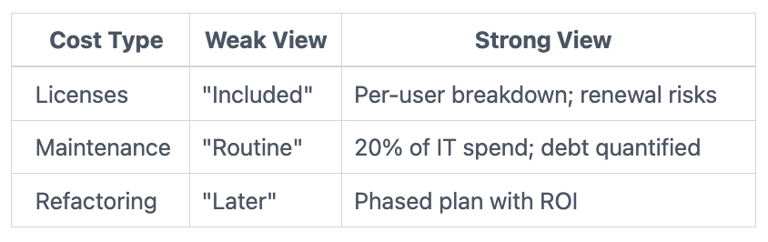
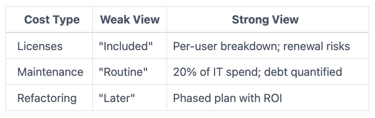
Use a cost checklist: List fees, debt scores, upgrade paths. Buyers reward transparency.
How Deep Is Your Reliance on Third-Party Vendors?
Buyers flag vendor concentration. They review SLAs, exits, and risks.
Weak answer: "Trusted partners." No diversification shown.
Strong answer: "Top vendors cover 40% stack. Multi-vendor strategy; 90-day exit plans tested. SLAs met 99%."
Weak spots: Single failures halt operations.
Ask vendors: "What notice for incidents? Access to logs?" Diversify now. For third-party oversight, check board incident response oversight.
How Quickly Can Your Stack Integrate with Ours?
Buyers end with integration. They probe APIs, data flows, and standards.
Weak answer: "We use modern tools." Silos unaddressed.
Strong answer: "Modular APIs integrated last acquisition in 60 days. Common standards like OAuth; data mapping complete."
Flags: Monoliths or mismatched formats.
Run a compatibility test. Past successes prove readiness. Buyers prioritize seamless merges.
Key Takeaways to Strengthen Your M&A Position
Audit cyber posture quarterly. Use board metrics to show trends.
Benchmark scalability now. Test against merged volumes.
Quantify tech debt. Build a TCO model with roadmaps.
Map vendor risks. Diversify and test exits.
Prove integration speed. Document APIs and past wins.
Brief your board. Align on these questions for oversight.
Run a diligence simulation. Practice answers under pressure.
FAQs: Answering Common M&A Tech Diligence Worries
How long does tech due diligence take? Typically 4-8 weeks. Security and integration drag longest. Prep docs early to speed it.
What if we find big tech debt? Quantify impact. Show a fix plan with costs. Buyers often fund if ROI clear.
Can cyber gaps kill the deal? Yes, if material. Disclose incidents fully. Strong controls mitigate concerns.
How do vendors affect valuation? High reliance cuts value 10-20%. Prove diversification and SLAs.
What integration proof wins buyers? API docs, data schemas, migration history. Demo a mock merge.
Should boards own tech prep? Yes. Set risk appetite. Demand reporting. For practices, see board cyber governance best practices.
Run a tech stack audit this week. Brief your board on these five questions. Test integration paths before talks start.
You gain clearer oversight. Deals close stronger. Growth follows without surprises.
Tyson Martin is the executive public and pre-IPO companies in financial services, AI/data, SaaS, and cloud hire to make trust a measurable asset, one accountable answer to Is it secure? Is it resilient? Is the AI governed?
© 2026. All rights reserved.
Navigation
Free Resources
Contact

Stay ahead of your next board agenda
Sign up for Reports & Learnings From the Boardroom. Plain-English AI and cyber governance insights, biweekly. No pitch.
No spam. Unsubscribe anytime. · Or download the Director's AI Question Pack — 25 questions free