
Who Owns AI Risk? How to Assign AI Governance Ownership Before Your Board Asks
Get a clear governance model with named owners, decision rights, stop authority, escalation rules, and board-ready reporting.


As organizations scale their operations, AI governance and effective AI risk management have become critical priorities for executive leadership. AI adoption is moving faster than your policies, reporting, and accountability model. Technology, legal, security, privacy, risk, HR, and business teams all touch the work. Yet directors will still ask one direct question: who owns the risk?
Buying another AI tool will not answer it. Neither will a broad policy that says everyone is responsible. You need named decision-makers, clear limits, proof that controls work, and a path for issues that exceed management's authority.
TLDR: AI Risk Ownership in Plain English
AI risk ownership means one person has the ultimate accountability and authority to decide whether an AI use case should operate.
Start with your highest-impact AI uses, especially those involving sensitive data or affecting customers and employees, to ensure you are meeting your commitment to Responsible AI.
The common mistake is assigning tasks across many teams without naming the single person who can accept, pause, or fund the risk decision.
Your Board of Directors should oversee risk appetite, material exceptions, and reporting quality, but they should not be expected to approve every low-risk AI tool.
Build a central register, assign clear decision rights, define stop authority, and report open issues with owners and dates to ensure your AI Risk Management framework is effective and accountable.
What AI Risk Ownership Means, and What It Does Not
AI risk ownership is the authority and accountability to identify, assess, approve, monitor, escalate, and accept risk tied to an AI use case.
It is not a policy-writing exercise. It is not tool administration. It is not asking the CISO to carry every technology, legal, employee, and business consequence created by AI.
A policy can set expectations. An inventory can show what exists. A dashboard can show activity. None of those answers who can decide whether a use case is acceptable.
That distinction matters because AI risk crosses functions. A generative AI assistant may expose confidential customer information or create Data Privacy concerns. An automated hiring screen may affect job candidates. A vendor model may create contract, security, reliability, and disclosure issues at the same time.
Everyone can contribute. One person must still be accountable.
Why AI Risk Cannot Sit With One Department
The business leader owns why the use case exists and whether the benefit is worth the exposure. Technology owns system performance, integration, and Operational Risks related to reliability. Security owns cyber exposure and access controls, while the CISO, Chief Risk Officer, and Chief Compliance Officer provide critical oversight. Legal and privacy departments own data use, contract terms, and regulatory obligations.
The board owns major risk appetite decisions and oversight of the decision system.
Consider an AI tool that summarizes customer calls and recommends follow-up actions. Sales may own its business value. Privacy may review recordings and retention. Security may set access limits. Technology may test vendor integration. The accountable business owner still decides whether the tool should operate within those conditions.
Shared input does not mean shared accountability. When accountability is shared, difficult decisions usually wait.
The Difference Between an AI Risk Owner and an AI Operator
An operator configures the tool, reviews outputs, manages a vendor relationship, or monitors alerts. The AI risk owner decides whether the use is acceptable and what happens when controls fail.
Use a simple test. Who can stop the use case? Who can approve an exception? Who can fund a fix? Who must notify leadership? Who can explain the decision to the board?
If those answers point to different people with no clear authority, you have a gap. Start by defining decision rights before the next important AI approval.
Use a Four-Part AI Governance Ownership Model
A workable model has four parts: purpose, control, challenge, and oversight. Every material AI use case needs all four to maintain alignment with frameworks like the NIST AI RMF and the EU AI Act.
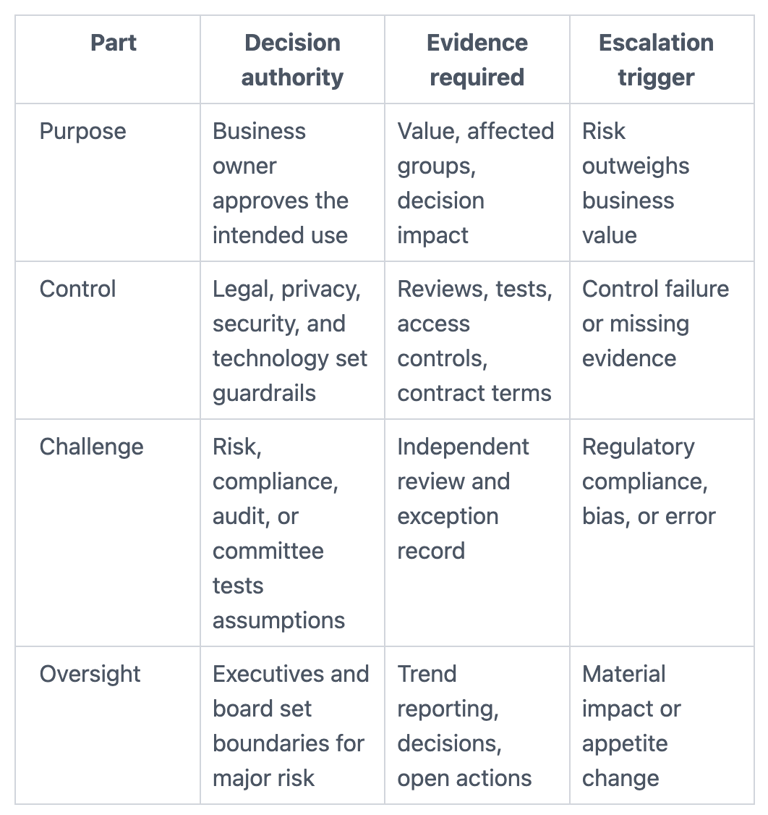
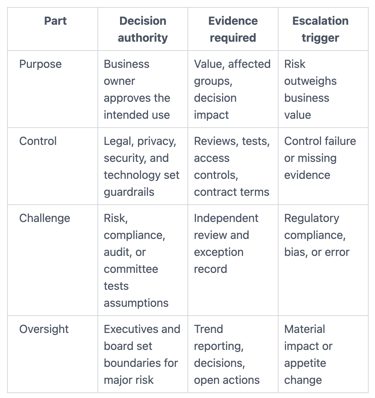
This is not a large committee structure. It is a way to prevent a useful business idea from becoming an unmanaged liability.
Assign One Accountable Business Owner to Every AI Use Case
Assign a named person, not a department. That person owns the purpose, expected outcome, affected customers or employees, and the decision to continue, change, or stop the use case.
Your AI Inventory should record:
Purpose and expected business outcome
Named business owner and stop authority
Affected people, data used, and vendor or model
Decision impact, risk rating, and next review date
The AI Inventory should focus first on priority uses. Include Shadow AI, embedded vendor features, automated decisions, and tools that process sensitive data. You do not need perfection to begin. You need enough visibility to make a sound first decision.
Give Control Leaders Clear Duties
Legal, privacy, security, technology, HR, and records teams should each have defined duties. Privacy reviews data classification and permitted use. Security addresses access, logging, model exposure, and vendor security evidence. Technology teams focus on data integrity, reliability, integration, and recovery. Legal reviews contract terms, disclosures, subcontractors, data deletion, and exit support.
HR should review systems affecting hiring, performance, discipline, or workforce monitoring. Customer-facing uses need clear ownership for customer harm and trust impact.
Control owners provide evidence and recommendations. They do not replace the business owner's accountability.
Create an Independent Challenge and Escalation Path
The person promoting an AI use case should not be the only person deciding whether the risk is acceptable. Risk, compliance, legal, internal audit, or an AI governance committee can provide independent challenge.
Set escalation triggers before a problem appears. Escalate when a use involves sensitive data, high-impact decisions, material financial or operational effects, unacceptable error or bias, major vendor concentration, a security incident, or risk outside approved appetite.
If no one can pause the system without asking three committees for permission, you do not have effective governance.
Reserve Major Risk Acceptance for Executives and the Board
Management should approve routine uses that fit within defined limits. Executives or the board should decide on material exceptions, high-impact uses, major risk appetite changes, and risks tied to public disclosures or fiduciary duty.
The board does not need to approve every chatbot. It needs confidence that management knows which uses matter, who owns them, and when escalation is required. AI governance for boards should focus on those decision boundaries.
Turn AI Governance Ownership Into Board-Ready Evidence
A board needs a short, honest view. What changed? Which AI uses matter most? Where is risk outside appetite? Who owns the response? What decision is needed, and when will management return with evidence?
A policy inventory does not answer those questions. Neither does a dashboard full of model counts, training completions, or technical activity.
Report Decisions, Exposure, Actions, and Dates
Use a one-page update with four parts:
Decisions made or needed, including approve, accept, pause, fund, change priority, or require more evidence based on a formal Risk Assessment.
Top AI risks stated in business terms, such as customer harm, downtime, Cybersecurity Risk, legal exposure, financial loss, or trust damage.
Actions with one accountable owner, proof milestones validated by AI Audits, and clear dates for completion.
Issues that may require executive or board escalation for effective Risk Mitigation.
Use ranges when impact is uncertain. False precision creates false confidence. Clear ranges are more useful than a number nobody can defend.
For sharper management discussion, use these AI governance questions management must answer.
Set Review Rhythms That Match the Risk
Low-risk internal tools can follow a lighter cycle. High-impact systems and fast-changing vendor models need closer review.
Review before launch, after material changes, when contracts change, after incidents, and when new evidence changes the risk picture. Board reporting should follow business change, threat activity, vendor dependence, and risk appetite. It should not wait for an arbitrary audit calendar.
Prepare for the Questions Directors Will Ask
Be ready to answer these questions without technical detours:
Who owns this AI use case, and what can they decide?
What happens if the model is wrong or unavailable?
Which risks are we accepting on purpose, and how are we tracking them?
What evidence shows the controls work?
Who can pause the system?
What would be material to the business or require disclosure?
Directors who need additional prompts can Download the AI Boardroom Question Pack.
Build the Ownership Model in 90 Days
Do not turn this into a two-year transformation. The goal is a usable model with named people, decision rights, thresholds, evidence, and a reporting rhythm.
First 30 Days: Find the Uses and Name the Owners
Inventory current and planned AI uses. Rank them by business impact, data sensitivity, autonomy, affected people, and vendor dependence.
Name one accountable business owner for each priority use. In many organizations, a Chief AI Officer may act as the central coordinator to support these business owners and ensure alignment. Record approval authority, stop authority, and the next review date for every project.
Days 31 to 60: Set Guardrails and Escalation Rules
Create a simple path for low, medium, and high-risk uses by developing a cross-functional strategy. This approach ensures that legal, security, and operations teams are aligned on the required guardrails. Define prohibited or restricted uses, required reviews, evidence standards, exception approval, incident reporting, and review dates.
Management should know when it can accept risk, fund mitigation, pause deployment, change the design, or escalate issues.
Days 61 to 90: Test the Model and Report What Changed
Run a tabletop exercise to ensure your model supports Trustworthy AI. Use a realistic event, such as a vendor model exposing sensitive data or an inaccurate automated decision affecting a customer or employee.
Test who decides, who communicates, who preserves evidence, and how quickly the system can be paused. Report open risks, completed actions, owners, and dates to the executive team and board.
If you need outside judgment before that conversation, Get Board-Ready on AI and Cyber Risk.
Use a Simple Test to Find Ownership Gaps
For each important AI use, name the business owner, control owners, approval authority, risk acceptance authority, stop authority, incident lead, board reporting owner, and next review date.
If any answer is unclear, you have an accountability gap, even if a policy exists. See Where Your Board Actually Stands before assuming the current reporting model is enough.
Frequently Asked Questions About AI Governance Ownership
Who owns AI risk in a company?
The accountable business owner owns the specific use case. Legal, privacy, security, technology, HR, and risk teams own defined controls and reviews. Executives and the board maintain oversight of the overall risk appetite and major escalation decisions.
Should the CISO own all AI risk?
No. The CISO should own cybersecurity input and security controls. However, the CISO cannot own the business purpose, legal exposure, employee impact, or commercial decision for every AI use. Effective AI management requires an AI Triad approach, which balances security, privacy, and business utility to ensure that risks are managed collectively rather than siloed under one role.
What should the board approve?
The board should approve or oversee material risk appetite, high-impact exceptions, and major changes in AI governance. They should also focus on issues with potential fiduciary, disclosure, financial, or trust consequences to ensure that AI governance remains aligned with broader corporate strategy.
How should you handle third-party AI tools?
Treat vendor AI as a business dependency within your broader AI governance framework. Carefully review data use, security evidence, subcontractors, incident notice terms, deletion commitments, model changes, and exit support. If a vendor provides thin evidence regarding their security or compliance practices, you must implement compensating controls or reconsider the partnership.
How often should AI ownership be reviewed?
Review ownership before launch, after a material change, after an incident, when a vendor changes terms or capabilities, and at least annually for active priority uses.
What if no executive will accept accountability?
Pause the use case or escalate it. A tool without an accountable owner is not ready for broad deployment.
Clear Ownership Is the First Control
AI governance fails when everyone contributes but no one is truly accountable. You fix this by identifying priority uses, naming business owners, assigning specific control duties, defining stop authority, and setting clear thresholds that trigger escalation. Ultimately, accountability remains the most vital AI governance control.
Your board does not need more AI activity reports. It needs evidence that your AI governance framework ensures all decisions have clear owners, risks have defined limits, and open issues have resolution dates. When you establish this level of transparency, you demonstrate that your organization has the necessary oversight to manage complex risks effectively.
For practical prompts and board-level guidance, Explore Boardroom AI and Cyber Risk Resources.
Tyson Martin is the executive public and pre-IPO companies in financial services, AI/data, SaaS, and cloud hire to make trust a measurable asset, one accountable answer to Is it secure? Is it resilient? Is the AI governed?
© 2026. All rights reserved.
Navigation
Free Resources
Contact
Stay ahead of your next board agenda
Sign up for Reports & Learnings From the Boardroom. Plain-English AI and cyber governance insights, biweekly. No pitch.
No spam. Unsubscribe anytime. · Or download the Director's AI Question Pack — 25 questions free