
Board Cyber Risk Advisor vs. Traditional Security Consultant: What Boards Need Most
See when a Board cyber risk advisor gives you clearer oversight, stronger accountability, and better board decisions than a consultant.


When cyber risk reaches the boardroom, you usually don't need more technical detail. You need clearer oversight, better decisions, and reporting that holds up when pressure rises.
That is why a Board cyber risk advisor often matters more than a traditional security consultant. A consultant can assess controls, support compliance, test defenses, and help fix real problems. That work has value. Still, if your board can't answer what matters most, who owns it, what changed, and what needs a decision now, the bigger gap is not technical.
Both roles can help you. They solve different problems. If your main issue is tool selection, testing, or remediation, hire the consultant. If your main issue is visibility, accountability, and board judgment, you likely need the advisor.
Key takeaways
A traditional security consultant helps you assess and improve controls.
A board cyber risk advisor helps you improve oversight, reporting, and decisions.
Boards often get technical output without getting decision clarity.
When accountability is blurry, strong consulting work still leaves leadership exposed.
Many companies need both roles, but not for the same job.
The real difference is not security expertise, it is the job to be done
You can think of this as the difference between a mechanic and a navigator. One helps fix the engine. The other helps you decide where to go, what risks to accept, and when to change course.
Here is the practical comparison:
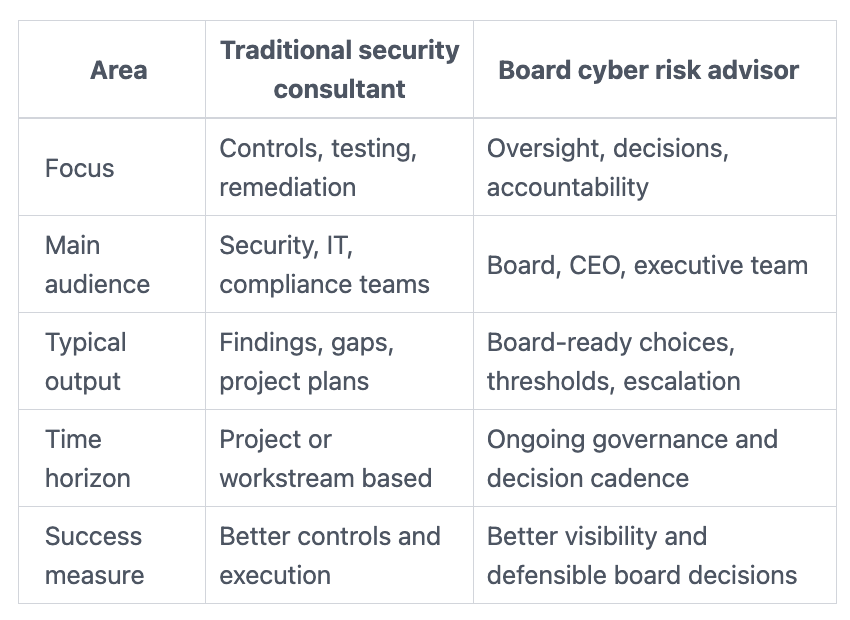
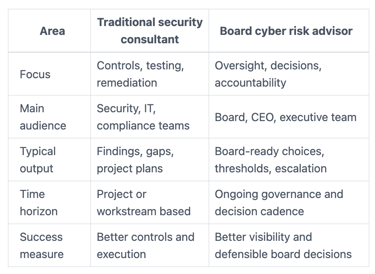
The point is simple. Both roles may understand security well. The real difference is where that knowledge lands and what it is meant to change.
What a traditional security consultant is usually hired to do
A traditional security consultant is often brought in for a defined assignment. You may need an audit, maturity review, compliance support, penetration test, incident help, roadmap, or architecture advice. You may need someone to evaluate tools, review identity controls, or help your team close known gaps.
That work can be strong and necessary. In many cases, it should happen.
The limit shows up later. The work often ends with technical findings and recommendations. Your board may still not know which risks matter most, who owns the business outcome, what tradeoffs management is making, or where the company sits outside acceptable exposure.
What a board cyber risk advisor is hired to help leadership see
A board cyber risk advisor helps you see whether the company can govern cyber risk, not only whether it can describe technical gaps. That means better reporting, sharper escalation, and clearer ownership.
A good advisor helps you test whether board updates are decision-useful, whether management owns the right issues, whether thresholds are clear, and whether board challenge is landing in the right place. That is the work described in Board Cyber Risk Advisor, where the role centers on appetite, escalation, and ownership.
The value is translation and judgment. You are not buying technical theater. You are buying a clearer operating picture.
Why traditional security consulting often leaves boards with unanswered questions
Boards can receive strong technical work and still feel uncertain. That happens because the board is accountable for oversight, while the consultant's output is often built for operators.
The mismatch creates false comfort. You get findings, scores, and remediation plans, yet you still cannot say what the business is accepting, where management confidence is weak, or what the board should press on next.
If your board can't name the decision in front of it, the problem is no longer security depth. It is governance clarity.
Boards do not need more data, they need clearer visibility
Most boards are not starved for information. They are starved for usable visibility.
A dashboard may show open issues, patch counts, and program updates. Yet it may not show trend, ownership, business impact, decision points, or where management has low confidence. That is why many cyber packs feel busy but not useful.
Good board visibility is simpler. You need to see what changed, where exposure is growing, who owns the issue, what management recommends, and what happens if action slips. That is the standard behind board reporting that translates cyber risk into business impact.
Technical findings do not automatically become governance decisions
A penetration test does not tell you your risk appetite. A maturity assessment does not tell you where to spend next. A control gap does not decide whether you delay a launch, accept a vendor risk, or raise the issue to the board chair.
That translation step often goes missing.
As a result, boards struggle to judge investment, sequencing, third-party exposure, incident readiness, or accepted risk. The issue is not lack of intelligence. The issue is that technical output does not convert itself into board choices.
When pressure rises, that gap gets expensive.
What boards need most when cyber risk becomes a leadership issue
Once cyber risk becomes a board issue, you need more than a report. You need a leadership tool. That means an advisor who can connect cyber risk to trust, growth, operational continuity, fiduciary oversight, and management accountability.
Good support changes the discussion. Meetings become less about "What happened in security?" and more about "What changed in business risk, what choice is in front of us, and who owns the next move?"
That is the difference between being informed and being ready.
A board cyber risk advisor helps you ask better questions before a crisis
Before a crisis, your board should be able to ask plain questions and get plain answers.
Examples matter. Your board should be able to ask:
What changed since last quarter that raises or lowers risk?
Where is risk ownership weak or split across too many leaders?
What could materially disrupt operations this year?
What risk is management accepting right now, and why?
What would you regret not challenging before the next incident?
These are not technical questions. They are oversight questions. They force clarity on ownership, trend, thresholds, and judgment. If your board cannot get clean answers, you do not have a knowledge gap. You have an oversight gap.
Good board support turns cyber from a technical topic into a business decision
Strong advisory support helps you connect cyber risk to the rest of the business. That includes vendor dependence, AI use, transaction readiness, public trust, core operations, and execution risk.
For example, risk appetite should not live as a vague phrase in committee minutes. It should show up in clear thresholds, escalation rules, and tradeoffs the board can defend. How boards set technology risk appetite is useful because it frames those choices in business terms, not tool terms.
The same is true for incident readiness. Boards do not run the response, but they do need clear decision rights, escalation paths, and confidence that no one will say, "We assumed," after the fact. That is why board incident response oversight matters once leadership stakes rise.
When this support is in place, your discussions improve. You see fewer vague updates, fewer stalled decisions, and fewer moments where the board learns too late that exposure drifted past what anyone intended to accept.
How to decide which kind of help your board needs right now
Start with the problem you are trying to solve, not the title of the person you might hire.
If the issue is technical depth or execution, a traditional consultant may be the right fit. If the issue is board clarity, management accountability, or weak decision support, a board cyber risk advisor is usually the better choice. In some companies, you need both, but in a sequence that makes sense.
Choose a traditional security consultant when the problem is technical depth or execution
A consultant is usually the right call when you need a control assessment, regulatory prep, incident forensics, architecture review, testing, implementation help, or a project roadmap.
In short, if you know what work must be done and need technical depth to do it well, bring in the consultant.
Choose a board cyber risk advisor when the problem is clarity, oversight, and decision confidence
An advisor is the better fit when reporting is weak, ownership is unclear, board pressure is rising, an incident exposed confusion, leadership is changing, AI oversight feels loose, or the company is moving toward M&A and the board still cannot see risk clearly.
That is where board cyber governance best practices become useful. The aim is not more activity. It is better oversight that leads to stronger decisions.
FAQ
Does a board cyber risk advisor replace your CISO? No. Your CISO runs the program. The advisor helps the board and executive team govern it more clearly.
Do you need this role before an incident? Often, yes. It is cheaper and calmer to fix weak oversight before a live event exposes it.
Do smaller companies need a board cyber risk advisor too? Sometimes they need one even more. Smaller teams often have less room for fuzzy ownership, weak reporting, or late escalation.
If your main issue is control design, testing, or technical execution, a traditional security consultant may be the right answer. If your main issue is board visibility, management accountability, and decision quality, a board cyber risk advisor is usually what you need most.
That is the bottom line. Boards rarely fail because they lacked one more finding. They fail because they lacked a clear view, a clear owner, or a clear decision path when it mattered.
Before your next meeting, identify the one cyber risk question your board still cannot answer clearly. Start there. That answer will tell you which kind of help you need.
Tyson Martin is the executive public and pre-IPO companies in financial services, AI/data, SaaS, and cloud hire to make trust a measurable asset, one accountable answer to Is it secure? Is it resilient? Is the AI governed?
© 2026. All rights reserved.
Navigation
Free Resources
Contact
Stay ahead of your next board agenda
Sign up for Reports & Learnings From the Boardroom. Plain-English AI and cyber governance insights, biweekly. No pitch.
No spam. Unsubscribe anytime. · Or download the Director's AI Question Pack — 25 questions free