Board Technology Advisor: Better Oversight, Less Complexity
A board technology advisor helps you see risk clearly, ask better questions, and improve oversight without adding more meetings or noise.


A board technology advisor helps you see risk more clearly, ask better questions, and make cleaner decisions, without adding another layer of meetings, reports, or technical noise.
That matters because weak oversight rarely comes from lack of effort. It usually comes from unclear ownership, crowded reporting, and fast-moving technology choices that nobody has translated into board-level decisions. You can have full calendars, thick decks, and still leave the room unsure what changed, what matters now, and who owns the next move.
A good advisor doesn't add bureaucracy. A good advisor reduces friction. You use the role to improve visibility, judgment, and accountability, then keep the operating model light. Here's how the role works, where it adds value, and how to use it without making governance heavier.
Key takeaways you can use before the next board meeting
A board technology advisor helps you translate technology, cyber, AI, vendor, and recovery issues into decisions you can govern.
You usually need the role when growth, vendor dependence, weak reporting, or leadership gaps make oversight harder.
The role should sharpen existing governance, not create a parallel structure.
Better oversight comes from clear ownership, better reporting, and clear escalation rules, not more dashboards.
If the board can't tell what changed, what needs a decision, and who owns it, you have a visibility problem, not a meeting problem.
What a board technology advisor actually does for you
In plain English, the role helps you govern technology risk like business risk. That means the advisor helps you frame issues in terms of exposure, tradeoffs, timing, and accountability.
This is not a replacement for your CIO, CISO, CTO, GC, or outside counsel. Management still runs the function. The advisor helps you see whether the story you are hearing is decision-useful, whether ownership is clear, and whether the board is focused on the right level.
If you already feel under-informed, the answer usually isn't more material. It's better translation. A board technology advisor helps convert technical detail into board judgment, much like a good controller turns raw transactions into a useful financial picture.
The role is to improve board judgment, not run the technology function
Your board should not run technology operations. However, it does need enough clarity to challenge assumptions and approve major choices with confidence.
That boundary matters most when you're making large platform bets, reviewing cyber readiness, setting AI guardrails, managing key vendors, or preparing for an incident. In those moments, the advisor helps you separate what belongs at the board level from what should stay with management. If you need a sharper example of that boundary in cyber oversight, see this view on a Board Cybersecurity Advisor.
A good advisor reduces noise by turning technical detail into decisions
Most boards don't need more reporting. They need reporting that answers five things fast: what changed, why it matters, who owns it, what happens next, and what decision is needed.
So the advisor should push for trend lines, business impact, ownership gaps, and escalation triggers. That is the point. Less information, used better.
Good oversight is not more detail. It's clearer judgment at the right altitude.
Why oversight gets harder as the business grows
Growth makes technology harder to govern. Tool sprawl grows. Vendors carry more of the business. AI use spreads faster than policy. Reporting gets longer, while clarity often gets worse.
As a result, many boards feel buried in material but still under-informed. Management may be working hard. The problem is that effort does not equal visibility.
The business cost shows up quickly. Decisions slow down. Challenge gets weaker. Incidents feel surprising. Accountability blurs because nobody can tell where a cross-functional issue starts and where it should escalate.
More dashboards do not fix weak visibility
A long deck can create the illusion of control. Yet many board packets still fail the basic test: can you tell what changed since last quarter, what matters now, and where intervention is needed?
If not, you do not have decision-ready reporting. You have activity reporting. Stronger board reporting for cybersecurity programs follows a simpler rule, clarity over volume.
Unclear ownership is what turns technology risk into board risk
When ownership is fuzzy, uncertainty rises. You see it when IT owns the tool, security owns the policy, legal owns the wording, operations owns the impact, and nobody owns the outcome.
Then the board inherits the fog. That is why technology, cyber, AI, and vendor issues become board problems. Not because the board asked too many questions, but because decision rights were never made clear.
What good oversight looks like without adding layers
Better oversight is lighter than most people expect. You do not need a new committee, a new scorecard every month, and three more meetings. You need a few governance basics that hold under pressure.
Start with clear ownership. Add a small set of board-level metrics. Define when issues escalate. Then tie discussion to business priorities, not technical status. That model is consistent with stronger board cyber governance practices, and it works beyond cyber alone.
Start with clear decision rights and escalation rules
Your board should know which issues require board awareness, which need approval, and which stay with management.
For example, a major platform shift may need board approval if it affects customer experience, cost, or concentration risk. A material cyber event may require immediate escalation. An AI use case with legal or brand impact may need review before launch. A single-point vendor dependency may need a decision long before it causes downtime.
This is where many teams get stuck. They wait for a live problem, then debate authority in the room. That is slow and expensive. Clear decision rights reduce heat later.
If risk appetite still lives in scattered assumptions, it helps to define technology risk appetite and thresholds in plain business terms.
Ask for fewer metrics, but make each one decision-useful
A useful board metric should help you act. If it cannot support a decision, it belongs in management reporting.
This comparison helps:
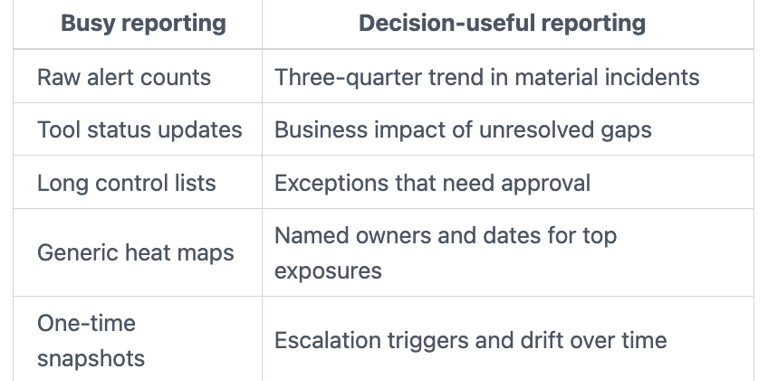
The takeaway is simple. Ask for trends, exceptions, dependencies, recovery readiness, and unresolved ownership gaps. Cut vanity metrics and technical theater.
Use the advisor as a translator, challenger, and pressure test
The best use of a board technology advisor is not as a lecturer. It is as an independent voice who helps you test whether the reporting is credible, whether management assumptions hold up, and whether the board is spending time on the right risks.
That also applies in incident readiness. If your board has not reviewed decision rights, first-day communications, and escalation thresholds, your oversight will get shaky when pressure rises. This guide to board incident response oversight shows what that looks like in practice.
You don't need heavier governance. You need governance that can survive stress.
How to bring in a board technology advisor without creating more process
Keep the role narrow at first. Tie it to the few oversight gaps that matter most right now.
That might mean improving board reporting, clarifying ownership, pressure-testing cyber and AI oversight, or reviewing incident readiness. A focused mandate prevents role confusion and keeps management from feeling boxed in.
Use a focused mandate tied to your biggest oversight gaps
Start with two or three board-level needs, not a broad rewrite of governance. If reporting is weak, fix reporting. If ownership is blurred, clarify decision rights. If the board lacks confidence in readiness, test escalation and response assumptions.
That narrow scope keeps the role useful and calm.
Set a simple rhythm for board input and management support
Use a light cadence. Pre-meeting review works well. Quarterly briefings can work. Targeted deep dives during leadership transition, M&A, or incident recovery can work too.
The role should sharpen the conversations you already have. It should not multiply them. If you need a board-focused model for surfacing blind spots fast, this perspective on a Cybersecurity Governance Advisor for Boards is a useful reference.
Questions leaders should ask before they add this role
Before you add a board technology advisor, test the real problem.
Can you clearly see what matters, what changed, and who owns it
If your answer is no, you likely have a reporting and accountability issue. Adding more reports won't fix that by itself.
Are technology, cyber, AI, and vendor risks being discussed at the right level
If the board is buried in operations, the boundary is wrong. If the board only hears about material issues after the fact, the boundary is also wrong.
The answer is not a heavier committee stack. The answer is clearer ownership and better escalation.
Frequently asked questions about using a board technology advisor
When does a company need a board technology advisor?
You usually need one when growth, complexity, or leadership gaps make board oversight harder to trust. The trigger is often weak reporting, rising vendor dependence, AI adoption, or a recent incident.
Is this different from a virtual CIO or vCISO?
Yes. A vCIO or vCISO usually helps run or support management execution. A board technology advisor helps you improve governance, challenge assumptions, and support board-level decisions.
Will this slow management down?
Not if you use the role well. In most cases, it removes delay because ownership, thresholds, and decision needs become clearer.
What should the board expect in the first 90 days?
You should expect sharper reporting, clearer ownership, a better view of top exposures, and cleaner escalation rules. You should not expect a new bureaucracy.
Better oversight does not come from adding complexity. It comes from improving clarity, accountability, and decision quality.
So before your next board meeting, identify one or two gaps that keep showing up. Maybe reporting is noisy. Maybe ownership is fuzzy. Maybe escalation rules are still implied, not defined. Start there, and keep the advisor's mandate tight.
That is how you improve oversight without making governance heavier. You reduce confusion, improve judgment, and give both the board and management a clearer operating picture.
Tyson Martin advises boards and CEOs on technology, cyber risk, AI oversight, and governance during growth, transition, and other high-pressure moments. Sources referenced: Internal TysonMartin.com resources.
Tyson Martin is the executive public and pre-IPO companies in financial services, AI/data, SaaS, and cloud hire to make trust a measurable asset, one accountable answer to Is it secure? Is it resilient? Is the AI governed?
© 2026. All rights reserved.
Navigation
Free Resources
Contact
Stay ahead of your next board agenda
Sign up for Reports & Learnings From the Boardroom. Plain-English AI and cyber governance insights, biweekly. No pitch.
No spam. Unsubscribe anytime. · Or download the Director's AI Question Pack — 25 questions free