
Technology Risk Appetite Is the Missing Link in Board Oversight
Define your technology risk appetite so your board can set clear limits, improve reporting, and make stronger oversight decisions.


Tyson Martin advises boards and CEOs on technology, cyber risk, AI oversight, and operational resilience.
If you haven't defined your technology risk appetite, you don't have a complete oversight model. You have a series of judgments made in meetings, in exceptions, and during incidents.
That gap matters because most boards now oversee cyber, AI, vendors, and core operations that depend on technology. Yet many still haven't said, in clear business terms, how much technology risk the company is willing to take to hit its goals. As a result, oversight turns reactive. Reporting gets noisy. Management gets too much room to interpret risk in the moment.
You don't need a long policy to fix this. You need a practical boundary that tells management where speed is acceptable, where caution is required, and when the board must step in.
Key takeaways leaders can use before the next board meeting
Technology risk appetite sets decision boundaries, not abstract ideals.
It helps you separate acceptable risk from avoidable drift.
It improves escalation because teams know what must come up fast.
It makes board reporting more useful because data ties to agreed limits.
It reduces hidden tension between growth goals and control expectations.
It gives you a better way to judge AI, vendor, cyber, and uptime tradeoffs.
What technology risk appetite actually means at the board level
At the board level, technology risk appetite is a plain statement of how much technology-related risk you are willing to accept in pursuit of strategy. It is not a technical setting. It is not a long register. It is not a compliance artifact.
It is a leadership tool.
You use it to make tradeoffs around growth, uptime, trust, AI use, vendor dependence, and recovery. If your company wants to move fast with new products, that choice affects change risk, vendor risk, and cyber exposure. If your company runs in a regulated environment, your appetite for data misuse or ungoverned AI use may be low. Those are board-level calls.
If you want a deeper view of how boards set and monitor technology risk appetite, the basic principle stays the same. Start with business impact, then define the limits.
It is not a list of risks, it is a boundary for decisions
A risk list tells you what could go wrong. An appetite statement tells you what level of risk you will accept, what you will not accept, and what must be escalated.
That difference matters. Without boundaries, every issue looks urgent, or worse, every issue gets explained away. Teams push for speed. Others push for control. You get heat, not clarity.
A workable appetite helps you decide on funding, exceptions, timing, and escalation. It tells management, "You can make choices inside this boundary. Cross it, and bring it up."
Why boards confuse appetite, tolerance, and maturity
Boards often mix up three different ideas.
Appetite is the amount of risk you are willing to take. Tolerance is the amount of variation you can absorb in a specific area. Maturity is how developed your capability is.
For example, you may have a low appetite for outages in customer-facing operations. Your tolerance might be four hours of downtime for one service and one hour for another. Your maturity level describes whether your team, vendors, and recovery design can actually meet that expectation.
When those terms blur together, conversations get sloppy. You start talking about "improving maturity" when the real issue is that nobody agreed on the business boundary.
Why this missing piece weakens board oversight
When technology risk appetite is missing, oversight usually looks busy from the outside. Dashboards exist. Committees meet. Incidents get discussed. Still, key decisions remain unclear because reporting, ownership, and escalation are not tied to agreed limits.
That weakness shows up faster now because change moves faster. AI tools enter workflows without much review. Third-party dependence grows. Core operations rely on a smaller number of systems and vendors. A single failure can hit revenue, service, and trust at once.
If your board materials can't show whether you are inside appetite, near the edge, or already outside it, they are not decision-ready.
Reporting stays busy, but decisions stay blurry
Many board packs show patching status, incident counts, project updates, and red-yellow-green scores. That is activity. It is not enough for oversight.
You need reporting that answers a harder question: are you operating within your stated comfort level?
That is why board reporting that translates cyber risk into business impact matters. A useful board report shows trend, threshold, ownership, and what decision is needed. A busy report only proves that work is happening somewhere.
Management and the board can think they agree when they do not
This is one of the more expensive failures.
Management may assume aggressive growth justifies more technology risk. Directors may assume tighter control comes first. Nobody notices the mismatch until an outage, vendor failure, or AI mistake forces the issue.
Then the room changes. Leaders think they were acting in line with strategy. Directors think management took liberties. In truth, both sides were working from an unstated model.
A defined appetite reduces that hidden gap. It turns assumptions into agreed boundaries.
What a workable technology risk appetite looks like in practice
A usable appetite model is small, clear, and tied to business outcomes. You do not need to cover every technical detail. You need the categories that can change business performance and board exposure.
In practice, that usually means business context, a short set of risk categories, measurable thresholds where possible, named owners, and clear escalation rules. It should also connect to your governance rhythm and to board incident response oversight, because appetite without escalation is theory.
This quick comparison shows the difference:
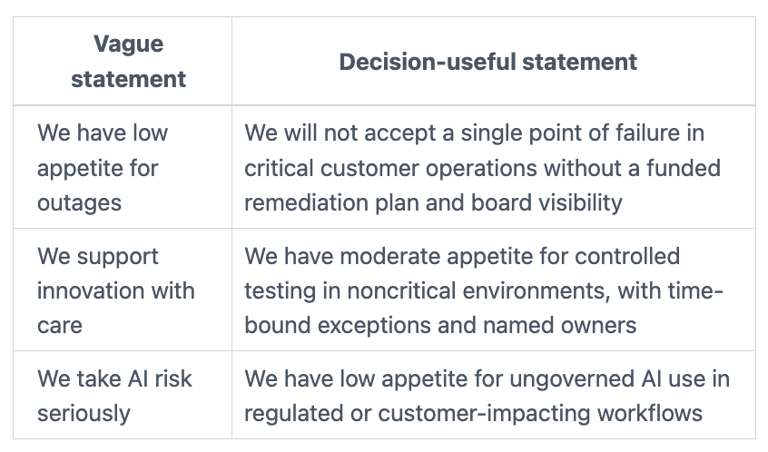
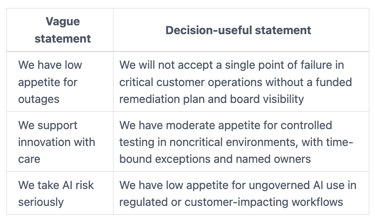
The pattern is simple. Good statements tell you what the business will accept, where the line sits, and what happens when you approach it.
Tie it to the risks that can change business outcomes
Keep the categories few. Cybersecurity, service continuity, data handling, AI use, third-party dependence, and major change execution are often enough.
That focus matters because boards lose traction when the framework tries to cover every issue. You are not writing a technical encyclopedia. You are defining where the business can absorb risk and where it cannot.
This is also where wider board cyber governance practices matter. The board's job is to set direction, hold boundaries, and require proof.
Use plain language that supports action
Your appetite statement should work the same way for the board, the CEO, and operators. If each group reads it differently, it will fail under pressure.
Plain language helps. So do direct statements such as limited tolerance for single points of failure in critical operations; low appetite for ungoverned AI use in regulated workflows; moderate appetite for controlled testing in noncritical areas.
Those statements are not perfect. They are useful. That is the standard that matters.
Questions you should ask to pressure-test your current model
If you want to know whether your current oversight model is strong enough, don't start by asking whether security is good. Ask whether ownership, reporting, and escalation are clear enough to support decisions.
A strong set of audit committee cyber risk questions can expose gaps fast.
Questions for the board and audit committee
Where have you defined acceptable technology risk in business terms?
What threshold breaches must come to the board, and how fast?
Which risks are you taking by choice, and which ones by neglect?
Where are you relying on vendor assurances instead of direct visibility?
Which current reports show trend against appetite, not only activity?
Questions for management before the next reporting cycle
Which technology risks sit outside your intended appetite today?
Where is ownership unclear or split in ways that slow action?
What tradeoffs are being made for speed, and who approved them?
Which exceptions have no expiry date or no real compensating control?
What should change in reporting so directors can see threshold breaches sooner?
Those questions do more than test security posture. They test whether your oversight model can hold under pressure.
Common questions about technology risk appetite
Is technology risk appetite just a cyber issue?
No. Cyber is part of it, but it is not the whole picture. Your real exposure also includes uptime, third parties, data handling, AI use, failed changes, and operational dependence on technology.
Who should own it, the board or management?
Both, but in different ways. The board sets and challenges the boundary in line with strategy. Management turns that boundary into operating choices, metrics, and escalation rules.
How often should you review it?
At least once a year. Still, annual review is only the floor. You should refresh it sooner after an acquisition, a major incident, a new AI use case, a leadership change, or a period of rapid growth.
A stale appetite statement can be worse than none at all, because it creates false comfort.
Technology risk appetite is the link between strategy, reporting, and real oversight. Without it, you are left with noise, interpretation, and late surprises.
Your next move is simple. Look at the materials for your next board meeting and test one point: do they show where the company is inside appetite, near the edge, or already outside it?
If they don't, the reporting is not the main problem. The missing boundary is.
Tyson Martin is the executive public and pre-IPO companies in financial services, AI/data, SaaS, and cloud hire to make trust a measurable asset, one accountable answer to Is it secure? Is it resilient? Is the AI governed?
© 2026. All rights reserved.
Navigation
Free Resources
Contact


Stay ahead of your next board agenda
Sign up for Reports & Learnings From the Boardroom. Plain-English AI and cyber governance insights, biweekly. No pitch.
No spam. Unsubscribe anytime. · Or download the Director's AI Question Pack — 25 questions free