
When a Company Needs a Fractional CISO vs a Full-Time CISO
When does a company need a fractional CISO vs full-time? Use board pressure, risk, and ownership gaps to choose the right security leader.


How to choose the right level of security leadership when ownership is fuzzy and the board wants straight answers.
Published May 2026
Growth has a way of exposing weak ownership. The tool stack grows, the reports pile up, and the board still wants one clean answer, who owns cyber risk, and what are they doing about it? Buying another tool or assigning another task will not fix that.
Your real question is not just who runs security. It's what level of leadership the business needs to make clear, defensible decisions. Sometimes you need part-time strategic judgment. Sometimes you need interim stabilization. Sometimes you need a full-time executive who lives in the work.
Use the pressure in front of you, not the title you think sounds strongest. The right call comes down to urgency, risk, complexity, reporting needs, and how much accountability one person must carry.
TL;DR
A fractional CISO fits when your team can execute, but leadership needs sharper direction, better reporting, and clearer decision rights.
A full-time CISO fits when the work needs daily ownership, faster escalation, and constant coordination across teams and vendors.
If you cannot name the top risk, the owner, and the deadline, your problem is usually governance, not tooling.
Board pressure, audit findings, incidents, AI adoption, vendor concentration, and leadership turnover can change the answer fast.
Pick the smallest leadership step that gives real control, not the biggest title.
What a fractional CISO does, and what a full-time CISO changes
A fractional CISO gives you senior-level judgment on a part-time basis. They help you set priorities, define risk appetite, tighten reporting, and explain cyber risk in business terms. They are useful when the program needs direction more than headcount. That's why many mid-market companies need leadership before they need a large security organization.
A full-time CISO is embedded in the business. They own the program day to day, move work across teams, and stay close to incidents, remediation, and executive tradeoffs. Neither role is a technical trophy. Both exist to change decisions and outcomes.
The signals that point to part-time strategic help
Pick fractional help when the team can do the work, but leadership is fuzzy. You may need better board reporting, a tighter risk register, cleaner decision rights, or help preparing for a committee review. A board cyber risk oversight check can show whether your issue is weak visibility or weak leadership.
This model fits companies that need a board advisor or a vCISO without adding a full-time salary. It also fits teams that already have capable operators, but need someone to make the work coherent. If the question is, "What matters now, what can wait, and who says yes?", fractional support may be enough.
The signals that point to a full-time leader
Choose full-time leadership when the work needs constant attention. Active incidents, repeated audit issues, a large security program, or heavy cross-functional coordination all point this way. If one person has to keep priorities aligned every week, part-time advice will run out of road.
This also applies when regulation or customer scrutiny is high and decisions cannot sit for days. A full-time CISO gives you one accountable executive who can own pace, follow-through, and escalation. If the board wants the work to move every week, not every month, you need someone in the chair.
Use business pressure, not headcount, to make the call
Do not start with salary bands or org charts. Start with pressure. Fast growth, acquisition prep, sensitive data, cloud moves, new product launches, and weak ownership all raise the bar. The right answer changes when the business changes.
Here's the simplest way to compare the options.
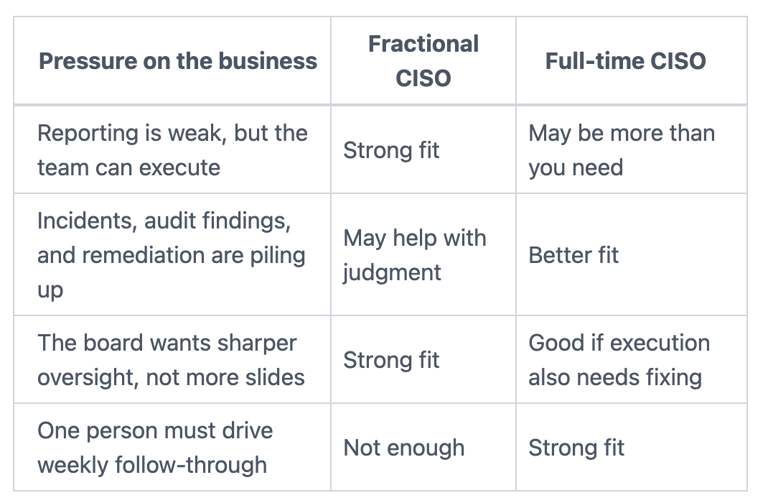
If you are in active cleanup after a resignation, a breach, or a board wake-up call, interim support may sit between the two. That is a different choice. It's about stabilization, not ongoing part-time guidance.
When the company is stable enough for a fractional model
Fractional works best when execution is already in place. The team can handle controls, vendors, and fixes. What they need is senior judgment, clearer priorities, and help tying risk to business choices. If your main pain is reporting, prioritization, or board communication, fractional support can do the job.
That choice should still be about control. Cost matters, but not as much as clarity. If part-time leadership gives you better decisions and no one is waiting on a single overworked executive, that's a sound move.
When the company has outgrown part-time support
You have outgrown part-time help when risk keeps piling up faster than governance. Decisions sit too long, ownership is hazy, and the board keeps asking the same questions. At that point, the company needs someone close enough to the work to move it.
A full-time CISO is the better fit when the role is no longer advisory. You need one person to keep the queue moving, not one person to comment on the queue.
Look for the decision triggers that should change your model now
You should re-open the question any time the operating picture changes. The old answer can stop fitting fast.
Scan for these triggers:
A CISO left, or the team is between leaders.
You just had a breach, near miss, or serious audit finding.
The board or audit committee is asking for clearer answers.
A major vendor changed, failed, or became too central.
AI is rolling into the business faster than oversight can keep up.
Growth, diligence, or acquisition activity is raising the stakes.
Those moments expose whether the current model still works. If your leadership model can't absorb them, it's the wrong model.
Executive gaps and leadership transitions
If your CISO left, the team is between leaders, or the security function never had enough structure, drift starts fast. Fractional help can stop the slide. Interim leadership is better if you need someone to run the room while you rebuild. If the gap is long and the program is thin, hire the full-time leader.
The mistake here is turning security into a committee decision. That sounds collaborative. It usually means no one owns the result.
Incidents, audits, and board pressure
A breach, near miss, regulator question, or audit finding exposes weak control in a hurry. Those moments demand faster reporting, cleaner escalation, and harder calls. If the board wants to know what changed and what you are doing now, informal support will not hold.
This is where boards need board cyber risk reporting that names risk, owner, deadline, and decision. Anything softer turns into noise.
AI, vendor risk, and fast growth
AI rollout, a new critical vendor, or rapid scale changes the risk profile. You need someone who can keep technology choices tied to business appetite. If directors are also asking how management is governing AI, the AI governance questions for board directors help pressure-test the answers.
Vendor concentration, model use, and third-party exposure all need the same plain-language treatment. If the company is adding risk faster than it can explain it, leadership needs to change.
What good decision-making looks like for boards and executives
Boards and executives do not need another status update. They need a decision-shaped answer. What is the top risk, who owns it, what does it cost to fix, and what happens if you wait?
If nobody can name the owner, the escalation path, and the deadline, you do not have a security decision. You have a delay.
Questions that expose unclear ownership
Use direct questions. They force the issue.
Who owns the top cyber risk by name and role?
What can they change without another committee?
What breaks if funding slips?
Who escalates to the CEO or board, and when?
If those answers are fuzzy, you probably do not need more reporting. You need stronger leadership and clearer decision rights. If you want a sharper view of that structure, the work around defining decision rights is the right place to start.
Questions that show whether the role is being measured well
Measure security leadership by outcomes, not activity. Time to fix critical issues, recovery readiness, vendor coverage, and clean escalation tell you more than patch counts or meeting volume. Good reporting shows what changed, what it means, and what decision you want.
That is the point of board cyber risk reporting. If you want directors to ask better questions, use the questions every director should ask the CISO and look for named owners, deadlines, and tradeoffs.
A simple way to choose the right level of support
Use three lanes, fractional, interim, full-time. The job is not to buy the biggest title. It's to pick the smallest leadership step that gives real control.
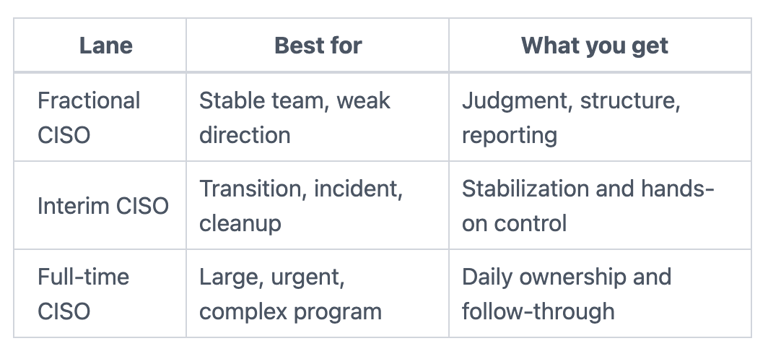
If the choice still feels fuzzy, go back to the basics of decision rights and accountability. That usually clears the fog fast.
Choose fractional CISO support when you need judgment and structure
Pick this when the team can execute, but executives need help setting risk appetite, tightening governance, and making reporting useful. It fits companies that need a smart external hand more than a daily operator.
Choose full-time CISO leadership when execution is the bottleneck
Pick this when the calendar is full of blockers, issues, and follow-up. A full-time CISO is the right call when the business needs one person who can stay on the work, coordinate across functions, and keep remediation moving. If the program stalls whenever that person is not in the room, it should not be part-time.
Conclusion
The answer to when a company needs a fractional CISO vs full-time is not hidden in the org chart. It's hidden in the pressure on the business. If your team needs senior judgment, cleaner reporting, and better governance, fractional support can be the right move.
If the company needs one accountable leader to run the work every day, hire full-time. Do not confuse a bigger title with more control. Look at ownership, reporting quality, escalation speed, and how much of the security program depends on one person to keep moving.
If you want a clearer read on whether your current setup is strong enough, Move Past Technical Noise and Strengthen Board Oversight.
FAQ
Is a fractional CISO only for small companies?
No. It works for any company that needs senior judgment more than daily execution. Size matters less than pressure and ownership.
When is interim CISO support the better choice?
Use interim support after a departure, breach, or major transition. It's built for stabilization, not long-term part-time advice.
Can a fractional CISO prepare you for a full-time hire?
Yes. A good one can define the role, sharpen the scorecard, and show you what the business really needs before you hire.
What if the board keeps asking the same cyber questions?
That usually means reporting is not decision-shaped. You need owners, deadlines, and clearer escalation, not another dashboard.
Related reading
If you want a sharper answer before the next board meeting, start with the current ownership, the reporting you trust, and the speed of your decisions.
Tyson Martin is the executive public and pre-IPO companies in financial services, AI/data, SaaS, and cloud hire to make trust a measurable asset, one accountable answer to Is it secure? Is it resilient? Is the AI governed?
© 2026. All rights reserved.
Navigation
Free Resources
Contact
Stay ahead of your next board agenda
Sign up for Reports & Learnings From the Boardroom. Plain-English AI and cyber governance insights, biweekly. No pitch.
No spam. Unsubscribe anytime. · Or download the Director's AI Question Pack — 25 questions free