
Why boards should not be making technology, cyber, and AI decisions in the dark
You can't govern tech, cyber, and AI in the dark. See how clearer reporting, ownership, and risk appetite help your board make better decisions.


You can hold more meetings, ask for more dashboards, and still leave the boardroom unsure what matters. That is the common failure in board cyber conversations. It is not a failure of care. It is a failure of structure.
You may be getting regular updates. Your team may be working hard. Still, you may not know what changed, what tradeoff sits in front of you, or what decision needs your judgment. Activity gets mistaken for clarity.
Until information is shaped for decisions, more effort only creates more noise.
Key takeaways you can use in your next board cyber discussion
Most cyber reporting fails because it describes work, not choices.
Decision-ready information starts with what changed and why it matters to the business.
Boards need clear options, clear owners, and clear consequences.
Better structure helps directors govern without drifting into technical detail.
Better questions improve reporting faster than demanding more slides.
When cyber updates focus on decisions, oversight gets sharper and surprises drop.
The real problem is not effort, it is how the information is framed
Most board cyber updates are full of motion. They show project status, patch counts, audit notes, and training rates. That can sound thorough. It can also leave you unable to govern.
Why? Because most updates are built for reporting, not for decision-making.
A reporting-shaped update tells you what management did. A decision-ready briefing tells you what leadership must decide. Those are not the same thing. One creates awareness. The other creates action.
That difference sits at the center of strong board cyber governance best practices. It also sits at the heart of cybersecurity governance for boards, where oversight depends on clarity, ownership, and follow-through.
Why long reports and technical dashboards still leave the board unclear
Dense reporting often creates the appearance of rigor while hiding the real issue. A 30-page packet can feel serious. Yet it can still fail the board.
Most failures follow the same pattern. You get too many metrics, but no ranking. You hear technical status, but not business impact. You see progress, but not the consequence of delay. You hear that risk exists, but not who owns it.
Think of it like a map with every road highlighted. The board still cannot see the next turn.
This quick comparison shows the difference:
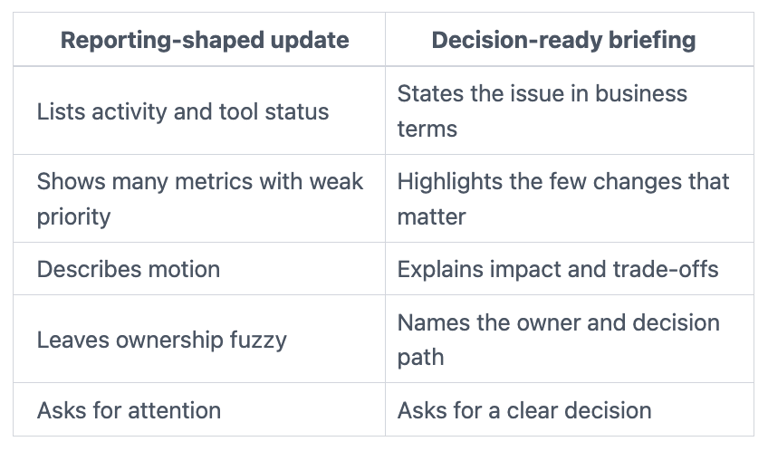
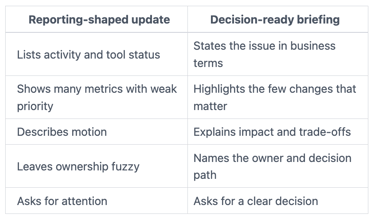
The simpler format often looks less impressive. It is far more useful.
A board cyber update is not successful because it is detailed. It is successful because it helps you decide.
What decision-makers actually need from a board cyber update
A useful board update answers a few basic questions in plain language. What changed since the last review? Why does that change matter to revenue, operations, legal exposure, or trust? What decision is needed now, if any? What are the real options? Who owns the risk and the response? What happens if you do nothing this quarter?
That is the standard.
If a briefing cannot answer those questions, it is not board-ready, even if it is technically accurate. Accuracy matters, of course. Still, structure is what turns information into judgment.
What a decision-ready board cyber conversation looks like
A good cyber conversation does not try to make directors technical. It helps them exercise judgment. That means the order of the information matters as much as the content.
You will get stronger meetings when you begin with the business decision, then provide the context, then show the supporting facts. That approach matches how directors already govern other enterprise risks. It also aligns with better board reporting for cybersecurity programs and the discipline behind how boards set technology risk appetite.
Start with the business decision, not the cyber detail
The first line of a board cyber briefing should not be a threat summary. It should be the decision.
For example, management may need approval to fund a control gap tied to a customer-facing platform. Or it may need the board to accept a temporary risk while a system migration finishes. In other cases, the decision may be about oversight, such as requiring monthly reporting until a recovery weakness is fixed.
When you start with the decision, the room gets focused faster. Directors know why they are listening. Executives know what must become clear. The discussion moves toward choice, not drift.
The reverse order causes trouble. If you begin with detailed cyber facts, directors must first decode the issue, then infer the business effect, then guess whether a decision is buried somewhere inside. That is slow, and it often ends in vague comfort.
Use a simple structure: issue, impact, options, recommendation, owner
You do not need a complex model. You need a stable one.
A practical board packet can place five labels at the top of each material cyber issue: issue, impact, options, recommendation, owner. That simple structure changes the quality of the conversation.
The issue states the problem in plain English. The impact explains the likely business effect. The options show the trade-offs, not just one preferred path. The recommendation tells the board what management believes should happen. The owner makes accountability visible.
Clarity comes from that structure. Better oversight follows from clarity.
When the structure stays stable from quarter to quarter, the board can see trend, drift, and unresolved risk without re-learning the format each time.
How boards can stop rewarding noise and start asking better questions
Boards often say they want better cyber reporting. Then, without meaning to, they reward volume. Long decks look diligent. More metrics look safer. Technical vocabulary sounds precise.
That habit keeps weak reporting alive.
Instead, ask questions that test whether a briefing supports governance. The right prompts can do more than another dashboard ever will. Many of those prompts are similar to the audit committee cyber risk questions that expose whether a cyber plan reduces real business harm or only creates busier reporting.
The questions that reveal whether a briefing supports real governance
Start with the simplest question in the room: "What decision are you asking us to make?" If the answer wanders, the briefing is not structured well enough.
Then press on the areas that show whether the update is useful. Ask, "What changed since last quarter?" Ask, "What are the trade-offs?" Ask, "Where are we relying on trust instead of evidence?" Ask, "Who is accountable if this risk grows?" Finally, ask, "What happens if we wait?"
Those questions do not make the conversation harsher. They make it clearer.
They also help management. Once leaders know the board expects decision-ready information, they can stop spending time on low-value reporting that no one uses.
How to push for clarity without creating blame or defensiveness
Boards do not improve cyber oversight by cornering management. They improve it by making the standard clearer.
Keep the tone calm. Make the goal shared. You are not saying the team failed because the deck was confusing. You are saying the organization needs information shaped for decisions because the stakes are high.
That small shift matters.
You can say, "This is useful work, but we still need the decision, the owner, and the consequence of delay on one page." That invites refinement. It does not create theater. It also reduces the chance that management hears a request for better structure as a personal criticism.
Shared language helps here. If the board and management both use the same decision format, the discussion gets shorter, sharper, and less defensive over time.
Better structure leads to better trust, better oversight, and fewer surprises
When cyber information is structured for decisions, the boardroom changes. Meetings get shorter. Questions get better. Ownership gets harder to blur.
That is not a formatting win. It is a governance advantage.
Better structure improves escalation because thresholds become clearer. It improves judgment because trade-offs become visible. It improves follow-through because owners and review dates become harder to lose. It also helps you avoid the late, painful moment when an issue becomes urgent only because nobody framed it early enough.
This is the same discipline behind board oversight of incident response, where confusion about ownership or escalation turns a hard event into a worse one.
Why clarity is a governance advantage, not just a reporting improvement
Clarity does more than tidy up board materials. It helps you govern at the level the moment requires.
When issues arrive with a decision path, you can compare cyber risk with other business risks. When risk appetite is explicit, you can judge whether current exposure is acceptable or drifting. When ownership is named, you can hold progress to account.
That is how trust grows, not from bigger decks, but from clearer decisions.
Common questions boards ask when cyber reporting still feels foggy
How much cyber detail should a board actually see?
You need enough detail to understand business impact, timing, trade-offs, and accountability. You do not need every task, ticket, or tool status. If a detail does not help you decide, it usually belongs in management reporting, not board reporting.
What is the difference between cyber reporting and cyber governance?
Cyber reporting shares information. Cyber governance uses structured information to make decisions, assign ownership, and track outcomes. Reporting can exist without governance. Governance cannot exist without decision-ready reporting.
How can management make cyber updates more useful fast?
Start by changing the order. Lead with the decision, not the background. Cut low-value metrics that do not change a board choice. Then state the issue, business impact, options, recommendation, owner, and timing on one page. That one change often improves the conversation quickly.
Most boards do not have an effort problem. They have a decision-structure problem.
When you organize cyber information around choices, trade-offs, ownership, and business impact, the conversation becomes more useful. It also becomes more honest.
Take your next cyber update and ask for one thing first: the decision. If that part is unclear, the rest of the packet will not save the meeting.
Tyson Martin is the executive public and pre-IPO companies in financial services, AI/data, SaaS, and cloud hire to make trust a measurable asset, one accountable answer to Is it secure? Is it resilient? Is the AI governed?
© 2026. All rights reserved.
Navigation
Free Resources
Contact


Stay ahead of your next board agenda
Sign up for Reports & Learnings From the Boardroom. Plain-English AI and cyber governance insights, biweekly. No pitch.
No spam. Unsubscribe anytime. · Or download the Director's AI Question Pack — 25 questions free