
Cyber Risk Oversight: What Boards Own vs. Management Execution
You'll clarify cyber risk oversight by defining what boards own, what management runs, and how to cut surprises with clear reporting and escalation.


You face a clear divide in cyber risk oversight. Boards own setting cyber risk appetite. You approve high-level strategies and policies. You ensure oversight frameworks exist. You hold management accountable for outcomes. Management runs the day-to-day cyber program. They handle execution, incident response, vendor management, and routine reporting.
Blurry lines create problems. Surprises hit during growth or incidents. Decisions weaken. Trust erodes with stakeholders. Ownership gaps raise business risk. Regulators add pressure. Clear roles empower strong governance. You lead with confidence. Management executes without constant second-guessing.
Key Takeaways
Boards set cyber risk appetite and thresholds.
Management executes controls and daily operations.
Joint reporting builds trust and visibility.
Ask sharp questions quarterly to test progress.
Boards oversee trends; management owns details.
Define escalation paths to avoid surprises.
Tie oversight to business outcomes like revenue and uptime.
Why Clear Cyber Risk Oversight Matters to You Right Now
Growth strains visibility into cyber risks. AI accelerates threats. Vendors create blind spots. Incidents demand fast board calls. Poor division leads to blind spots for you. Management overloads with unclear duties.
Recent breaches show the cost. Boards faced blame for oversight gaps. Reactive approaches fail. Siloed efforts waste time. Proactive alignment works better. You stay ahead of rising regulations in April 2026.
You need this clarity because stakes grow. AI tools multiply attack surfaces. Vendor chains lengthen. Regulators demand proof of governance. Without it, you risk fines, lost revenue, or eroded trust.
Consider a mid-sized firm hit by ransomware. The board learned too late about weak vendor controls. Downtime cost millions. Clear oversight would have flagged the issue early. You avoid that path.
Strong oversight means fewer crises. It ties cyber to business goals. You focus on strategy. Management handles tactics. This balance supports resilience during expansion or transitions.
What You as a Board Member Should Own
You own strategic elements of cyber risk oversight. Define cyber risk appetite. Approve policies and frameworks. Oversee key metrics and trends. Ensure a culture of accountability. Challenge management's assumptions.
Do not pick vendors or run daily scans. Focus on high-level direction. Set decision rights and escalation thresholds. For example, approve a third-party risk framework. Let management select suppliers.
This approach fits audits or M&A. You gain defensible records. Management moves freely within bounds.
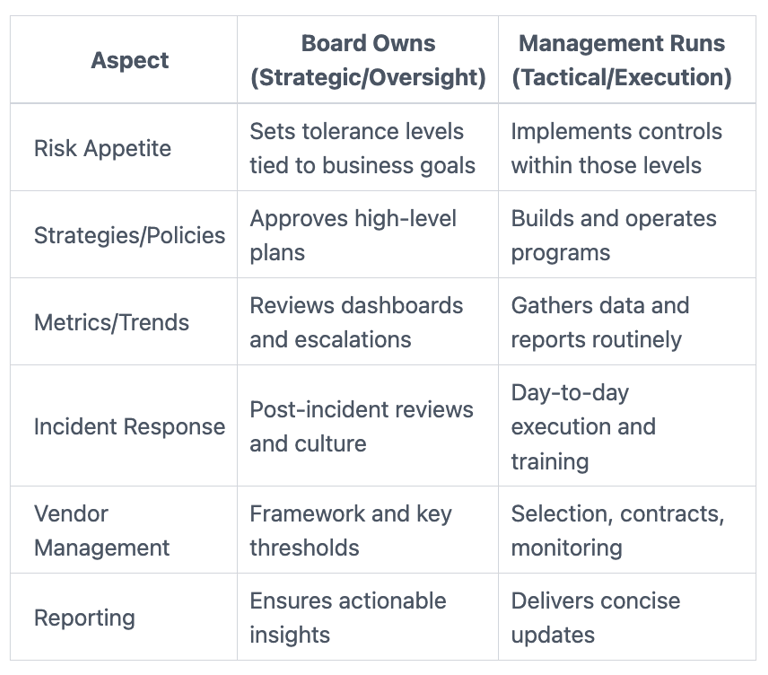
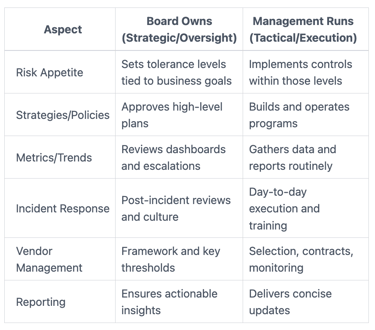
The table shows the split. You steer. They operate. This prevents overreach.
Setting Your Cyber Risk Appetite
You set boundaries on acceptable cyber risk. Tie them to goals like revenue protection or uptime. Tolerating brief downtime makes sense. Data loss never does.
Discuss scenarios in a workshop. Vote on thresholds like maximum outage hours. Document in a one-page statement. Review annually or after changes. For guidance, see how boards set technology risk appetite.
This clarity guides all decisions.
Overseeing Key Metrics and Trends
Focus on dashboards with trends. Track risk scores, incident frequency, vendor concentrations. Ignore trivia like patch counts.
Ask why numbers shift. Demand context on drifts. Quarterly reviews suffice. Tie metrics to appetite. This keeps oversight sharp without details.
What Your Management Team Should Run Daily
Management builds and runs the cyber program. They manage incidents and vendors. They deliver board-ready reports. They train staff within your limits.
They own outcomes. Report exceptions fast. Use the table above for reference. Over-delegation without check-ins fails. You delegate confidently with clear rhythms.
Pitfalls include hiding issues or vague updates. Quarterly deep dives fix that. Management focuses on speed and quality. You review post-incident.
This split empowers execution. You gain visibility without micromanaging.
Executing Controls and Incident Response
Management patches systems daily. They monitor threats and respond per playbooks. Speed matters in alerts.
You own post-incident reviews. For oversight tips, check board incident response oversight. Management ensures readiness through drills.
Delivering Clear, Actionable Reporting
Reports cover risks, gaps, and progress. Avoid data dumps. Use trends and decisions needed.
Concise formats build trust. Tie to business impact. See board reporting for cybersecurity program for examples. Management owns delivery. You oversee usefulness.
Common Breakdowns and How to Fix Them
Breakdowns hurt oversight. Boards micromanage details. Management hides bad news. Reporting lacks rhythm. Escalations confuse.
Micromanaging: Boards dive into tactics. Fix: Stick to appetite and trends. Delegate execution.
Hiding issues: Management delays reports. Fix: Set mandatory triggers. Quarterly deep dives enforce honesty.
Weak rhythms: Ad-hoc updates fail. Fix: Monthly dashboards, annual simulations.
Blurry escalations: No clear thresholds. Fix: One-page ladder with impact levels.
Spot these in your setup. Annual simulations test fixes. This cuts surprises.
Questions You Should Ask Management Today
Ask these to sharpen oversight. Group by theme.
Risk and appetite:
What cyber risks exceed our appetite?
How do trends align with thresholds?
Execution and readiness:
How prepared are we for AI threats?
What changed in vendor risks this quarter?
Reporting and accountability:
Which gaps need board decisions?
Who owns top risks, with proof?
What metrics show progress vs. activity?
Use them quarterly. Demand evidence. This drives action. For more, see cyber risk questions audit committee should ask.
Frequently Asked Questions on Cyber Risk Oversight
How often should boards review cyber risk? Quarterly deep dives work best. Monthly dashboards track trends. Tie to business changes. This balances oversight without overload (60 words).
What if management lacks skills? Bring targeted help like a board cyber risk advisor. They clarify without replacing staff. Focus on gaps in execution (52 words).
How does this tie to AI? AI adds speed to threats. Boards set appetite for model risks. Management tests controls. Review vendor AI tools quarterly (48 words).
Can boards delegate too much? No, if thresholds exist. Oversight means trends and escalations. Micromanaging slows everyone (38 words).
What about regulations? Align appetite to rules like SEC disclosures. Document decisions for defense (32 words).
Clear Ownership Cuts Surprises and Builds Resilience
You now see the divide. Boards own strategy and accountability. Management runs operations. This setup reduces risks.
Take three steps now:
Review risk appetite this quarter.
Test reporting for actionability.
Book a briefing on escalations.
For best practices, explore board cyber governance best practices. You have the clarity to lead.
Tyson Martin is the executive public and pre-IPO companies in financial services, AI/data, SaaS, and cloud hire to make trust a measurable asset, one accountable answer to Is it secure? Is it resilient? Is the AI governed?
© 2026. All rights reserved.
Navigation
Free Resources
Contact
Stay ahead of your next board agenda
Sign up for Reports & Learnings From the Boardroom. Plain-English AI and cyber governance insights, biweekly. No pitch.
No spam. Unsubscribe anytime. · Or download the Director's AI Question Pack — 25 questions free