
Defensible Decisions: A checklist for approving enterprise AI investments.
Blog post description.


You face pressure to approve AI investments fast. Rushed choices waste millions, expose cyber gaps, and invite regulators. Boards and CEOs make defensible decisions with a simple defensible decisions checklist. This seven-point tool covers strategy fit, risks, governance, and execution.
AI hype peaks in 2026. New rules demand accountability for bias, privacy, and security. Vendor demos dazzle, but many projects flop. You see failed pilots, biased outputs triggering lawsuits, and insecure models leaking data. Good decisions build resilience. They tie AI to growth without blind spots.
This checklist works for board packs or exec reviews. It ensures enterprise-scale fit. You probe value, quantify threats, vet partners, set rules, plan rollout, check ethics, and track results. Use it to cut surprises and defend choices.
Key takeaways follow now.
Key Takeaways for Approving Enterprise AI Investments
Align AI with core pains and growth plans before spending.
Scan cyber, privacy, and bias risks with independent audits.
Vet vendors on contracts, SLAs, and exit paths to avoid lock-in.
Define governance early: decision rights, reporting, escalations.
Map rollout metrics, integration snags, and kill switches.
Weigh ethics and societal effects for reputation protection.
Secure board buy-in via dashboards, not slide decks.
Run pitches through this defensible decisions checklist today.
Why Rushed AI Decisions Are a Growing Board Problem
You approve AI amid vendor pressure and growth needs. Speed outpaces oversight. AI moves faster than rules catch up. Boards chase pilots without baselines.
Real fails mount. Biased hiring models spark lawsuits. Insecure chatbots leak customer data. One firm lost $10 million on a flawed supply chain AI. Cyber doors open wide. Ransomware hits unpatched models. Vendor sway grows. Sales teams promise ROI without proof.
Consequences hit hard. Trust erodes when outputs fail. Scalability stalls. Compliance fines loom under 2026 AI acts. You face accountability gaps. Reporting stays weak. Ownership blurs between IT, ops, and legal.
Growth strains expose this. New tools pile on without strategy. Boards react to breaches, not lead. You need visibility into risks. Tie AI to business stakes: revenue, ops, customers. Demand evidence over hype. That shifts you from surprise mode to control.
Blind Spots That Derail Most AI Investment Approvals
You spot demos, not gaps. Shiny interfaces hide weak security. Unproven ROI claims ignore baselines. Ethics fade under speed. Ownership post-buy stays blurry. Vendors dominate without checks.
Hype leads. You approve based on promises, then face bias suits or data leaks. No independent scans mean missed model flaws. Contracts lack SLAs. Integration snags halt ops.
Weak processes repeat. Here's a comparison:
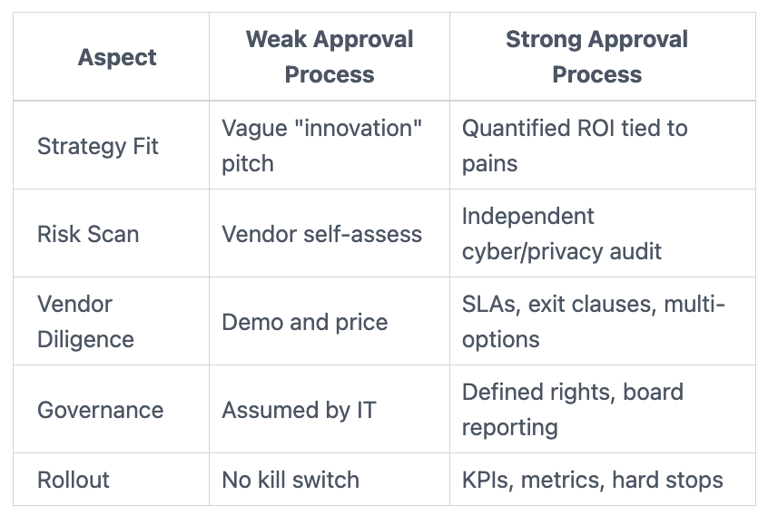
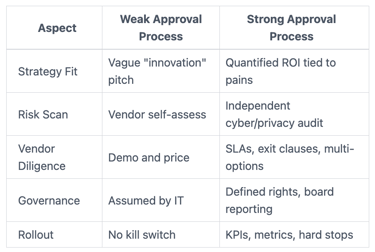
Weak paths waste cash. Strong ones build defense. You avoid surprises by probing red flags early. Focus on business fit. Demand proof. That turns blind spots into strengths.
The Defensible Decisions Checklist: Seven Steps to Confident AI Approvals
This defensible decisions checklist gives you a repeatable frame. Tailor it to enterprise scale. Use it in reviews. Each step probes fit, flags issues. Good looks like clear metrics, owners, evidence.
Step 1: Nail Strategic Alignment and Clear Business Value
You check if AI solves real pains. Does it fit growth plans? Demand quantified ROI with baselines. Ask: Does it scale ops? What metrics prove value, like 20% efficiency gain?
Red flags: Vague "transformative" claims. Probe flops: What if ROI misses? Good: Baselines, pilots, phased rollout. Link to board technology risk appetite for thresholds.
Step 2: Quantify Cyber, Privacy, and Bias Risks Up Front
You require risk scans now. Cover data security, model flaws, 2026 regs. Stress board cyber ties. Demand audits.
Red flag: No third-party review. Good: Vulnerability maps, bias tests, privacy impact. Quantify: Potential leak costs? Tie to cyber oversight like board cyber risk advisor.
Step 3: Vet Vendors and Third-Party Dependencies Hard
You diligence sellers deeply. Check contracts, SLAs, exits. Avoid lock-in.
Good: Multi-vendors, data ownership clear. Red flag: One lock-in source. Probe: Breach notice times? Align with cybersecurity governance advisor for boards.
Step 4: Define Governance and Oversight from Day One
You set decision rights, reporting cadence, escalations. Link to board view.
Good: No rogue silos. Red flag: IT owns all. Ensure visibility via packs. See board cybersecurity advisor for routines.
Step 5: Map Implementation, Metrics, and Kill Switches
You demand roadmaps, KPIs, stops for fails. Cover snags, monitoring.
Good: Integration tests, dashboards. Red flag: No off-ramps. Probe: Underperform triggers?
Step 6: Weigh Ethics, Society Impact, and Long-Term Resilience
You audit fairness, societal hits. Protect reputation.
Good: Bias checks, impact reports. Red flag: Ignored effects. Tie to trust via board incident response oversight.
Step 7: Secure Board Buy-In with Transparent Reporting
You track post-approval via dashboards. Demand trends over trivia.
Good: Quarterly views, escalations. Red flag: Buried details. Use board reporting for cybersecurity program.
Sharp Questions to Pressure-Test Any AI Proposal
You probe with these. They uncover gaps fast.
What baseline proves ROI, and what if it misses 30%?
Which cyber flaws did independent audit find?
What data leaves our control, and privacy safeguards?
Bias tests: Results, fixes, re-runs?
Vendor SLAs for uptime, breaches, exits?
Who owns post-buy ops, decisions, escalations?
Kill switch triggers and timelines?
Integration risks to core systems?
Ethics audit: Societal effects, reputation hits?
Dashboard metrics for board tracking?
FAQs: Answering Real Leader Concerns on AI Investments
How much cyber risk is too much for AI? You set thresholds like data leak costs or downtime. Use audits. Accept low if contained; escalate material. Ties to appetite statements.
When does AI hit board agenda? Material risks: Revenue ties, regs, cyber exposures. Quarterly if growth strains oversight.
Vendor lock-in: How to avoid? Demand multi-options, data portability, exits in contracts. Test SLAs yearly.
Bias risks: What proves mitigation? Independent audits, diverse data, ongoing tests. Track outputs for fairness.
Post-buy governance: First steps? Define rights, reporting, KPIs day one. Link to cyber risk questions audit committee should ask.
This defensible decisions checklist empowers you. It cuts hype, builds defense. Run your last pitch through it today. Set governance rhythms next board meeting. Demand audits on top risks. You'll gain clearer oversight, fewer flops, confident growth.
Tyson Martin is the executive public and pre-IPO companies in financial services, AI/data, SaaS, and cloud hire to make trust a measurable asset, one accountable answer to Is it secure? Is it resilient? Is the AI governed?
© 2026. All rights reserved.
Navigation
Free Resources
Contact


Stay ahead of your next board agenda
Sign up for Reports & Learnings From the Boardroom. Plain-English AI and cyber governance insights, biweekly. No pitch.
No spam. Unsubscribe anytime. · Or download the Director's AI Question Pack — 25 questions free