
How a Board Cyber Risk Advisor Cuts Noise and Improves Oversight
See how a board cyber risk advisor helps you cut reporting noise, clarify ownership, and give your board stronger cyber oversight.


Tyson Martin advises boards and CEOs on cyber risk, technology governance, and decision-making under pressure. He helps you improve reporting, clarify ownership, and make stronger oversight decisions when the stakes rise.
A board cyber risk advisor improves oversight by helping you see signal through clutter. The role is not to add more commentary. It is to turn technical risk into business impact, sharpen reporting, and keep the board focused on decisions.
Most boards do not suffer from too little information. They suffer from weak clarity, soft ownership, and updates that are busy but not decision-ready. The right advisor does not replace management, and does not create a second reporting chain. Instead, you get a cleaner line between what management runs and what the board must judge.
Key takeaways
You need fewer cyber metrics, not more, if those metrics show change, impact, and ownership.
A board cyber risk advisor helps you govern better by translating risk into business choices.
Good oversight depends on clear escalation rules, clean reporting, and defined decision rights.
If your board feels informed but not confident, your issue is probably reporting quality, not board engagement.
The best advisor reduces friction for management and improves challenge for directors.
What usually creates noise in board cyber oversight
Noise in board oversight rarely starts with bad intent. It usually starts with good people trying to be thorough. Management brings more dashboards, more project updates, and more technical detail because they want to show work. The result, however, is often the opposite of clarity.
You get motion without meaning. You get slides without judgment. You get reassurance without proof.
If a cyber update does not show what changed, what matters, who owns it, and what needs a decision, it is not helping oversight.
Too much reporting, not enough meaning
Many board packets are full of metrics, maturity charts, heat maps, and incident summaries. Yet they still leave you with the same four unanswered questions. What changed? Why does it matter now? Who owns it? What decision is needed?
That is the core failure pattern. More slides do not create better oversight. In many cases, they hide the absence of clear thinking.
A long deck can even create false confidence. It feels complete. It sounds serious. Still, if it does not show business exposure and decision thresholds, it is not board-useful. You are not there to audit tool counts. You are there to oversee risk, tradeoffs, and readiness.
When management and the board are looking at different problems
Management often looks at tools, tasks, staffing, and project status. Those things matter, but they are not the board's main lens. You need to see exposure, trend, business impact, recovery confidence, and where risk may exceed tolerance.
When those views are not aligned, conversations drift. Management explains activity. Directors ask for impact. Then both sides leave slightly frustrated.
Over time, that gap creates duplicate conversations and weak challenge. The board keeps asking the same questions because answers never land in board language. Management starts to feel misunderstood. Meanwhile, important trends can slip past both sides.
How a board cyber risk advisor improves oversight without getting in the way
A board cyber risk advisor should act like a filter, not a funnel. You do not need another voice adding more noise. You need a steady guide who helps the board and management focus on the few issues that matter most.
That means tighter framing, cleaner escalation, and stronger translation. It also means less friction in the room, because everyone knows what the update is for.
They turn technical detail into decision-ready insight
A good advisor translates control gaps, incidents, vendor exposure, and recovery weaknesses into plain business terms. You see how a risk could affect revenue, downtime, trust, legal exposure, or strategic timing. That changes the conversation quickly.
Now the board can judge options instead of decode jargon. You do not need to become a technical expert to exercise good oversight. You need clear framing, likely consequences, and real choices.
That is where the advisor adds value. Instead of hearing, "Identity controls remain immature," you hear, "A weak admin path could disrupt core operations and delay customer delivery." One statement describes a technical condition. The other gives you something to govern.
They clarify who owns what, and when the board should step in
Better oversight depends on decision rights. If ownership is vague, escalation becomes emotional. People either wait too long, or bring every problem uphill.
A board cyber risk advisor helps you draw the line. Management owns execution. The board owns oversight, thresholds, and material tradeoffs. When those lines are clear, updates get sharper and incidents get calmer.
That work often starts with simple questions about how boards set technology risk appetite. It also shows up in better board incident response oversight, where triggers, roles, and board touchpoints are defined before a live event tests them.
The point is not more process. The point is fewer avoidable surprises.
What good looks like when the advisor is helping the board well
When the advisor is doing the job well, the board does not feel buried. You see fewer metrics, but better ones. You see trend instead of trivia. You understand top exposures, what changed, and where accountability sits.
This shift is easier to spot when you compare the two states side by side.
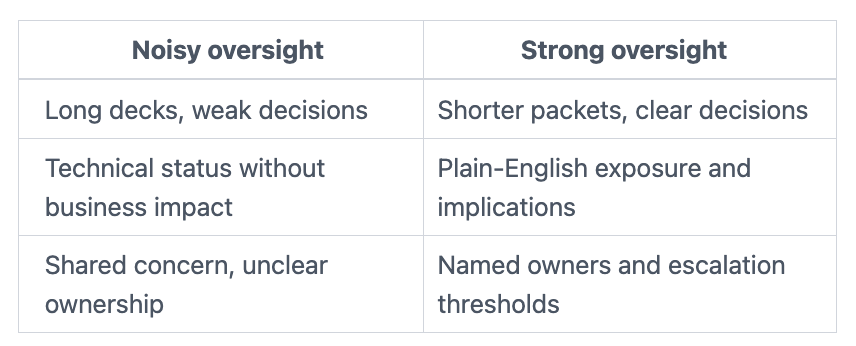
The payoff is not cosmetic. The board can challenge management more effectively because the information is finally shaped for governance.
The board packet gets shorter, clearer, and more useful
Strong reporting has a stable structure. It shows a small set of metrics, movement over time, plain-English commentary, accountable owners, and clear watch items or decisions. That is what good board reporting for a cybersecurity program should do.
You should not need a scavenger hunt to find the real issue. A useful packet lets you see, in minutes, whether exposure is rising, whether a commitment slipped, and whether management needs a board call.
That kind of discipline also helps management. It forces teams to explain risk in business terms, cut weak metrics, and stop burying the lead.
Board conversations shift from fear and jargon to judgment and action
Once the reporting improves, the tone changes. Cyber stops being a separate language spoken by a few people in the room. It becomes part of normal business governance.
Directors ask better questions. Management prepares better answers. The meeting spends less time on definitions and more time on choices.
That shift is at the heart of stronger board cyber governance best practices. You are not trying to make the board technical. You are making oversight sharper, calmer, and more consistent.
How to tell if you need a board cyber risk advisor now
You usually do not need an advisor because your board lacks interest. You need one because oversight is under strain. Growth is raising exposure. Vendor dependence is increasing. Reporting is active, but not settling the real questions.
The warning signs are often subtle at first. Then they become expensive.
Warning signs that oversight looks active but is still weak
Look at your last two board or audit committee updates. If they were long, busy, and still left directors uncertain, that is a signal. If a recent incident exposed unclear roles, that is another. If cyber updates do not connect to business exposure, the board cannot judge what matters.
A third sign is repetition. The same audit committee questions come up quarter after quarter because the answers stay vague. If that sounds familiar, these cyber risk questions for audit committees can help you test whether the issue is depth, ownership, or reporting quality.
Weak oversight often looks busy from the outside. Inside the room, it feels unsatisfying.
The first questions to ask before the next board meeting
Before the next meeting, pressure-test your current model with five direct questions:
What are your top cyber exposures in business-impact terms?
What changed since last quarter, and why?
Where is ownership still weak or split?
What would trigger board escalation right now?
What are you still not seeing clearly enough to make a clean decision?
Those questions do two things fast. They expose whether the reporting is decision-ready, and they show whether an advisor could reduce confusion before the next hard moment arrives.
Frequently asked questions about using a board cyber risk advisor
Does the advisor replace your CISO or security leader?
No. Your CISO runs the program. The advisor helps the board oversee it more clearly. That difference matters, because it protects management authority while improving board judgment.
Does this role create more cost and complexity?
It should create less. The right advisor cuts waste in reporting, reduces repeated conversations, and helps you make cleaner calls faster. If the role adds layers and meetings without better clarity, it is being used the wrong way.
How often should the board engage the advisor?
That depends on your risk, growth, and current reporting quality. Some boards need support each quarter. Others need help during transition points, after incidents, or when ownership is unclear.
When is an outside advisor better than relying only on internal reporting?
Outside help makes sense when internal reporting is too technical, too political, or too inconsistent to support strong oversight. Independence can help you see what insiders may normalize.
The bottom line is simple. The right advisor does not give you more noise. You get cleaner reporting, clearer ownership, and better board judgment.
A practical next move is to review your last two cyber updates and ask whether they showed what changed, what matters, who owns it, and what decision was needed. If not, it may be time to define what a strong board cyber risk advisor should clarify first.
Tyson Martin is the executive public and pre-IPO companies in financial services, AI/data, SaaS, and cloud hire to make trust a measurable asset, one accountable answer to Is it secure? Is it resilient? Is the AI governed?
© 2026. All rights reserved.
Navigation
Free Resources
Contact
Stay ahead of your next board agenda
Sign up for Reports & Learnings From the Boardroom. Plain-English AI and cyber governance insights, biweekly. No pitch.
No spam. Unsubscribe anytime. · Or download the Director's AI Question Pack — 25 questions free