
Fiduciary Duty in 2026: The new legal standard for technology oversight.
In 2026, your fiduciary duty includes tech oversight. Learn how boards should govern cyber, AI, and vendor risk to reduce Caremark exposure.


In 2026, your fiduciary duty of care requires you to oversee technology risks with the same rigor as financial controls. Courts now treat cyber threats, AI decisions, and vendor dependencies as mission-critical issues. Recent rulings equate tech failures to operational breakdowns that demand active board attention.
You face real stakes as a board member, CEO, or executive. Poor oversight invites personal liability through expanded Caremark claims. It erodes shareholder trust and stalls deals or growth. Investors and regulators watch closely. The SEC ramps up scrutiny on disclosures.
You build defensible oversight through three steps. First, define your technology risk appetite in plain terms. Second, demand reports that tie trends to business impact. Third, ask pointed questions each quarter. These actions create records that show you acted responsibly.
Key takeaways:
Treat cyber and AI risks like financial controls to meet fiduciary standards.
Set clear thresholds for downtime, data loss, and vendor exposure.
Use quarterly dashboards focused on trends, not status updates.
Ask five core questions on ownership, escalation, and readiness.
Document decisions to prove oversight during lawsuits.
Test incident paths annually to avoid surprises.
Link tech risks to revenue, operations, and trust.
Why This Shift Hits Leaders Hard Right Now
Growth strains your operations. AI rolls out faster than controls. Cyber incidents hit weekly. Vendor ties deepen without checks. Boards face more scrutiny. In 2026, SEC rules demand timely disclosures on material tech risks. Post-incident suits rise. Rulings expand Caremark duties to cover tech oversight failures.
You feel the pain from weak visibility. Ownership blurs across teams. Reports bury risks in metrics. Personal liability looms if you ignore trends. Shareholder actions target directors who rubber-stamp updates. Deals stall without proof of resilience.
Consider high-profile cases. A retailer faced suits after a vendor breach halted sales for days. Directors paid because oversight lacked escalation rules. Another firm lost a merger over unpatched AI systems exposing data. Courts ruled the board failed basic care.
You cannot defer this. Tech risks now match financial ones in impact. Ignore them, and you invite claims, fines, and lost trust.
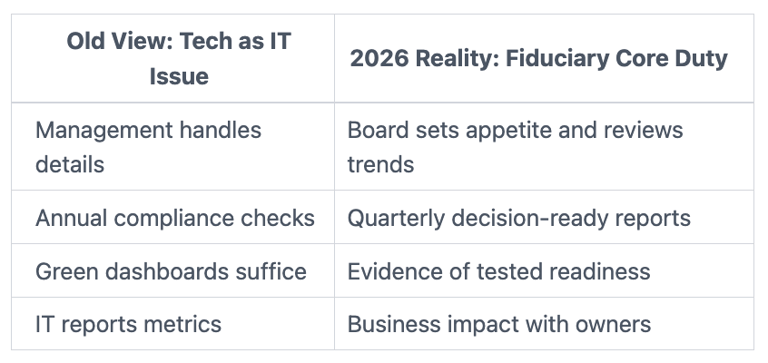
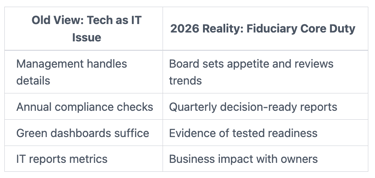
This table shows the gap. The new standard demands proof you oversee actively. As a result, you reduce surprises and build defensible records.
The 'Mission-Critical' Risk Trigger
Courts label tech risks mission-critical when they threaten core operations. A 2025 Delaware ruling held directors liable for ignoring AI vendor gaps that leaked customer data. Impact matched financial fraud.
In 2026, cases tie cyber lapses to duty breaches. Boards must show they probed risks and demanded fixes. Business harm drives these calls: revenue stops, regulators probe, trust fades. You meet the bar by documenting appetite and follow-through.
Blind Spots That Leave Boards Exposed
You rely on checklists that miss trends. Reports stay vague on ownership. Management assumes you stay high-level. AI and cyber evolve too fast for old cadences. These gaps expose you to claims.
Common failures include:
Busy metrics hide risk shifts.
No tie to risk appetite statements.
Vendor risks buried in procurement.
Infrequent questions let issues drift.
You might think annual reviews suffice. However, quarterly checks reveal drifts early. Weak spots lead straight to liability. For instance, boards sued after incidents showed unmonitored AI tools.
Link these to stronger practices. See cyber risk questions audit committees should ask for prompts that surface gaps. Or explore board cybersecurity advisor support to build visibility.
Reporting That Fails the Duty Test
Reports focus on trivia like patch counts. They skip risk appetite links. Vendor exposures hide in footnotes. As a result, you lack decision context.
Strong reports show trends against thresholds. Demand them. Check board reporting for cybersecurity programs for examples that pass the test.
What Defensible Oversight Actually Looks Like
You start by setting tech risk appetite. Name downtime limits for key services. Define data loss windows. Outline vendor thresholds. This creates boundaries management follows.
Next, require decision-useful reports. Quarterly dashboards track trends. Tie metrics to appetite. Define escalation paths for breaches. Build a cadence of board questions.
Examples help. Use dashboards with risk posture over time, not snapshots. Quarterly reviews cover incidents and AI gaps.
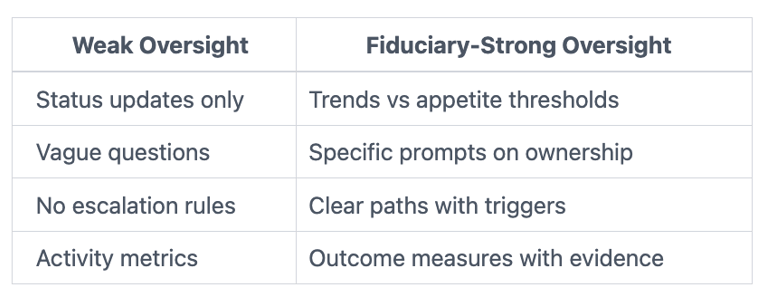
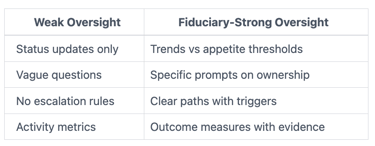
This framework guides you. Implement it to show courts you acted. Reference board cyber governance best practices. Or learn how boards set technology risk appetite for thresholds.
Key Elements of a Board-Ready Dashboard
Include four must-haves. First, risk posture trends over quarters. Second, incident readiness scores from tests. Third, AI governance gaps with owners. Fourth, vendor control coverage.
These prove fiduciary care. Trends show if you stay within appetite. Tests confirm recovery works.
Questions Your Board Should Start Asking Today
You lead with sharp questions. Group them by focus. Start on risk appetite.
Does our risk appetite cover AI decisions and vendor downtime?
Who owns top tech risks, with escalation triggers?
What trends show us drifting outside appetite?
How do reports tie cyber gaps to revenue impact?
When was the last incident test, and what changed?
Which vendors could halt operations, and what's our backup?
What decisions do you need from us this quarter?
Use these quarterly. They build records. See board incident response oversight for escalation details. Or audit committee cybersecurity questions.
Your Next Steps to Meet Fiduciary Duty
Strong oversight starts now. Pick three questions above. Review your last tech report against dashboard elements. Schedule a risk appetite workshop.
FAQs
How often should you review tech risks? Quarterly fits most boards. Tie it to business changes like AI rollouts or vendor shifts. Monthly signals catch drifts early.
What if management resists deeper questions? Insist on evidence. Assign owners and dates. Escalate to CEO if needed. This shows your care.
Does this reduce personal liability? Yes, records of appetite, trends, and decisions defend you. Courts seek proof of process, not perfection.
How do you set risk appetite quickly? Run a one-day session on crown jewels and thresholds. Document outcomes. Review annually.
You build trust and speed with these steps. Growth accelerates without blind risks.
Tyson Martin is the executive public and pre-IPO companies in financial services, AI/data, SaaS, and cloud hire to make trust a measurable asset, one accountable answer to Is it secure? Is it resilient? Is the AI governed?
© 2026. All rights reserved.
Navigation
Free Resources
Contact


Stay ahead of your next board agenda
Sign up for Reports & Learnings From the Boardroom. Plain-English AI and cyber governance insights, biweekly. No pitch.
No spam. Unsubscribe anytime. · Or download the Director's AI Question Pack — 25 questions free