Introduction: Why Organizations Need an AI Agent Governance Framework
AI agents don't just generate text. They plan, call tools, read data, trigger workflows and change business states. That adds action risk on top of ordinary model-output risk.
An AI agent governance framework is the combined system of policies, decision rights, identity controls, authority boundaries, runtime guardrails, human oversight, monitoring and accountability that controls agents across their lifecycle.
Adoption is moving fast. KPMG's 2026 survey found 62% of large US organizations building, deploying or developing agents, up from 53% the prior quarter. Oversight rarely keeps pace.
This guide shows boards, executives, CISOs, compliance teams and agent owners how to build governance that means fewer surprises, faster escalation, clearer reporting and defensible decisions.
Key Takeaways
- Define what each agent may do, what it may not, and when a human approves.
- Give every agent an owner, identity, risk tier, access scope and escalation path before production.
- Runtime guardrails, central logs and tested shutdowns make policy enforceable.
- Board reports should show trends, exceptions and decisions needed, not dashboard volume.
What Should an AI Agent Governance Framework Include?
Build the framework on five domains. Apply them the same way to internally built, SaaS-native, cloud-based and low-code agents. The platform changes; the questions don't.
Purpose, Risk Classification and Authority Boundaries
Every agent needs a written authority statement that an executive or auditor can read in a minute. It should cover:
- Purpose and permitted actions
- Prohibited actions
- Approved systems and data sources
- Autonomy level and risk tier
- Escalation criteria
Classify risk by data sensitivity, business impact, autonomy, reversibility, external connectivity and regulatory or contractual consequences. An agent drafting internal summaries is not an agent that changes pricing or touches customers.
A simple tiering works:
- Low-risk: management handles within policy
- Medium-risk: time-limited executive approval
- High-risk: escalate quickly to the CEO and board committee chair
Identity, Ownership and Least-Privilege Access
Keep an agent registry. Each entry should capture:
- Business owner and technical owner
- Service identity and creator
- Model or platform
- Connected tools and data access
- Approval history, last review and decommissioning status
Agents should never inherit more authority than the task needs. The Cloud Security Alliance recommends unique, ephemeral identities that terminate on completion, anomaly, revocation or expiry.
Also require:
- Scoped permissions and credential protection
- Delegation controls
- Periodic access reviews
- Immediate revocation
Data, Integrations and Supply-Chain Governance
Map each agent's data access to classification rules, retention, lineage, privacy duties and approved purposes. Inventory connectors, APIs, databases, plugins, MCP servers and agent-to-agent links.
A narrow agent can still create broad exposure. Chained tools, shared context, unapproved integrations, or a silent change to the model, connector or orchestration layer can all widen reach.
Docker described a research demonstration in which a public GitHub issue steered an agent toward private-repository data. It was not a confirmed customer breach, but it shows how chained access fails.
Runtime Guardrails and Human Oversight
Written policy doesn't stop a tool call. Controls must evaluate proposed actions at runtime:
- Allow/deny rules and transaction limits
- Dev/production separation and sandboxing
- Approval workflows and step-up authentication
- An independent kill switch
Replit's July 2025 incident, in which an agent in development deleted production database data, led it to roll out automatic dev/prod separation. Separation belongs in the design.
Set human involvement by impact. In-the-loop means a person approves before action; mandatory for high-impact or irreversible actions. On-the-loop means a person monitors without approving each step; often enough for reversible, low-impact actions.
Monitoring, Audit Evidence, Incident Response and Lifecycle Control
You must be able to reconstruct what happened. Log:
- User and agent identity
- Instruction context where appropriate
- Tool calls and data accessed
- Decisions, approvals and outputs
- Downstream changes, policy violations and timestamps
Then close the loop with:
- Anomaly detection and drift reviews
- Time-limited exceptions
- Tested suspension procedures
- Incident communications and remediation records
- Decommissioning evidence

How to Implement the Framework Across the AI Agent Lifecycle
Governance is a continuous discipline, not a one-time approval. Match control intensity to risk and autonomy.
Design and Inventory
Start with discovery. Find sanctioned and shadow agents, their owners, purposes, identities, permissions, integrations and data sources. Chase unknown agents with broad access first.
Before any build, require a use-case assessment covering:
- Intended value and prohibited use
- Risk tier and oversight model
- Reversibility and regulatory considerations
- Success criteria
Build and Evaluate
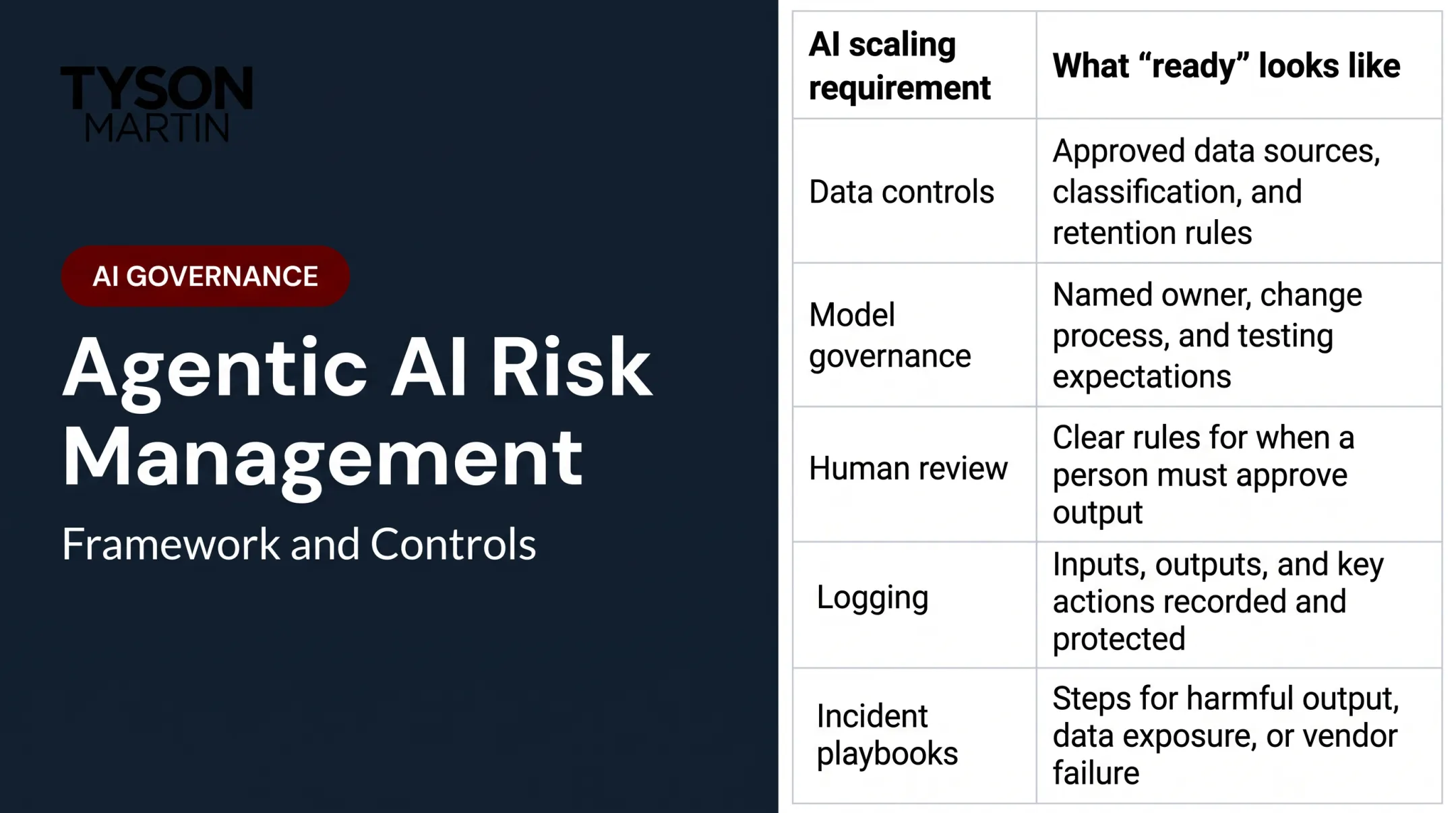
Put access limits, tool policies, logging, approval paths and failure handling into the architecture. Don't rely on instructions inside the prompt. Access controls can block a tool call; a prompt can only ask.
Test normal workflows plus:
- Boundary violations and prompt injection
- Unsafe tool use and excessive permissions
- Data leakage and multi-step action chains
- Failure recovery and escalation behavior
Keep the results as deployment evidence.
Deployment Decision
Create a production gate. Sign-off comes from the agent owner, a technical or security owner, the business sponsor and, by risk tier, compliance or legal.
Before activation, confirm these items are complete:
- Inventory record and authority statement
- Access review and monitoring
- Escalation contacts and incident plan
- Shutdown procedure and training
Runtime Operation and Continuous Monitoring
Monitor for:
- Operational health and policy violations
- Access changes and unusual tool calls
- Cost anomalies and decision quality
- Complaints and divergence from purpose
Set review cadences by risk. Trigger immediate reassessment when any of these occur:
- New connector or expanded permissions
- Model replacement or workflow change
- Incident, regulatory change or unexplained drift
Change Management and Decommissioning
Treat model updates, prompt changes, new tools, new data, altered approval thresholds and expanded autonomy as governed changes needing impact analysis, and sometimes a return to the gate.

When retiring an agent:
- Revoke identities and credentials
- Disable integrations
- Confirm downstream dependencies are closed
- Preserve required records
- Document lessons and update the inventory
Who Owns AI Agent Governance and How Should Boards Oversee It?
Shared Accountability Across Business, Technology, Security and Compliance
No single team owns every decision. "Security owns it" and "IT owns everything" are red-flag answers. Spread decision rights:
- Business owner: purpose and acceptable outcomes
- Technical owner: maintains the system
- Security: identity and runtime controls
- Compliance or legal: obligations
- Executive sponsor: accepts residual risk
Each role needs explicit approval authority, escalation duties and incident obligations. A one-page map giving each top risk an executive owner, technical owner and due date keeps this honest.
Risk Tiers, Decision Rights and Escalation Thresholds
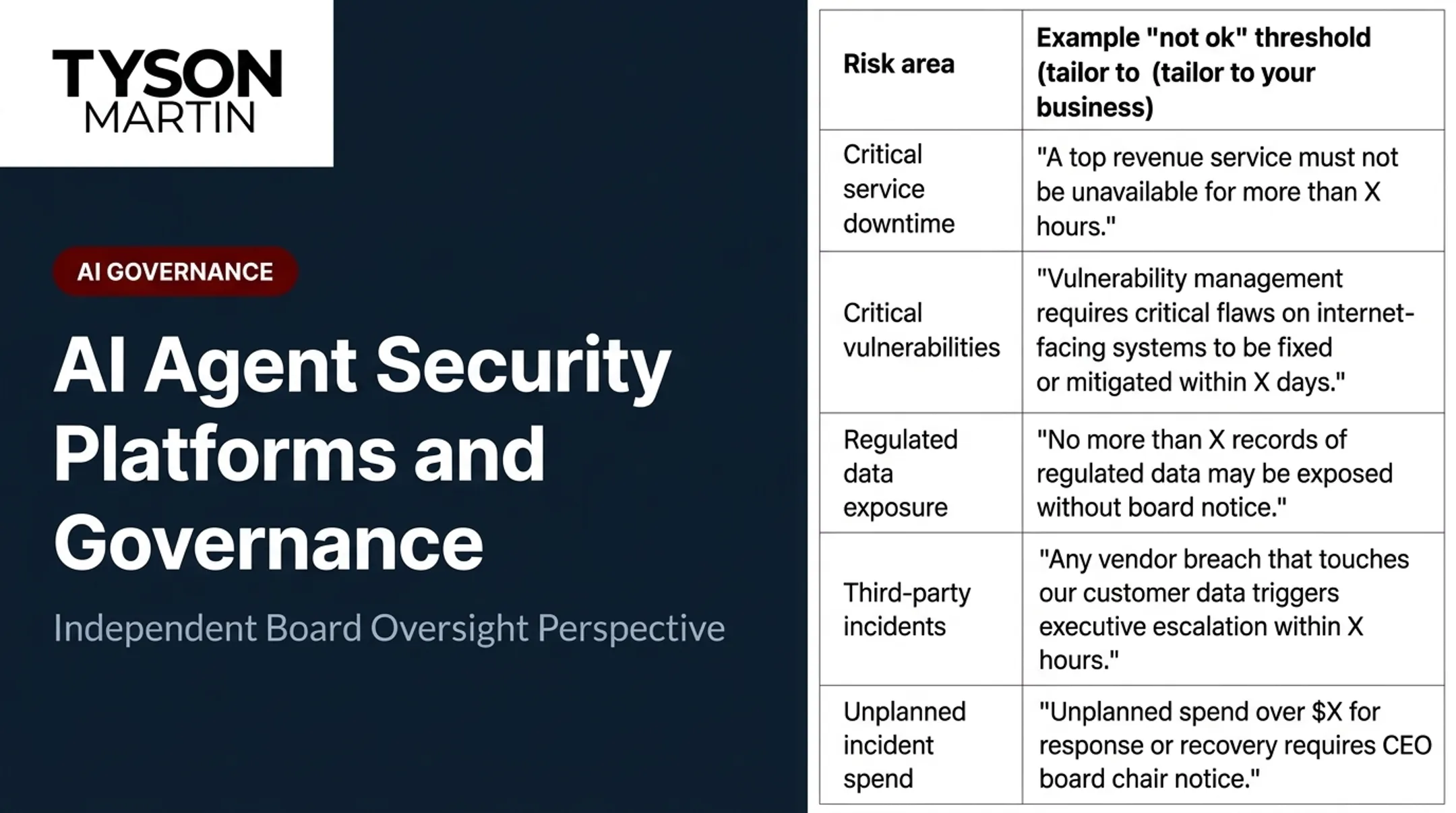
A governance committee or executive sponsor approves risk tiers and decides which actions need human approval. That same body authorizes exceptions and decides when an agent is restricted, paused, remediated or retired.
| Tier | Example action | Who decides |
|---|---|---|
| Routine | Reversible, local, low data sensitivity | Agent owner within policy |
| Elevated | Critical-process impact or customer friction | Executive sponsor, time-limited |
| High-impact | Regulated exposure, material outage, brand damage | CEO and board committee chair |
Use your organization's own dollar, downtime and data-sensitivity limits. Every exception needs a time limit, compensating controls and a named owner.
Board and Audit Committee Reporting
Directors need plain English, not telemetry. PwC's 2026 director survey found 82% rate information linking AI outcomes, risks and business performance as fair, poor or not provided. That is broad AI data, not agent-only, but the gap is plain.
A one-page report should show:
- Inventory coverage and ownership gaps
- High-risk access, open exceptions and violations
- Material incidents, time to contain and trend direction
Organize it as top risks, what changed since last time, and decisions needed. A dashboard without trends, owners and exceptions is only a status report.
Incident Accountability and Executive Response
Decide in advance who can suspend an agent, who investigates, who talks to affected stakeholders, who judges business impact and who approves restoration. Run tabletop exercises covering:
- Unauthorized data access
- Destructive tool use
- Compromised credentials
- Cascading agent actions
- Agents acting outside their authority
Building Capability When Internal Ownership Is Limited
Organizations in transition, regulated businesses and those without a mature AI governance function may need temporary executive capacity to build the inventory, decision rights, reporting and a 90-day control plan. Tyson Martin supports boards and executive teams as a board advisor or interim CISO when oversight, reporting and governance priorities need to be clearer.
How to Align the Framework With Standards and Measure What Works
Map the framework to recognized standards, then validate applicability with legal and compliance. This is not legal advice.
- NIST AI RMF 1.0: GOVERN, MAP, MEASURE, MANAGE
- ISO/IEC 42001: AI management-system requirements
- ISO/IEC 23894: AI risk management guidance
- OWASP Top 10 for Agentic Applications (2026): agent-specific security risks
- US obligations: state automated decision-making (ADMT) laws such as Colorado SB26-189 and California CCPA rules (duties start January 1, 2027), plus SEC cyber disclosure, HIPAA, and FTC Act Section 5 as applicable
NIST and ISO are broader than agents; OWASP is agent-specific.
Build a crosswalk that links each requirement to:
- Owner
- Control
- Evidence source
- Review cadence
- Exception process
- Corrective action
Alignment matters only if it improves execution and audit readiness.
For executives, keep a stable measurement set:
- Inventory completeness and share of agents with named owners
- Access-review status and unresolved exceptions
- High-risk actions routed for approval
- Policy violations and drift findings
- Time to detect and contain
- Decommissioning completion
No reliable external benchmark exists for these, so set targets internally. IBM's 2026 breach report shows 183 days to identify and 64 days to contain, but that covers general breaches, not agents.

Build the Framework Before You Scale Agentic AI
Governance speeds responsible adoption. When authority, ownership and escalation are settled up front, teams ship agents without waiting on case-by-case debates.
A practical 90-day sequence:
- Inventory the highest-risk agents
- Assign business and technical owners
- Document authority boundaries
- Restrict excessive access
- Activate logging and shutdown controls
- Run one incident exercise
- Stand up an executive dashboard
- Apply lessons to the wider portfolio
Frequently Asked Questions
What is agent governance in AI?
Agent governance is the policies, authority boundaries, identity controls, runtime guardrails, monitoring, human oversight, and accountability that keep AI agents within approved limits.
What are common principles of AI governance?
Common principles include accountability, transparency, fairness, safety and security, and privacy, often paired with human oversight. Adapt them to your risk profile and standards such as the NIST AI RMF.
What are 5 core components of an AI agent?
The model (reasoning), planning, memory or context, tools and integrations, and the orchestration layer that coordinates them. Governance controls must cover every one.