Introduction
In the first hour of a cyber incident, leaders want everything. Responders have fragments. Poorly managed communication fills that gap with guesses, which delay decisions and erode trust.
The Unisys case shows the risk. The SEC fined Unisys $4 million after finding it described cyber risks as hypothetical when it knew intrusions had exfiltrated data.
An incident response communication plan is the pre-approved framework for who communicates, what gets shared, which channels are used, how messages are approved, and when updates arrive.
This guide covers building the plan, running it live, tailoring messages by audience, and improving it through testing.
Key Takeaways
- Decision rights, escalation thresholds, and approved channels must exist before the incident.
- Every update separates confirmed facts, unknowns, impact, actions, decisions needed, and the next update time.
- Responders, executives, customers, regulators, and media each need different detail.
- Test communication alongside technical response and track trends over time.
Why Incident Response Communication Matters
Communication supports containment and recovery. Verified information has to reach the people who authorize actions, remove blockers, and manage expectations. If leaders cannot explain what changed in the last 24 hours, the response has activity but not control.
How It Differs from Crisis Communications and Outage Notices
A routine outage notice describes a known fault. A cyber incident is messier:
- Evidence is incomplete and changes hourly
- Legal and privacy sensitivities apply from the start
- An active adversary may be watching
- Regulatory clocks may be running
CISA's service-provider guidance favors candid uncertainty over silence or speculation, while warning that too much detail can jeopardize the investigation.
The Business Cost of Getting It Wrong
Credibility usually breaks in one of two ways: overpromising and walking it back, or hiding uncertainty and being caught by new facts. Either path drives downtime, customer distrust, regulatory exposure, and rushed executive decisions.
IBM's 2026 report puts average breach notification cost at $0.45 million per breach, though that measures notification effort, not loss caused by poor messaging.
Build an Incident Response Communication Plan Before an Incident
Define Scope and Activation Criteria
Define which events activate the plan, including:
- Suspected compromise or confirmed breach
- Ransomware and material service disruption
- Third-party incidents, data exposure, and insider threats
- Anything needing executive or regulatory involvement
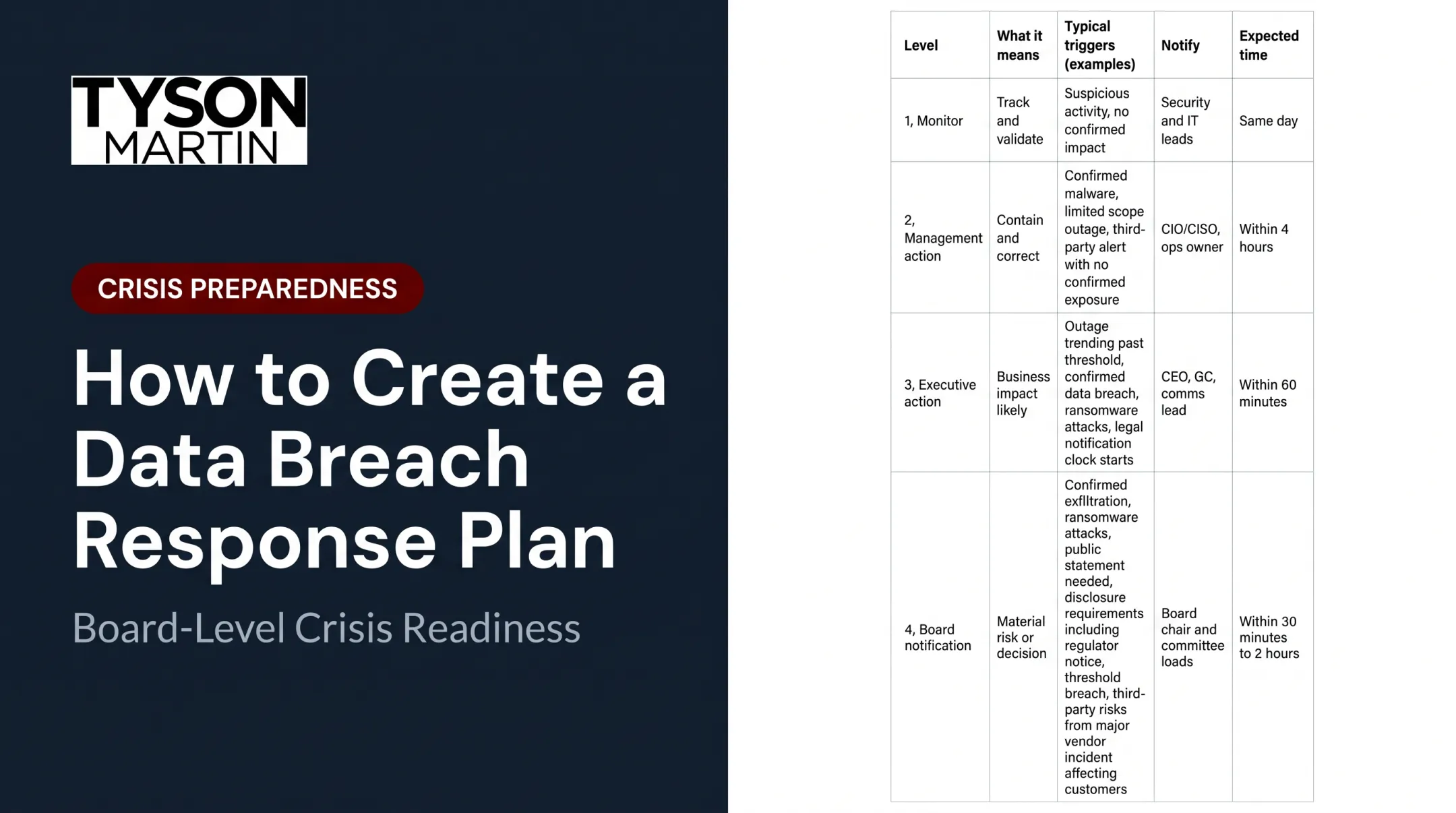
Make severity levels measurable so non-technical leaders can apply them. One workable four-level ladder:
| Level | Trigger | Who is notified, and when |
|---|---|---|
| 1 Monitor | Suspicious activity, no confirmed impact | Security and IT leads, same day |
| 2 Management action | Confirmed malware | CIO or CISO within 4 hours |
| 3 Executive action | Likely business impact, such as a confirmed data breach | CEO and legal counsel within 60 minutes |
| 4 Board notification | Material risk or severe-incident decisions | Board chair and committee leads, 30 minutes to 2 hours |

Assign Roles and Decision Rights
Name primary and backup owners for each role:
- Incident commander
- Security lead
- Communications lead
- Executive liaison
- Legal and privacy counsel
- Compliance, HR, customer support, and PR
One incident commander runs the clock.
Then settle who can:
- Declare an incident or severity level
- Approve containment actions, including system shutdowns
- Authorize external statements
- Contact regulators or law enforcement
- Brief the board
- Hand off authority when the incident escalates
NIST SP 800-61 Rev. 3 expects roles, responsibilities, and authority to be documented and communicated in advance.
Build the Audience and Channel Matrix
For each audience, record information needs, approved channel, message owner, and fallback contact:
- Responders and executives
- Employees
- Customers, partners, and vendors
- Regulators and law enforcement
- Investors and media
Plan for failure. Email, identity systems, and collaboration tools may be compromised. CISA's #StopRansomware guide recommends hard-copy or offline plans and out-of-band calls during coordinated containment so attackers aren't alerted.
Prepare Templates and a Common Language
Draft templates in advance for:
- First acknowledgment and internal situation report
- Board brief and employee notice
- Customer message, partner notice, and regulator notification
- Media holding statement and resolution update
Each template should state:
- What is confirmed and what is under investigation
- Who is affected
- What the organization is doing
- What recipients should do
- When the next update comes
Have legal, privacy, communications, and business owners review them in advance. Templates are starting points, not permission to publish unverified claims.
Set Up a Single Source of Truth
Choose one authoritative record: a controlled incident log, or a single channel with pinned updates. It should hold:
- Timeline, verified facts, and decisions
- Owners, timestamps, and approvals
- Published messages
Define how corrections are issued, how conflicting reports are resolved, and who can access sensitive entries. NIST Rev. 3 also calls for restricted access and preserved data integrity.
Communicate Clearly During an Active Incident
Acknowledge Fast, Based on Verified Facts
The first half hour often decides whether the next two weeks are controlled or chaotic. Agree on three rules in advance: do not guess, do not overpromise dates, and say what you are doing next.
The first message should:
- Acknowledge the incident
- Describe known impact without speculation
- State the immediate response
- Give any action recipients must take
- Commit to the next update time, not a resolution time
The communications lead can issue a holding statement while technical teams keep investigating.
Set a Cadence Tied to Severity
Combine a fixed schedule with event triggers. Update when scope changes, containment status shifts, customer impact grows, a regulatory issue appears, or an executive decision is required.
Bridge calls every two hours work well early. Cover actions taken, open questions, risks, and next steps.
Communicate even when nothing has changed; CISA advises timestamping updates in that case. Just avoid repetition and details that expose the investigation.
Keep Executives and Boards on Decisions
Leadership needs four things each day:
- Known facts
- Clearly labeled suspicions
- Actions underway with owners and timing
- Decisions required that day
The board chair's first update, within 30 minutes, should cover a short summary, current impact, actions, and the next update time.
Tyson Martin's plain-English principle applies: what changed, what matters, what decision is needed, and how management is controlling the risk. Leave raw alerts and channel chatter with the incident team.

Tailor depth by role:
- CEO and COO need business impact
- General counsel needs legal exposure
- The audit committee needs control and disclosure status
Coordinate Internal and Customer-Facing Teams
Give the service desk, account teams, HR, and sales approved language, escalation contacts, and rules for handling questions. Point everyone to the authoritative timeline so side conversations do not create contradictory facts.
Permit specialized side channels only where the work requires them. No unapproved statements, even under pressure.
Protect Communication Integrity
- Use authenticated, access-controlled channels with a backup method
- Separate verified facts from hypotheses
- Avoid sharing unnecessary indicators or personal information
- Record approvals and revisions
- Preserve communication evidence with legal and forensic guidance
Close with a Clear Resolution Message
Confirm what is restored or contained, note remaining limits or monitoring, and tell stakeholders what to do next. State when the post-incident review or customer follow-up will occur.
Do not declare victory because systems are back up if eradication, notification, or heightened monitoring is still underway.
Tailor Communication to Stakeholders and Regulatory Needs
Responders and Operations Leaders
Share the following in the secure incident workspace:
- Indicators and affected assets
- Working hypotheses
- Assigned actions and dependencies
- Containment status
Require timestamps, owners, and decision records. Keep facts separate from assumptions.
Executives, Boards, and Committees
Translate findings into business exposure, operational consequences, legal considerations, customer impact, and decisions required.
The NACD handbook says board briefings should cover facts, impact, containment, and disclosure steps, with escalation thresholds and clear decision authority.
A stable dashboard showing trends works better than a stream of alerts.
Employees, Customers, Partners, and Vendors
- Employees: what is affected, and where official information lives
- Customers: practical impact, protective steps, support routes, and when to expect more
- Partners and vendors: notice when shared systems, contracts, supply-chain ties, or joint containment need their involvement
Regulators, Law Enforcement, and Counsel
Decide in advance:
- Who evaluates notification duties
- Who contacts each authority
- What evidence is preserved
- How messages stay consistent across jurisdictions
Engage general counsel, privacy, and compliance early, ideally by hour 6.
Duties depend on entity type, facts, data, and contract. Examples:
| Regime | Key requirement |
|---|---|
| SEC Form 8-K Item 1.05 | Four business days after a materiality determination, not discovery |
| State breach laws | All 50 states have them; definitions and timing differ |
| HIPAA | Individual notice within 60 days of discovery |
| FTC Safeguards Rule | FTC notice within 30 days for 500+ consumers |
| NYDFS Part 500 | 72 hours after determining a qualifying incident |
| Banking agencies | 36 hours after determining a notification incident |
| CIRCIA | Proposed 72 hours; not mandatory until the final rule takes effect |
Also check contracts, NIST, CISA, and ISO 27035 guidance. This article is not legal advice; confirm obligations with counsel.
Media and Public Audiences
Use one authorized spokesperson and a reviewed holding statement. Confirm awareness, avoid speculation, protect investigative details, and point readers to the official source.
Monitor social media and press for misinformation and new signals, but don't let unverified posts set the official narrative.
Test, Measure, and Improve the Plan
Run Cross-Functional Tabletops
Include the full response bench: incident commander, security, IT, legal, privacy, communications, HR, customer support, executives, and a board or committee representative. CISA's tabletop packages offer customizable scenarios and after-action templates.
Inject stress every 10 to 15 minutes so the pressure stays realistic:
- Incomplete information
- A down email system
- Third-party involvement
- Conflicting demands
- A slow executive decision
- A notification deadline
Measure with Stable Indicators
Track a small set over time:
- Time to activate, escalate, and first acknowledgment
- Update timeliness
- Decision latency
- Escalation accuracy
- Message consistency
- Unresolved communication actions
- Stakeholder feedback
Use benchmarks cautiously. IBM's 247-day breach lifecycle measures identification and containment, not communication speed. Report trends and corrective actions, and don't let metrics replace judgment.
Hold a Blameless Review and a 90-Day Plan
Reconstruct the communication timeline. Look for unclear ownership, approval bottlenecks, channel failures, audience gaps, and confusing messages. Convert findings into owners, due dates, updated templates, revised thresholds, and a focused 90-day plan.

Where internal ownership is thin, Tyson Martin's board advisory and interim or fractional CISO support can establish the governance and operating rhythm.
Conclusion: Make Incident Communication Executable
An incident response communication plan works as an operating capability you can run under pressure. It defines authority, protects verified information, supports business decisions, and preserves trust when it matters.
Start this month:
- Compare your current plan against this guide.
- Validate decision rights and fallback channels.
- Run a cross-functional exercise.
- Report improvement trends to executives and the board.
Frequently Asked Questions
What is an incident response communication plan?
It is the framework for roles, audiences, channels, approvals, escalation thresholds, message templates, and update cadence during a cybersecurity incident. It is agreed before anything goes wrong.
Who should be responsible for incident response communication?
The communications lead owns messaging, while the incident commander keeps operational authority. Legal, technical, executive, privacy, and business stakeholders contribute according to defined decision rights.
What should the first message during a cyber incident include?
Acknowledge the incident, state confirmed impact and immediate actions, and tell recipients what to do. Note what is still unknown, and give the time of the next update.
How often should you communicate during a cybersecurity incident?
Set cadence by severity and material developments. Send regular, timestamped updates even when little has changed, and never promise an uncertain resolution time.
How should organizations communicate with customers and regulators after a data breach?
Validate facts first, then get legal and privacy review. Apply the relevant federal, state, and sector requirements, tailor language to each audience, preserve evidence, and keep every notification consistent.
How should executives and boards be briefed during a live incident?
Lead with business impact, confidence level, risk, response progress, decisions required, and the next milestone. Leave raw technical detail with the response team.