Introduction
Cybersecurity stopped being an IT problem years ago. It now touches business continuity, financial results, legal exposure, reputation, and stakeholder trust. The IBM Cost of a Data Breach report puts the US average breach cost at $11.5M, against a global average of $4.99M.
Directors are expected to exercise informed oversight, and many struggle to do that without drowning in technical detail.
This guide helps US boards understand their responsibilities, separate governance from management, ask useful questions, judge the reports they receive, and make decisions they can defend. It is general guidance, not legal advice.
Key Takeaways
- Fold cyber risk into enterprise risk management and tie it to strategy and risk appetite.
- Name owners across the board, committees, executives, CISO, and legal counsel.
- Demand reports on business impact, trends, and open decisions, not activity counts.
- Keep records of active oversight: minutes, approvals, exercises, and follow-up.
Why Cybersecurity Is a Board-Level Responsibility
Cloud adoption, remote access, customer data, AI tools, and interconnected suppliers mean one failure can hit revenue, operations, safety, compliance, and valuation at once. Verizon's 2026 DBIR found third-party involvement in 48% of breaches, a 60% jump year over year.
Governance versus management
The roles differ, and blurring them causes trouble in both directions.
- The board sets expectations, approves risk appetite, oversees strategy and resources, challenges assumptions, and monitors outcomes.
- Management selects and runs controls, handles daily risk, leads response, and reports material changes upward.
The board should not direct engineers on containment, debate tools during a live incident, or freelance external communications. It does own oversight of material risk, readiness funding, and disclosure posture, and it cannot hand those off.
The US oversight environment
Legal duties vary by entity type, sector, and state. A few anchors:
- Delaware oversight law. Caremark claims require bad faith, either an utter failure to implement reporting systems or a conscious failure to monitor them. A breach alone does not meet that bar.
- SEC rules (public companies). Item 1.05: disclose material incidents within four business days of the materiality determination. Item 106: annual descriptions of risk management, board oversight, and management's role.
- Regulated sectors. NYDFS Part 500 and the FTC Safeguards Rule require annual CISO or board reporting where they apply. HIPAA and PCI DSS add separate obligations.
- State law. All 50 states and DC have breach-notification statutes, and the details differ.
- CIRCIA. Federal incident-reporting rules are still pending a final rule. Do not treat proposed deadlines as in force.
Verify applicability with counsel before relying on any of this.
The Core Responsibilities of a Board of Directors
Set cyber risk appetite and strategic priorities
Ask management to express exposure in business terms: downtime, financial loss, customer impact, safety, regulatory exposure, and recovery capability. Concrete thresholds beat adjectives. Examples include restoring a customer portal within 6 hours of a major outage, or tolerating no more than 15 minutes of order-data loss.
Then approve priorities tied to the services, data, and dependencies that matter most. That is a different job from approving a tools budget. A one-page appetite statement also cuts the "we need more data" stalling.
Establish clear accountability and reporting lines
Spell out who does what:
- Full board: overall oversight and appetite
- Audit or risk committee: regular reports and follow-up
- CEO and COO: enterprise decisions and funding
- General counsel: legal and disclosure coordination
- CISO and CIO: program execution and candid reporting
- Business-unit leaders: risk ownership in their areas
Define who receives regular reports and who may escalate urgently. Security leadership also needs authority, access to decision-makers, and resources. Deloitte's 2024 survey found roughly one-fifth of CISOs report directly to the CEO, a global benchmark rather than a rule.
Oversee investment, talent, and execution
Tie spending and staffing to documented risk, business priorities, and measurable outcomes. Choices should follow a ranked roadmap, not the loudest request.
Ask whether the organization has the right internal expertise, managed services, succession coverage, and executive backing for its stage. Key-person dependence is a common weak spot.
Monitor resilience and incident readiness
Oversee incident response, business continuity, disaster recovery, backup protection, crisis communications, and legal coordination. Confirm who holds decision authority in a major event.
A written plan is not proof of readiness. Verify that tabletop exercises happened, lessons have owners, and recovery assumptions were tested. Two tests matter: a tabletop that forces executive decisions, and a recovery test that restores critical systems and data.
Address third-party, AI, and systemic risk
Third-party oversight should include:
- Vendor access and critical suppliers
- Cloud providers and software dependencies
- Concentration risk, data sharing, and contract terms The July 2024 CrowdStrike update failure hit about 8.5M Windows devices and was not an attack, which shows how common-provider dependency alone can halt operations.
On AI, ask how internal use is governed, how confidential data is protected, and how AI-enabled threats such as deepfake fraud are evaluated. IBM found 68% of breached organizations lacked AI governance to manage AI or detect shadow AI.

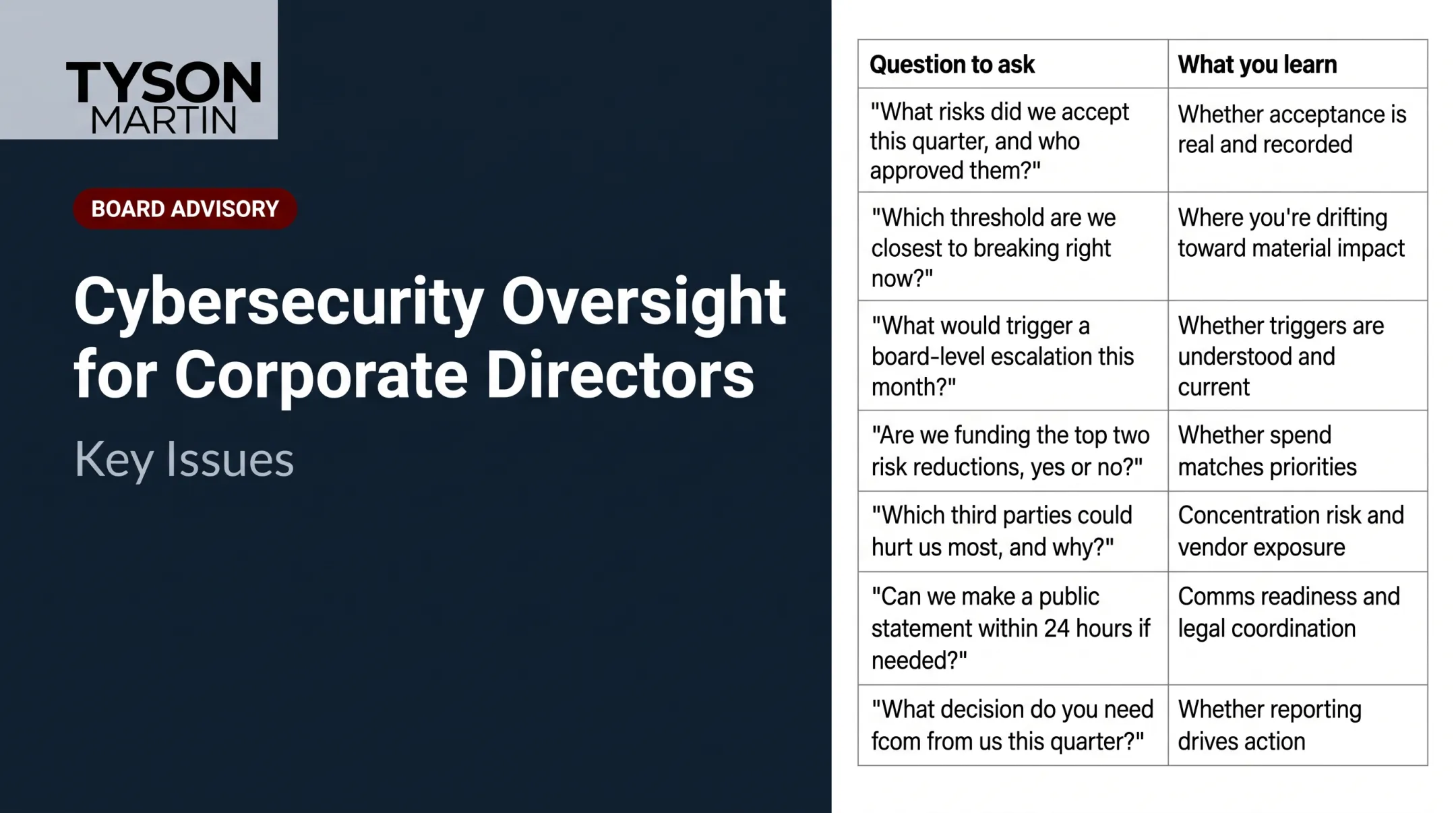
What Boards Should Ask Management About Cybersecurity
Use these questions in management briefings to move past status updates into business impact, ownership, and residual risk.
Risk exposure and business impact
- What are our most significant cyber risks, stated as business impact?
- Which business services would be hit first?
- What assumptions support management's assessment?
- What changed since the last briefing?
- Which risks sit outside approved tolerance?
A strong answer names three to five scenarios, each with impact and an owner.
Security program effectiveness
- Which controls protect critical assets and identities?
- How is control effectiveness tested?
- What did independent assessments, audits, or penetration tests find, and what was fixed?
Compliance is not proof of control. A dashboard can show 97% of critical vulnerabilities closed while one unpatched system still interrupts customer onboarding for 48 hours. Frameworks and certifications should support risk-based judgment, not replace it.
People, authority, and resources
- Does security leadership have the authority, budget, staff, and executive access it needs?
- Do key responsibilities rest on one person?
- How are training, privileged access, and insider risk handled?
- Who holds decision authority when senior technology leaders are unavailable?
Incident response and escalation
- When would the board be told, and who decides materiality?
- How are legal and disclosure decisions coordinated?
- How do we communicate if corporate systems are compromised?
- When was the last exercise, what lessons remain open, and what changed afterward?
- What do backup restoration tests show about actual recovery times?
Third-party and emerging technology exposure
- How are critical vendors assessed before onboarding and monitored afterward?
- Do contracts require prompt incident reporting?
- When do we replace a vendor whose risk is unacceptable?
- What is our exposure to shadow AI, sensitive data in external tools, software supply chains, and impersonation?
- Can management explain these risks in business language?
Strong answers cite the contract clause, not a verbal assurance. One vendor was assumed to report quickly, but the contract never required it.
How to Build a Board-Ready Cybersecurity Report
What a cybersecurity report is for
A cybersecurity report is a recurring leadership document covering risk posture, material changes, control performance, incidents, decisions needed, and progress against agreed priorities. It exists to help directors make decisions and meet oversight duties. It is not a dump of alerts, tickets, or tool output.
Use a consistent structure
Keep the format and glossary stable so trends are comparable. Include:
- Executive summary
- Current risk posture
- Changes since the last report
- Critical assets and dependencies
- Control effectiveness
- Incidents and near misses
- Third-party exposure
- Major initiatives and resource needs
- Decisions requested from the board
One page of summary plus one page of detail works well. A useful update answers, in order: what changed, what it means, what management is doing, what support is needed, and what happens if action slips.
Pick metrics that tell a story
Good candidates:
- Coverage of critical assets
- Identity and privileged-access protection
- Remediation of high-risk findings
- Detection and response performance
- Recovery-test results
- Third-party assurance
- Unresolved exceptions
Every metric needs context: the risk it represents, direction of travel, target or tolerance, data source, and the action triggered by decline. Directors do not need "87.3%." Ranges and plain targets work better. Twenty-five numbers ask directors to guess what matters.
Report decisions, exceptions, and uncertainty
Highlight overdue remediation, accepted risks, control limitations, conflicting evidence, and resource gaps. Use plain statements: what could happen, how likely or disruptive, what is being done, what is unknown, and when it returns for review.
Perception gaps are real. In Splunk's 2025 research, 29% of CISOs called budgets adequate versus 41% of board members. Candid reporting closes that gap.
Set cadence and escalation rules
NACD guidance suggests reporting at least quarterly, with immediate updates after material incidents or major exposure shifts. That is guidance, not a statutory schedule. A practical rhythm is quarterly board updates, monthly committee touchpoints, and fast escalation when something breaks.
Define escalation triggers: financial impact, customer exposure, operational disruption, or disclosure implications. A one-page escalation ladder prevents both silence and overreaction.

When an organization lacks consistent security leadership or is in transition, an independent board advisor or interim CISO can help. Tyson Martin works with boards on exactly this: stable dashboards, clear decision rights, and credible reporting, independent of the in-house CISO and security vendors.
A Practical 90-Day Action Plan for the Board
No authoritative benchmark validates a 90-day timeline, so treat it as a practical structure, not a requirement.
Days 1-30: Establish the baseline
Ask management for:
- Risk register and critical-asset view
- Security org chart
- Incident response plan
- Third-party inventory
- Recent assessments and open high-risk exceptions
- Current board reporting
Compare them for consistency. Note where evidence, ownership, thresholds, or business-impact views are missing. A risk register that runs 50 pages will not get used.
Days 31-60: Clarify decisions and test readiness
- Approve or refresh risk appetite, reporting cadence, committee ownership, and escalation thresholds.
- Coordinate how materiality is determined.
- Set expectations for management follow-up.
- Schedule a tabletop with executives, legal, communications, technology leaders, key vendors, and a board representative.
Tabletop injects should arrive every 10 to 15 minutes with new facts, rumors, or regulator notices.
Days 61-90: Turn findings into accountable execution
Require a prioritized improvement plan with named owners, dependencies, milestones, resource needs, and progress measures. The next board report should show what changed and what remains blocked.

Outside support fits during a leadership transition, merger, modernization effort, material incident, or stretch of inconsistent reporting. NYDFS lets covered entities use a third-party CISO but leaves compliance responsibility with the entity.
Frequently Asked Questions
What is a cybersecurity report?
A cybersecurity report is a board-level summary of cyber risk, material changes, incidents, control effectiveness, decisions, and progress. Unlike a technical security operations report, it focuses on business impact and choices for directors.
What are the board of directors' responsibilities for cybersecurity?
Directors set risk appetite, oversee strategy and resources, hold leaders accountable, and monitor resilience, incident readiness, and third-party risk. They document follow-up, while management runs daily operations.
How often should a board receive cybersecurity updates?
Quarterly is a common baseline, adjusted to the organization's risk profile. Material incidents or significant exposure changes should trigger immediate escalation.
What cybersecurity metrics should a board review?
Focus on business-oriented indicators: critical-asset coverage, control effectiveness, remediation trends, response capability, recovery testing, third-party exposure, and unresolved exceptions.
What questions should directors ask the CISO?
Ask about the most significant current risks, their business impact, changes since the last briefing, control limitations, resource needs, incident readiness, and decisions needing board attention.
How can a board demonstrate effective cybersecurity oversight?
Keep minutes showing real discussion and challenge, clear committee ownership, documented decisions, and regular reporting. Show tested response plans, tracked remediation, and follow-up on material risks.