Introduction
Boards don't need more security data. They need a reliable view of exposure, likely business impact, what management is doing, and which decisions need oversight.
The gap is real. In an IANS and Artico survey, 82% of directors rated regulatory-trend reporting satisfactory or excellent, but only 47% said the same about explaining how evolving threats affect the business. Only 30% described a strong, collaborative relationship with their CISO. The sample of directors was small (17), so treat it as a signal, not a verdict.
This article covers four principles: translate exposure, build a stable report, measure meaningful change, and connect reporting to governance and action.
Key Takeaways
- Lead with top risk scenarios, what changed, residual exposure, and business consequence.
- Define every board metric once, then show its trend and cause.
- Make risk owners, decision rights, and escalation thresholds explicit.
- End with decisions, owners, and a time-bound plan, not a list of tools or tickets.
Why Modern Board Reporting Breaks Down
Alert volumes, patch counts, maturity scores, and compliance percentages help security teams run the program. They don't answer what a director asks: how exposed are we, what would it cost, are we ready, and what trade-off are you asking me to approve?
A packet with 10 charts and zero decisions makes leaders feel informed without putting them in control.
Static, inconsistent reports erode confidence
Reports fail in predictable ways:
- Metrics change every quarter, so trends can't be compared.
- Detail buries shifts in cloud, identity, third-party, or business-process exposure.
- A 50-page risk register goes unread.
- Control gaps get listed as if they were risks.
Oversight versus execution
The board oversees risk, sets appetite, allocates capital, and holds management accountable. Management and control owners execute.
The SEC's Regulation S-K Item 106 reflects this split. It requires annual 10-K descriptions of board oversight and management's role in assessing and managing material cyber risks, as described in SEC guidance. It's a disclosure rule, not a report template, and legal counsel should confirm how it applies to your organization.
Principle 1: Translate Cyber Risk Into Business Exposure
Start with a board-level risk statement
Use one structure for every top risk:
- Scenario: the business asset or process and the threat or event
- Impact: the likely operational or financial consequence
- Likelihood: how probable, and how fast it could move
- Controls in place: what currently reduces exposure
- Residual risk: what remains after those controls
- Decision ask: what you need from the board

Keep the vocabulary straight
Boards get confused when terms blur. NIST's glossary gives workable definitions:
- Threat: an event or circumstance that could harm operations, assets, or people.
- Vulnerability: a weakness a threat could exploit.
- Control gap: a missing or weak safeguard.
- Incident: an occurrence that jeopardizes confidentiality, integrity, or availability.
- Risk: exposure to a potential event, a function of impact and likelihood.
- Business impact: the effect on revenue, customers, people, or obligations.
A simple taxonomy ties each of these to an asset, an owner, a control, and a board-level outcome.
Connect findings to enterprise consequences
Translate findings into revenue interruption, customer or employee harm, regulatory exposure, litigation, lost trust, safety concerns, or a stalled strategic initiative.
Illustrative scenario (hypothetical): The board has set acceptable customer-portal downtime at 4 hours on business days. Tested recovery is closer to 12 hours. The gap comes from backup isolation and restore time. The ask: fund a fix, estimated at $X over 60 days, or accept the exposure for a defined period.
Prioritize by appetite and materiality
Rank risks using likelihood, impact, velocity, asset criticality, control effectiveness, and response readiness. High technical severity doesn't automatically mean high business priority. A critical flaw on an isolated test system matters less than a moderate weakness in the order-fulfillment path.
Benchmarks help context but aren't forecasts. IBM's 2026 study put the US average breach cost at $11.5 million, from a nonstatistical global sample.
Turn budget requests into choices
For each request, show the exposure addressed, expected risk reduction, alternatives, dependencies, and residual risk if deferred. Then state the decision plainly: fund identity improvements tied to fraud and outage exposure, or approve a phased plan.
Principle 2: Build a Stable, Decision-Oriented Board Report
Lead with a concise executive summary
Open with one page that covers:
- Overall posture and changes since the last report
- Top unresolved risks
- Material incidents or near misses
- Management's response
- Decisions requested
Use a repeatable architecture
Keep the sequence the same every time:
- Top risk scenarios
- Exposure and control effectiveness
- Incident and response readiness
- Third-party and technology dependencies
- Progress against priorities
- Decisions required

Push technical evidence to an appendix. A 10-slide readout plus a 2-page action plan usually beats a 60-page report.
Build a dashboard with fixed definitions
Define every metric with:
- Definition and scope
- Owner and data source
- Reporting period
- Baseline, target, or threshold
- Explanation of material changes
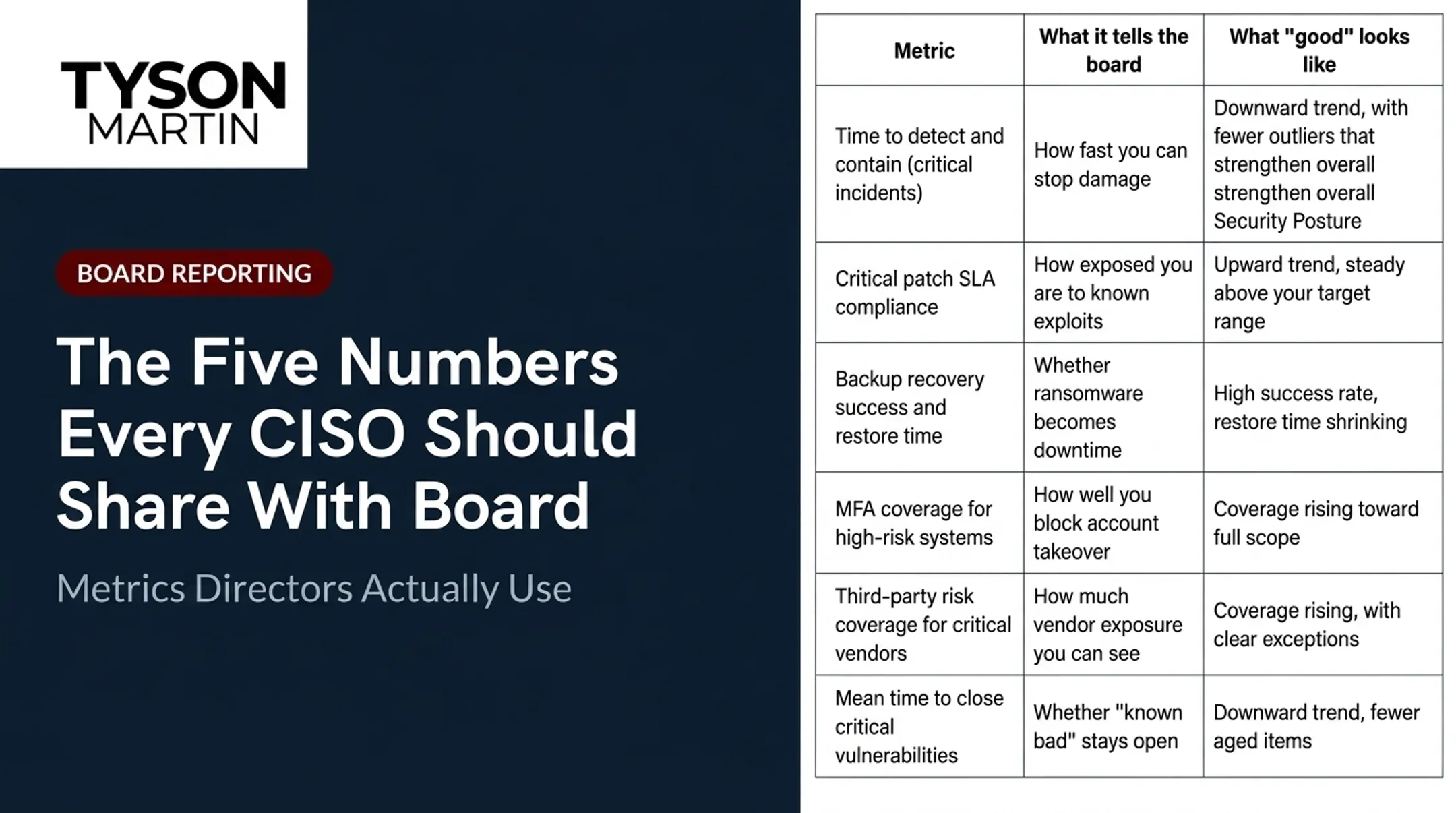
Set baselines in the first month, then commit to trend reporting. Aim for 8 to 12 metrics, with about five board-level outcome metrics held stable and supporting metrics rotated.
Match depth to the audience
- Pre-read: summary, dashboard, decisions requested.
- In the room: the two or three issues that need discussion.
- Management only: control detail, ticket status, tool performance.
Rehearse answers on exposure, risk acceptance, funding, and readiness before the meeting.
Set a cadence, plus event-driven escalation
A practical rhythm is quarterly board updates, monthly committee touchpoints, and fast escalation when something breaks. Escalate when:
- Risk shifts materially
- A significant incident occurs
- A critical dependency fails
- A threshold is crossed
Legal clocks differ from reporting practice. Form 8-K Item 1.05 requires filing within four business days after determining materiality, not after discovery. Confirm current SEC and CISA expectations with legal or compliance reviewers.
Principle 3: Measure Trends, Preparedness, and Accountability
Choose metrics that represent exposure and outcomes
Group board metrics into a few categories:
- Residual risk across priority scenarios
- Critical-asset coverage
- Control effectiveness
- Remediation of business-critical exposure
- Response performance and recovery readiness
- Third-party concentration
Showing 25 numbers asks directors to guess what matters.
Balance KRIs and KPIs
Key risk indicators signal exposure approaching or exceeding appetite. Key performance indicators show whether the program is performing.
Leading indicators such as patch latency, privileged access coverage, and restore-test results reveal emerging exposure. Lagging indicators such as incidents, losses, and downtime show whether improvements worked.
Report trends, not snapshots
A three-month trend shows whether risk is worsening, flat, or improving. Show movement against appetite and note changed assumptions.
External data adds context only. Verizon's 2026 DBIR found third parties involved in 48% of breaches, a 60% increase over the prior dataset. Use that to prompt questions, then answer them with your own vendor data.

Add narrative and confidence
For every important number, explain:
- What it means and what caused the change
- Which assets or business units are included, and what's excluded
- How reliable the data is
- What action follows
Boards don't need "87.3%." Use plain targets, such as critical patches above 95% on time or core services restored within 24 hours. Avoid false precision.
Assign owners
Map each priority risk to a named business owner, supporting control owners, an escalation threshold, a target date, and a measurable next outcome. One accountable leader per risk, not a committee.
When a metric goes red, clarify business impact, approve trade-offs, confirm owners and dates, and require a follow-up.
Principle 4: Turn Reporting Into Governance and Action
Make decision rights and thresholds explicit
Show who can accept, transfer, mitigate, or escalate each risk, and which conditions pull in the board or a committee. Identifying a risk doesn't make the CISO its owner. The CFO may own payment risk, the COO may own operational downtime, and the CIO may own platform risk.
Practical thresholds to set:
- Maximum tolerable downtime
- Maximum data-loss window
- Maximum fraud loss per period
- Exceptions expiring in 60 or 90 days with a named owner and compensating control
Escalate on a breach, a worsening trend, or repeat exceptions.
Close with an action and decision log
Record the board's direction, approved or deferred investments, accepted residual risks, owners, dependencies, and follow-up dates. Then convert those commitments into a 90-day plan with measurable outcomes. Reserve full-board time for material thresholds, major incidents, and large funding trade-offs. Leave deeper reviews to the audit or risk committee.
Know when independent support helps
Some organizations lack clear decision rights, credible reporting, or fast escalation. Tyson Martin provides board advisory and interim or fractional CISO leadership for these situations, with a 90-day plan, owners, and measurable outcomes the board can inspect. The advisory role supports management; it doesn't replace it.
Frequently Asked Questions
What are the top 5 cybersecurity risks?
There's no universal ranking. Commonly assessed categories include identity compromise, ransomware or disruptive attacks, cloud and configuration exposure, third-party risk, and data or business-process compromise. Rank them by your own assets, threats, and impact.
What is cybersecurity taxonomy?
It's a shared classification system for assets, threats, vulnerabilities, controls, risks, scenarios, impacts, owners, and metrics. It lets technical findings translate consistently into enterprise reporting.
How should a CISO report cybersecurity risk to the board?
Use a business-focused format that leads with top scenarios, exposure, impact, trend, residual risk, management response, decisions required, and owners. Skip raw technical activity.
What cybersecurity metrics should a CISO present to the board?
Present a limited, stable set of KRIs and KPIs covering exposure, control effectiveness, response and recovery readiness, critical assets, third parties, and progress against appetite.
How often should a CISO report cybersecurity risk to the board?
Follow a predictable cadence aligned to board and committee calendars, at least quarterly. Add event-driven escalation when material risk, incidents, or thresholds change.
What is the difference between a cybersecurity risk, threat, and vulnerability?
A threat is a potential cause of harm. A vulnerability is a weakness that could be exploited. Risk combines likelihood and business impact in a specific organizational context.