Introduction: Why CISO Reporting Structures Matter
A CISO's reporting line decides more than who signs the performance review. It shapes access to decision-makers, how independent risk assessments stay, who controls budget, how fast incidents escalate, and who answers for remediation.
The data shows how scattered practice is. IANS and Artico's 2026 survey found 46% of CISOs hold EVP or SVP titles, yet title says little about access to the CEO or board.
There is no universally correct structure. The right model depends on risk profile, regulatory exposure, operating model, leadership maturity, and whether the CISO has credible access to the board or the right committee.
Key Takeaways
- A CISO can report to the CIO, CEO, CRO, CFO, general counsel, or another executive, and each model has its own conflicts.
- Escalation rights, decision authority, and board cadence matter as much as the formal line.
- CIOs and CISOs have different jobs but must align on priorities, budgets, and execution.
- Test any structure by asking whether independent advice gets enough authority to drive action.
What Is a CISO Reporting Structure?
A CISO reporting structure is the formal and functional arrangement that determines who supervises the CISO, who receives security updates, who controls resources, and how cyber risk escalates.
The Pieces of the Arrangement
- Solid-line manager: the executive who sets goals, evaluates performance, and usually controls budget.
- Dotted-line relationships: secondary reporting to a CEO, CRO, or committee for risk visibility.
- Board or committee access: a separate oversight channel, not a management line.
- Operational partners: technology, legal, compliance, privacy, audit, and enterprise risk teams.
C-Level Is Not a Reporting Line
"C-level" describes executive responsibility and scope. It does not require a direct line to the CEO. A CISO can hold a C-suite title and report to the CIO, COO, or CRO, depending on the company's governance model.
The same applies to roles beneath the title. One documented ownership model assigns enterprise risk to the CEO, the security program to the CISO, key systems to the CIO or CTO, disclosure posture to legal, and recovery priorities to operations. The line on the org chart matters less than whether those assignments are written down.
Common CISO Reporting Lines and Their Trade-offs
Published benchmarks disagree because they sample different populations. IANS reports 64% of CISOs under IT leadership. Heidrick & Struggles' 2025 survey found 42% reporting to the CEO. Treat these as snapshots of different groups, not a US-wide norm.
CISO Reporting to the CIO
Benefits:
- Security is less of an outsider in IT planning.
- IT already has budget and project-management muscle.
- Implementation is faster because priorities are shared.
Conflict: the CISO must independently assess systems and projects the CIO owns. When priorities collide, security flaws may never reach executives, and security budgets can be cut to protect delivery.
CISO Reporting to the CEO or Executive Committee
This raises visibility, authority, and access to enterprise decisions. ISACA's analysis points to better business alignment and less CIO-related conflict.
The risks are practical. Benefits are not guaranteed. Direct CEO reporting can consume significant executive time, and strategy can drift from implementation unless the CISO and CIO share a clear operating model.
CISO Reporting to the CRO, CFO, or General Counsel
These lines tie cybersecurity to enterprise risk, financial exposure, legal obligations, privacy, and disclosure. Grouping the CISO with other risk executives can strengthen independent challenge.
The trade-off is distance. A CISO far from IT may struggle with budgeting, project awareness, and policy enforcement with the teams that carry out remediation.

Board and Committee Access
Board access is an oversight mechanism, not a substitute for daily management. Recurring sessions should cover:
- Material risks and changes since the last briefing
- Risk acceptance decisions
- Major incidents and remediation status
- Resource constraints
Frequency is not depth. IANS found 95% of CISOs give regular board updates, but only 25% get 30 or more minutes for cyber discussion.
Hybrid and Matrix Structures
A common hybrid is a solid line to the CIO with a dotted line to the CEO, CRO, or audit committee. FHLBank Indianapolis documents this in its 2025 10-K: the CISO works under the CIO, has a dotted line to the chief risk and compliance officer, and briefs a risk committee. Significant incidents trigger prompt reporting.
Matrices only work when decision rights, escalation thresholds, reporting frequency, and accountability are documented. Otherwise a dotted line is decoration.
How to Choose the Right Reporting Structure
Assess Risk and Complexity
Consider:
- Data sensitivity and operational dependence on technology
- Third-party exposure and threat environment
- Business-unit or geographic complexity
- Potential cost of a major incident
Enterprise customers asking for SOC 2 evidence, NIST CSF alignment, or ISO 27001 certification signal rising expectations. So does an incident or near miss in the last 18 months. Use benchmarks as context, not prescription.
Match the Line to Your Risk Governance Model
Pick the sponsor best placed to own security decisions. A CFO suits payment-heavy risk, a COO suits downtime-driven risk, and a CRO suits mature enterprise risk programs. If the reporting executive also owns the systems being assessed, the CISO needs a separate escalation path.
Regulation shapes this too. NYDFS Part 500 requires covered entities to designate a CISO and report in writing to the senior governing body at least annually. The FTC Safeguards Rule sets a similar annual floor for a Qualified Individual. SEC Item 106 requires disclosure of board oversight and management's role, but prescribes no org chart.

Test Independence and Authority
Ask:
- Can the CISO present an unfavorable risk assessment without editing?
- Can unresolved issues be escalated past the manager?
- Do security priorities compete fairly for funding?
- Can management formally accept residual risk, with an owner and expiry?
Clarify the CIO-CISO Relationship
ISACA's 2025 comparison separates the CIO's focus on technology strategy, projects, and IT budget from the CISO's focus on security strategy, risk assessment, policy, and incident response.
"Who is higher" is the wrong question. Define which decisions each role owns and where joint approval is required. High-risk go-live approvals, vendor security terms, and major architecture changes typically belong in a shared lane.
Account for Transitions
Leadership changes, mergers, incidents, rapid modernization, or a missing security executive can outrun controls. A temporary governance solution may be needed.
Tyson Martin steps in as interim or fractional CISO in these transitions. The work sets reporting cadence and decision rights before day one, then delivers a baseline view in the first month and a measurable 90-day plan.
How to Make Any Reporting Structure Work
Define Decision Rights in Writing
A charter should name who holds each decision right:
- Sets security strategy
- Approves exceptions and accepts residual risk
- Funds remediation
- Owns incident decisions
- Speaks to regulators, customers, and the board
One useful split uses three lanes: Owns, Shared, and Advises. Risk acceptance sits with the accountable business leader.
Build Independent Escalation and Board Access
Specify when the CISO can bypass the normal line, which committee receives escalations, and how urgent matters move. The NACD handbook recommends escalation thresholds based on financial, legal, or reputational impact. Set triggers, timelines, and who calls the CEO, audit chair, and full board.
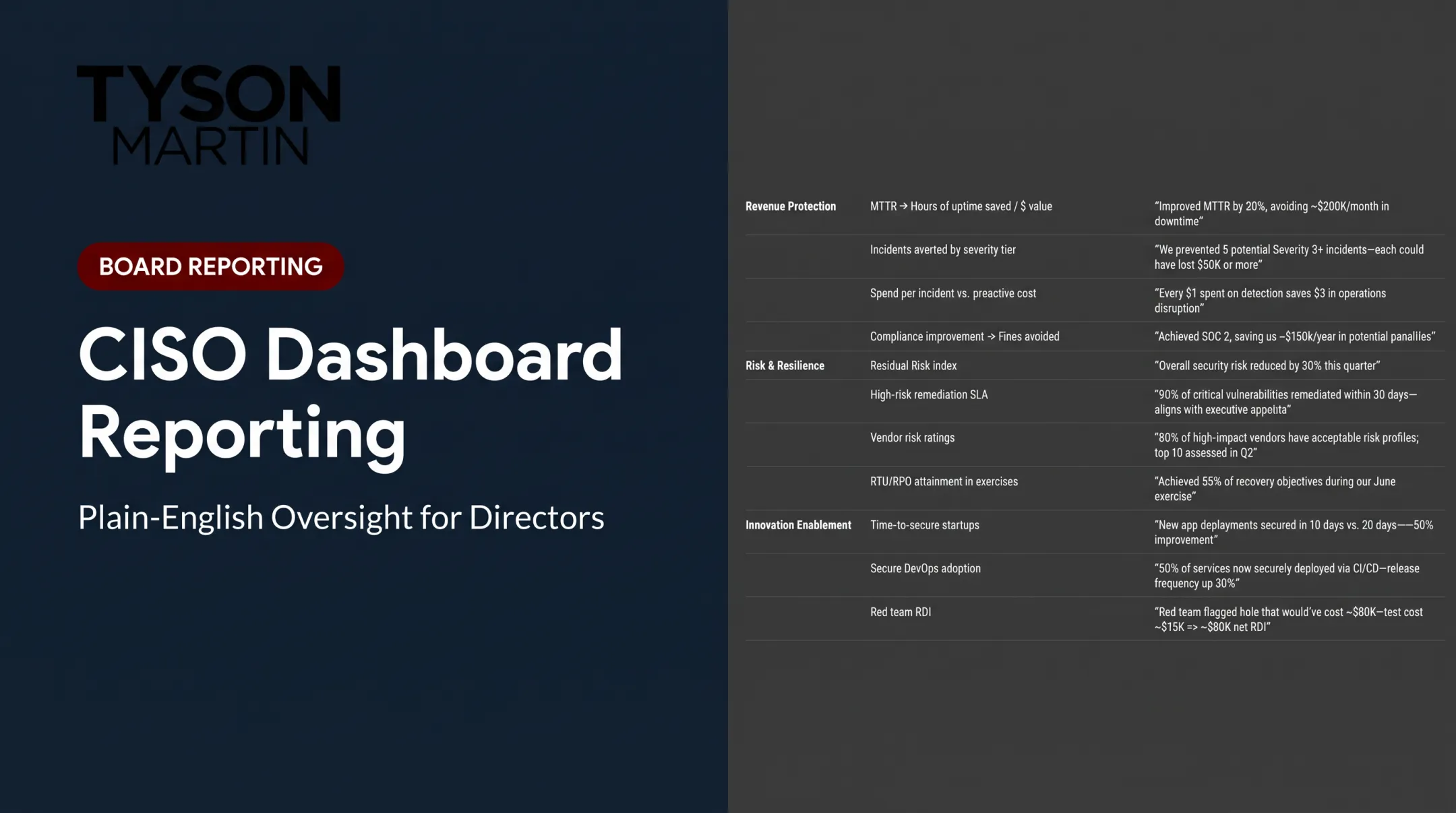
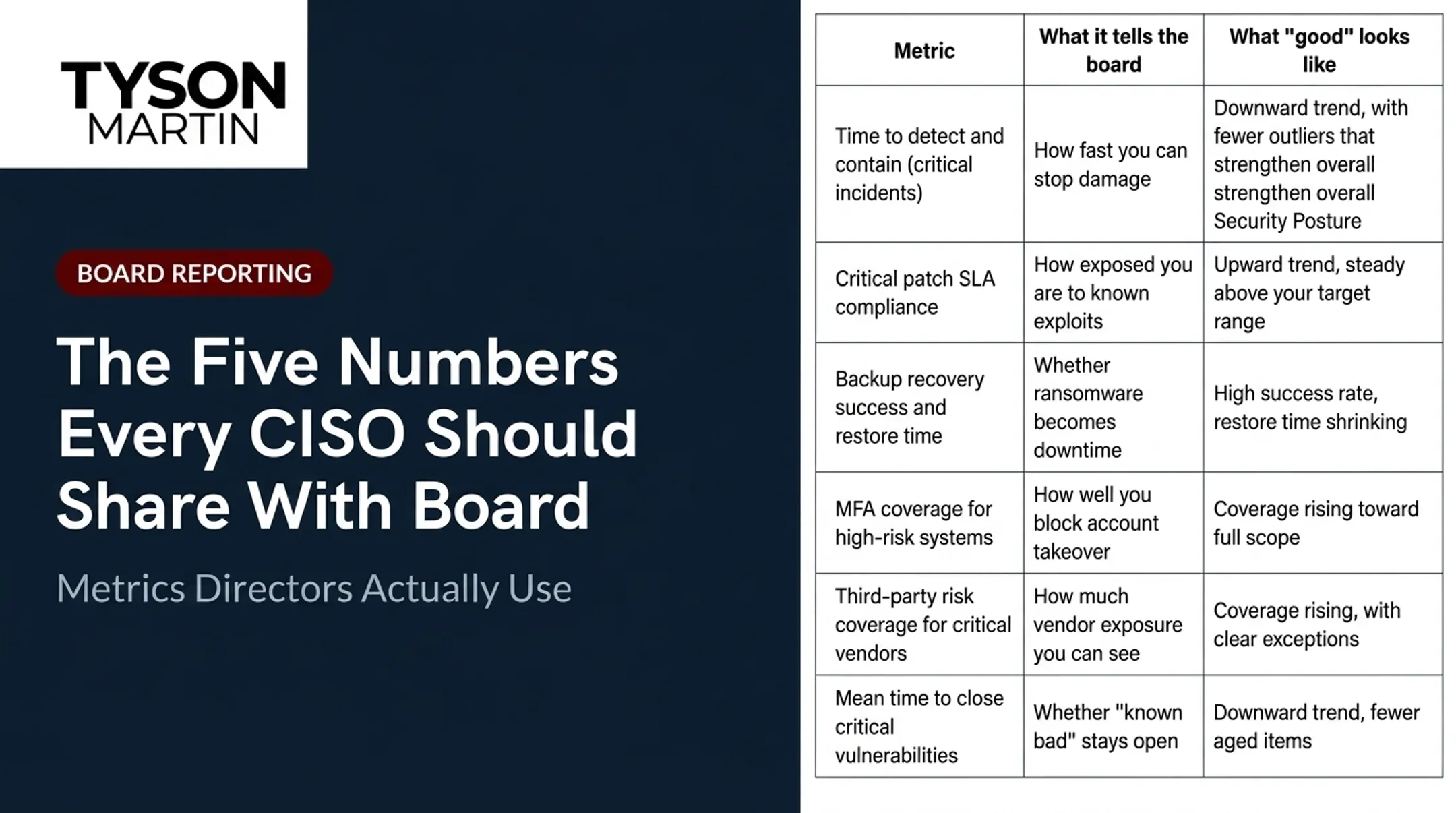
Measure Performance, Not Activity
Use a stable dashboard that tracks:
- Material risks and control effectiveness
- Resilience and remediation commitments
- Third-party exposure
- Decisions needed
NIST SP 800-55 Volume 1 advises selecting a limited set of measures that stay consistent over time. Trend beats trivia.
Align Budgets and Accountability
The CIO and CISO should separate shared technology costs from security-specific investments, document dependencies, and assign owners. EY's 2025 US study found 68% of other C-suite leaders place cybersecurity inside the IT budget, which is where security-versus-delivery trade-offs get buried. When funding or capacity blocks a committed control, report it.
Keep a Repeatable Cadence
- Monthly: management risk review ending in a decision
- Quarterly: board or committee deep dive
- Immediate: escalation when defined incident or risk thresholds are crossed
Each update answers four things in plain English: what changed, why it matters, what decision is needed, and who owns the next action.

Conclusion: Align Authority With Accountability
The strongest structure gives the CISO enough independence to give credible risk advice and enough proximity to technology and business leaders to drive execution. Titles and lines matter less than documented authority.
Boards and executive teams needing clearer oversight, credible reporting, or leadership stability during a transition can explore Tyson Martin's board advisory and interim or fractional CISO support.
Frequently Asked Questions
Who does a CISO typically report to?
Reporting to the CIO is common, though some CISOs report to the CEO, CRO, CFO, general counsel, or executive committee. The right line depends on risk, governance, and organizational design.
Is CISO a C-level position?
It is typically a C-suite or senior executive role, but title, authority, and access vary. Reporting line alone does not determine executive status.
Who is higher, CIO or CISO?
Neither is automatically higher. The CIO leads technology delivery; the CISO leads cyber risk and security. Documented decision rights settle who decides what.
Who does a CIO typically report to?
Usually the CEO, COO, or another top executive. Foundry's 2026 survey found 40% report directly to the CEO.
Can a CISO report directly to the board?
Typically the CISO reports to management while keeping regular access to the board or audit and risk committee. Direct escalation fits cases like suppressed risk information or a major incident.
What should a CISO report to the board?
Material cyber risks, changes since the last briefing, incident and resilience readiness, remediation commitments, accepted residual risk, business-tied metrics, and decisions needing board oversight.