The governance gap is wide. Only one in five organizations has mature autonomous-agent governance, according to Deloitte's 2026 survey. Meanwhile, McKinsey's 2025 survey found 23% of respondents scaling agents somewhere in the enterprise, with another 39% experimenting.
This guide is for boards, audit and risk committees, security leaders, and executives. It argues that a working program connects agent discovery, identity controls, runtime monitoring, policy enforcement, named ownership, and executive reporting.
Key Takeaways
- Treat each agent as a non-human identity with an owner, purpose, scope, and lifecycle.
- Demand effective-authority mapping and runtime evidence, not inventory alone.
- Governance needs risk tiers, decision rights, and escalation paths.
- Pick platforms on lifecycle coverage, integrations, and low friction.
What Are AI Agent Security Platforms and Why Does Governance Matter?
An AI agent security platform discovers, assesses, governs, monitors, and protects autonomous agents and the systems they touch. It overlaps with, but is not the same as, model security, conventional IAM, SIEM, AI governance software, or cloud security. Each of those sees a slice. None sees what an agent does with delegated authority.
The AI agent attack surface
The layers needing protection:
- Model instructions, prompts, and retrieved content
- Tools, APIs, and connected data
- Memory and credentials
- Agent-to-agent communication
- Hosting infrastructure
- Downstream business workflows
OWASP's Top 10 for Agentic Applications (2026) names goal hijack, tool misuse, identity and privilege abuse, memory poisoning, insecure inter-agent communication, and rogue agents among the threats. Demonstrations make this concrete. Researchers showed a malicious public GitHub issue steering an agent through the Model Context Protocol (MCP) into private repositories. That was a demonstration, not a confirmed customer breach.

Why governance is inseparable from technical security
Tools enforce rules. Governance decides the rules. It assigns accountability for what an agent may do, who approves high-risk actions, how exceptions work, and when an agent is suspended or retired.
An exception, for example, needs three things: a time limit, compensating controls, and a named person (not a team) who closes it. Without that, a platform just produces findings nobody owns.
Core Capabilities of an AI Agent Security Platform
Agent discovery, inventory, and effective-authority mapping
Require continuous discovery of registered, shadow, orphaned, and third-party agents. Each record should show owner, purpose, version, environment, connected tools, data access, and lifecycle status.
A list of agents isn't enough. The platform must resolve effective authority: inherited permissions, group membership, OAuth scopes, service credentials, and cross-application access. That answers the real question, which is what the agent can actually reach.
Identity, credentials, and least-privilege access
- Give every agent a unique identity, never a borrowed developer or employee login
- Use short-lived, task-scoped credentials with automated rotation and fast revocation
- Apply workload identity standards such as SPIFFE and delegated-token patterns from OAuth token exchange
Static role-based access breaks down when an agent's needs shift by task, requester, or data sensitivity. Attribute-based or policy-based authorization evaluates those factors at request time, in line with NIST's ABAC guidance. NIST's agent identity paper is still a February 2026 draft, not a final standard.
Runtime monitoring and behavioral detection
Collect telemetry on tool calls, API parameters, data access, authentication events, agent handoffs, memory writes, configuration changes, and downstream actions. Capture prompts and retrieved content where appropriate.
Behavioral baselines catch what static reviews miss: unusual data movement, excessive tool use, privilege abuse, and the outcomes of prompt injection.
A NIST-run competition drew over 250,000 attacks against 13 frontier models, and NIST's red-team results show every target was successfully attacked at least once. That's competition evidence, not enterprise breach frequency, but it argues against assuming prevention alone works.

Runtime guardrails, response, and human approval
Evaluate tool allowlists, sandboxing, egress restrictions, rate limits, policy gateways, action blocking, token revocation, and emergency shutdown. OWASP recommends per-tool scopes, kill switches, and credential revocation.
High-impact or irreversible actions need explicit human approval. Set the trigger by action type, data sensitivity, or dollar threshold, not by the agent's own judgment. Define what happens when no approver is available. The safe default is that the action waits.
Posture management, testing, and audit evidence
- Detect configuration drift and review dependencies
- Run prompt-injection and adversarial tests before production
- Use version control, pre-production approval, and rollback
- Keep exportable, tamper-resistant logs of tool invocations and parameter changes
Those records support incident reconstruction, internal reviews, and customer commitments.
AI Agent Governance Framework for Enterprise Organizations
Assign ownership and decision rights
Separate board and audit committee oversight from management accountability, security ownership, data stewardship, legal review, and engineering responsibility. Then write down who can:
- Approve a new agent
- Accept residual risk
- Grant exceptions
- Change permissions
- Declare incident severity
- Retire an agent
A one-page map giving each top risk an executive owner, a technical owner, and a due date works well. A RACI shows who decides, who executes, and who must be consulted.
Classify agent risk and establish policy tiers
Tier agents by autonomy, data sensitivity, connected systems, transaction authority, external communication, reversibility, and business impact. A simple three-level model works:
| Tier | Profile | Who accepts risk |
|---|---|---|
| Low | Limited local impact, low data sensitivity | Management, within policy |
| Medium | Affects a critical process or customers | Time-limited executive approval |
| High | Possible material outage, regulated exposure, or brand damage | CEO and board committee chair; full board past thresholds |
Map each tier to controls: stronger identity, restricted tools, extra testing, enhanced monitoring, or executive sign-off.
Govern the full agent lifecycle
Controls run from intake through design, testing, deployment, change management, periodic access review, ownership transfer, and retirement. Watch for shadow deployments, agents left behind by departing employees, orphaned credentials, model changes, and drift.
Underfunding is a quiet failure here. When nobody has time to maintain tools, agents go stale and exceptions pile up.
Build continuous assurance and executive reporting
A stable reporting set covers:
- Agent inventory and ownership coverage
- High-risk agents and their effective authority
- Policy exceptions with expiry dates
- Runtime incidents, time to detect, and time to contain
- Unresolved findings and trend direction
Translate this into board questions:
- What changed since the last review?
- Which agents can affect sensitive systems?
- Where are decision rights unclear?
- What needs escalation or funding?
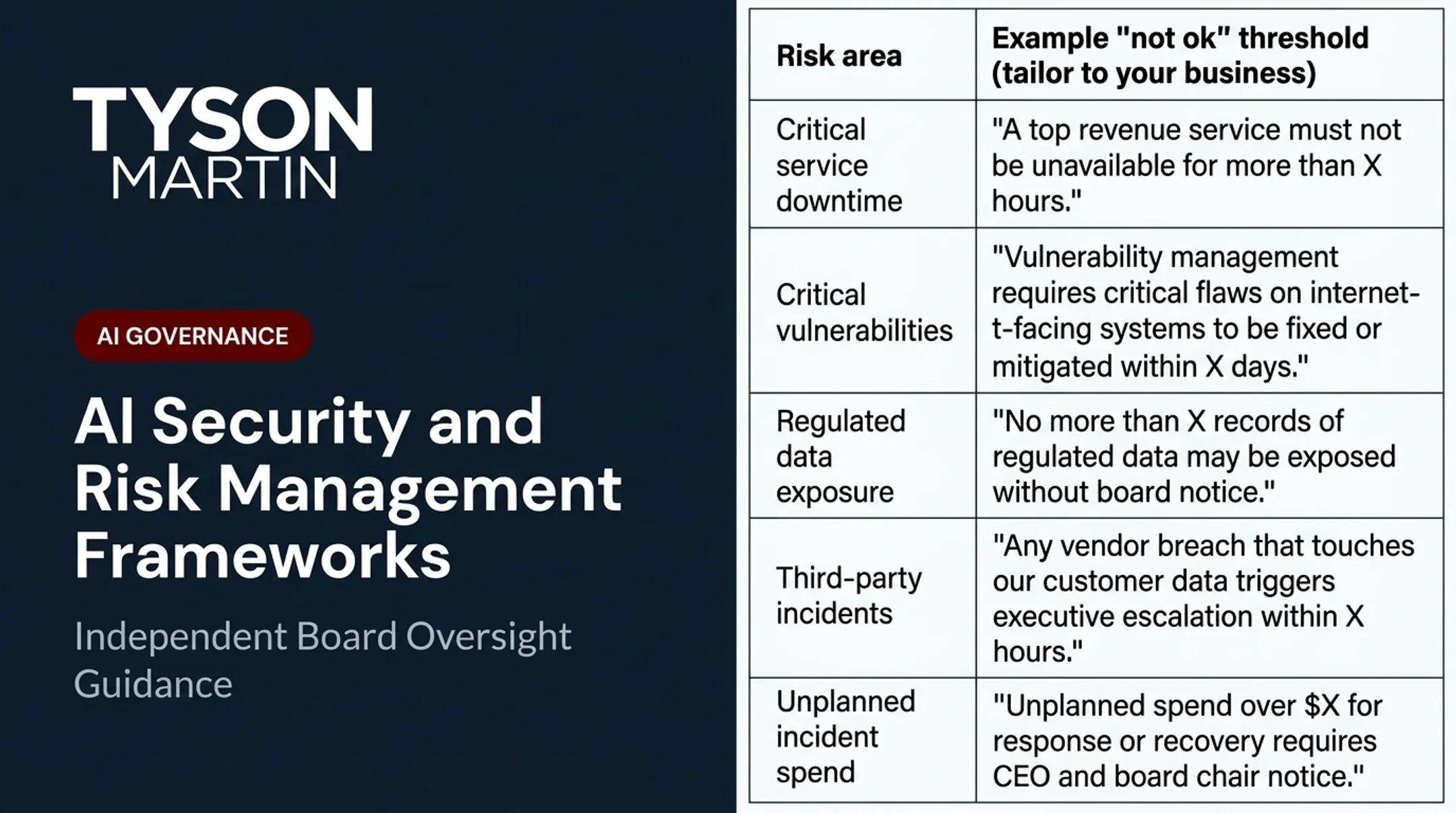
NACD's 2026 AI discussion guide raises similar questions, including how agent identity restricts data access and how controls are tested. It supplies no numeric thresholds, so set your own and document them.
Extend governance to multi-agent and third-party workflows
- Authenticate agent-to-agent communication and validate message schemas
- Bound delegation and keep traceable action chains
- Check authorization at every handoff
- Run vendor diligence on model providers, tool providers, MCP servers, connectors, and subcontractors
- Contract for evidence retention and incident notification
MCP guidance forbids token passthrough, so ask vendors how they comply.
How to Evaluate and Choose an AI Agent Security Platform
Compare platform categories before vendors
Several platform categories each cover part of the problem:
- AI security posture management
- Runtime gateways and non-human identity tools
- Cloud, Kubernetes, and data security
- SIEM/SOAR and GRC platforms
Decide whether you need one consolidated control plane, integrated specialist tools, or a layered architecture. Your agent estate, deployment model, and existing controls drive that choice.
Be skeptical of category claims. Independent agent-specific vendor-performance benchmarks are scarce, so rely on your own testing.
Assess deployment coverage and architectural fit
Check support for SaaS agents, cloud workloads, Kubernetes, on-premises systems, employee-built assistants, model providers, and tool-calling frameworks. Confirm the platform works through APIs, gateways, connectors, or telemetry without forcing unsafe changes or creating a new blind spot.
Test the depth of security controls
Build a scorecard that covers:
- Discovery, ownership, and effective-authority mapping
- Credential lifecycle and tool-call inspection
- Memory and data boundaries
- Runtime detection, human approval, and quarantine
- Incident response
Then demand proof-of-value scenarios:
- A shadow agent appears
- An agent holds excessive permissions
- Indirect prompt injection redirects an agent
- Unusual data movement occurs
- A credential is compromised
- A multi-agent handoff goes wrong
Review integrations and usability
Confirm links to identity providers, secrets managers, cloud platforms, ticketing, SIEM/SOAR, and tracing tools. Judge alert quality, investigation workflow, role-based administration, policy versioning, evidence export, and the staff effort needed to run it.
Perform vendor, privacy, and commercial diligence
Ask how the provider handles:
- Prompts, logs, and model training
- Subprocessors and regional processing
- Retention, support access, breach notification, and deletion
Verify answers against contracts, not marketing pages.
SOC 2 and ISO 27001 help, but their scope is broader than agent-action security. Compare pricing drivers, proprietary lock-in, policy and telemetry portability, and exit terms rather than counting features.
Implementation and Executive Oversight
Build a practical 90-day implementation sequence
- Days 1-30: Inventory enterprise-wide, rank by effective authority and data sensitivity, and document owners and purposes.
- Days 31-60: Pilot controls on representative workflows. CISA's May 2026 guidance suggests starting with low-risk, non-sensitive uses.
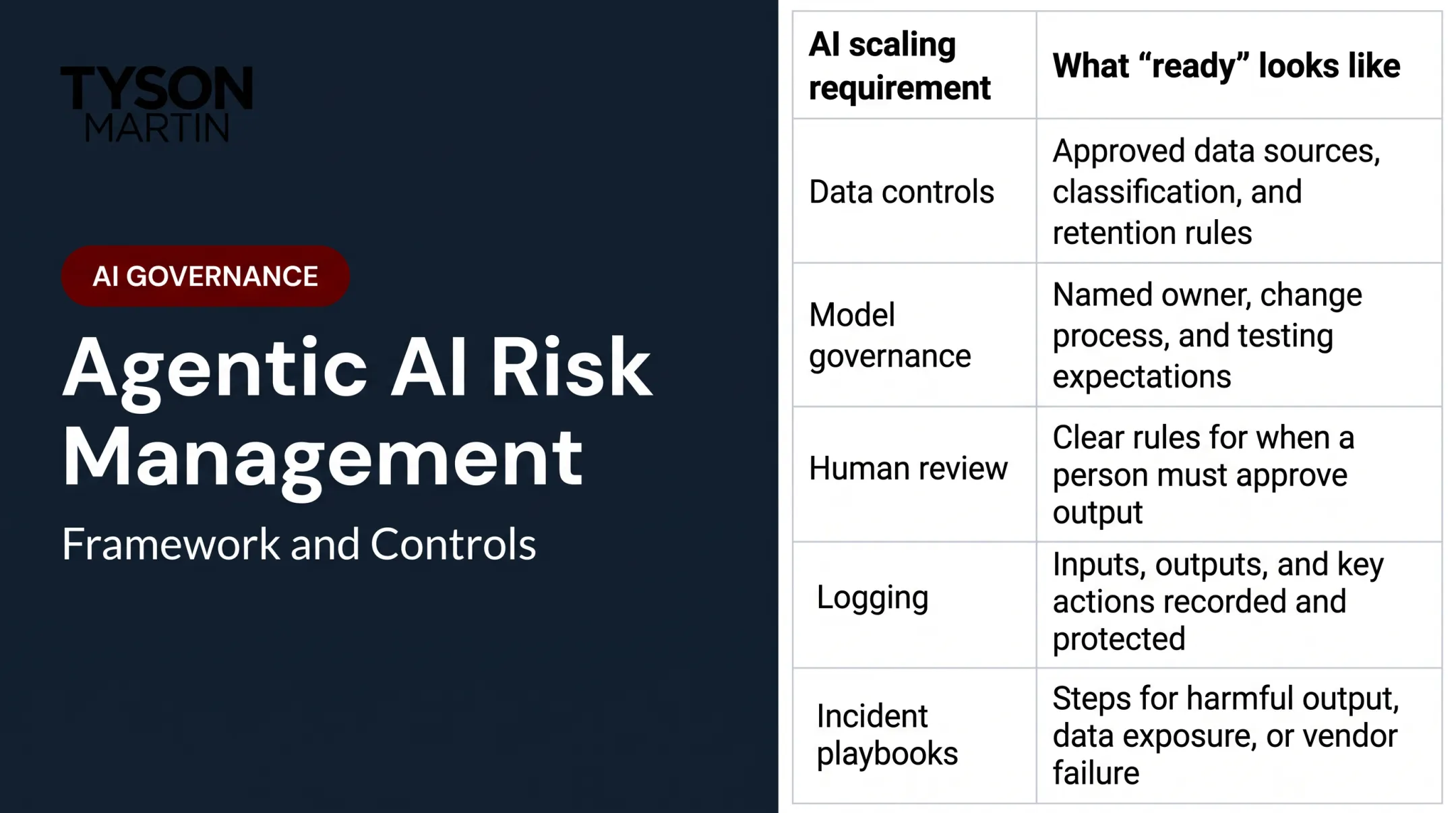
- Days 61-90: Add identity binding, least-privilege fixes, runtime telemetry, enforcement, incident playbooks, and reporting. Then expand.

Prepare for incidents and validate controls
Your playbook should cover:
- Isolating the agent
- Revoking or rotating credentials
- Preserving prompts and action traces
- Identifying affected data and systems
- Assessing downstream actions
- Notifying stakeholders
- Restoring approved behavior
NIST SP 800-61r3 provides the broader response structure.
Run tabletops and adversarial tests for:
- Prompt injection
- Unsafe tool use
- Credential theft
- Memory poisoning
- Runaway execution
- Bad delegation
Create an executive operating cadence
Use plain-English reporting that covers:
- Risk posture
- What changed
- Trend
- Decisions required
- Unresolved exceptions
- Named owners
Monthly artifacts and quarterly deep dives keep oversight a rhythm instead of a reaction. Don't bury boards in raw alerts.
Some organizations lack the internal capacity to set this up. An independent board advisor or interim or fractional CISO can clarify decision rights, set escalation thresholds, and turn platform findings into a governance plan.
Tyson Martin works in this role, advising and validating independently of vendors rather than operating security tools. Weigh the tradeoffs: ISACA notes that part-time security leadership can blur accountability, so define scope in writing.
Frequently Asked Questions
What is an AI agent security platform?
It's technology that discovers, governs, monitors, and protects autonomous agents and the systems they access. It spans discovery, identity, posture management, runtime monitoring, enforcement, and audit, going beyond general AI or application security.
How does AI agent governance differ from traditional AI governance?
Traditional governance centers on model and data risk. Agent governance adds delegated authority, tool use, autonomous actions, identity, lifecycle ownership, human approvals, and traceable workflow outcomes.
What capabilities should an AI agent security platform include?
Look for continuous inventory, effective-authority mapping, non-human identity controls, least privilege, runtime monitoring, guardrails, incident response, integrations, and compliance evidence.
How do organizations secure AI agents with least privilege?
Use unique agent identities, task-scoped and time-bound access, minimal tool permissions, and dynamic authorization. Add periodic access reviews, credential rotation, and monitoring for privilege expansion.
Which frameworks are relevant to AI agent security in the US?
NIST AI RMF, NIST CSF 2.0, OWASP agentic guidance, MITRE ATLAS, and ISO/IEC 42001 are common anchors. Sector and contractual rules may also apply, so confirm current obligations with qualified legal and compliance professionals.
How should boards oversee AI agent risk?
Boards should oversee accountability, risk appetite, material use cases, reporting cadence, escalation, and high-risk exceptions. The key test is whether management can show effective authority and runtime control over agents.