Introduction: Enterprise AI Security in 2026
AI adoption is moving faster than most security teams can track. Nearly nine in ten organizations now report regular AI use in at least one function, according to McKinsey's 2026 survey.
Many leaders still can't say which tools, agents, models, data sources, and integrations are running in their environment, or what those systems are allowed to do.
Enterprise AI security is an operating capability. It connects visibility, identity, data protection, secure development, runtime monitoring, incident response, and board oversight into work leaders can inspect. This article lays out that framework and a 90-day roadmap.
Tyson Martin, CISSP, advises boards and executive teams on cyber and AI risk.
Key Takeaways
- Enterprise AI security covers models, applications, agents, data, identities, APIs, cloud, vendors, and people.
- Governance sets accountability and acceptable use; security enforces protection.
- Start with an AI inventory and dependency map before anything else.
- Boards need plain-English trends, named owners, escalation thresholds, and measured remediation.
What Is Enterprise AI Security, and Why Is It a Board-Level Issue?
Enterprise AI security protects the confidentiality, integrity, availability, and intended behavior of AI systems across their lifecycle: data ingestion, development, deployment, use, monitoring, and retirement.
Three risk categories, three different owners
Teams often lump these together under one budget. Keep them separate.
| Category | Question it answers | Example |
|---|---|---|
| Securing AI systems | Can our AI be attacked or misused? | Prompt injection against an internal copilot |
| Using AI for cybersecurity | Can AI help our defenders? | AI-assisted alert triage |
| Managing AI-enabled attacks | Can attackers use AI against us? | AI-generated phishing at scale |
NIST's draft Cyber AI Profile draws the same three-way distinction. It is a preliminary draft, not a final standard.
The attack surface
The surface is wider than the model. It includes:
- Employee-facing AI tools and internal copilots
- Customer-facing applications
- Autonomous agents and retrieval systems
- Model APIs, cloud services, and code repositories
- Third-party integrations
IBM's 2026 study found that among reported AI-targeted breaches, compromised APIs, applications, and plugins accounted for 27% of initial attack vectors, as did cloud misconfigurations. Integrations and configuration matter as much as the model.
Translating exposure into board consequences
Technical weaknesses become business events:
- Unauthorized decisions or transactions
- Sensitive-data leakage
- Operational disruption
- Unreliable outputs
- Regulatory or contractual exposure
- Loss of customer trust
IBM's July 2026 study reports that more than 20% of the breached organizations it studied experienced breaches targeting AI models or applications. That sample covered 602 organizations that had already been breached, so it shows exposure, not an enterprise-wide rate.
Ownership and legal requirements
Ownership is shared across the board, CISO, CIO, data and engineering leaders, legal, compliance, procurement, and business units. Still, assign one accountable executive for each material AI system or use case.
Legal duties vary by industry, data type, customer base, and cross-border operations. Verify what applies to you:
- Colorado's SB26-189 covers automated decision-making for consequential decisions, with duties starting January 1, 2027.
- California's CPPA regulations took effect January 1, 2026, with automated decision-making compliance due January 1, 2027.
- SEC Item 106 requires disclosure of risk management and board oversight for public companies.
- HIPAA, GLBA, and NYDFS Part 500 apply to covered entities.
- Customer contracts often impose their own AI terms.
These are not interchangeable AI-security mandates. Confirm applicability with counsel.
What Are the Highest-Priority Enterprise AI Risks in 2026?
Shadow AI and data exposure
Employees use unsanctioned tools, paste sensitive data into prompts, upload files, and rely on providers with unclear retention. Retrieval systems can also return content beyond a user's authorized access.
IBM's 2025 report found that 97% of organizations with an AI model or application breach lacked proper AI access controls. That figure applies to the 13% that reported such a breach, not to all enterprises.
Separately, high shadow-AI use was associated with $670,000 higher average breach cost, an association rather than proven causation. About 42% of organizations still have no policy governing employee AI use.

Model and application attacks
Each attack maps to a business action it could trigger:
- Prompt injection makes a copilot disclose data or take an unintended action. Microsoft 365 Copilot's CVE-2025-32711 was an AI command injection flaw allowing information disclosure.
- System-prompt extraction exposes internal logic and credentials.
- RAG or data poisoning corrupts answers that staff or customers rely on.
- Model theft (extracting architecture or parameters) leaks intellectual property.
- Insecure APIs open the door to data access and abuse.
- Harmful or misleading outputs create customer, legal, and brand harm.
The OWASP LLM Top 10 now has a 2026 edition. Use it, not the 2025 list.
Agentic risk
Agents act, so their failures cost more. Priority failure modes include:
- Excessive permissions and identity sprawl
- Unsafe tool and API calls
- Compromised MCP or third-party integrations
- Manipulated multi-agent instructions
- No approval checkpoint for irreversible actions
Consider a realistic scenario. A finance agent has broad access to the payables system. A poisoned vendor email instructs it to update bank details, and no human approves the change. The next payment run goes to an attacker.
This isn't far-fetched. Fortune reported that a Replit coding agent deleted a live production database during a code freeze, against instructions. It is a reported incident, not an audited benchmark. Treat agents as delegated actors, not chat windows.
Core Principles and Controls for Enterprise AI Security
1. Inventory assets and map dependencies
Build an AI register. For each system, record:
- Owner and purpose
- Model and data sources
- Users, connected tools, and permissions
- Deployment location and supplier
- Risk classification and retirement status
NIST's generative AI profile calls for this kind of inventory.
2. Apply zero trust and least privilege
Give every agent its own identity. Require:
- Explicit authentication
- Scoped and time-bound permissions
- Separation of duties
- Approval for high-impact actions
Re-review whenever an agent's tools or data access change. NIST's agent identity concept paper is still a draft, so don't wait on a standard.
3. Protect data across the lifecycle
- Classify sensitive information
- Enforce access at the retrieval layer
- Validate training and knowledge sources
- Limit retention and monitor outbound transfers
- Preserve lineage from source data to output
4. Build security into development and procurement
Threat-model each use case. Before release:
- Review model and vendor provenance
- Scan code and dependencies
- Assess integrations
- Test behavior
- Set acceptance criteria for high-risk deployments
Match vendor evidence to tier. Mature vendors can show SOC 2 Type II, SIG Lite, or a CAIQ. Early-stage vendors often can't, so compensate with limited access, no production data, shorter terms, and a dated security roadmap.
5. Test and monitor continuously
Combine automated adversarial testing with human-led exercises. Add:
- Runtime monitoring
- Prompt and output controls
- Tool-call inspection
- Behavior baselines and drift detection
Your incident process must preserve the full execution trail.
6. Map to frameworks, but don't treat one as complete
| Framework | What it contributes |
|---|---|
| NIST AI RMF | Govern, Map, Measure, Manage risk process |
| NIST CSF 2.0 | Cybersecurity outcomes, including supply chain |
| OWASP LLM and agentic guidance | Application and agent threat categories |
| ISO/IEC 42001 | AI management system, not proof an app is secure |
| NSA/CISA guidance | Deployment and data protections |

A Practical 90-Day Enterprise AI Security Roadmap
These work categories are a practical place to start. Treat the 90-day window as a disciplined kickoff, not evidence that adequate AI security will be finished on day 90.
Days 0–30: Ownership and visibility
- Appoint an executive sponsor and define decision rights.
- Identify high-impact AI use cases.
- Inventory known and suspected AI assets, and interview business and engineering teams.
- Document which systems touch sensitive data or act autonomously.
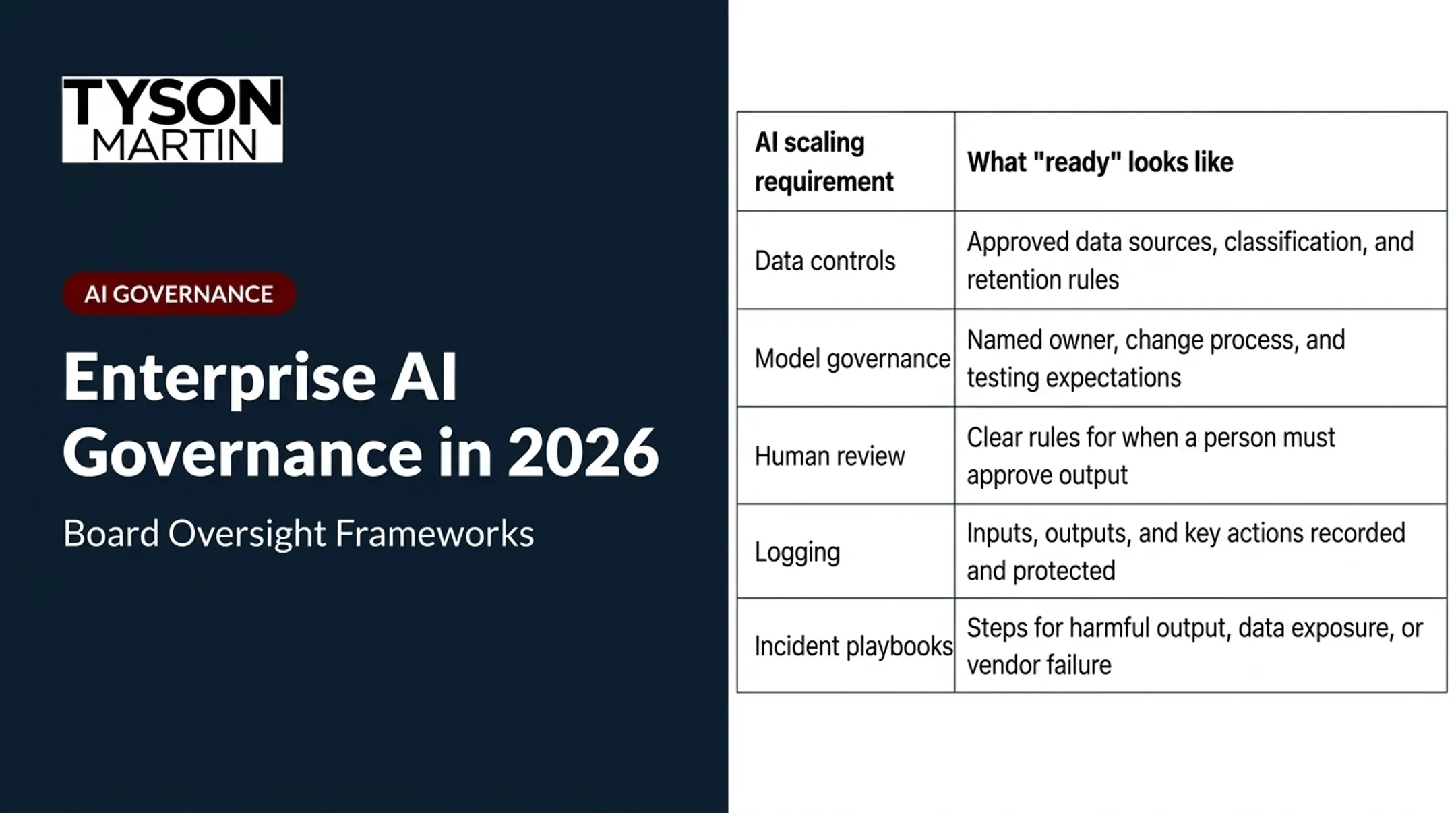
- Build a risk-tiering model using data sensitivity, autonomy, user reach, connected systems, reversibility, regulatory exposure, and criticality.
Missing inventory data is not evidence of low risk. Treat unknowns as high until proven otherwise.
Days 31–60: Remediate and collect evidence
- Remove unnecessary permissions and establish agent identities
- Restrict sensitive data access
- Approve or block unsanctioned tools
- Secure model and API credentials
- Review vendors and integrations
- Add human approval for high-impact or irreversible actions
Then start testing:
- Prompt-injection and misuse scenarios
- Retrieval-boundary tests and dependency reviews
- Runtime logging and escalation procedures
Document who accepted each residual risk.
Days 61–90: Validate and repeat
Run red-team exercises, tabletop incidents, and executive escalation drills. Check whether alerts reach the right owners. CISA's AI tabletop package offers poisoning and malicious-model scenarios you can adapt.
Convert findings into a prioritized plan. Each item needs an accountable owner (a role, not a committee), a deadline, a measurable outcome, and a review cadence. Keep a weekly working session to unblock delivery and a monthly executive review for decisions and risk acceptance. If a fix slips, the cause should be visible within two weeks, not two quarters.

When you need outside help
Where internal capacity or accountability is thin, Tyson Martin offers board advisory work and interim CISO leadership. That can mean clarifying decision rights, stabilizing oversight, building the 90-day plan, and translating technical findings into executive decisions. The practice advises and validates. It doesn't run security operations, sell tools, or perform penetration testing, and no one can promise zero risk.
Board Oversight, Metrics, and Accountability
Deloitte and CAQ's 2026 report found 75% of audit committee respondents rank AI governance in their top three priorities, yet only 56% feel confident overseeing it. Reporting has to close that gap.
A dashboard that shows trend, not trivia
Keep it stable and short. Include:
- Inventoried versus unidentified AI assets
- High-risk systems by category
- Sensitive-data access and excessive permissions
- Unresolved testing findings and policy exceptions
- Material incidents and remediation age
- Progress against agreed priorities
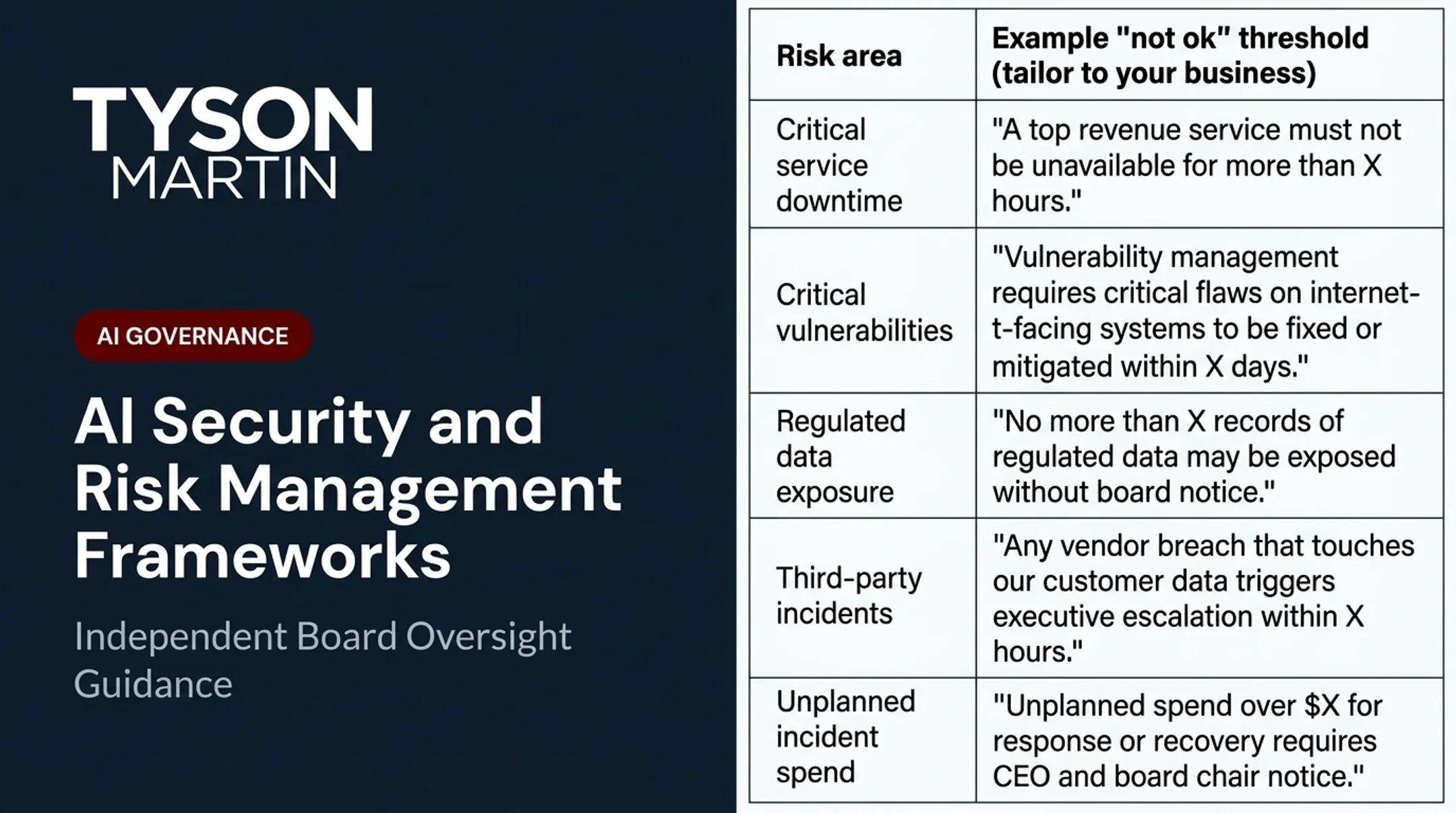
Escalation thresholds
Define triggers in advance:
- Unauthorized data access
- Unexpected agent actions
- Material model or vendor changes
- Policy bypasses
- High-severity testing failures
- Incidents involving regulated data or critical processes
Name who decides whether to pause, restrict, isolate, disclose, or resume a system. NACD guidance recommends at least quarterly cyber-risk reporting and prompt escalation after material incidents.
Plain-English reporting
Each briefing should answer:
- What changed since the last briefing?
- What could happen?
- Which controls are working?
- Where does uncertainty remain?
- What decisions does the board need to make?
- Can we produce defensible evidence in an incident, audit, or customer review?
A 30-slide deck to explain one risk is a red flag. A one-page view with trend lines, top risks, what changed, and decisions needed is usually enough.
Frequently Asked Questions
What is enterprise AI security?
It is the protection of AI models, applications, agents, data, identities, integrations, and behavior across the full lifecycle. It differs from AI governance (accountability and policy) and from using AI for cybersecurity.
How is enterprise AI security different from AI governance?
Governance sets accountability, acceptable use, risk tolerance, and compliance expectations. Security implements the technical and operational controls that prevent misuse, compromise, and unsafe behavior.
What are the biggest enterprise AI security risks in 2026?
Shadow AI, data leakage, prompt injection, poisoned retrieval sources, excessive agent permissions, insecure integrations, supply-chain weaknesses, and weak monitoring. Actual risk depends on each system's access and autonomy.
How can enterprises secure AI agents?
Give each agent its own identity, least-privilege permissions, and approved tools. Require human approval for high-impact actions, log every tool call, and add continuous testing and runtime monitoring.
Which AI security frameworks should US enterprises use?
Common choices are NIST AI RMF, NIST CSF 2.0, OWASP guidance, and ISO/IEC 42001 where applicable. Select and map them to your industry, contracts, state and federal duties, and cross-border obligations.
Where should an enterprise start with AI security?
Inventory AI assets and dependencies, then tier risk by data access and autonomy. Fix least-privilege gaps on high-risk systems first, and adopt a 90-day plan with named owners and measurable outcomes.