Private equity cybersecurity risk is a portfolio-wide exposure. It spans the general partner, portfolio companies, employees, deal data, shared technology, vendors, cloud environments, and acquisition integrations. It is not an IT department problem.
This article covers the exposure, how to assess it across the deal lifecycle, how to govern it at board level, which controls and evidence matter, and a focused 90-day plan.
Key Takeaways
- Treat cyber as an investment, transaction, operational, and governance risk.
- Turn diligence findings into price, deal conditions, day-one priorities, or documented risk acceptance.
- Set common minimum controls, tiered goals, named owners, and consistent reporting.
- Give boards trend data, escalation thresholds, and proof that recovery works.
Why Private Equity Cybersecurity Risk Is an Investment and Transaction Risk
Why the attack surface is different
Attackers like PE ecosystems. They hold financial and personal data, deal documents, intellectual property, and cash movement, spread across organizations with uneven security maturity. The firm's own exposure is one thing. What it inherits through portfolio companies and service providers is another.
Common attack paths include:
- Email and identity compromise
- Ransomware
- Cloud misconfiguration
- Exposed remote access
- Weak privileged-account controls
- Vulnerable vendors
- Insecure integrations created during acquisitions
The Verizon 2026 DBIR found ransomware in 48% of breaches and third-party involvement in 48%. These are broad datasets, not PE-only samples, but the pattern fits.
How incidents destroy value
The cost pathways are familiar:
- Downtime and incident response
- Forensic, legal, and remediation fees
- Regulatory investigations and notification duties
- Lost customers and delayed closings
- Higher insurance premiums and weaker buyer confidence
Keep three measures separate: transaction price effects, portfolio operating losses, and sponsor-level materiality. Brookfield's CDK portfolio company shut down systems after unauthorized activity in June 2024 and issued customer billing credits. Yet Brookfield said it expected no material impact on Brookfield Business Partners. Same incident, different entities, different answers.

A cyber event can also become a transaction risk when the firm wasn't the point of compromise. If a portfolio company, vendor, or shared service handles sensitive information on the firm's behalf, the exposure travels with it.
Where fragmentation creates blind spots
Disconnected tools, outsourced IT, separate investor communication systems, shadow AI, and inconsistent controls make it hard to tell whether a problem is isolated or systemic.
A checklist records that a control exists. An operating model verifies that it is effective, owned, monitored, and recoverable. Tyson Martin's assessment work defines a mature program the same way: repeatable, measurable, and owned.
Questions to ask first
Boards and investment committees should ask:
- What is our risk appetite, and which assets are material?
- Who is accountable, and which critical dependencies and known exceptions exist?
- Are we ready for an incident, and which decisions need us?
- What changed since the last briefing, and which risks are rising or falling?
- Can management show progress with evidence?
How to Assess Cybersecurity Across the Private Equity Deal Lifecycle
Pre-close cyber due diligence
Request and validate:
- Prior incidents and claims
- Asset and data inventories
- Identity and access controls
- Endpoint protection, vulnerability and patch management
- Cloud configuration
- Backups and recovery testing
- Third-party dependencies
- Cyber insurance, regulatory obligations, and open litigation
- Existing security assessments
Separate what the target supplies from what you validate independently. Kroll's diligence guidance says to assess governance, defensive capabilities, and key controls rather than rely on self-disclosure. Independent evidence includes technical testing, configuration reviews, incident records, and interviews with technology and security leaders.
Turning findings into deal decisions
Sort findings into five buckets:
- Potential deal-breakers
- Valuation or escrow considerations
- Required pre-close remediation
- Day-one actions
- Risks accepted only with an accountable owner and monitoring plan
Rate severity on business criticality, exploitability, data sensitivity, recovery capability, regulatory exposure, and time and cost to fix. Precedent exists: Verizon cut the Yahoo purchase price by $350M after breaches surfaced (not a PE deal, but instructive).
Holdbacks tied to remediation milestones or escrows that fund post-close fixes follow the same logic. Representations and warranties insurance underwriters also scrutinize diligence quality, and known issues can be excluded.
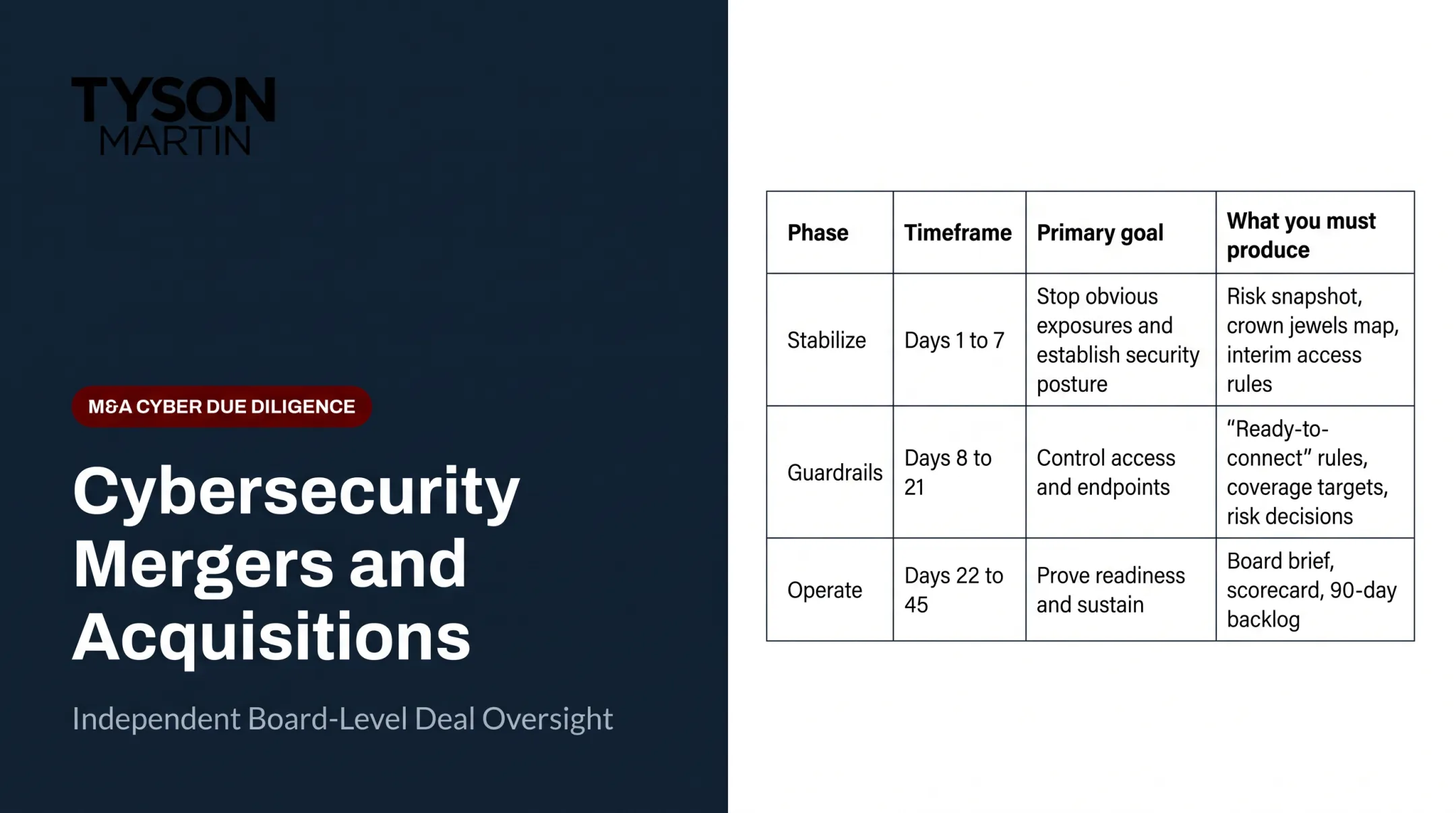
Day-one and post-close priorities
- Secure privileged accounts and review inherited access
- Decide how to separate or integrate identities safely
- Confirm logging and monitoring
- Protect backups and preserve incident evidence
- Validate critical vendor access
- Communicate escalation procedures
Tie the first post-close plan to the value-creation plan. Security funded as a side IT project gets cut first.
During the holding period
Run a baseline assessment at each portfolio company, then build a risk-tiered roadmap across people, process, technology, governance, and recovery. Smaller companies need sequenced improvements, not identical controls on the same timeline.
Track these as trends, not unsupported targets:
- Critical vulnerability exposure
- Privileged access coverage
- Detection and response readiness
- Recovery test results
- Third-party risk
- Unresolved exceptions past due
- Progress against remediation commitments
ACA's 2026 benchmark found half of assessed portfolio companies at elevated or high risk, and those in structured monitoring over a year were more than twice as likely to score low risk.

Protecting value before exit
Build buyer-ready evidence early:
- Updated inventories and remediation records
- Independent testing and tabletop results
- Compliance documentation and third-party reviews
- Clear owners for remaining risks
An unresolved issue near exit can stretch diligence timelines, complicate representations and warranties, dent buyer confidence and valuation, and leave post-closing obligations.
How to Build Portfolio-Wide Cyber Governance and Reporting
Clarify accountability and decision rights
Define roles for the general partner, investment committee, operating partner, portfolio-company board, CEO, CISO or CIO, general counsel, risk leaders, and critical vendors. A RACI model shows who owns, approves, executes, advises, and is informed.
Set escalation thresholds for:
- Material incidents
- Unacceptable control gaps
- Missed remediation milestones
- Suspected regulatory exposure
- Risks that could affect a transaction or investor commitment
Prioritize decision rights and escalation thresholds that hold in real incidents.
Common expectations without identical maturity
Set a minimum control baseline for every company, then add tiers for industry, data sensitivity, size, regulatory obligations, operational criticality, and shared-service integration.
Frameworks give a common language: NIST CSF 2.0, CIS Controls, ISO 27001, SOC 2. But alignment is not proof. ISO certification addresses conformity of a management system, while SOC 2 examines control design, operation, and effectiveness. They are not interchangeable assurance claims.
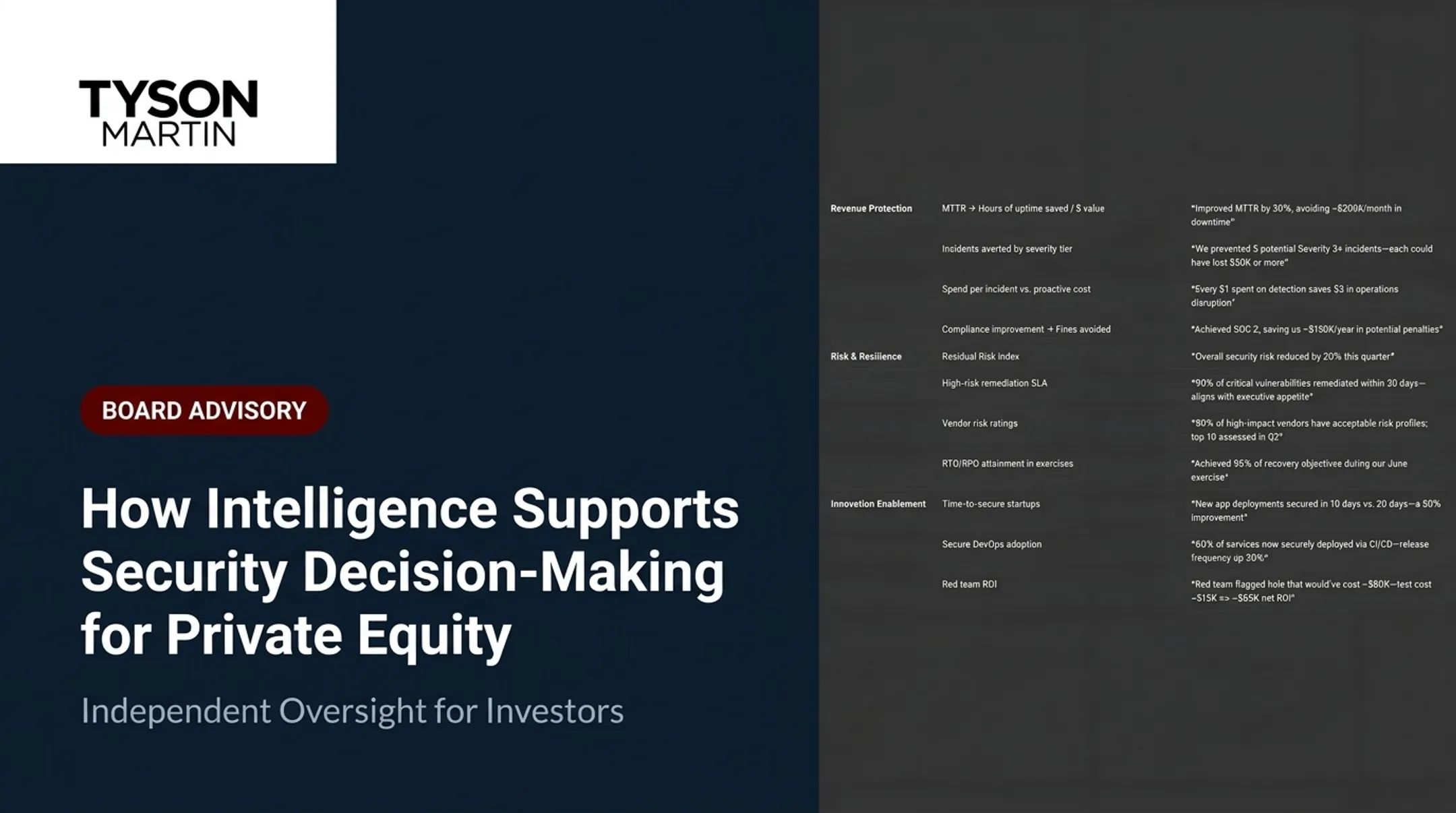
Build a board-ready dashboard
Show portfolio risk trends, material exceptions, priority remediation, incident readiness, third-party exposure, progress against objectives, and decisions needed. A strong board pack leads with:
- Plain-English risk posture
- What changed since the last briefing
- Stable metrics that show trend, not trivia
- Clear ownership of next actions
The NACD handbook recommends reporting at least quarterly, plus material incidents and significant risk changes.
Make incident response a governance process
Document who handles technical, legal, insurance, communications, board, investor, and portfolio-company duties before anything happens. Regulation S-P now requires registered investment advisers to maintain written incident response programs, with customer notice generally within 30 days of awareness.

Run tabletops with decision-makers. Cover scenarios such as:
- Ransomware
- Business email compromise
- Vendor compromise
- Data theft
- Cloud disruption
- An incident discovered mid-transaction
Add independent challenge
Use independent validation after a major acquisition, material incident, significant technology change, repeated missed remediation, or high-risk vendor dependency. Require evidence that controls operate and recovery works, not just policies and annual assessments.
Right-size leadership capacity
Some firms and portfolio companies need a dedicated CISO, cyber operating partner, board advisor, or interim or fractional executive. The need is sharpest during transitions, when someone must stabilize risk and turn technical findings into business decisions.
Tyson Martin provides board advisory and interim CISO leadership for organizations in transition, during M&A, or after an incident. Engagements center on a 90-day plan with owners and measurable outcomes, without slowing the business. He advises and validates rather than operating security.
The Controls and Evidence That Matter Most
Foundational controls and resilience
Tie each control to an outcome and an evidence source.
| Control | Evidence |
|---|---|
| Phishing-resistant MFA on email, VPN, critical accounts | Coverage reports, config validation |
| Privileged access and least privilege | Access reviews, admin account counts |
| Endpoint detection, patching | Critical vulnerability trend |
| Logging and monitoring | Log retention, coverage review |
| Offline, encrypted, tested backups | Restore test results |
CISA's ransomware guide backs these priorities and warns that ransomware can encrypt or delete reachable backups. Extend the same evidence standard to segmentation, encryption, email security, and data classification.
A scorecard might start at 40% MFA coverage on privileged accounts. Report that honestly rather than promising 100% in two weeks.
Third-party, cloud, and AI exposure
Assess critical vendors, managed service providers, cloud environments, investor portals, and shared services across:
- Access paths and concentration risk
- Subcontractors and notification duties
- Testing cadence and exit provisions
A useful question: which outage would stop revenue within 24 hours, and what is the workaround?
AI exposure often shows up as unapproved tools, sensitive data in public systems, manipulated outputs, weak access controls, deepfakes, and automated phishing. IBM's 2025 research tied high shadow AI use to $670,000 higher average breach costs.

Practical controls stay simple:
- Keep an AI inventory
- Set acceptable-use rules
- Require human oversight
- Scale monitoring to risk
Prove you can respond and recover
Incident response, continuity, disaster recovery, breach notification, crisis communications, insurance, and legal escalation plans must be coordinated and tested together. Prove readiness with:
- Timed-inject tabletop exercises
- Backup restoration tests
- Recovery-time checks
- Lessons-learned tracking
A policy document alone does not prove a backup works.
A Practical 90-Day Cybersecurity Improvement Plan
Days 0–30: establish visibility and ownership
- Inventory portfolio companies, critical systems, sensitive data, key vendors, known incidents, open findings, insurance coverage, and security leaders
- Set risk appetite, decision rights, reporting cadence, and the definition of a material cyber issue with the board, investment committee, general counsel, and operating leaders
- Anchor appetite to money, downtime, customer harm, and legal duty
Days 31–60: prioritize remediation and readiness
- Convert the baseline into a risk-tiered roadmap with named owners, dependencies, milestones, funding assumptions, and exception criteria
- Include the top 10 risks, cost ranges, and closure proof
- Start with high-consequence gaps: identity, privileged access, endpoint visibility, exposed systems, backups, critical vendors, incident response, and recovery testing
If a fix slips, the roadmap should show why within two weeks, not two quarters.
Days 61–90: validate, report, and institutionalize
- Deliver a board-ready dashboard
- Run at least one tabletop or recovery exercise
- Independently validate selected controls
- Document what changed, what remains open, and which decisions are needed
- Set a recurring review that refreshes assessments after acquisitions, major technology changes, incidents, vendor changes, and exit preparation

Frequently Asked Questions
What is private equity cybersecurity risk?
It is exposure across the fund, portfolio companies, vendors, deal data, and transaction lifecycle. It can hit operations, valuation, compliance, and investor trust.
Why is cybersecurity important in private equity due diligence?
Diligence uncovers inherited liabilities, informs deal terms and price, and identifies day-one priorities before the buyer takes operational responsibility.
What should private equity firms include in cyber due diligence?
Incidents, assets and data, identity, vulnerabilities, cloud, vendors, backups, recovery, insurance, regulatory duties, and security testing. Weigh how well the evidence is validated.
How do private equity firms manage cybersecurity across portfolio companies?
They set minimum controls, risk-based maturity tiers, named owners, portfolio dashboards, shared playbooks, independent validation, and recurring reporting.
Who is responsible for cybersecurity risk in a private equity firm?
Responsibility is shared among the board, investment committee, operating partners, portfolio leadership, security and technology teams, general counsel, and critical third parties. One executive should own it.
How can a private equity firm improve cybersecurity in 90 days?
Establish visibility and ownership, fix high-consequence gaps, test response and recovery, then set an ongoing reporting cadence.