Introduction
A cybersecurity breach does not automatically make every director personally liable. Exposure tends to follow three things: no reasonable oversight system, ignored red flags, or approval of misleading security statements.
That makes cyber a governance issue, not just an IT one. It touches fiduciary duties, regulators, shareholder claims, customer trust and disclosure. The IBM 2026 report puts the average US breach cost at $11.5M.
This article covers US liability concepts, board responsibilities, defensible oversight practices and insurance. It is general information, not legal advice. Get counsel on your governing law, industry and facts.
Key Takeaways
- Directors owe reasonable oversight and informed decisions, not perfect security.
- Risk rises when boards have no reporting system, ignore repeated warnings or let inaccurate disclosures stand.
- Good evidence includes clear ownership, regular reporting, documented decisions and tested response plans.
- Insurance and indemnification reduce financial exposure but never replace active oversight.
Can Board Members Be Personally Liable for Cybersecurity Breaches?
Yes, in limited circumstances. Personal liability is uncommon when boards document real oversight, but fiduciary-duty and disclosure theories still create real exposure.
What personal liability means in the US
Claims against the company differ from claims against individual directors. Directors can face shareholder derivative actions, regulatory investigations, disclosure claims, and fiduciary-duty claims.
No single national rule applies. The outcome depends on:
- The state of incorporation and its corporate law
- Charter documents and indemnification provisions
- The director's own conduct and the facts
Caremark and the oversight duty
Under the Delaware Caremark line of cases, directors face risk if they utterly fail to implement a reporting system or consciously ignore significant warning signs. In Marchand v. Barnhill (Del. 2019), the court reversed a dismissal where a board allegedly had no board-level monitoring of mission-critical food safety. That was not a cyber case.
Courts look at the board's good faith, information and response. A breach alone is not the test.
The cyber derivative cases illustrate this. None resulted in findings of liability:
- SolarWinds (Del. Ch. 2022): dismissed. Cyber responsibility had been assigned to board committees.
- Marriott (Del. Ch. 2021): dismissed. Allegations did not show conscious disregard of red flags.
- Home Depot (N.D. Ga. 2016): dismissed. Board and audit-committee reporting plus a remediation plan defeated the claim.
- Wyndham (D.N.J. 2014): dismissed. The board's refusal of the shareholder demand received business-judgment protection.
The lesson: documented committee ownership, reporting and follow-through helped these boards. It is no guarantee for yours.
When disclosures create extra exposure
Inaccurate or incomplete statements about controls, incident history, or compliance create separate risk.
The SEC's 2023 rules require Form 8-K Item 1.05 disclosure of a material incident within four business days after determining materiality, and that determination must happen without unreasonable delay. Annual filings must describe board oversight and risk-management processes.
SEC settlements show the pattern. The agency charged four companies in October 2024 (Unisys paid $4M; Avaya, Check Point and Mimecast paid roughly $1M or less each) over allegedly misleading breach disclosures. Blackbaud paid $3M in 2023. These were corporate penalties, not director penalties.

SolarWinds and its CISO faced an SEC suit over the company's pre-incident security statement. Most claims were dismissed in 2024, and the parties later stipulated to dismissal. Treat these as liability pathways, not predictions.
Limits on protection
Indemnification, exculpation, fee advancement and D&O insurance may help. Delaware's Section 102(b)(7) exculpation excludes loyalty breaches, bad faith, intentional misconduct and knowing violations. Indemnification under Section 145 has statutory conditions, with extra limits in derivative cases.
Bad faith, fraud and knowing violations may not be protected the way ordinary negligent oversight might be. Certain regulatory penalties may not be insurable. Ask qualified counsel for a determination.
What Cybersecurity Oversight Requires from the Board
Accountability without running security
The board sets risk appetite, approves priorities and resources, assigns oversight to the full board or a committee, and requires management to execute and report. Directors do not run the security team.
Typical ownership:
- CEO: enterprise risk
- CISO: the security program
- CIO or CTO: key systems
- General counsel: disclosure posture
- Operations: recovery priorities
Useful, recurring information
Reports should use business terms: critical services, material data, risk trends, open high-severity findings, recovery capability, vendor exposure and progress against approved priorities.
A one-page scorecard in the same format each month shows drift. It should carry:
- Top five risks in business-impact terms
- Three to six key defenses with trend arrows
- Incident readiness and third-party exposure
- Exceptions needing a board decision
A good example: the business tolerates 4 hours of customer-portal downtime, but tested recovery is closer to 12 hours. That gap is a board decision. A raw count of blocked attacks is not.

Boards also need direct access to the CISO, especially when management reporting could filter or delay bad news. Deloitte recommends annual strategic reporting and quarterly ongoing reporting.
Highest-risk exposures
Tie each risk to your sector, critical processes, sensitive data, contracts and federal or state rules. Common board-level risks:
- Ransomware and operational disruption
- Identity compromise and privileged access
- Cloud misconfiguration and software vulnerabilities
- Business email compromise and insider threats
- Supply-chain compromise and data loss
- Insecure use of AI
Sector rules vary. NYDFS Part 500 requires CISO reporting to the governing body at least annually. The FTC Safeguards Rule requires similar reporting for covered financial institutions. Neither applies to every company.
Third parties and critical providers
Ask whether management can name the suppliers behind critical operations, and how fast it would learn of a provider's material incident. Expect:
- Due diligence and security terms in contracts
- Access controls, encryption and defined incident-notice times
- Audit rights and subcontractor oversight
- Business continuity plans and tested workarounds
- Termination and data-return procedures
Flag concentration risk, where one cloud, identity provider or managed-service partner could stop the business.
Incident escalation and disclosure
Before an incident, the board approves escalation criteria and knows who contacts it. During one, it supports legal and forensic work and oversees continuity. Afterward, it reviews remediation.
Public companies must follow the SEC rules above. Private and regulated organizations face different contractual, state or sector obligations. Counsel should map them in advance.
How Boards Can Build a Defensible Oversight Process
Create a repeatable cadence
Set an annual and quarterly cycle that covers:
- Risk assessment and budget review
- CISO reporting and policy approval
- Critical-vendor review
- Insurance review and exercises
One workable calendar puts third-party risk in Q1, incident readiness in Q2, and recovery testing in Q3.
Tighten the cadence during an acquisition, technology overhaul, leadership change, or live incident.
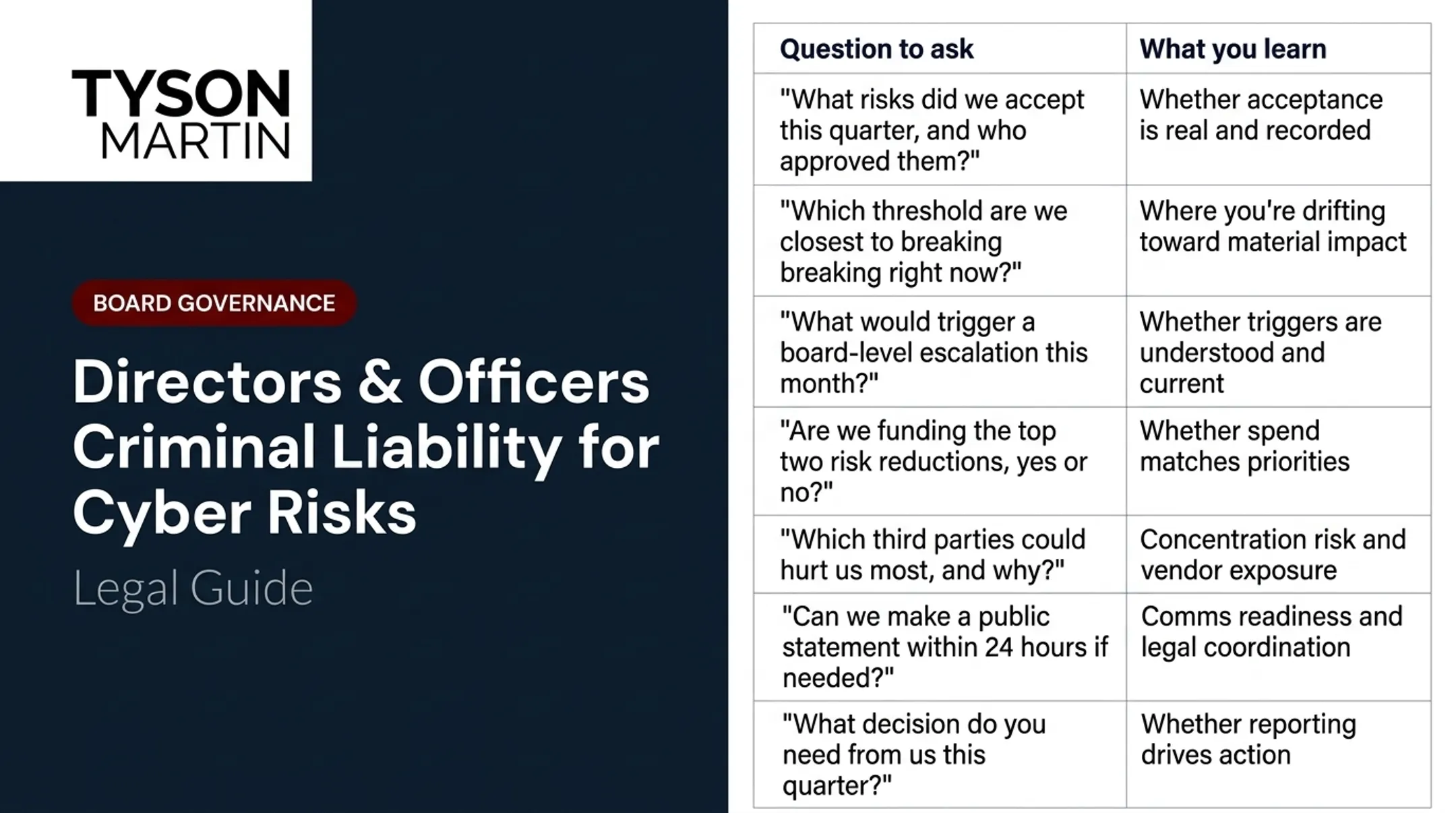
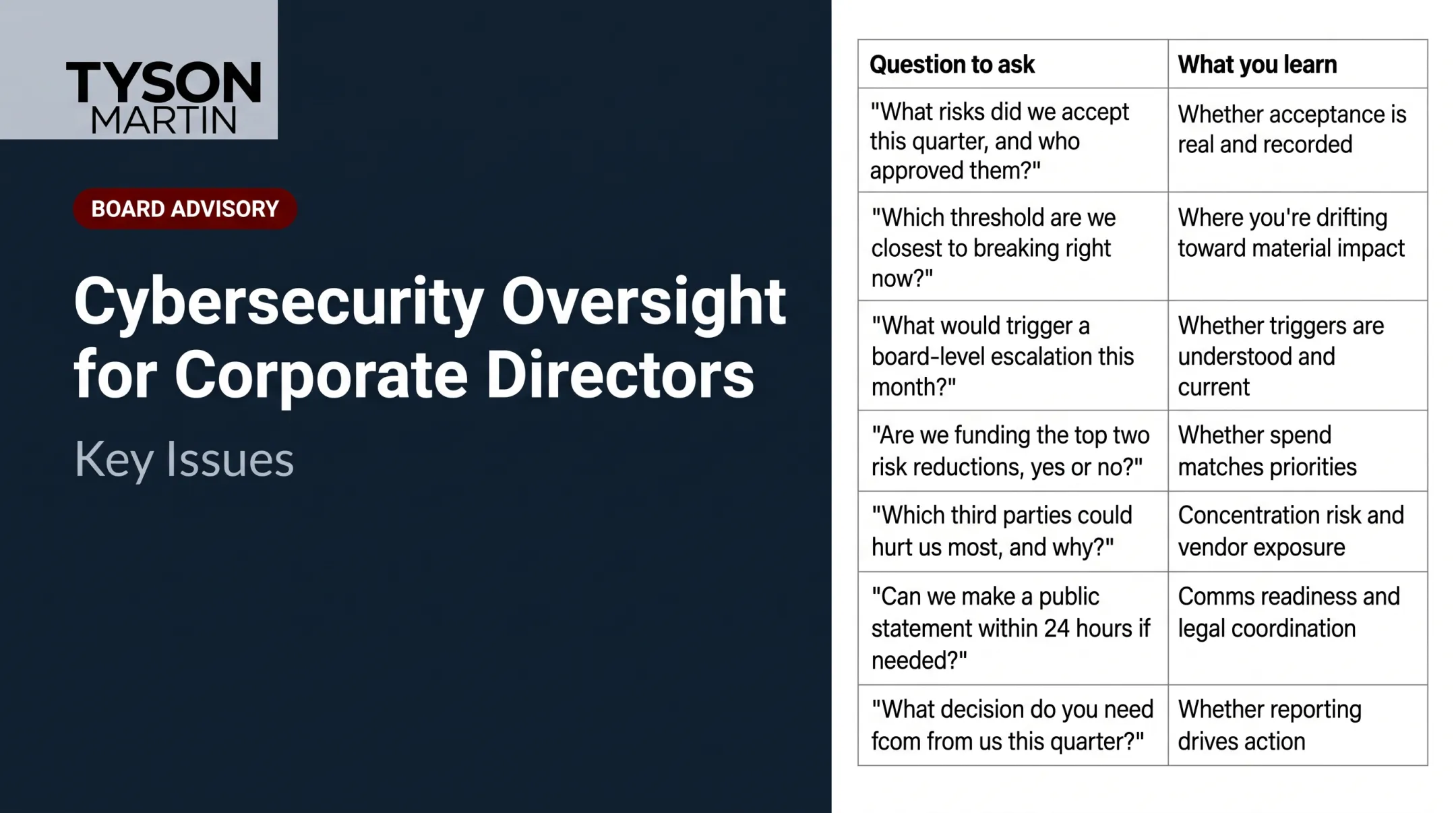
Ask questions that test follow-through
- What are our most material cyber risks?
- Which critical services could fail?
- What has changed since the last briefing?
- Which high-risk findings remain open, and who owns each fix?
- Do management's claims match testing results?
- Is risk acceptance documented, and does the budget match our stated appetite?
- What decision do you need from us?
Document substantive oversight
Minutes should record the issue, information received, alternatives considered, decisions, owners, deadlines, and follow-up. "Cybersecurity was discussed" proves little.
Keep board reports, risk acceptances, and remediation tracking in a secure, access-controlled record. Keep sensitive technical detail out of broad distribution.
Documentation helps, but minutes alone do not guarantee a defense.
Respond to red flags
Investigate when you see:
- Repeatedly missed remediation deadlines
- Unexplained security exceptions or control gaps
- Inconsistent executive reporting
- Failed exercises or audit findings
- Vendor warnings
- Public statements that do not match reality
Ask management for a defined response, independent validation where fitting, a timetable, and a documented decision if a risk is accepted.
Test the plan before an incident
A written plan is not enough. Run tabletop exercises, backup and recovery tests, and drills on crisis communications, legal escalation, regulatory notification, and alternate communications. CISA tabletop exercise packages are free to use. Judge each exercise by the corrective actions it produces, with owners and deadlines.

When outside support helps
Some boards need independent, plain-English reporting, clearer decision rights, escalation thresholds, stable metrics, or a 90-day improvement plan with owners. Tyson Martin provides board advisory and interim or fractional CISO services for these situations, with an independent view separate from the in-house CISO and security vendors.
Outside support strengthens governance and execution. It does not transfer the board's legal responsibilities, and it is not legal advice.
Cyber Insurance and Other Liability Protections
Cyber versus D&O insurance
Cyber policies may cover selected first-party breach costs and third-party cyber claims. D&O policies may respond to covered claims alleging wrongful acts by directors or officers. AIG describes Side A (individuals when the company cannot indemnify), Side B (company reimbursement), and Side C (entity coverage).
Policy interaction, retentions, exclusions, defense terms, insured-versus-insured language, and conduct exclusions should be reviewed by a broker and counsel.
What cyber coverage may include
Depending on wording, coverage may include:
- Incident response and forensic investigation
- Notification and credit monitoring
- Data restoration and business interruption
- Cyber extortion
- Crisis communications
- Regulatory investigations, where legally insurable
- Third-party claims
"Property" in a cyber policy generally means digital data, systems and software, plus restoration costs. Physical property and every kind of data loss are not automatically covered. Read the definitions.
Cost, limits and exclusions
No universal price exists. Marsh reports that US cyber rates have been moving down, but those are portfolio trends, not quotes. Pricing depends on revenue, industry, records held, security controls, claims history, limits, retention, and ransomware exposure.

Review these terms closely:
- Sublimits and waiting periods
- Consent-to-settle and panel-provider requirements
- Prior-knowledge provisions
- Minimum-security warranties
- Social engineering exclusions
- Exclusions triggered by unimplemented controls
- War or state-backed attack clauses
Cyber insurance does not cover reputation damage, customer attrition, or fines from inadequate governance.
Other protections
Review indemnification agreements, advancement rights, charter protections, vendor insurance requirements, contractual risk transfer, and incident-response retainers. Revisit them at each renewal. They complement oversight and never substitute for it.
Conclusion: Making Cybersecurity Oversight Defensible
The standard is informed, good-faith oversight the board can defend after an incident: clear accountability, credible reporting, timely escalation, adequate resources, and documented follow-through.
Before the next breach or regulatory inquiry, ask your general counsel, risk leader, CISO, broker, and independent advisors to review:
- Board cadence and reporting quality
- Incident response plan
- Insurance program
- Unresolved red flags
Frequently Asked Questions
Can members of a board of directors be held personally liable for cyber incidents?
Not automatically. Liability may arise from fiduciary duty, disclosure, regulatory, or other claims when a director's conduct meets the relevant legal standard.
What are the top cybersecurity risks for boards of directors?
Boards face oversight failures, ransomware disruption, inaccurate disclosures, and third-party dependence. Identity compromise, data exposure, and weak incident response also create board-level exposure.
How much does cyber liability insurance for boards of directors cost?
It varies by organization and policy scope. Main factors are revenue, industry, data held, security controls, claims history, limits and retention. Get a broker quote.
What types of property or assets are covered by cyber liability insurance?
Coverage may address digital data, systems, restoration, response costs and some business interruption and liability exposures. Physical property and excluded losses need separate review.
What should a board do immediately after a cybersecurity breach?
Activate the incident-response plan, notify designated legal and technical advisors, and preserve evidence. Assess materiality and reporting duties, control communications and document board involvement.
How can directors document that they provided adequate cybersecurity oversight?
Keep substantive minutes, recurring risk reports, documented decisions and risk acceptances, and remediation tracking. Add board training, tested response plans and evidence that management followed through.