Leaders see the gap. WEF's 2026 outlook shows CEOs ranking fraud and phishing first, while CISOs rank ransomware first. Both are reasonable. Neither is shared.
Alignment means tying security decisions to business objectives, critical processes, risk appetite, and measurable outcomes. This guide covers mapping priorities to cyber risk, setting decision rights, reporting in stable business metrics, and running a 90-day plan.
Key Takeaways
- Protect the processes that matter most; don't treat every asset equally.
- Boards need plain-English reports: what changed, why, who decides, what action.
- Risk appetite and escalation thresholds protect the business without slowing it.
- Alignment is an operating discipline, revisited after major changes.
Why Security Strategy Must Align with Business Objectives
Every major business move changes the risk profile. Cloud adoption, AI initiatives, market expansion, M&A, and growing customer data each add dependencies and exposure.
NACD's 2026 handbook notes that cloud supports AI strategy but brings regulatory exposure and systemic vulnerabilities. Acquirers also inherit a target's weaknesses under integration pressure.
M&A shows the stakes. Verizon discovered Yahoo's breaches during due diligence, which led to a $350 million reduction in the purchase price.
How misalignment develops
- Technical jargon that hides the business decision
- Isolated security choices made without business owners
- Compliance-only programs
- Competing budgets with no shared ranking
- Metrics that count activity instead of risk
A 98% patch-compliance rate can conceal crown-jewel systems running 30 days behind. The dashboard looks green while the business is exposed.
What it costs
The results are predictable:
- Delayed escalation when risk actually matters
- Poorly prioritized spending across competing demands
- Avoidable disruption to operations and deals
- Unclear accountability between security and the business
- Security treated as a blocker instead of a partner
The evidence on preparedness is telling. PwC's 2026 survey found only 47% strongly agree cyber risk is a standing board agenda item, and just 39% have a fully formalized continuity plan addressing cyber risk. These are preparedness gaps, not measured losses from misalignment, but they show where the work is.
A Business-Aligned Security Strategy Framework
Start with business objectives, risk appetite, and success criteria
Interview the CEO, COO, CFO, general counsel, product leaders, and business-unit owners. Ask what growth, continuity, customer trust, regulatory readiness, or expansion goals matter most this year, and what would derail them.
Then define risk appetite in practical terms:
- Risks the organization will accept temporarily
- Risks that require mitigation
- Conditions that trigger executive or board escalation
A useful test: which vulnerabilities must be fixed in 30 days, and which can wait 90? Then tie each objective to what security must enable, such as safe product launches, trusted transactions, or uninterrupted critical operations.
Map business processes, assets, and dependencies
Build a business-impact map: critical processes, supporting applications, data, infrastructure, vendors, owners, and dependencies. Assets inherit the criticality of the functions they support, according to NIST's BIA guidance.
Mapping surfaces what technical inventories miss: third-party dependencies, identity weaknesses, fragile recovery, single points of failure.
Consider two similar findings. An unpatched flaw on the platform that takes customer orders threatens revenue today. The same flaw on an internal test system is a routine ticket. Same severity score, very different business priority.

Translate cyber risk into business language
Describe each risk as a scenario:
- The threat or failure condition
- The affected business process
- Likely operational consequence
- Legal or regulatory exposure
- Customer impact
- Recovery challenge
A board-ready statement might read: the customer portal could be down 24 hours in peak season because of a single point of failure.
Separate likelihood, business impact, control effectiveness, and residual risk. Severity scores alone can't do that. When quantifying, use labeled ranges and stated assumptions. NIST IR 8286A notes ranges can be more useful than point estimates and that analyses are not predictions.
Prioritize controls and investments by business value
Rank initiatives by their ability to reduce material risk, protect critical objectives, meet required obligations, enable growth, or improve resilience.
NIST CSF 2.0, ISO/IEC 27001, and CIS Controls give structure. They don't replace your own analysis. A hybrid works well: CSF for executive reporting, CIS for engineering execution, ISO for the management-system layer.
Avoid the common traps: checklist compliance, chasing vulnerability counts, and buying tools with no owner, process, or expected outcome.
Build a roadmap with owners and decision points
Each major initiative should state:
- The business objective it supports
- The risk addressed
- The accountable owner
- Dependencies
- Target outcome
- The decision required
- How it will be verified
Sequence foundations first: identity, asset visibility, recovery, incident response, vendor risk, application security, and executive reporting.
Document every exception with compensating controls, an expiration date, and an acceptance authority. An exception with no expiry is a failure mode, not agility.
Build Governance, Decision Rights, and Cross-Functional Execution
Define accountability
Responsibility is distributed across the organization. The board provides oversight while executives hold accountability. Security leaders run the program, technology teams own systems, and business owners own the processes and data at risk.
A short decision-rights map should answer five questions:
- Who sets risk acceptance thresholds?
- Who approves exceptions, and for how long?
- Who decides budget tradeoffs?
- Who declares incident severity and can order a shutdown?
- Who makes go/no-go calls on critical vendors?
In a typical RACI:
- CEO or board sponsor owns appetite and tie-breaking
- COO owns continuity
- GC owns legal exposure and notifications
- IT owns identity and core-service reliability
- Security provides risk clarity and independent challenge
Set escalation thresholds
Escalate immediately for material business disruption, suspected sensitive-data exposure, missed recovery objectives, or risk beyond appetite. Triggers can be set in dollars, downtime, data sensitivity, or legal exposure.
Clock confusion is common. Discovery, materiality determination, and disclosure are separate events. Under the SEC's rules, Form 8-K Item 1.05 is generally due four business days after a materiality determination, which must happen without unreasonable delay after discovery. NYDFS and the FTC use different triggers, so none is a universal clock.

Test the paths. Tabletop exercises should include executives, legal, communications, operations, technology, security, and key vendors. Executives should take part as decision-makers, not observers.
Embed security in existing processes
Build security into the processes that already run the business:
- Strategic planning and product development
- Cloud and AI adoption
- Procurement and vendor management
- M&A diligence
- Joiner-mover-leaver and change management
Early involvement cuts late rework, and a clear exception path keeps urgent projects moving. Connect incident response to business continuity, crisis management, legal review, and customer communications.
Create a communication rhythm
- Working level: monthly cross-functional risk reviews with legal, finance, HR, product, and operations
- Executive: decision meetings on blocked items, costs, and exceptions
- Board: reporting at least quarterly, and immediately after material incidents, per NACD guidance
Use one format everywhere: what changed, why it matters, what's being done, what's uncertain, what leadership must decide.
Build culture without shifting blame
Make training role-specific: handling sensitive data, approving vendors, managing access, writing code, and reporting incidents. The human element appears in 62% of breaches in Verizon's 2026 DBIR, but training alone won't fix that.
Pair training with usable processes, leaders who model good behavior, and non-punitive reporting. Add executive and board tabletops so leaders learn their roles before a crisis.
Measure, Report, and Continuously Improve Security Alignment
Choose metrics tied to outcomes
Organize metrics around continuity, critical-data protection, customer trust, regulatory readiness, resilience, and safe growth. Balance leading and lagging indicators:
- Leading: patch lag on critical assets, untested backups, vendor gaps
- Lagging: time to detect and contain, downtime hours, recovery time
Patch counts, alert volumes, blocked attacks, and training completion belong in reports only when they connect to material risk.
Build a stable dashboard
Keep 5 to 12 trend-based metrics, each with an owner and threshold, and don't swap them every cycle. Every report should cover:
- Current posture and trend
- Top risks and accepted risks
- Business changes and actions underway
- Decisions needed
If management needs 40 slides, the story isn't crisp yet.
Present uncertainty honestly. Use ranges and note data limits instead of false precision.
Test whether it works
Validate alignment with a mix of methods:
- Control testing and independent assessments
- Penetration testing where appropriate
- Incident exercises and recovery tests
- Vendor reviews and lessons learned
Ask whether each control operates consistently, has an owner, and reduces the intended risk.
The Cyber Safety Review Board's Exchange Online review found the 2023 intrusion preventable and Microsoft's security culture inadequate. It recommended direct CEO and board attention and a public reform plan with senior-officer accountability. Microsoft also left an inaccurate public explanation uncorrected for months.

Boards should treat governance and communication as first-order issues, equal to the technical controls.
Review and recalibrate
Schedule regular reviews, plus trigger-based ones after:
- Incidents, acquisitions, or leadership changes
- New regulations or major technology shifts
- New products or strategy changes
Compare priorities with current objectives, appetite, threats, and resources. Retire low-value work, reassign owners, and redirect spend.
A 90-Day Roadmap for Putting Alignment Into Practice
These phases are a practical sequence, not a prescribed standard.
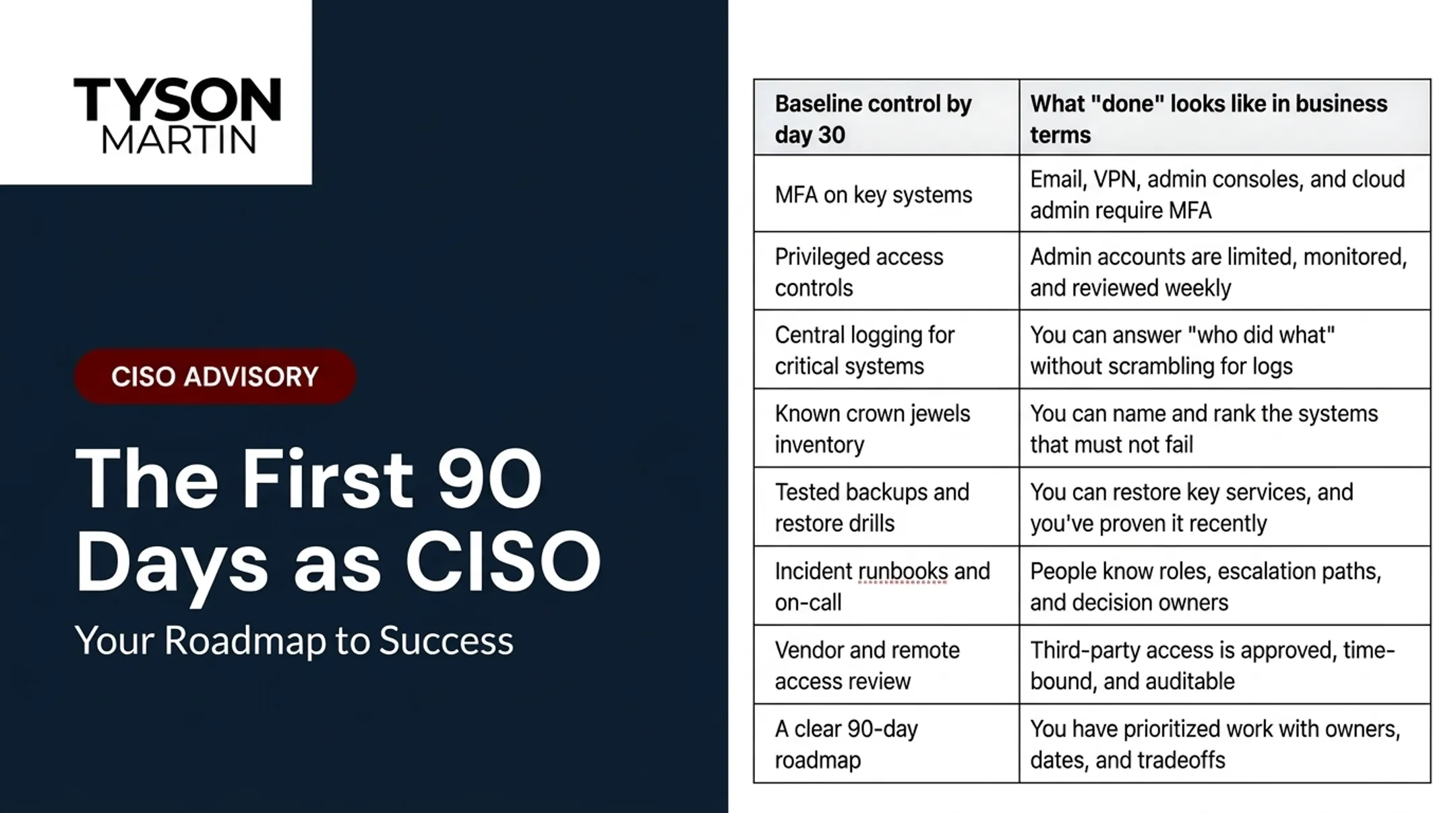
Days 0–30: Establish the baseline
- Interview leaders and business owners on objectives, appetite, critical processes, decision rights, and pain points
- Review security plans, incident records, assessments, obligations, dashboards, vendor dependencies, recovery plans, and open risk acceptances
- Deliver a short briefing: what's known, what's uncertain, the biggest gaps, and the first decisions needed
Days 31–60: Prioritize and assign
- Convert findings into ranked business-risk scenarios and a roadmap with owners
- Give each top risk an executive owner, technical owner, and due date
- Agree on 5 to 7 stable metrics and draft the dashboard
- Stand up the forum, cadence, risk-acceptance process, and escalation model
Days 61–90: Operationalize and inspect
- Run an executive tabletop and test one critical recovery or escalation process
- Record improvements with owners and dates
- Deliver the first leadership briefing with plain-English risk statements, trends, residual risk, and recommended decisions
Some organizations lack the capacity for this, especially during a leadership gap, M&A, modernization, or an incident. A board advisor or interim or fractional security executive can supply governance and execution. Tyson Martin offers board advisory and interim or fractional CISO services as one option, with an independent, plain-English approach to oversight.
Turn alignment into an operating discipline
Alignment is a continuous loop: set priorities, assign decisions, measure risk, adapt. Start small with one critical business objective, one material risk scenario, one accountable owner, and one leadership decision.
Frequently Asked Questions
How do you align IT strategy with overall business goals?
Start with business objectives, then map the systems and processes that support them. Assess business impact, define risk appetite, and measure outcomes against agreed priorities.
How do you ensure team alignment with organizational goals?
Share objectives, set clear decision rights, and hold cross-functional forums. Give each role specific accountability, communicate in plain English, and review progress regularly.
Who is ultimately responsible for ensuring the security of an organization's information and data?
Responsibility is shared. The board oversees, executives are accountable, security and technology leaders run the program, and business owners own their processes and data. The exact split depends on structure and obligations.
What is the main goal of information security?
It protects the confidentiality, integrity, and availability of information. In doing so it supports trusted operations, resilience, compliance, customer confidence, and growth.
What metrics should boards use to measure security alignment?
Use trend-based measures tied to material risk: critical-risk reduction, recovery readiness, incident response, availability of key services, control effectiveness, and overdue executive decisions.
How often should a security strategy be reviewed?
Review on a regular leadership cadence, with board reporting at least quarterly. Add reviews after incidents, acquisitions, major technology or business changes, new regulations, or leadership transitions.