Introduction
Cybersecurity oversight is now an enterprise-risk and governance responsibility, not an IT reporting exercise. Directors still have to understand material cyber risk, challenge management, and make defensible decisions without owning technical implementation.
The exposure is real. IBM's 2025 research puts the average U.S. breach cost at $10.22 million. It is an average, not a forecast for any one company.
This article covers board responsibilities, oversight priorities, useful questions and metrics, incident readiness, disclosure considerations, and a 90-day plan for U.S. organizations.
Key Takeaways
- The board oversees risk appetite, accountability, resources, resilience, and escalation. Management executes.
- Trend and business-impact reporting beats counts of alerts, vulnerabilities, or tools.
- Predefined decision rights and escalation thresholds reduce surprises during incidents.
- Oversight must reach vendors, cloud, acquisitions, AI, regulation, recovery, and communications.
Why Cybersecurity Is a Board-Level Responsibility
A serious incident can hit enterprise value, operations, customer trust, legal exposure, financial reporting, and deal outcomes at once. UnitedHealth reported $2.223 billion in 2024 direct response costs for the Change Healthcare attack, plus $867 million in business disruption impacts. Those are one company's figures, but they show how a single event can reach every one of those areas.

Courts have also set oversight expectations. In Marchand v. Barnhill (2019), Delaware's Supreme Court revived claims against directors who had no board-level monitoring of a mission-critical risk. It was a food-safety case, not a cyber case, but the principle carries over.
The SolarWinds derivative suit was dismissed because a subpar reporting system was not an utter failure. Don't read that as comfort. Build the reporting system anyway.
Oversight versus execution
Directors set expectations, approve risk posture and resources, challenge assumptions, and monitor outcomes. Management operates controls and handles daily threats. A cyber-savvy director sets risk appetite and funding discipline. They do not configure firewalls.
How expectations vary
Obligations differ by organization type:
- Public companies face SEC disclosure rules.
- Regulated industries such as banking and healthcare carry sector-specific notification duties.
- Digital-native and service businesses depend heavily on availability and customer trust.
- Companies in leadership change, modernization, M&A, or post-incident recovery carry elevated risk.
Confirm your specific obligations with qualified legal and compliance professionals.
What Directors Should Oversee
Risk appetite and critical services
Start with harm statements. Which systems, data, suppliers, and customer-facing operations would cause material harm if disrupted? Make them concrete: if checkout is down more than four hours, sales are lost for good. If a supplier outage stops shipping for two days, contract penalties follow.
Accountability and decision rights
Check that roles are explicit for the board, audit or risk committee, CEO, COO, CIO, CISO, general counsel, finance, operations, and business units. One accountable executive should have authority over cyber priorities and spending.
The roadmap as a portfolio of risk decisions
Tie every budget request, hire, and modernization project to a specific risk reduction. Ask for three to five outcomes for the year, such as faster remediation of critical issues, tested recovery times, and stronger vendor coverage.
Third parties, cloud, acquisitions, and AI
Dependency is a growing exposure. Verizon's 2025 report found third-party involvement in 30% of breaches, roughly double the prior share (global data, not U.S.-only). Require:
- A top-10 critical vendor list and a plan for any one being down 72 hours
- Evidence of due diligence, contract protections, and monitoring
- Documented cloud shared-responsibility models
- Exit or contingency plans
- Diligence on acquisition targets before close
Marriott's Starwood breach began around 2014 and went undetected until 2018, after the 2016 acquisition. Inherited cyber risk can sit undiscovered for years.
For AI, NIST's AI RMF puts risk decisions on executive leadership. The SEC has also fined advisers for misleading AI claims.
Digital resilience
Prevention fails sometimes. Confirm that critical operations can continue during disruption, and review:
- Incident response and crisis leadership
- Backups and recovery priorities
- Third-party coordination when systems fail
The July 2024 CrowdStrike update affected an estimated 8.5 million Windows devices without any attacker involved.
The Questions and Metrics Directors Should Use
A useful update answers, in order: what changed, what it means, what management is doing, what support is needed, and what happens if action slips.
Six questions to ask
- What has changed since the last briefing? Demand plain English on threat exposure, systems, control effectiveness, accepted risks, incidents, and near misses.
- Which risks could materially affect our most important services, customers, or obligations? Tie answers to a current inventory of critical assets, data flows, and dependencies.
- How do we know the controls are working? Ask for leading and lagging indicators: testing results, audit findings, remediation performance, identity and access, vulnerability management, detection, response, and recovery exercises.
- Which metrics show trend rather than activity? Prefer multi-period trends on exposure, control health, and recovery over raw activity counts.
- What decisions or risk acceptances need the board? Surface choices that exceed management authority, sit outside appetite, or lock in material residual risk.
- What evidence supports management's assessment? Request testing, audit, tabletop, and third-party assurance, not narrative confidence alone.
Metrics that matter
NACD's 2026 handbook favors measurable risk reduction over activity counts. Useful measures include:
- Critical assets and estimated financial exposure
- Exposure by business unit over time
- Incident number and severity
- Detection and containment times
- Third-party concentration
- Recovery time for crown-jewel systems
Vanity measures count alerts, tools, or blocked attacks. Blocked-attack numbers can even rise when monitoring improves. A wall of 25 numbers forces directors to guess what matters.
The decision dashboard
A one-page dashboard should show what changed, why it matters, who owns it, and what decision is needed. Flag resource tradeoffs, overdue remediation, exceptions, concentration risk, and issues beyond tolerance. For vendors outside tolerance, the options are accept (with an expiry date and named owner), reduce, transfer, or replace.

Back it with independent assurance: internal audit, control testing, tabletop results, supplier reviews, and documented follow-through. Insurance deserves scrutiny too. The NAIC's 2026 report notes standard policies often exclude or limit social-engineering and funds-transfer fraud losses.
Incident Response, Disclosure, and Digital Resilience
Build the governance model before the incident
Set these elements before an incident hits:
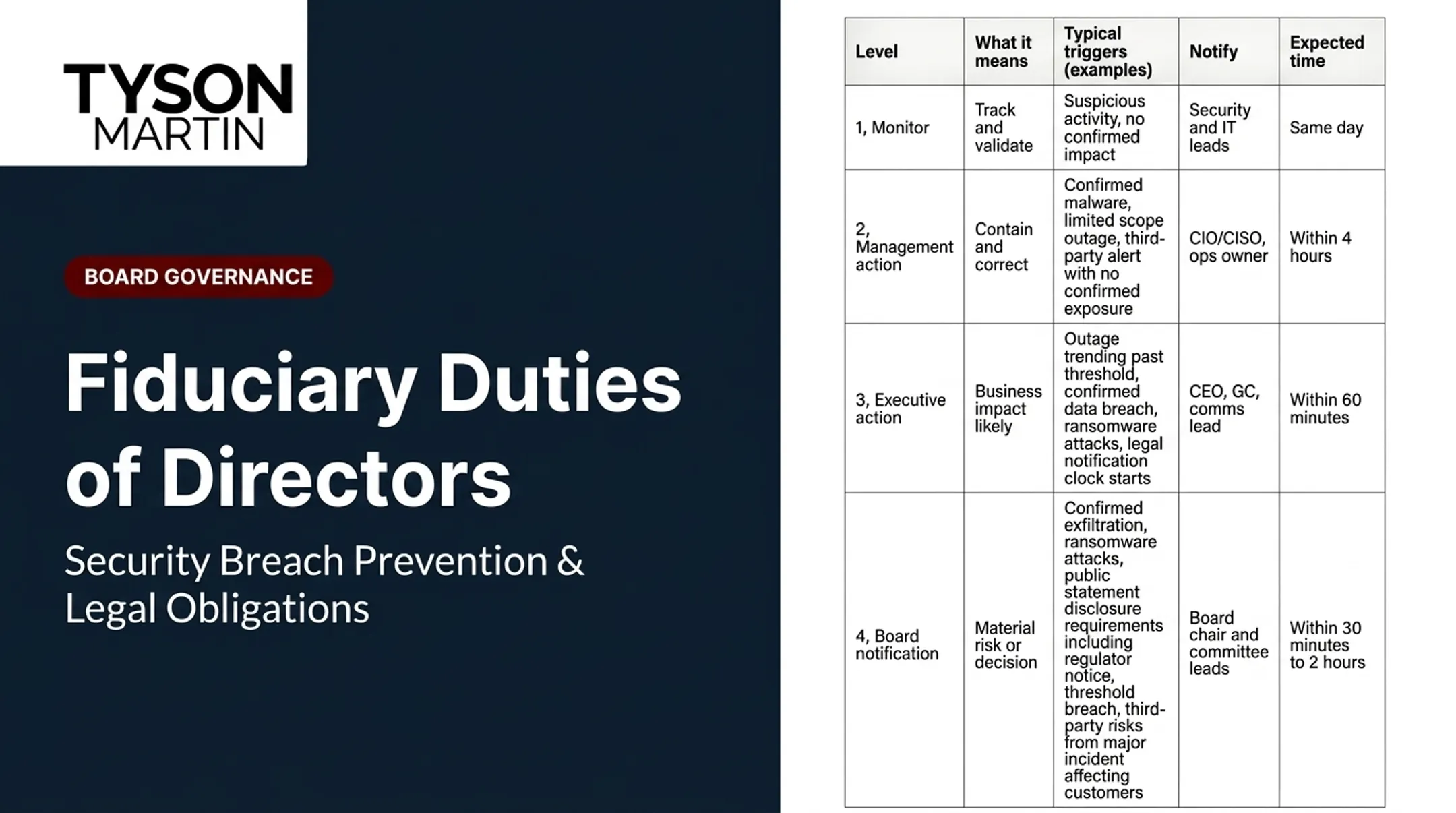
- Severity levels and escalation triggers
- Decision owners and board notification procedures
- What directors receive at each stage
A one-page escalation ladder works. So does a lightweight RACI that settles who can take systems offline, approve emergency spend, decide ransom posture, and sign off on customer language.
How the board behaves during an incident
- Provide oversight and challenge, not technical direction
- Keep communication channels clear
- Support timely decisions
- Confirm that management documents facts, assumptions, actions, and unresolved risks
Pre-decide what the chair receives first: current impact, actions underway, and next update time.
U.S. disclosure and reporting landscape
Requirements differ by entity, trigger, and recipient. No single clock covers everything. Verify current rules with counsel.
- SEC (public companies): Form 8-K Item 1.05 is due generally four business days after a materiality determination, not discovery. Annual filings describe board oversight and management's role.
- HIPAA: Individual notice without unreasonable delay, within 60 days of discovery.
- FTC Safeguards Rule: Notice within 30 days of discovery for events involving 500 or more consumers.
- NYDFS Part 500: 72 hours after determining a qualifying incident occurred; 24 hours for extortion payments.
- Federal banking agencies: 36 hours after determining a notification incident occurred.
- CIRCIA: The final rule is under OIRA review. Proposed clocks (72 hours for incidents, 24 hours for ransom payments) are not currently operative.
- State laws: California, for example, requires attorney general notice when more than 500 residents are affected.
Enforcement is real but uneven. In October 2024, the SEC settled with four companies over misleading cyber disclosures, with penalties from $990,000 to $4 million. In November 2025, the SEC's SolarWinds case was dismissed with prejudice.
Communications and coordination
Align factual updates across every audience that needs them:
- Customers and employees
- Regulators and law enforcement
- Insurers, lenders, and investors
- Vendors and the board
Forensic, legal, operational, and investor-relations tracks must agree on wording and timing. Internal messaging, customer statements, and any 8-K should match.
Tabletops and learning
Run recurring exercises with directors and executives. Use realistic scenarios: ransomware, cloud outage, compromised vendor, data theft, and AI failure. CISA offers free customizable tabletop packages. Every exercise should end with fixes assigned to owners and deadlines, then a re-test.
Closure isn't the end. Update risk assumptions, controls, contracts, response plans, training, board reporting, and funding. NIST's 2025 incident guidance says to share lessons as identified, not only after recovery.
A Practical 90-Day Action Plan for Directors and Executives
Frameworks such as NIST's organizational profiles support a current-state, target-state, gap-analysis, action-plan sequence. They don't prescribe a 30/60/90 calendar, so treat the plan below as a practical way to apply them.
Days 1 to 30: Establish the baseline
- Document the governance model and reporting lines
- List critical services and open high-priority risks
- Review recent incidents and near misses
- Map regulatory exposure and third-party dependencies
- Identify the board's information gaps
Days 31 to 60: Agree on the rules
- Set risk appetite and decision rights
- Define escalation thresholds
- Settle dashboard content, committee responsibilities, and reporting cadence
- Choose the first board tabletop scenario
Days 61 to 90: Prove it
- Approve a prioritized roadmap with owners and measurable outcomes
- Validate the most important controls and recovery assumptions
- Run the exercise
- Schedule a follow-up showing completed actions and unresolved decisions

When outside help makes sense
An independent board advisor or interim or fractional CISO can help when an organization needs:
- Credible reporting
- Clearer accountability
- Leadership stability
- A way to turn an assessment into an executable plan
Tyson Martin offers board advisory and fractional executive services built around plain-English risk posture, stable dashboards, escalation thresholds, and 90-day plans with owners and measurable outcomes.
The practice advises and validates. It does not run security operations.
Frequently Asked Questions
What is the board's role in cybersecurity oversight?
The board oversees risk appetite, accountability, resources, resilience, and escalation. Management handles technical execution and daily operations.
How often should corporate directors review cybersecurity?
NACD recommends at least quarterly, plus immediate review after material incidents or significant changes in exposure. Match cadence to your risk profile and business changes.
What cybersecurity metrics should a board monitor?
Use a short, stable set: critical exposure, control effectiveness, remediation, resilience, third-party risk, and trend. Avoid relying only on activity counts.
Should the CISO report directly to the board?
Structure varies. SEC rules don't prescribe a CISO-to-CEO line. The board needs reliable CISO access, clear escalation rights, and a way to challenge filtered information. A quarterly executive session helps.
What should a board do after a cybersecurity incident?
Support governance, confirm escalation and legal processes are active, and monitor recovery and communications. Require documented lessons learned. Don't direct the technical response.
How can directors prepare for regulatory and disclosure requirements?
Map applicable U.S. requirements, assign ownership with management and counsel, and keep evidence of oversight decisions. Rehearse notifications and verify current rules before relying on them. This article is not legal advice.