Introduction
Technology decisions now move faster than most boards can oversee them. Deloitte's 2024 survey found that 79% of respondents describe their boards as having limited, minimal, or no AI knowledge, and only 2% call them highly knowledgeable.
Cyber risk, AI adoption, vendor exposure, and regulatory expectations all land on the same agenda. A technology advisory board gives leadership independent expertise without creating a second management team or shifting fiduciary authority away from directors.
This article covers what a tech advisory board is, why organizations form one, how to build it, and how to run it with clear governance and useful reporting.
Key Takeaways
- A tech advisory board gives non-binding guidance; management executes and directors govern.
- Build it around specific strategic questions and capability gaps, not impressive names.
- Write down decision rights, escalation triggers, confidentiality terms, and reporting expectations.
- Judge it by results: executable priorities, faster escalation, fewer surprises.
What Is a Tech Advisory Board?
What a technology advisory board does
A tech advisory board is a group of external experts in technology, cybersecurity, data, cloud, product, or a specific industry. They advise executives and the board of directors on strategic technology questions.
Typical questions include:
- Where to put technology investment when budgets are tight
- How to sequence modernization
- How to govern AI use as it spreads
- How exposed the company is to cloud concentration
- How to prepare for the first hours of a ransomware event
- What to examine in technology diligence on an acquisition
How it differs from other structures
The AICD's advisory board guidance describes advisory boards as experienced people giving advice with no binding decision-making authority or executive function. Directors, by contrast, carry fiduciary duties of care and loyalty, vote on matters, and answer legally for outcomes. Advice never moves that accountability.
Other structures serve different purposes:
- Business or growth advisory boards focus on commercial strategy, not technology.
- Customer advisory boards collect customer feedback on products and experience.
- Scientific advisory boards provide research expertise.
- Consultants deliver defined projects.
- Fractional or interim executives supply hands-on leadership capacity.
Organizations can use several of these at once, provided each has a distinct purpose. An advisory board is also different from an auditor, who tests controls against a standard at a point in time, or a penetration tester, who finds weaknesses. The advisory board helps decide which issues matter to the business and what to do first.
HSBC offers a documented example. In 2017 it appointed a Technology Advisory Board of technologists and entrepreneurs from the US, China, India, and Israel, with quarterly advice on digital strategy, infrastructure, and cybersecurity.
Why Organizations Create a Tech Advisory Board
Connecting technology to strategy and risk
Without outside expertise, technology gets treated as an IT problem. An advisory board helps directors tie it to growth, resilience, customer experience, regulatory duties, and risk appetite.
Exposing blind spots
Outside advisors see what internal teams have normalized. The NIST Cybersecurity Framework 2.0 points to several areas where gaps hide:
- Leadership accountability and clear cyber roles
- Supplier prioritization and ongoing third-party monitoring
- Replacing aging software in proportion to risk
- Inventories of data and its metadata
Third parties matter more every year. The Verizon 2026 DBIR reports third-party involvement in 48% of breaches, up from 30% the year before. Cloud concentration and AI governance deserve the same scrutiny, since the NIST AI Risk Management Framework calls for documented human oversight and regular testing.

Better investment decisions
Independent advisors pressure-test assumptions, compare alternatives, and surface dependencies. A good transformation decision memo presents options, cost ranges, measurable outcomes, and what happens if assumptions fail.
Support during transitions
An outside sounding board is most valuable when things change: a new CEO, a merger, an incident, fast growth, or no permanent technology executive. A new director cannot fix weak reporting or unclear ownership on day one. Advisors can help sooner.
Plain-English board communication
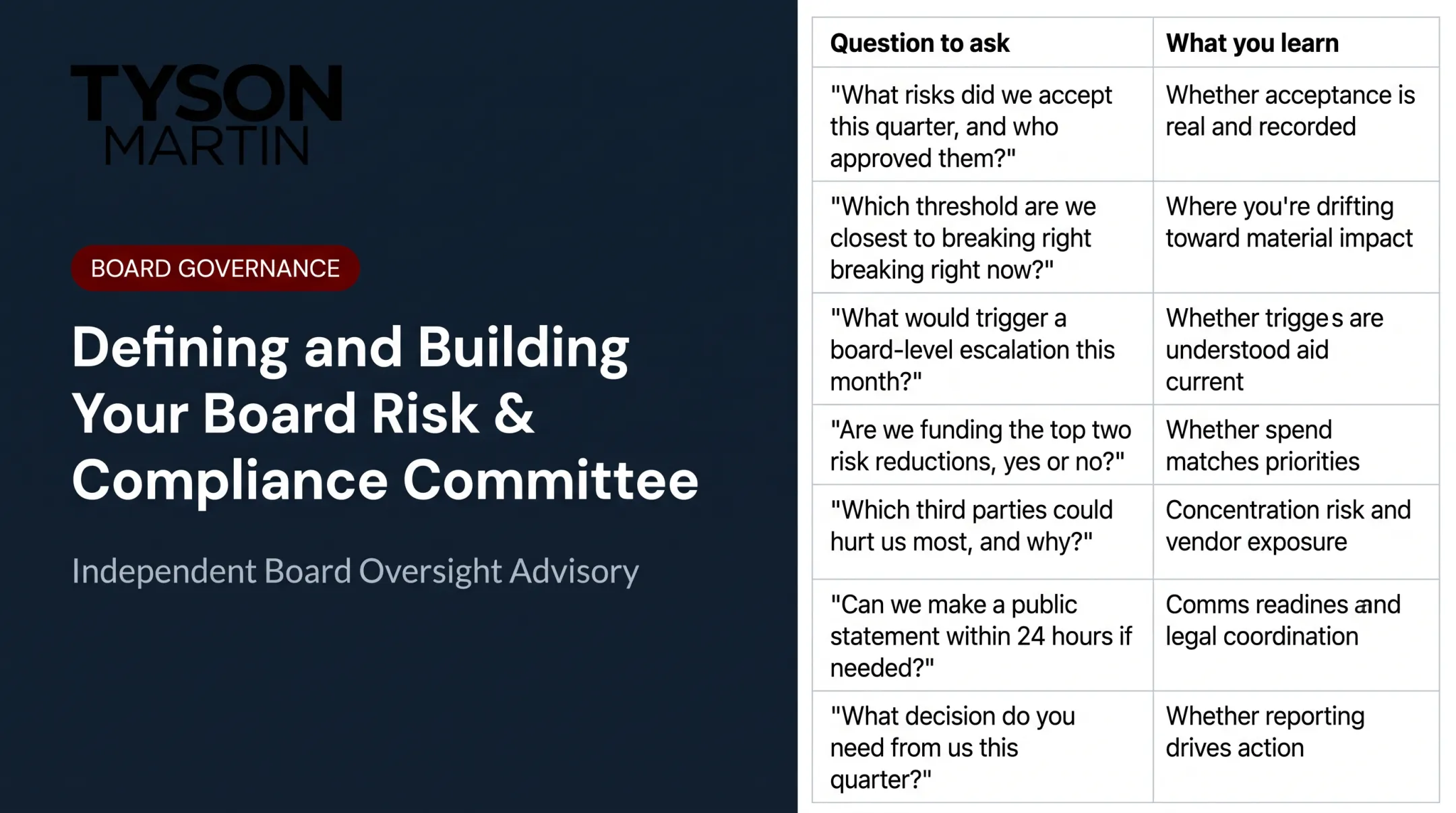
Directors need clarity, not raw technical detail. Reporting should state current posture, what changed, trend direction, open decisions, owners, and escalation needs. The NACD-ISA Director's Handbook warns that heat maps and maturity ratings often fail to explain materiality or the cost-effectiveness of mitigation.
How to Build a Tech Advisory Board
Define the mandate and scope
Start with the most important technology and risk questions for the next planning period. Turn them into a written charter covering:
- Purpose and scope
- Expected outputs
- Authority limits
- Success criteria
Clarify how the group works with the board, the audit or risk committee, the CEO, general counsel, CIO, and CISO. Without that clarity, recommendations create shadow management.
Build the right skills mix
Build a skills matrix from your strategy and risk profile. Cover the domains your strategy actually depends on:
- Cybersecurity and cloud
- Data, AI, and architecture
- Operations and resilience
- Regulated-industry and M&A experience
- Change leadership
NACD publishes a Board Skills Matrix sample that can serve as a starting point.
Seek complementary backgrounds: technical depth, commercial judgment, delivery experience, and willingness to challenge. A group with identical assumptions adds little. Research from Bresman and Edmondson found that team diversity improves performance only when psychological safety is high, so safety matters as much as the mix.
Recruit and assess candidates
Evaluate each candidate on:
- Relevant, applied experience
- Independence and conflicts of interest
- Ability to talk to nontechnical stakeholders
- Willingness to challenge leadership
- Capacity to show up consistently
Applied experience often beats title or prestige. HSBC's members were chosen for hands-on work in authentication, fraud prevention, and machine learning. A former CISO is not automatically the best fit either. Strong candidates also come from product, risk, and operations roles where they owned outcomes.
Formalize expectations before launch
Put terms in writing before anyone starts:
- Scope, time commitment, and meeting cadence
- Compensation
- Confidentiality, intellectual property, and conflicts
- Information access
- Term length, renewal, and replacement
Compensation varies widely, from expenses to per-meeting fees to retainers. No reliable market rate exists for enterprise technology advisory boards.
State plainly that advisors recommend, question, and help prioritize. Management owns implementation.
Launch with a usable rhythm
Before the first session, establish:
- Meeting calendar
- Pre-read standard
- Agenda format
- Decision log and action register
Then run a 90-day plan that names baseline assessments, decisions, owners, and measurable outcomes. Keep the group from turning into an execution team.

How to Operate and Govern a Tech Advisory Board
Establish decision rights and escalation
Define what the advisory board advises on, what management decides, what needs board or committee visibility, and what triggers immediate escalation. Possible triggers include:
- A material cyber incident
- Risk acceptance beyond stated appetite
- A major technology investment
- A critical third-party dependency
- A regulatory concern
- A transformation milestone at risk
These are examples, not universal legal thresholds. For SEC registrants, the SEC's 2023 cyber rule requires an 8-K within four business days after determining an incident is material, not after discovery.
It sets no numerical materiality threshold, so an internal trigger is not a disclosure standard. Counsel should guide that determination.
Create reporting that supports decisions
Use a stable dashboard so directors can see movement over time. Include:
- Risk posture and changes since the last briefing
- Trend direction and priority initiatives
- Resilience indicators and major dependencies
- Overdue actions and decisions needed
The NACD-ISA handbook offers example measures:
| Dimension | Example measure |
|---|---|
| Economic exposure | Cyber-loss exposure in dollars |
| Resilience | Critical-system downtime and time to recover |
| Response | Mean time to detect and remediate |
| Suppliers | Share of supply chain failing security assessment |
Keep the set small. Eight to twelve metrics is workable, with a few board-level outcome measures held steady while supporting metrics rotate.
Run focused, prepared meetings
Require pre-reads that explain the decision, evidence, alternatives, assumptions, risk implications, and proposed next steps. Reserve real time for challenge. Record recommendations and dissent, assign owners and due dates, and send a short follow-up summary.

Protect independence and trust
Address conflicts early, especially advisors whose commercial relationships could shape recommendations. Control access to sensitive incident information.
Privilege is fragile. Greenberg Traurig's 2025 analysis notes that privilege does not protect underlying facts, and in the Capital One case a forensic report lacked work-product protection because it served business purposes.
An NDA or counsel's presence does not automatically make information privileged.
Psychological safety, a shared belief that interpersonal risk-taking is safe, lets advisors challenge executives. Without it, the board becomes an endorsement forum.
Review, adapt, and connect advice to execution
Review the board against its charter at set intervals:
- Quality of decisions
- Relevance of expertise
- Speed of escalation
- Completion of actions
- Changes in technology risk
Rotate members as needs change. When a company needs sustained hands-on leadership, an interim or fractional executive may fit better than an advisory panel. Tyson Martin provides board advisory services and interim CISO leadership for organizations in transition, which can be a practical next step.
FAQ
Does a tech advisory board replace a CISO or CIO?
No. It advises and challenges. The CISO, CIO, and management teams still run operations and own execution.
Can advisors make binding decisions?
No. Advice is non-binding, and the board of directors keeps its fiduciary authority and voting power.
How often should it meet?
Quarterly is a common starting cadence, as in HSBC's model. No single schedule is required, so set it in the charter.
How should advisors be paid?
Arrangements range from expense reimbursement to per-meeting fees or retainers. Define compensation in the engagement terms.
When is an interim executive better than an advisory board?
When you need hands-on leadership after an incident, during a transition, or before a permanent hire.