Introduction
Many boards treat the CISO and CTO as interchangeable "technology executives." They aren't. One governs cyber risk. The other builds and scales technology.
Blurring the two has a cost. Escalation slows, work gets duplicated, and innovation ships without security review.
IBM puts the global average breach cost at $4.99M in 2026, up 12% from the prior report. PwC data also shows that fewer than half of CISOs have meaningful input into cyber investment and board updates.
This guide defines each role, shows where they overlap, explains which one your organization may need first, and makes the case that decision rights matter more than titles.
Key Takeaways
- A CISO leads security, cyber risk, resilience, and compliance oversight.
- A CTO leads product technology, architecture, engineering, and innovation.
- Neither role is automatically higher; reporting lines and board-approved authority decide.
- Companies with both roles need written decision rights for cloud, AI, data, and incidents.
CISO vs CTO: Quick Comparison
| Dimension | CISO | CTO |
|---|---|---|
| Primary mandate | Reduce cyber risk to data, systems, customers, and operations; support resilience and compliance | Build the technology, products, and platforms that drive growth |
| Orientation | Cross-functional and risk-oriented: board, legal, compliance, IT, HR | Product- and engineering-oriented: product, development, architecture |
| Core ownership | Security strategy, policies, risk assessments, incident response, third-party cyber risk, awareness | Technical vision, architecture, roadmaps, build-versus-buy, emerging tech |
| Success measures | Risk visibility, control performance, tested response, regulatory readiness, credible board reporting | Reliability, delivery, scalability, technical quality, innovation outcomes |
| Executive question | "What could materially harm us, and how prepared are we?" | "What should we build, and how do we deliver it reliably and securely?" |
A note on CISO metrics: security is not the absence of incidents. Useful measures include:
- Time to contain and recover
- Critical control coverage on crown-jewel assets
- Security debt burn-down
A typical target is critical patch SLAs above 95%.
What Are the CISO and CTO Roles?
CISO: Mandate and Leadership Lens
CISO stands for Chief Information Security Officer. ISACA describes the role as the executive-level voice of the security function, generally accountable for security architecture, operations, governance, risk, and compliance.
That is broader than buying tools or running a SOC. The CISO translates threats, vulnerabilities, and regulatory duties into decisions a board can act on.

Typical responsibilities:
- Security strategy and governance
- Identity and access management
- Incident preparedness and response
- Third-party risk
- Employee awareness
- Compliance coordination with legal and risk teams
A CISO is especially valuable when:
- Operating in regulated industries or handling sensitive data
- Navigating M&A, modernization, or customer assurance reviews
- Recovering from an incident or a leadership change
- Audit findings keep repeating, or security work keeps losing to delivery deadlines
CTO: Mandate, Responsibilities, and Use Cases
CTO stands for Chief Technology Officer. McKinsey describes the role as concerned with both product and technology development, identifying disruptive technologies and shaping the organization's response.
A CTO weighs choices by customer value, scalability, delivery speed, technical quality, talent, and long-term maintainability.
How the role shows up in practice:
- Product company: Etsy appointed Mike Fisher CTO in July 2017. Under him, the marketplace moved its systems to Google Cloud, finishing in February 2020.
- Non-software business: Deere's CTO, Jahmy Hindman, is responsible for a stack spanning hardware, embedded software, connectivity, data platforms, and applications.
CTO scope isn't limited to software products.
Where the Roles Overlap
The CISO and CTO need to work together on:
- Cloud architecture and shared-responsibility decisions
- Application security and software development practices
- Data protection
- AI adoption
- Vendor selection
- Vulnerability remediation and resilience
CISA's secure-by-design guidance treats security as part of product quality, and says leadership must make it a design requirement. NIST's AI Risk Management Framework asks organizations to document roles and communication lines for AI risk decisions.
A simple decision-rights split works well:
- CTO decides: engineering approach, performance tradeoffs, and delivery sequencing within agreed guardrails
- CISO decides: control requirements, risk-acceptance thresholds, and incident-readiness standards
- Joint: launch readiness when risk and delivery collide, new core patterns such as identity, logging, and secrets, and major third-party integrations
- Escalate: stop-ship criteria, material legal exposure, and risks above agreed thresholds
The frameworks support explicit allocation. They don't dictate which title owns every decision, so write it down.

CISO vs CTO: What Is Better for Your Organization?
The question is rarely which title is better. Ask which leadership gap creates the most business risk or limits execution.
Prioritize a CTO When
- Your product or competitive edge depends on technology
- Engineering lacks a coherent technical roadmap
- Architecture decisions are slowing growth
- Innovation and delivery need executive ownership
Prioritize a CISO When
- You handle sensitive or regulated information
- Cyber exposure is material and security governance has no clear owner
- An audit or customer assurance review is approaching
- Incident readiness and board reporting are weak
No authoritative study establishes a universal CISO-first or CTO-first hiring order, so judge by the gap that creates the most risk for your organization.
When You Need Both
Prevent conflict with a few habits:
- Write decision rights and escalation thresholds (dollars, downtime, data sensitivity, legal exposure)
- Agree on shared metrics, such as high-risk remediation time and incident containment time
- Hold a weekly 30-minute risk-and-delivery sync
- Involve security early, not after the decision
Reporting lines matter too. In Heidrick & Struggles' 2024 survey, only 14% of CISOs globally (9% in the US) reported directly to the CEO. Whatever your structure, the CISO needs a path to communicate material risk to leadership and the board.
Smaller or Transitional Organizations
One leader can cover both areas temporarily, but not indefinitely. Segregation-of-duties principles exist because no one should be positioned to both create and conceal errors.
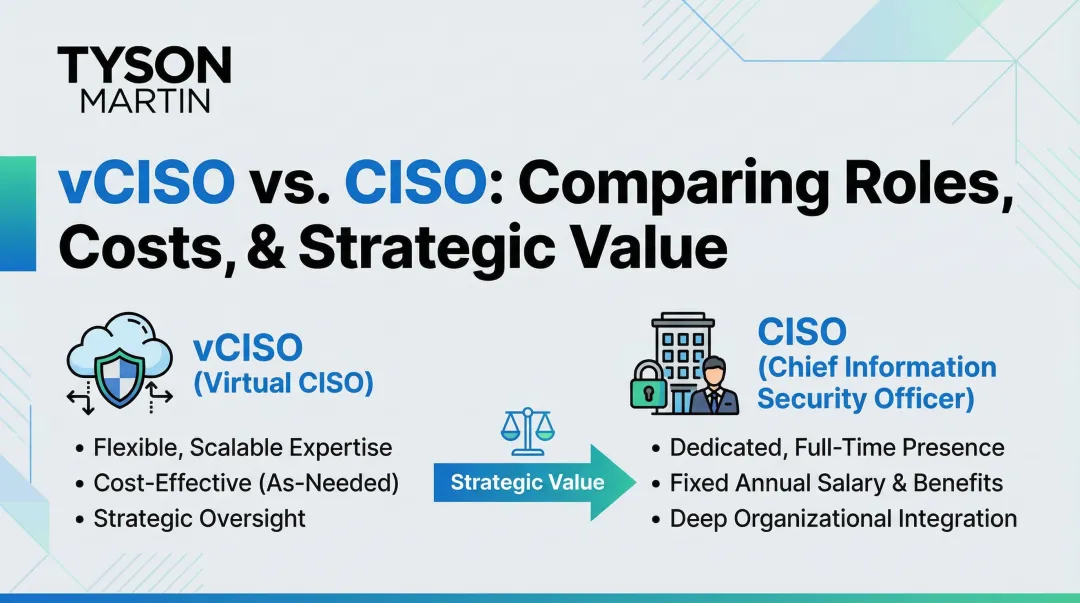
ISACA notes that part-time CISOs can fill a vacancy, mentor a new CISO, or support specialized efforts. It also flags competing client commitments and unclear accountability as risks, so scope the work carefully.
Tyson Martin works with organizations in transition as a board advisor and interim or fractional CISO. Engagements focus on prioritized risks tied to revenue, downtime, legal exposure, and trust, with clear owners and a sequenced roadmap. The work is advisory leadership, not security operations.
Real-World Examples and Decision Scenarios
Scenario 1: Etsy's Modernization Challenge
Etsy's challenge was operational as much as architectural: running containerized workloads at scale, not just moving software into containers. The missing need was technology leadership, and a CTO appointment in 2017 preceded the move to Google Cloud. Etsy reports finishing the migration in February 2020, and the work enabled a foundational upgrade to its marketplace ranking algorithms.

The timeline shows sequence and outcome. That does not prove the CTO hire alone caused the result.
Scenario 2: Microsoft's Security-First Reset
The Cyber Safety Review Board's March 2024 report called the Exchange Online intrusion preventable and Microsoft's security culture inadequate. It recommended deprioritizing feature work until security improved.
In June 2024 testimony, Microsoft stated that when priorities conflict, the answer is "Do security." It also reported reallocating resources and creating an Office of the CISO. Identity and key-management changes were described as ongoing, so this shows a decision, not a finished fix.
The lesson: a security review can change a technology roadmap without ending innovation.
Signals and Responses
| Signal | Leadership response |
|---|---|
| Slow delivery, unclear roadmap, architecture bottlenecks | CTO |
| Recurring audit findings, untested incident plan, no board-ready metrics | CISO |
| Security reviews happening after launch | Written decision rights |
| Leadership gap during M&A, incident, or transition | Interim or fractional CISO |
If your board or executive team has unclear technology or cyber decision rights, explore Tyson Martin's board advisory and interim or fractional CISO support.
Conclusion
The CTO creates and scales technology value. The CISO protects the organization's ability to operate, innovate, and maintain trust. They solve different problems.
Don't look for a winner. Define your immediate risk, growth, regulatory, and execution needs. Then put these in writing and revise them whenever the reporting structure changes:
- Reporting lines
- Escalation rules
- Shared measures
- Collaboration expectations
Frequently Asked Questions
Which is better for my company, a CIO or a CTO?
A CIO usually leads internal IT and enterprise systems. A CTO usually leads product technology, engineering, and innovation. Choose based on your operating model and your biggest leadership gap.
Is a CTO higher than a CIO?
Neither is universally higher. Structure, reporting lines, scope, and board-approved authority determine seniority.
What does CISO stand for in cyber security?
Chief Information Security Officer. The role is responsible for security strategy, cyber risk, resilience, governance, and compliance.
What is the difference between a CISO and a CTO?
The CISO focuses on security risk and protection. The CTO focuses on products, engineering, architecture, and innovation.
Should a CISO report to the CTO?
It depends on the organization. The CISO needs enough independence, escalation access, and authority to report material risk directly to executives or the board.
Can one person serve as both CISO and CTO?
Temporarily, in small or early-stage companies. Document responsibilities, flag conflicts of interest, and add specialist or fractional support as complexity grows.