Introduction
Your security team may flag dozens of serious risks. The board still has to decide which ones get funding, which get accepted, and which get transferred through insurance. "High, medium, low" labels rarely settle that debate.
Cyber risk quantification (CRQ) estimates the likelihood and business impact of defined cyber scenarios, using data, models, assumptions, and ranges. The measurement gap is wide: PwC's survey found only 15% of executives measure cyber risk to a significant extent.
This guide covers how CRQ works, where FAIR and other frameworks fit, which data and outputs matter, and how to turn the numbers into defensible board decisions.
Key Takeaways
- CRQ improves decisions; it does not predict the next attack.
- Credible models link threat scenarios, controls, business impact, and financial exposure.
- Useful outputs include loss ranges, annualized exposure, residual risk, and control value.
- Governance, plain English, and named owners make CRQ stick.
What Is Cyber Risk Quantification and Why Does It Matter?
What CRQ measures
CRQ combines how often a loss event might occur with how large the loss could be. The result is a modeled range of outcomes, not a guaranteed forecast. FAIR defines risk as the probable frequency and probable magnitude of future loss.
It differs from other common approaches:
- Qualitative assessments use descriptors like low, medium, and high. They help with early triage and intangible risks.
- Risk scores rank items numerically but don't produce financial loss figures.
- Compliance checklists confirm controls exist. They rarely prove you can handle a real attack.
These approaches complement each other. Hubbard and Seiersen's How to Measure Anything in Cybersecurity Risk reports that scoring and risk matrices can add noise and error. Quantified ranges built on calibrated estimates are worth the effort for that reason.
Why CRQ matters to executive decision-making
Boards, audit and risk committees, CEOs, and finance leaders don't speak in CVSS scores. Dollars, probabilities, and time horizons give them a shared language.
Quantified risk supports decisions such as:
- Prioritizing remediation
- Comparing control investments
- Setting risk appetite
- Accepting residual risk
- Transferring exposure through insurance
- Evaluating third-party or M&A risk
Governance expectations are rising, though they don't apply uniformly. The SEC's 2023 rules cover public companies subject to Exchange Act reporting.
Domestic registrants must file Form 8-K Item 1.05 within four business days after determining an incident is material. Annual 10-K filings must also describe risk management and board oversight. Private organizations aren't bound by those rules, but directors still face the same questions.
NACD's 2026 Director's Handbook goes further. Its Principle Five calls for probable financial-loss distributions, validated models, and spending aligned with financial risk appetite.
How Does Cyber Risk Quantification Work?
Define the decision scope and business context
Start with a specific question, not a blanket assessment. "Should we fund immutable backups this year?" beats "What's our cyber risk?"
Then identify what could be hurt: critical services, data, applications, revenue processes, dependencies, and the people who own them. Three questions help:
- What must not fail?
- What is most exposed right now?
- Who owns decisions?
Build realistic scenarios and estimate likelihood
Broad categories like ransomware or insider misuse are too vague to model. Convert each into a scenario with:
- An initiating event and attack path
- The affected business process
- A time horizon
- Frequency or probability assumptions
"Ransomware stops order fulfillment for three days" is modelable. "Ransomware" is not. Three to five scenarios that would cause material pain are a sensible starting set. Incident history, threat intelligence, logs, and monitoring data inform the likelihood estimates.
Evaluate controls and resilience
Controls change both likelihood and severity. Preventive and detective controls such as MFA, segmentation, and monitoring reduce how often events succeed. Response and recovery controls limit how much damage lands.
Test claims against reality. One customer-portal example sets tolerable downtime at 4 hours while tested recovery sits closer to 12 hours. That gap is the real exposure. CISA's ransomware guidance recommends offline, encrypted backups and regular recovery testing for exactly this reason.
Estimate the full magnitude of loss
Direct costs are the easy part. FAIR's taxonomy also covers productivity, response, replacement, fines and judgments, reputation, and competitive advantage. Think through:
- Investigation and legal response
- Notification and restoration
- Business interruption and contractual penalties
- Regulatory consequences
- Customer impact and lost opportunity
Benchmarks help but have limits. IBM's 2026 report cites a $4.99M global average breach cost across 602 organizations, but its sample is not statistical. Treat it as context, not your scenario estimate.
Model, validate, and interpret
Monte Carlo simulation runs a model thousands of times with random variables. The output is a distribution of outcomes instead of a single number. NIST IR 8286A also recommends calibration training, sensitivity analysis, and comparing forecasts to actual results.

Before anything reaches leadership, document the assumptions, data sources, uncertainty, control dependencies, and validation steps.
CRQ Methods, Models, and Outputs
Compare common CRQ approaches
FAIR breaks risk into threat event frequency, vulnerability (susceptibility), and loss magnitude. Its strength is financial comparability. The tradeoff is the expertise and data effort required to apply it well.
| Approach | Strengths | Limits |
|---|---|---|
| Manual or consulting-led | Deep context, flexible | Slower, harder to refresh, reliant on specialists |
| Repeatable, integration-enabled | Consistent, scalable, refreshable | Needs good data, and can hide assumptions |
PwC notes that automation still needs human interpretation of business context.
Complementary frameworks
NIST, ISO, COBIT, and OCTAVE supply governance and control structure. They don't compute loss. FAIR explicitly complements them rather than prescribing controls.
- NIST CSF 2.0 supplies risk-governance outcomes, including appetite and tolerance
- NIST IR 8286 series covers scenarios, prioritization, and enterprise risk registers
- ISO/IEC 27005 and ISO 31000 guide risk assessment and treatment
- COBIT clarifies who decides, funds, and accepts risk
Different inputs offer different views. Useful sources include:
- Top-down scenarios and bottom-up risk registers
- Threat intelligence and internal incident records
- Insurance or loss data and control telemetry
Public datasets like Verizon's DBIR have different populations and loss definitions, so none substitutes for organization-specific estimates.
Interpret the main outputs
| Output | Plain meaning | Decision it supports |
|---|---|---|
| Single loss expectancy | Expected cost of one incident | Single-event impact |
| Annualized loss expectancy | Expected loss per year | Control cost versus expected loss |
| Loss exceedance curve | Chance losses exceed a given amount | Setting thresholds and appetite |
| Cyber value at risk | Potential loss at a stated probability and timeframe | Financial communication |
Residual risk, what remains after controls, is the number boards usually accept, transfer, or fund against.
Select a method leaders can trust
Select a method using these criteria:
- Data quality and explainability
- Repeatability and refresh cadence
- Visible assumptions
- Integration with GRC and security processes
- Third-party risk support
- Usefulness in board reporting
Gartner's 2026 research warns that CRQ projects stall when promised precision doesn't produce decision insight. A precise-looking number is not the goal.
How to Implement CRQ in an Organization
Start with one decision-relevant use case
Pick a material question: ransomware resilience, a critical vendor dependency, a major investment, a cyber insurance renewal, or an upcoming board decision. Quantifying everything at once is how programs stall.
Establish ownership, data governance, and refresh rules
Assign roles before building models:
- Security and technology supply control and incident data
- Finance validates loss assumptions and translates exposure into business terms
- Legal and privacy weigh regulatory and notification consequences
- Business operations and procurement own process and vendor dependencies
- Internal audit provides independent assurance without owning management's risk decisions
Decide who owns assumptions, who validates results, and who accepts residual risk. Assign one executive owner per top risk, with a technical owner supporting.
Refresh after material incidents, acquisitions, major technology changes, outsourcing, or control changes. NACD calls for at least quarterly board reporting, plus immediate escalation after material incidents or significant exposure shifts.

Where outside leadership helps
Some organizations lack the experience to set decision rights, reporting cadence, and a 90-day plan. Tyson Martin advises boards and executive teams on cyber risk oversight and steps in as an interim or fractional CISO during transitions. The work centers on decision rights, escalation thresholds, plain-English reporting, and a 90-day plan with owners and measurable outcomes, without slowing the business. He doesn't run security operations; he advises and validates.
Turning CRQ Into Board-Level Decisions
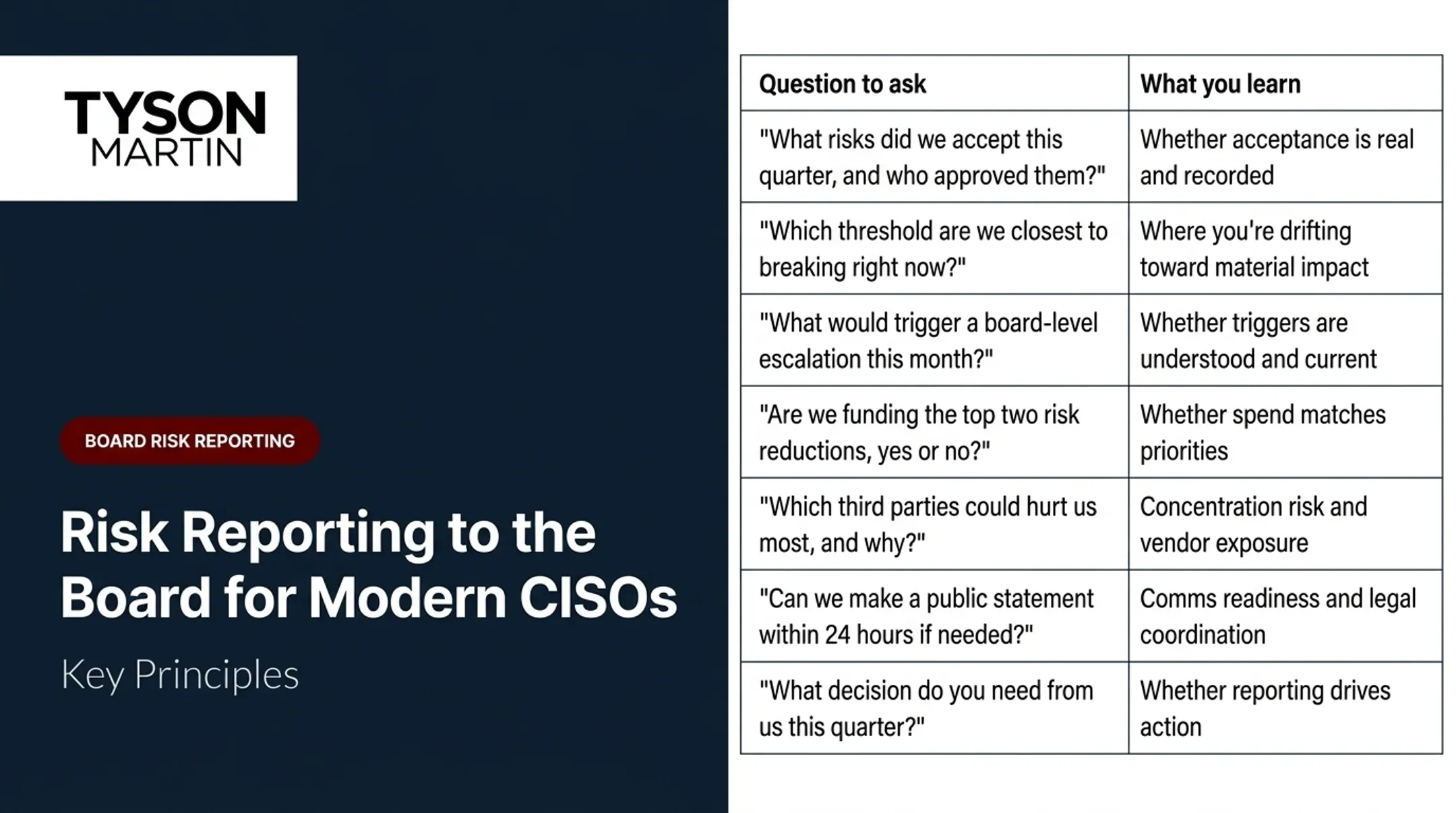
Report what changed, what matters, and what decision is needed
A useful update answers, in order: what changed, what it means, what management is doing, what support is needed, and what happens if action slips. Include:
- Current exposure and movement since last briefing
- Key assumptions and top scenarios
- Control changes and business owners
- Escalation thresholds
- The specific decision required
A one-page brief beats a 50-page register nobody reads.
Connect exposure to priorities and accountability
Compare proposed controls on risk reduction, cost, effort, dependencies, and time to benefit. Offer two to three options, each with cost, time, operational impact, and residual risk.
Then assign a treatment: mitigate, accept, transfer, avoid, or monitor. NIST IR 8286B frames these choices as bringing residual exposure within tolerance.
The Maersk M&A case shows why framing matters. A FAIR analysis of a target's ransomware exposure initially failed to move negotiators because the annualized loss looked small against the deal price.
Once the team translated it into EBITDA effects and a price risk premium, the recommendations were accepted. Express risk in the decision-maker's terms.

Build trust through transparency
Show ranges and confidence, not false certainty. Say what data is thin and flag when the model changes. Boards trust analysts who show their assumptions.
Close the loop with this checklist:
- Name an owner for every top risk
- Define a measurable outcome for each
- Set review dates, with a quarterly refresh
- Build a 90-day plan with due dates
- Test decisions in a tabletop exercise
Frequently Asked Questions
What is cyber risk quantification?
CRQ uses quantitative data, probability, scenario analysis, and financial impact estimates to support cyber risk decisions. It expresses risk as probable loss frequency and magnitude.
How does CRQ differ from a qualitative cyber risk assessment?
Qualitative assessments use descriptive ratings like low, medium, and high. CRQ estimates likelihood and potential loss in measurable terms. The two work well together.
What data is needed to quantify cyber risk?
You need critical assets and processes, incident and threat data, control effectiveness, third-party dependencies, recovery information, and financial impact assumptions.
What is the FAIR model in cyber risk quantification?
FAIR, Factor Analysis of Information Risk, is a recognized quantitative approach. It analyzes threat event frequency and probable loss magnitude, using ranges to represent uncertainty.
How often should an organization perform CRQ?
Cadence should follow business change and decision needs. Refresh after material events or control changes, and review important scenarios at least quarterly.
Does cyber risk quantification replace frameworks such as NIST or ISO?
No. CRQ complements governance, security, and compliance frameworks by adding a quantitative view of potential business impact.