Introduction
Teams can now add AI to customer support, marketing, engineering and analytics in a matter of weeks. Oversight rarely moves that fast. The gap shows up as unclear ownership, unmanaged data, unreliable outputs and regulatory exposure.
The numbers are uncomfortable. IBM's 2025 breach report found that 63% of breached organizations had no completed AI governance policy, and 20% had a shadow-AI-related breach.
Effective AI governance is an operating system for AI decisions, accountability and oversight as use cases change, not a static policy or a one-off technology project. This article covers principles and risk tiers, decision rights, lifecycle controls and board reporting.
Key Takeaways
- Tie AI governance to business goals, risk appetite, privacy and cybersecurity.
- The board oversees; named executives and owners stay accountable for outcomes.
- Risk-tiered controls and approval gates beat one policy applied to everything.
- Good governance cuts ambiguity and rework instead of adding bottlenecks.
What AI Governance Is and Why It Matters
What AI governance includes
AI governance is the set of policies, roles, decision rights, controls, and oversight that guides AI from idea and data selection through development, deployment, monitoring, and retirement.
It covers more than models:
- Prompts, training data and operational data
- Third-party tools and embedded vendor features
- Automated workflows and human decision points
- Downstream business processes
Why organizations need a strategy
Weak governance has practical costs: shadow AI, privacy and intellectual-property exposure, biased outputs, inconsistent approvals, and decisions nobody can explain to executives or regulators.
Boards often learn of problems too late. Only 12% of companies feel very prepared to manage AI governance risks. Among boards that found governance failures, 62% heard about them from media, regulators, or lawsuits rather than internal monitoring.
Disclosure lags too. ISS research found 31.6% of large US companies disclosed some board AI oversight, while only 11% explicitly allocated it to the full board or a committee.
Governance versus data governance
Data governance manages the quality, ownership, access, lineage, protection, and appropriate use of data. AI governance covers the wider system and the decisions that use it.
The two must connect wherever sensitive, personal, confidential, or regulated data trains, prompts, evaluates, or runs an AI system. A model can be well governed and still be fed data nobody approved.
Establish Principles, Pillars and Risk Tiers
Turn principles into operating requirements
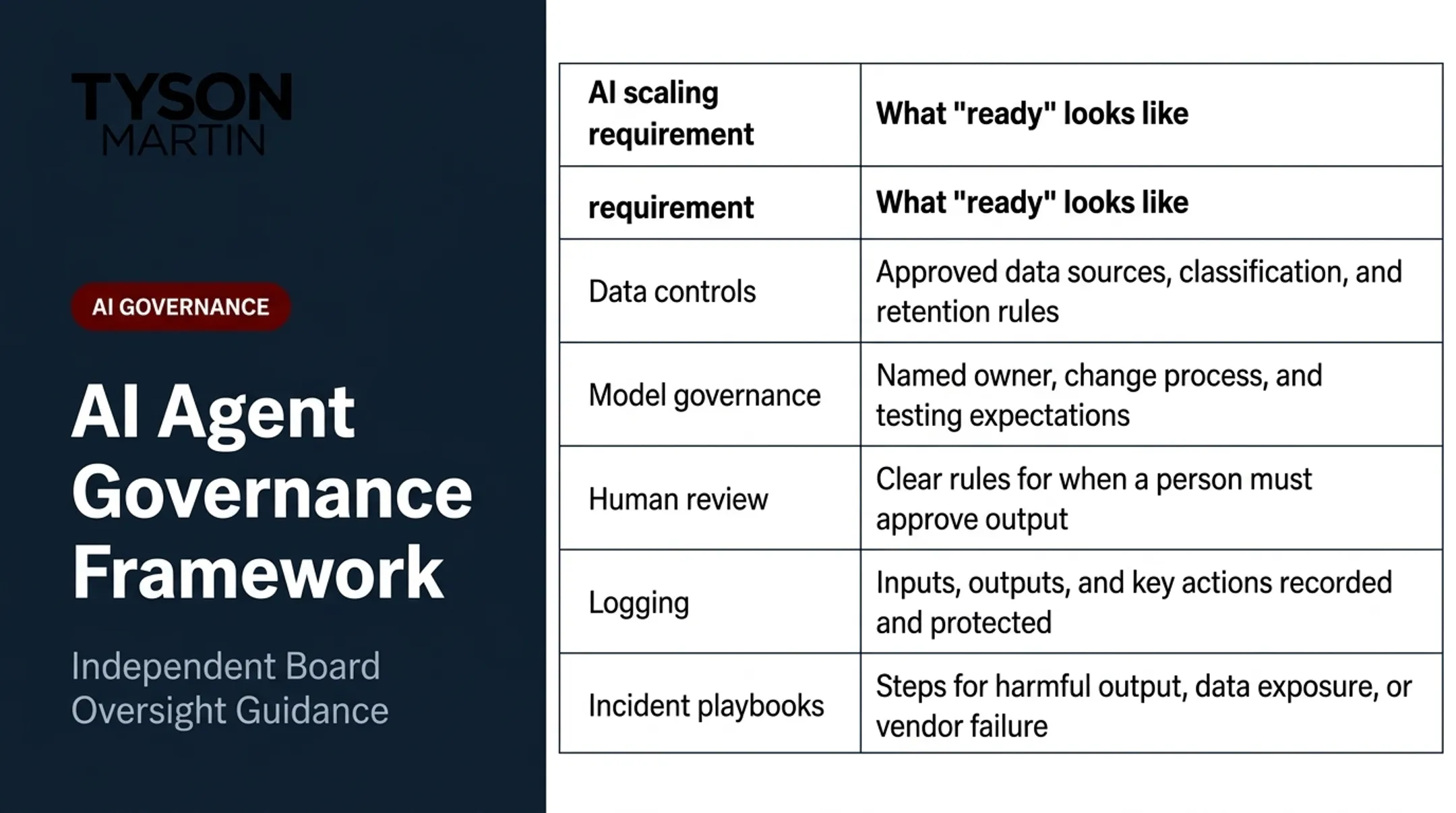
"Fairness" and "transparency" mean nothing until a team can act on them. Each principle should answer an operational question:
- Who owns the outcome?
- What data is permitted?
- What testing is required?
- When is human review mandatory?
- What happens when a control fails?
A practical six-pillar model
Frameworks group these ideas differently, so treat this as a working model, not a legal standard. Adapt it to your industry, risk appetite and AI maturity.
| Pillar | Representative control or evidence |
|---|---|
| Accountability and oversight | Named accountable owner |
| Fairness and bias management | Bias assessment |
| Privacy and data protection | Data-use record |
| Security and resilience | Security review before deployment |
| Transparency and explainability | System documentation |
| Human oversight and safety | Human intervention procedure |
Apply risk tiers instead of one-size-fits-all controls
Classify systems by affected populations, decision impact, data sensitivity, degree of automation, reversibility of harm, and reliance on third parties. NIST's framework is non-prescriptive and offers no universal numerical tiers, so set thresholds that fit your context.
One workable pattern from risk-acceptance practice:
- Low: limited local impact, short duration, low data sensitivity. Management accepts within policy.
- Medium: touches a critical process or creates real customer friction. Time-limited executive approval.
- High: possible material outage, regulated exposure or brand damage. Fast escalation to the CEO and board committee chair.
Internal writing aids carry a different risk profile than AI that touches customers, makes decisions or changes pricing. Tier accordingly.
Select and align frameworks
Know what kind of obligation you're looking at:
- NIST AI RMF: voluntary risk-management framework (Govern, Map, Measure, Manage).
- ISO/IEC 42001: management-system standard that supports voluntary certification through independent bodies.
- Binding law and contracts: sector rules, privacy, employment and consumer-protection requirements.
Current US examples include the EEOC's guidance that federal discrimination protections apply to AI-assisted hiring, NYC Local Law 144 bias audits, and Colorado's SB26-189. Duties under the Colorado law begin January 1, 2027. Map overlapping requirements once instead of building disconnected compliance programs.
Create a policy and evidence baseline
Keep the policy set short. Cover:
- Acceptable and prohibited uses
- Data handling and vendor review
- Approvals and human oversight
- Incident reporting, employee use, and exceptions
Retain evidence for each system:
- Purpose, owner, and risk class
- Data sources and evaluation results
- Approvals, known limitations, and monitoring plan
- Material changes and incident records
Assign Accountability, Governance Structure and Decision Rights
Separate board oversight from management execution
The board or a designated committee oversees AI strategy, risk appetite and material exposures. Management implements controls and runs the program.
Name one executive accountable for the enterprise program. Name a business or system owner for every use case. Delaware's Marchand v. Barnhill decision isn't about AI, but it shows why boards need a good-faith reporting system for mission-critical risk.

Clarify responsibilities across the organization
- Board: strategy, risk appetite, management performance
- Executive sponsor: program accountability
- Legal, compliance and privacy: regulatory and data-use review
- Cybersecurity and technology: security, testing, monitoring
- Procurement: vendor terms and diligence
- HR: employee use and employment-related AI
- Internal audit: independent assurance
- Business owners: outcomes of individual use cases
A cross-functional committee can coordinate decisions. It shouldn't replace the sponsor's or owner's accountability.
Document decision rights and escalation thresholds
Build a RACI-style map that states who can:
- Approve a use case
- Accept residual risk
- Authorize deployment
- Require remediation
- Pause a system
- Communicate an incident
Define escalation triggers:
- Material change in use
- Unexpected model behavior
- Sensitive-data exposure
- Discriminatory impact
- Control failure or regulatory inquiry
- Use outside the approved purpose
A one-page escalation ladder works well: triggers, who notifies whom, expected response time, and what the first update must contain.
Build board-ready oversight
Set a regular cadence covering the AI inventory, highest-risk use cases, major changes, open exceptions, incidents, risk trends and regulatory developments. NACD guidance calls for frequent, forward-looking management updates.
Translate technical detail into business impact, trend direction, management action and the decision requested.
Where external support can help
Organizations in transition, facing incidents, or short on executive capacity may bring in a board advisor or interim or fractional CISO to set up decision rights, reporting, and escalation.
Tyson Martin advises boards and serves as an interim CISO in these situations. His background includes enterprise security and technology leadership at AWS, Home Depot, and Best Buy, plus active involvement with NACD and the NRF CISO Executive Committee.
Operationalize Governance Across the AI Lifecycle
Start with an AI inventory and use-case register
List approved, in-development, retired, and employee-created systems, including embedded vendor features, generative AI tools, agents, and automated decisions. Record data flows, owners, and business purposes.
Find shadow AI through:
- Procurement records
- Cloud environments
- Security monitoring
- Employee surveys
- Business-unit reviews
Respond constructively. Staff hide tools when the only response is punishment, so offer a fast approval path.
Embed risk and approval gates into the lifecycle
Place checkpoints at intake, design, data selection, development, testing, procurement, deployment, material change, monitoring, and retirement.
At each gate, require:
- Intended and prohibited use
- Affected users
- Data permissions
- Evaluation criteria and known limitations
- Security and privacy review
- Accountable owner and approval status
- Rollback conditions
A one-page responsible-AI gate that a board can read is better than a 60-page manual nobody uses.

Govern data, vendors and system dependencies
Controls should cover data quality, lineage, access, retention, privacy, intellectual property, prompt and output handling, and model provenance.
NIST's generative AI profile adds that acquisition diligence should cover IP, privacy, and security risks, with continuous monitoring of deployed third-party systems.
For vendors, address:
- Due diligence and subcontractors
- Data-use terms
- Audit rights
- Incident notification
- Service changes
- Continuity and exit planning
Monitor performance, behavior and drift
Monitor task performance, unsafe outputs, bias, data and concept drift, scope creep, access violations, availability, and use beyond approved purpose.
NIST's 2026 monitoring work flags missing ground-truth datasets and difficulty detecting degradation as real obstacles, so plan for them.
Tie each signal to an owner, review cadence, threshold, escalation path, and predefined response: remediate, restrict, retrain, roll back, or shut down.
Prepare for incidents and material changes
An AI incident playbook should cover detection, classification, containment, evidence preservation, communications, root-cause analysis, remediation, and governance updates afterward. Run at least one tabletop with the full executive team early.
Reassess a system when its users, data, autonomy, decision impact, geography, vendor, model, or purpose changes materially.
Create an executable 90-day starting plan
- Days 1-15: Secure executive sponsorship and agree on risk appetite.
- Days 15-30: Inventory current AI use.
- Days 30-45: Pick a pilot group of material systems and assign owners.
- Days 45-60: Set minimum documentation.
- Days 60-75: Test escalation paths with a tabletop.
- Days 75-90: Produce the first board dashboard.
Measure outcomes (owners named, systems classified, exceptions with expiry dates), not activity counts. Use pilot lessons to shape wider rollout.
Measure, Report and Improve the Governance Program
Choose metrics that support decisions
A balanced dashboard includes:
- Inventory completeness and risk classification
- Approval and review status
- Unresolved exceptions
- Monitoring coverage
- Incident trends and remediation progress
- Human-override activity
- Business outcomes
Favor stable trends and material exceptions over technical trivia. Boards need a credible picture, not a data dump.
Establish cadence and escalation
Management reviews operating metrics routinely. Committee briefings cover trends, top risks, and decisions. Events like sensitive-data exposure or regulatory inquiry escalate immediately, outside the normal cycle.
Decision-oriented reporting sounds like this: "Two high-risk systems lack current bias testing (up from zero last quarter). Management has paused one deployment and will complete testing in 30 days. We request committee approval to extend the second exception by 60 days."

Treat governance as a continuous improvement loop
Run periodic maturity assessments, policy reviews, control tests, training, and regulatory horizon scanning. Use post-incident reviews to update processes.
Feed input from users, audit, security, legal, and business teams back into risk tiers, controls, documentation, and the roadmap. ISO/IEC 42001's Plan-Do-Check-Act cycle is a useful model.
Frequently Asked Questions
Who is ultimately responsible for AI governance in a company?
It depends on the governance structure. The board oversees material strategy and risk, executive leadership is accountable for execution, and named system or business owners answer for individual AI outcomes.
What is the responsibility of corporate governance?
Corporate governance covers oversight of strategy, risk appetite, accountability, compliance, stakeholder interests, reporting and management performance. It stays at the oversight level and doesn't run day-to-day AI operations.
What are the six pillars of AI governance?
The six pillars are accountability and oversight, fairness and bias management, privacy and data protection, security and resilience, transparency and explainability, and human oversight and safety.
What does data governance mean?
Data governance is the policies, roles and controls managing data ownership, quality, access, lineage, protection, retention and appropriate use across its lifecycle.
Can AI do data governance?
AI can assist with discovery, classification, quality checks, monitoring and policy enforcement. People remain responsible for governance decisions, accountability, exceptions and oversight.