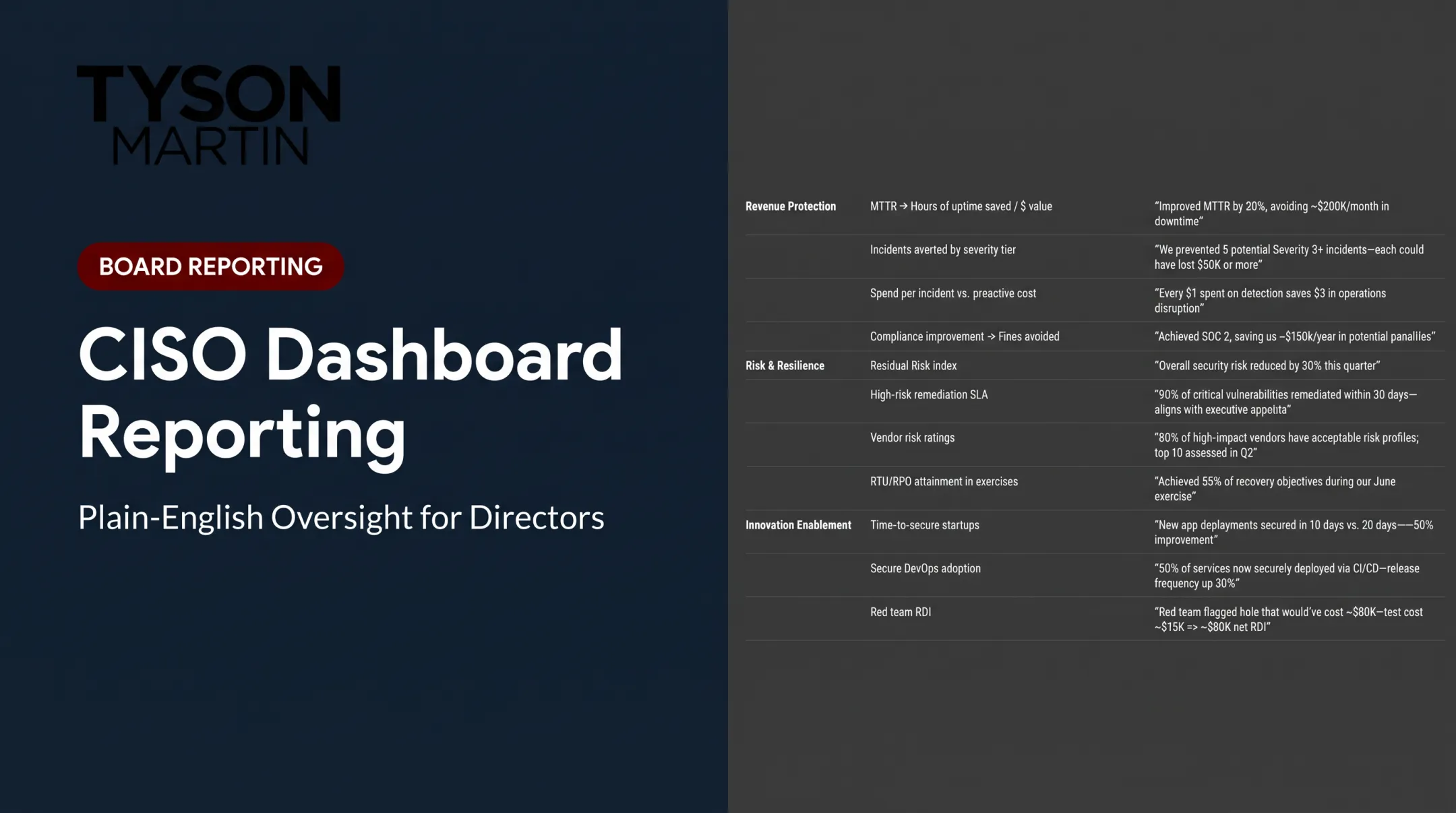
The five numbers below are not universal scores, and they don't replace operational dashboards. They are stable governance metrics that tie cyber conditions to business exposure, risk appetite, ownership, and action: material cyber risk movement, time exposed to a material incident, critical control coverage, security debt burn-down, and critical third-party exposure.
Key Takeaways
- Five consistently defined metrics beat a rotating pile of technical KPIs.
- Each number needs a baseline, trend, threshold, business consequence, and owner.
- Every briefing should end with a decision, escalation, funding request, or explicit risk acceptance.
- Operational detail belongs in the appendix.
Why Boards Need Five Stable Cybersecurity Numbers
The board oversees enterprise risk, reviews risk appetite, judges management's effectiveness, and decides on major investments and risk acceptance. It does not run the security operations center. Management owns execution; the board owns thresholds and risk acceptance for material issues.
Oversight is about process, not perfection. In the Marriott case, the Delaware Chancery Court dismissed the complaint because the board had received routine cyber updates, annual enterprise-risk assessments, and outside expertise. An incident alone did not establish liability.
Why activity metrics fail
Alert counts, total vulnerabilities, patches completed, and blocked phishing emails show effort. They don't show whether material business risk changed. A 98% patch compliance figure can hide a fatal gap if crown-jewel systems lag for 30 days.
The governing test
Every board metric should be stable enough to trend and specific enough to answer three questions:
- What changed?
- Why does it matter to the business?
- What decision follows?
If a metric can't be explained in one sentence, or the board can't act on it, drop it.
The Five Numbers Every CISO Should Share With the Board
1. Material cyber risk movement
This is the direction and significance of the organization's most important cyber risks over time. Present a ranked top-five list of material risk scenarios. For each, show:
- Affected business process
- Risk appetite
- Current controls
- Residual exposure
- Next decision needed
Avoid unsupported composite scores. Define "improved," "stable," and "worsened" in writing. A good trend means fewer high risks, less time stuck at "high," and clear mitigation milestones.
Where you quantify, use ranges rather than false precision. FAIR treats risk as probable loss frequency and magnitude, and expects uncertainty to appear as ranges or distributions.
2. Time exposed to a material incident
Translate detection, containment, and recovery into a question directors understand: how long could we stay exposed before meaningful control returns? Report it for high-severity events on Tier 1 services. Averaging those with everything else can show improvement while important services stay slow to defend.
Know which clock you're quoting:
| Source | Figure | What it measures |
|---|---|---|
| IBM, 2026 | 183 days to identify, 64 to contain (247 total) | Mean lifecycle, 602 breached organizations worldwide |
| Mandiant, 2026 | 14 days | Global median dwell time |
| Sophos US, 2026 | 53% recovered within a week | Ransomware recovery, 377 US respondents |
| SEC Item 1.05 | Four business days | Disclosure after materiality determination, not a performance benchmark |

These are different statistics over different populations, so don't treat them as targets. Per IBM's 2026 report, the 247-day figure is a global breach average. Set your own targets in plain language, such as "restore core services within 24 hours," and show scope and exclusions.
3. Critical control coverage
Measure whether essential controls operate on the systems and attack paths that matter most: privileged identity, endpoint detection, recovery, logging, segmentation, and authentication.
Define the numerator and denominator precisely. The CIS Controls, for example, measure administrative MFA coverage as properly configured administrative accounts divided by all administrative accounts, not employee headcount. Backup quality is restored backups working divided by backups tested.
Report these alongside:
- Coverage scope and approved exceptions
- Evidence the control works, since "installed" is not "working"
- The business consequence of uncovered assets
The Change Healthcare ransomware attack began with compromised credentials on a portal that lacked MFA, per Senate testimony. One gap on one path was enough.
4. Security debt burn-down
Track the size, age, priority, and closure rate of known gaps: overdue fixes on high-value systems, unsupported technology, unresolved audit findings, and accepted exceptions. The question for directors is whether you're closing debt faster than it accumulates.
Veracode's 2026 data, from 1.6 million applications, found that 82% of organizations carry security debt (risky flaws older than a year), and 60% of those have critical debt.
Show new, closed, and aging-past-target items, split by Tier 1 versus Tier 2 assets. Material items get a named owner and a target date.
5. Critical third-party exposure
Report the exposure created by critical suppliers, technology providers, partners, and concentration points. The core figure is the percentage of critical vendors with a current risk review, contractual protections, and a tested incident communication path.
Add unresolved high-risk findings, monitoring status, and the operational impact if a key provider fails. Ask for a top-10 critical vendor list and a plan for any one being down 72 hours.
Verizon's 2026 DBIR puts third-party involvement at 48% of breaches. "Involvement" is broader than vendor-caused, so don't cite it as vendor fault. The July 2024 CrowdStrike outage, a faulty update rather than an attack, showed that dependency risk exists without a breach.
How to Make Five Numbers Board-Ready
Define each number before it hits a dashboard
Write down the definition, data owner, reporting period, scope, calculation method, source systems, exclusions, and refresh process. Changing definitions quarter to quarter destroys comparability and can manufacture false improvement.
Pair every number with a threshold and trend
Show the current position, prior-period movement, longer-term direction, approved tolerance, and escalation point. A green or red status with no threshold doesn't tell directors whether management is within appetite. A three-month trend beats a single snapshot.
Out-of-appetite signals might include repeated restore failures, rising time to contain, and a growing list of expired exceptions.
Translate the metric into business exposure
Tie each number to a service, revenue stream, customer commitment, or regulatory obligation. A customer portal down 24 hours in peak season, from a single point of failure, is a boardroom sentence. Where dollar impact is uncertain, give a range with stated assumptions.
Attach an owner and a decision
Each material metric needs a named executive or business owner and a stated ask: approve funding, accept residual risk, change policy, reprioritize, or monitor. The CISO supplies expertise and recommendations; the business owner stays accountable for the risk decision. Include one to three "decisions requested" items, each with options, cost ranges, and a recommendation.

Keep the dashboard stable and inspectable
Use the same definitions, layout, and narrative sequence every time, with operational detail in an appendix. Stability supports trend recognition, faster escalation, and a defensible record of decisions. Where internal capacity is thin, Tyson Martin's board advisory or interim and fractional CISO support can help build this reporting system.
From Five Numbers to Continuous Board Governance
Avoid vanity metrics and isolated snapshots
Don't lead with activity counts, unsupported maturity scores, unexplained peer comparisons, or one quarter's result. Reference external benchmarks, but don't manage to them; your Tier 1 services and risk tolerance are your own. When data quality is poor, label your confidence and show the plan to improve it.
Establish a reporting and escalation rhythm
NACD's handbook recommends standardized reports at least quarterly, plus ad hoc updates around material incidents. A lightweight rhythm looks like this:
- Monthly one-page dashboard for management and committees
- Quarterly deep dive with the audit or risk committee
- Annual tabletop exercise and risk-appetite refresh
Add event-driven escalation when thresholds are crossed. Base triggers on business impact, such as a material outage defined in hours by critical service, rather than technical severity alone.
Close every briefing with the next action
End with what changed, what management is doing, what remains exposed, who owns the response, and what the board must decide or keep monitoring. The point of five numbers is fewer surprises, faster escalation, and clearer accountability, not a bigger dashboard.

Frequently Asked Questions
Who does the chief security officer report to?
It varies: the CIO, CEO, CRO, general counsel, or another executive. IANS found 64% report into IT leadership and 36% to business leaders. What matters is independence, direct board or committee access, and clear decision rights.
What metrics should a CISO present to the board?
The five above: material cyber risk movement, time exposed to a material incident, critical control coverage, security debt burn-down, and critical third-party exposure. Each carries a trend, threshold, business impact, owner, and required decision.
How often should a CISO report cybersecurity metrics to the board?
Report at least quarterly to the board or committee, with event-driven escalation when thresholds break. Calibrate to your risk profile and US obligations such as SEC disclosure timelines and, where applicable, NYDFS annual CISO reporting.
What is the difference between a cybersecurity KPI and a KRI?
A KPI measures performance against an objective. A KRI signals rising exposure or a risk nearing an unacceptable level. A board dashboard can use both, such as KPI-style patch SLAs next to KRI-style expired exceptions.
How do you explain cybersecurity metrics to nontechnical board members?
Connect each metric to business exposure, likely consequence, management response, uncertainty, and the decision required. Keep technical definitions in supporting material.
Should a board dashboard include cybersecurity activity metrics?
Keep them in the appendix or management report. The main dashboard should prioritize outcomes, exposure, control coverage, resilience, trend, and accountability.