Introduction
Boards and executives keep asking the same budgeting question: what should a fractional CISO cost in the US in 2026, and how much of that should be hourly versus recurring?
There's no single answer. Buyers may be purchasing:
- Occasional advisory access
- A defined compliance project
- A recurring leadership retainer
- Incident support
- Near-embedded coverage
Those are different products with different price tags.
SideChannel's April 2026 provider guide puts the broad range at $3,000 to $20,000 per month. This guide covers hourly and monthly ranges, engagement models, pricing factors, costs outside the rate, low-cost versus premium service, and a practical budgeting method.
Key Takeaways
- Published provider ranges run $200-$400/hour, $3,000-$20,000/month, and $10,000-$75,000/project.
- Scope, hours, complexity, compliance load, and urgency drive the quote more than the "fractional" label.
- Lower-cost advisory suits teams with capable internal operators; regulated or complex environments need more.
- Budget for implementation, tools, testing, audits, incident response, and transition, not just the CISO's rate.
How Much Does a Fractional CISO Cost? (Pricing Overview)
No fixed price exists. The advertised hourly rate is also not the engagement's total cost. Minimums, retainers, project fees, and out-of-scope work all change the final number.
One caveat on the data: no national US pricing survey exists. The figures below come from providers describing their own engagements, so treat them as evidence, not averages.
Typical 2026 US Pricing Ranges
| Category | Published range | Notes |
|---|---|---|
| General advisory | $200-$400/hour | Ad hoc support, board presentations, incident response |
| Ongoing leadership | $3,000-$20,000/month | Broad range, not a standard package |
| Mid-market example | $5,000-$12,000/month ($60,000-$144,000/year) | 200-500 employees; board reporting, multi-framework work |
| Fixed-scope projects | $10,000-$75,000 | Compliance readiness, policy builds, risk assessments |
Source for all four rows: SideChannel, 2026.

Monthly tiers from individual providers show how scope changes price:
- Advisory: from $3,000/month at vCISO.com, with a 48-hour response SLA (a response promise, not 48 hours of service)
- Operational: from $5,000/month, with program ownership and biweekly sessions
- Compliance-heavy: $10,000-$20,000/month for regulated or actively audited organizations
- Near-embedded: typically $10,000+/month, with hands-on leadership and same-day incident response
Our own benchmark is a bit narrower: monthly retainers of $3,000-$15,000 and annual retainers of $80,000-$150,000.
Most providers don't disclose how many hours each tier buys. Ask. Our experience is that light support runs 4-8 hours per week, standard support 8-16, and high-change periods 16-25.
Public price lists for regulated-industry hourly work, after-hours premiums, day rates, and individual deliverables (roadmaps, tabletops, SOC 2 readiness, M&A diligence) are uncommon. Get those quoted in writing.
Usually included: roadmaps, policies, vendor risk, board reporting, framework guidance, incident-response planning.
Often excluded: security tools, penetration tests, formal audits, managed monitoring, legal advice, travel, live incident response, and implementation labor.
Engagement Models
| Model | Predictability | Best fit |
|---|---|---|
| Hourly | Low | Limited, ad hoc advice |
| Monthly retainer | High | Ongoing accountability and roadmap ownership |
| Fixed-fee project | High, until scope changes | Assessments, readiness work |
| Hybrid | Medium | Retainer plus hourly for specific tasks |
Contract terms move the real budget. vCISO.com, for example, offers month-to-month retainers, a 15% discount for annual prepayment, and 30 days' cancellation notice. Another provider describes three-year agreements with quarterly payment.
Ask about rollover and unused-hour treatment, overage rates, after-hours premiums, minimum billable blocks, minimum monthly commitments, rush charges, and what happens to hours you don't use.
Key Factors That Affect Fractional CISO Pricing
Price reflects technical complexity, executive accountability, expected availability, urgency, and how much work the CISO owns versus recommends. No standard seniority multiplier exists, so each factor below is a negotiation point.
Hours, Availability, and Response Expectations
Hours per month, meeting cadence, board participation, onsite travel, and weekend or incident availability all shape the quote. Meetings may be weekly, biweekly, or monthly depending on risk.
A low hourly rate can still produce a high total. A large minimum, frequent unplanned requests, or heavy first-month onboarding all push cost up. Many engagements start heavy, then settle into a steady rhythm.
Scope and Deliverables
Strategy and oversight cost less than hands-on execution. Typical deliverables include:
- Ranked risk register
- 6-12 month security roadmap
- Policy governance and board reporting
- Vendor reviews and customer questionnaires
- Incident-readiness basics: roles, call tree, first-hour decisions, a tabletop
A recommendation-only scope costs less than one responsible for implementation coordination, evidence collection, remediation tracking, and executive reporting. A fractional CISO is not a part-time security engineer or an outsourced SOC.
Seniority, Credentials, and Relevant Experience
Experience running programs, briefing boards, handling incidents, and surviving audits matters more than letters after a name. CISSP requires five years of experience across at least two domains, so it signals a baseline. It doesn't establish a fee premium.
Check references, sector experience, and judgment. Confirm the named professional doing the work is the one you met in the sales call.
Organization Size, Complexity, and Security Maturity
Headcount, cloud footprint, applications, locations, vendors, data sensitivity, and M&A activity all matter. So does internal security staffing.
A 60-person company with a complex multi-cloud product may need more senior time than a 600-person company with mature controls and a strong team. Complexity beats headcount.
Compliance, Urgency, and Engagement Terms
SOC 2, HIPAA, PCI DSS, ISO 27001, NIST CSF, CMMC, privacy rules, cyber insurance questionnaires, and customer contract deadlines all add documentation and governance work.
Urgency adds a premium too:
- Post-incident stabilization
- Leadership transitions
- Fundraising and M&A diligence
- Short contract terms
- Rapid start dates
Fractional CISO Cost Breakdown
The CISO fee is one line in the security leadership budget. Label every cost as one-time, recurring, periodic, or potentially out of scope.
Discovery, Assessment, and Onboarding
One-time. Expect interviews, asset and data review, a risk assessment, stakeholder mapping, and a 30- or 90-day plan. By day 30, you should see a plain-language risk view with ranked risks and owners, not a giant slide deck.
Ask whether discovery is in the quoted fee or billed separately, and whether the assessment produces usable artifacts such as a risk register and first-pass roadmap.
Leadership Delivery and Ongoing Advisory
Recurring. This covers executive meetings, risk decisions, board and audit committee reporting, policy governance, vendor reviews, questionnaires, and roadmap management.
Pin down included hours, meeting limits, response expectations, documentation duties, and overage rates.
Implementation, Tools, Testing, Audit, and Incident Costs
Periodic or out of scope. Budget separately for:
- Remediation labor and specialist consulting
- Security software and managed detection
- Penetration tests and external audits
- Legal counsel and live incident response
Typical reference points:
- Penetration testing: starts at $15,000 for a fairly small scope, per Schellman (2023)
- SOC 2 audits: fixed fee after scoping, with no published rates
- Managed EDR: per-endpoint pricing, often with minimum agent counts and 12-month terms
- IR retainers: tiered by response-time SLA, with no published rates
Before signing, ask who owns the work product, whether the provider is compensated by vendors it recommends, and which costs continue after the engagement ends.

Low-Cost vs High-Cost Fractional CISO Services: How to Estimate the Right Budget
A higher rate isn't automatically better, and a lower one isn't automatically poor value. What matters is the decision authority, work product, availability, and execution capacity you actually need.
Comparing Lower-Cost and Higher-Cost Engagements
| Dimension | Lower-cost | Higher-cost |
|---|---|---|
| Executive availability | Scheduled sessions | Frequent, near-daily access |
| Response time | A few business days | Same-day |
| Board involvement | Occasional reports | Regular attendance |
| Compliance ownership | Guidance | Owned and tracked |
| Implementation | Recommendations | Coordination or hands-on |
| Incident support | Readiness planning | Active leadership |
Lower-cost services fit periodic governance, a focused roadmap, or organizations with strong internal IT and security operators. Premium engagements are justified in regulated environments, major transitions, complex vendor ecosystems, or high executive visibility.
Building a Budget From Workload and Outcomes
- Name the trigger. Routine governance, a customer questionnaire, an audit deadline, insurance renewal, an incident, M&A, or a leadership change.
- Estimate the workload. Cadence, internal owner, frameworks, systems, stakeholders, deliverables, and response expectations, all before comparing rates.
- Split the budget. Assessment and compliance preparation take more effort than maintenance, so price a first phase and a steady state separately.
As a sanity check, 8-16 hours per week at $200-$400/hour implies roughly $6,900-$27,700 per month. That's a rough calculation, not a quote. Retainers typically price below that.
What Most Buyers Miss
Common mistakes:
- Fixating on the hourly rate
- Ignoring minimum commitments
- Assuming unused hours roll over
- Skipping budget for the tools and labor needed to execute recommendations
Proposals deserve the same scrutiny. Red flags include:
- Vague scope
- Unnamed delivery staff
- Unclear incident escalation
- Undisclosed conflicts of interest
- Missing insurance information
- No measurable deliverables
- Weak ownership or exit terms
A solid contract defines the named CISO, decision rights, included work, exclusions, response expectations, success measures, documentation ownership, renewal terms, and a transition process. ISACA's guidance on virtual CISO risks (2021) flags competing-client availability, product-recommendation conflicts, and lock-in.
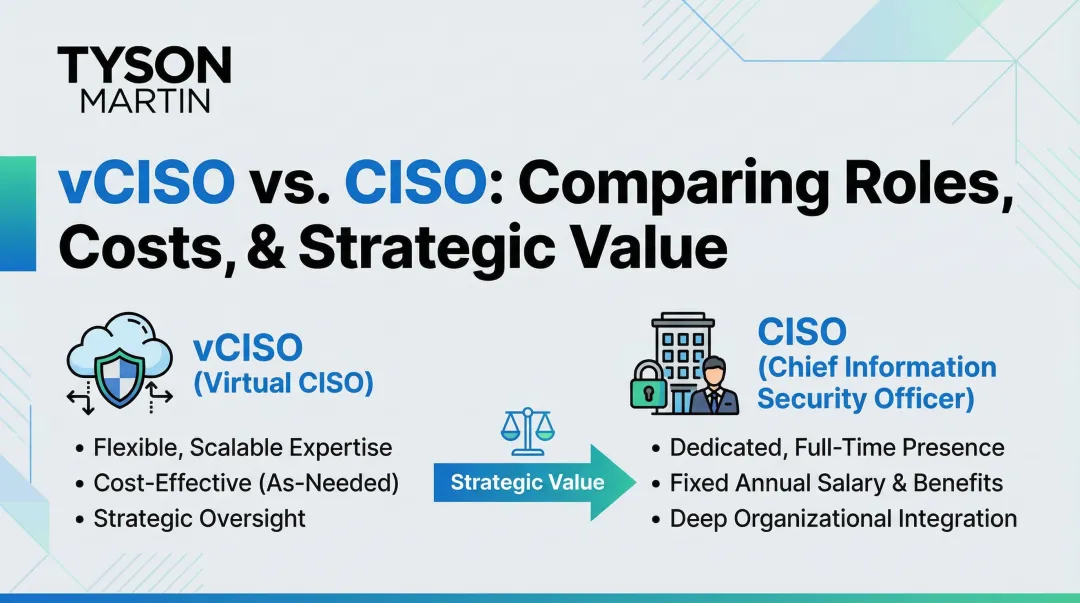
When a Full-Time CISO May Be More Economical
Consider a full-time hire when you need:
- Daily executive presence
- Continuous team leadership
- Frequent regulator or board contact
- Sustained incident ownership
- Enough demand that fractional spend approaches an employee's loaded cost
SideChannel says most organizations with 1,000+ employees need a dedicated CISO, though that's a staffing judgment, not a proven break-even.
Compare the full picture, not hourly rate against salary:
- Salary and equity
- Benefits (about 30% of total employer compensation, per BLS private-industry data)
- Recruiting (SHRM's median executive cost-per-hire is $10,625; median time-to-fill is 45 days)
- Onboarding, turnover, and vacancy costs
Our benchmark for a full-time CISO is $250,000-$500,000+. Heidrick's 2025 survey reports a US median total compensation of $880,000, but that skews toward large enterprises.

Conclusion
Fractional CISO pricing in 2026 depends on the outcome you buy, not the consultant's hourly rate. Scope, availability, complexity, compliance, and internal execution capacity set the real budget.
Tyson Martin helps boards and executive teams evaluate and structure fractional or interim CISO support around clear oversight, credible reporting, decision rights, escalation thresholds, and executable priorities.
Frequently Asked Questions
How much does a Fractional CISO cost?
Published US provider ranges are $200-$400/hour, $3,000-$20,000/month, and $10,000-$75,000 per project. Annual retainers commonly land between $60,000 and $150,000. Scope and structure decide the quote.
How much does cybersecurity cost per month?
It depends on size and risk, and no reliable US monthly benchmark exists. Spending covers leadership, tools, monitoring, testing, compliance, implementation, and response, so the CISO fee is only one part.
What is the typical hourly rate for a fractional CISO?
Published advisory rates run $200-$400/hour. Regulated, urgent, or after-hours work may be priced differently, and published rates for those aren't established, so get them quoted.
Is it better to pay a fractional CISO hourly or monthly?
Hourly suits limited or project work. A retainer fits ongoing accountability, predictable access, and roadmap ownership.
What is included in a fractional CISO retainer?
Typically strategy, risk governance, reporting, vendor reviews, questionnaires, policy oversight, and incident readiness. Tools, penetration tests, audits, and live incident response are commonly excluded.
When is a full-time CISO more cost-effective?
When demand is daily, the role includes team leadership, regulators and boards are frequently involved, or fractional spend nears the fully loaded cost of an employee.