Introduction
There's a fundamental tension at the heart of independent director service: you're expected to provide objective oversight without managing operations. Yet when fraud surfaces or governance fails, regulators hold you accountable for what you didn't see, didn't ask, and didn't document.
That tension isn't a reason to avoid board service. It's a reason to understand your actual exposure before you accept a seat.
The gap between "I don't run the company" and "I'm not liable for what happened" is wider than most directors realize. Independent directors face scrutiny from the SEC, Delaware courts, shareholder plaintiffs, and — increasingly — cybersecurity regulators, all operating under overlapping legal frameworks with different standards and different statutes of limitations.
This post covers the core liability categories you need to understand: your fiduciary duties under corporate law, securities law exposure, the high-risk scenarios where protections break down, cybersecurity oversight obligations under the SEC's 2023 rules, and what the protections you rely on actually cover — and where they stop.
Key Takeaways:
- Independent directors carry nearly identical legal duties to executive directors — independence often increases scrutiny, not reduces it
- The business judgment rule requires documented process; it is not a default shield
- D&O insurance excludes intentional misconduct — the exact allegation in serious enforcement cases
- The SEC obtained 119 officer-and-director bars in FY2025, making personal career consequences routine
- Cybersecurity oversight is a formal liability trigger under the SEC's 2023 disclosure rules, not a governance best practice
What Independence Actually Means — and Why It Creates More Liability, Not Less
The Legal Definition of Independence
Under NYSE Rule 303A.02 and Nasdaq Rule 5605(a)(2), a director is independent only after the board affirmatively determines no material relationship exists. Common disqualifiers include:
- Employment within the last 3 years
- Direct compensation exceeding $120,000 in any 12-month period within the last 3 years
- Immediate family ties to executive officers
- Auditor relationships or compensation committee interlocks
- Business payments exceeding 2% of the other company's gross revenues (NYSE) or $200,000 (Nasdaq)
SEC Rule 10A-3 adds a federal layer: audit committee members face additional independence requirements beyond exchange rules, including a prohibition on accepting compensatory fees from the issuer. Audit committees at NYSE and Nasdaq companies must have at least three members, all independent.
The Independence Trap
The designation that's supposed to signal objectivity becomes the source of heightened scrutiny when things go wrong. Because independent directors are specifically designated as the safeguard against management overreach, regulators treat their failure to detect or escalate problems as something more than ordinary negligence.
Role-specific accountability — not a blanket higher standard — is what drives enforcement.
The SEC's action against DHB Industries illustrates this this point directly. Outside directors Jerome Krantz, Cary Chasin, and Gary Nadelman — serving as audit committee members — were charged with ignoring significant red flags at a military body-armor supplier. The mechanism wasn't a general "higher standard" for all independent directors; it was role-specific. Their independence and audit committee status made their failure to investigate central to the SEC's case.
The practical implication: your independence questionnaire is a securities disclosure document. Incomplete or inaccurate answers don't just create an administrative problem — they create a securities disclosure exposure.
The Core Legal Duties That Create Personal Exposure
Duty of Care
Under Smith v. Van Gorkom, directors can breach the duty of care by approving a major transaction without an informed process. A reasonably prudent person in similar circumstances would:
- Read board materials before meetings, not during them
- Ask substantive questions about unusual transactions or outliers
- Seek outside expertise when a decision requires knowledge the board doesn't have
- Base decisions on adequate information, not management representations alone
Rubber-stamping is the clearest way to lose the protection the business judgment rule would otherwise provide.
Duty of Loyalty
Directors must place the company's interests above personal gain, disclose conflicts, and recuse from decisions where they have a personal stake.
The 2024 Craigie case makes the stakes concrete. The SEC charged James R. Craigie, former CEO, chairman, and board member of Church & Dwight, with concealing a close friendship with a company executive while responding to D&O questionnaires as an independent director. He agreed to pay a $175,000 civil penalty and accept a 5-year officer-and-director bar. The conduct wasn't fraud in the traditional sense — it was incomplete disclosure on an independence questionnaire. That's how low the bar is for enforcement exposure when loyalty obligations aren't met.
Duty of Candor and Securities Law Obligations
Directors of public companies bear personal responsibility for the accuracy of financial statements, proxy disclosures, and public communications. Under Securities Act Section 11, directors named in a registration statement face liability for false or misleading statements, subject to due-diligence defenses.
Securities law adds three additional exposure layers:
- Rule 10b-5: Prohibits material misstatements or omissions in securities transactions — directors who approve misleading disclosures are directly exposed
- Insider trading: Trading on material, non-public information — or tipping others who trade on it — triggers personal liability
- Officer-and-director bars are increasingly routine: the SEC obtained 124 bars in FY2024 and 119 in FY2025 — these are career-ending consequences, not exceptions

The Business Judgment Rule
The duties above define exposure. The business judgment rule defines the defense — but it has to be earned.
Courts applying Delaware law will defer to a board decision if directors followed a reasonable process, considered relevant facts, and acted in good faith without conflicts. Under Stone v. Ritter, Caremark liability requires bad faith — either an utter failure to implement a reporting system or a conscious decision not to monitor it.
The protection isn't automatic. Board minutes that show directors asked questions, requested follow-up, and engaged meaningfully with risks are the documented evidence any future defense requires.
Where Liability Strikes: High-Risk Scenarios That Catch Directors Off Guard
Audit Committee Liability
Accepting an audit committee seat multiplies personal exposure. When financial statements are restated or fraud emerges, audit committee members face direct scrutiny precisely because they had a defined oversight role over financial reporting.
One critical point that surprises many directors: state-law charter exculpatory provisions don't protect you from federal securities enforcement. Delaware's DGCL 102(b)(7) can eliminate monetary liability for certain fiduciary duty breaches — but it doesn't touch SEC enforcement authority, which operates on a completely separate track.
The Red Flag Problem
When warning signs exist and you don't act on them, ordinary negligence becomes something closer to willful blindness. The DHB Industries case is the clearest example: the SEC's theory wasn't that outside directors caused the fraud — it was that they ignored multiple red flags that should have triggered investigation.
Red flags that courts and regulators treat as escalation triggers include:
- Whistleblower complaints, even informal ones
- Auditor-raised concerns that management dismisses quickly
- Unusual transactions without clear business rationale
- Analyst questions management can't clearly answer
- Metrics that consistently look perfect in every category
When these appear, the governing question isn't whether you acted. The question is whether you acted on the record — with documentation to show it.
Post-Resignation Liability
Leaving a board doesn't end liability for events that occurred during your tenure. Relevant limitation periods include:
| Claim Type | Limitation Period |
|---|---|
| Securities Act Section 11 | 1 year after discovery; 3 years after offering |
| Exchange Act (private fraud claims) | 2 years after discovery; 5 years after violation |
| SEC penalties | Generally 5 years |
| Delaware fiduciary claims | Generally 3 years |

Tail coverage on indemnification agreements must be negotiated before departure, not after. Directors who resign without addressing this leave themselves exposed for years.
D&O Policy Drain Risk
In fraud scenarios, the officers who are primary enforcement targets can exhaust a company's D&O limits before independent directors access funds for their own defense. The policy doesn't disappear — it just gets consumed by others first.
Two cases illustrate this directly. In Just for Feet, legal commentary documents five former outside directors paying $41.5 million out of pocket to settle a bankruptcy trustee's claim after D&O insurance was exhausted. In WorldCom, outside directors made a $20.25 million personal payment even while D&O insurance contributed an additional $36 million. The coverage existed — it wasn't enough.
Before accepting or renewing a board seat, confirm:
- Side A coverage exists (protects directors when the company can't indemnify)
- Policy limits are adequate relative to the company's litigation exposure
- Advancement of defense costs is included, not just final indemnification
- Your indemnification agreement survives insolvency or a change of control
The Rising Stakes of Cybersecurity and Technology Oversight Liability
Cybersecurity Is Now a Formal Disclosure Obligation
The SEC's 2023 cybersecurity disclosure rules (Release No. 33-11216) created two specific board-level obligations:
- Form 8-K Item 1.05: Material cybersecurity incidents must be disclosed within 4 business days of a materiality determination
- Regulation S-K Item 106: Annual disclosures must describe the board's role in cybersecurity oversight — meaning the board's competence is now a matter of public record
This changes the liability calculus. Inaccurate or vague descriptions of board oversight in annual filings aren't just governance shortcomings — they're potential securities disclosure issues. In 2024, the SEC charged Unisys, Avaya, Check Point, and Mimecast with misleading cyber disclosures, with penalties ranging from $990,000 to $4 million.
What Inadequate Cyber Oversight Looks Like to a Regulator
Directors don't need to be technical experts. They do need a governance structure that produces defensible oversight. Failure patterns that draw regulatory attention include:
- Annual reports that overstate the board's oversight capabilities
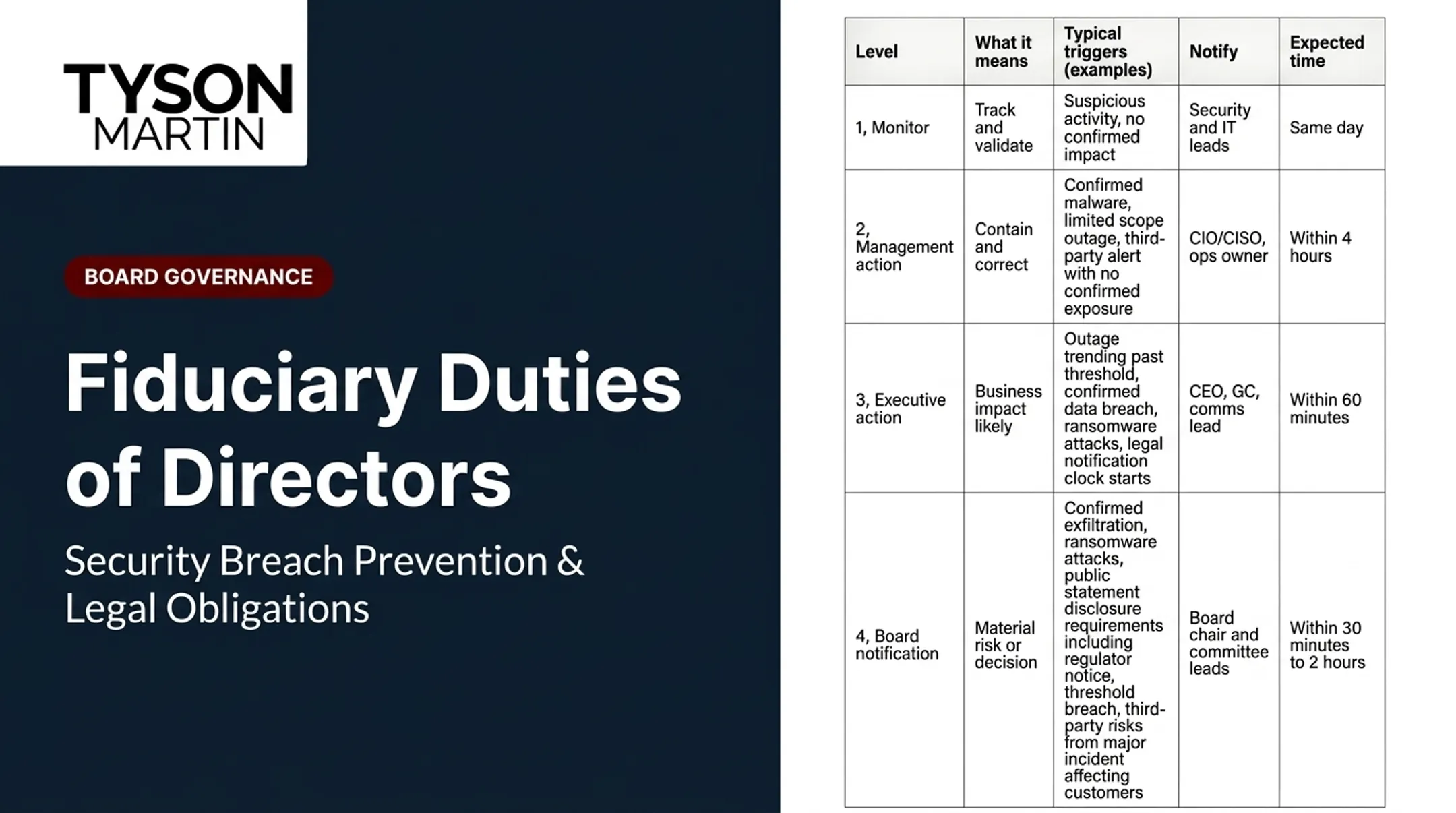
- No credible incident response plan or tested escalation thresholds
- Board reporting that shows activity metrics rather than material risk trends
- No defined process for escalating technology risk to board level
- Inability to identify when a cyber incident crosses the materiality threshold requiring disclosure
For independent directors without technology backgrounds, the core challenge is that you can't fulfill your duty of care if you can't assess whether the information you're receiving is accurate and complete. A board-level cyber advisor — someone who translates complex risk into plain-English governance decisions — creates the documented oversight trail that a director acting alone cannot.
That kind of engagement typically produces:
- A one-page risk register with owners and due dates
- A decision rights map for escalation and communications
- A board dashboard showing trend indicators, not just activity counts
- A disclosure playbook aligned to SEC Item 1.05 timing requirements

Tyson Martin's board cyber advisory practice works directly with boards and audit committees to build this governance infrastructure.
Data Privacy as a Distinct Liability Vector
Cybersecurity oversight doesn't exist in isolation. Sector-specific privacy regulations create parallel compliance obligations — and when a breach reveals gaps, they feed directly into Caremark analysis:
- GLBA Safeguards Rule (16 CFR 314.4): The most board-explicit federal privacy rule — the qualified individual must report to the board or equivalent governing body in writing, at least annually
- HIPAA Security Rule (45 CFR 164.308): Administrative safeguards apply to covered entities and business associates; board-level oversight gaps surface in breach investigations
- GDPR Articles 5(2) and 24: Controller accountability obligations require boards to ensure appropriate technical and organizational measures are implemented
Boards in regulated industries face heightened scrutiny when a breach reveals that compliance oversight existed only on paper.
Your Protections — and Their Real Limits
The three mechanisms most directors rely on each have meaningful gaps:
Summary of Director Protections
| Protection | What It Covers | Key Limitation |
|---|---|---|
| D&O Insurance | Defense costs, settlements, some damages | Excludes intentional misconduct and fraud — the exact allegations in serious cases |
| Corporate Indemnification | Legal fee advancement, loss coverage | Depends on company solvency; bankrupt companies can't fund your defense |
| Charter Exculpation (DGCL 102(b)(7)) | Monetary liability for certain fiduciary breaches | Doesn't apply to loyalty breaches, bad faith, or federal securities claims |
Where Protections Break Down
D&O policies typically exclude intentional misconduct, fraud, and knowing violations of law. These are precisely the allegations regulators make in serious enforcement actions. The exclusion doesn't require a criminal conviction. In many policies, the trigger is a final adjudication or "in fact" determination — and coverage disputes during active litigation mean contested protection precisely when defense costs are highest.
Indemnification depends on company solvency. When a governance failure triggers regulatory action, the company may be financially distressed, in bankruptcy proceedings, or actively suing the same directors it's supposed to indemnify. A contractual commitment to advance fees is worth little if the company can't fund it.
Independent Director Liability (IDL) policies cover individuals serving on multiple boards without employee status. They exist as a recognized product category and function as a backstop when Side A D&O limits are contested or exhausted.
Before joining a board: Negotiate personal indemnification agreements before service begins, confirm D&O policy limits and exclusions, and ensure tail coverage is addressed if you anticipate leaving.
Practical Steps to Reduce Your Exposure
Document Your Oversight Diligence
The contemporaneous record is the foundation of your defense. Practically, this means:
- Ask questions on the record at board and committee meetings
- Request written management responses to significant concerns
- Follow up in writing when prior questions weren't answered
- Confirm board minutes reflect your engagement, not just approvals

If the minutes show a series of unanimous approvals with no documented discussion, that record works against you in a post-incident review.
Conduct Due Diligence Before Accepting a Seat
Before joining:
- Review financial statements and understand the regulatory environment of the industry
- Assess existing governance practices — ask how the board actually operates under pressure, not just in calm periods
- Confirm D&O coverage is in place and understand the limits, exclusions, and retention amounts
- Ask who is accountable for the top three cyber risks by name and role — fuzzy answers are a governance warning sign
Tyson Martin recommends asking direct questions like: "Walk me through what the board does in the first 24 hours of a ransomware incident" and "When security conflicts with speed, who breaks the tie?" These questions reveal whether decision rights actually exist or whether the board will be improvising during a crisis.
Maintain Genuine Independence and Build Defensible Oversight
Once you're seated, disclose relationships and financial ties before they become enforcement facts. For cybersecurity oversight specifically, ensure the board receives regular, structured reporting that shows risk trends, open decisions, and ownership — not activity lists that provide the appearance of oversight without the substance.
Tyson Martin's Board Clarity Certification Program gives directors the preparation to ask meaningful oversight questions without becoming technical experts. The four-to-six-week cohort program delivers a director workbook and board-ready question library for every governance agenda item. That's the kind of informed engagement the business judgment rule requires.
Frequently Asked Questions
What are the liabilities of an independent director?
Independent directors face fiduciary liability (duties of care and loyalty), securities law obligations (accurate disclosures, no insider trading), and regulatory compliance exposure — shared equally with executive directors under both corporate and federal securities law. The title offers no shelter from either framework.
How long is a director liable after resignation?
Liability for events during board tenure doesn't end at departure. SEC penalty claims generally run 5 years; private securities fraud claims run 2 years after discovery or 5 years after the violation; Delaware fiduciary claims typically run 3 years. Negotiate indemnification tail coverage before leaving — not after.
Does D&O insurance fully protect independent directors?
D&O insurance covers many scenarios but excludes intentional misconduct and fraud, which are the most common allegations in serious enforcement actions. Coverage also depends on company solvency for Side B claims, and policy limits can be exhausted by co-defendants first, as the Just for Feet case demonstrated.
What is the business judgment rule and how does it protect directors?
Courts generally won't second-guess a board decision if directors followed a reasonable process, considered relevant facts, and acted in good faith without conflicts. The protection requires a documented record of that process : boards that can't produce evidence of informed deliberation don't get the benefit of the rule.
Can an independent director be held personally liable for a cybersecurity breach?
A breach alone doesn't automatically create personal liability. However, inadequate board oversight — particularly ignored red flags, inaccurate disclosures, or absent governance structures — can expose directors to SEC enforcement and shareholder litigation under the SEC's 2023 cybersecurity disclosure rules.
What should an independent director do when they identify a red flag?
Raise the concern formally and on the record at a board or committee meeting. Request a documented management response or investigation. Follow up until the item is resolved or formally accepted. Regulators treat ignored red flags as evidence of willful blindness : prompt, documented action is your protection.