The US fractional CISO market covers part-time, virtual, interim, and board-level security leadership. It is separate from full-time CISO employment. It is also harder to size than most vendor reports suggest, because no published US-only, leadership-only dollar estimate meets a reasonable methodology test.
This article maps the provider types, buyer triggers, regulatory forces, and talent economics behind demand. It labels what the evidence supports and what it doesn't. It is written for boards, CEOs, COOs, audit committees, and regulated organizations choosing a security leadership model.
Key Takeaways
- The market has several provider types, from independent executives to MSSP-backed and platform-enabled practices.
- Boards, regulators, customers, and insurers drive demand as much as technical need does.
- Buyers should test decision rights, incident coverage, independence, and handoff plans.
- Providers who pair plain-English reporting with practical priorities will win in 2026.
Key Trends in the 2026 Fractional CISO Market
The market is segmenting into distinct delivery models
"Fractional CISO" is not one product. ISACA's structural analysis describes independent consultants and MSSP suppliers, with retainer, project, and as-needed engagements. It dates from 2021, so it describes structure, not 2026 prevalence.
| Model | Typical fit | Tradeoffs |
|---|---|---|
| Independent executive or board advisor | Senior, personalized guidance for boards and C-suites | Multi-client capacity conflicts during incidents |
| Cybersecurity boutique | Governance, compliance, and risk support for SMEs, often in regulated sectors | Case examples rarely generalize; validate fit directly |
| MSP/MSSP-backed vCISO | Leadership bundled with managed operations | Upselling and lock-in risk |
| Platform-enabled provider | Repeatable workflows and dashboards at scale | Standardization can dilute judgment |
These categories overlap, so don't read them as separate customer pools. One firm can be a boutique that uses a platform.
Prevalence data remains thin. Cynomi's August 2026 preview survey of 200 US providers found 28% offer vCISO services. It is a sample, not market share or a growth rate.
Ownership is the split that matters in practice. A fractional CISO owns priorities and outcomes. Some "virtual" offerings bundle templates and hours with limited ownership. Fractional leadership sets direction but doesn't replace operations. Execution still needs internal staff, an MSP, or both.
Demand Is Moving Toward Board-Level Risk Governance
Security leaders are now expected to translate cyber risk into business decisions, investment priorities, and escalation thresholds. Board agendas reflect that shift. NACD's 2025 survey found 77% of directors discuss the material and financial implications of cyber incidents, up 25 percentage points from 2022. That shows more oversight activity. It doesn't prove boards are adding cyber experts.

What the rules actually say
Status matters. Here is what the rules require:
- SEC: Public companies file Form 8-K Item 1.05 within four business days of determining materiality, and describe board oversight under Regulation S-K Item 106.
- NYDFS Part 500: Covered entities may use a third-party CISO but retain responsibility. Written reports to the governing body are at least annual.
- FTC Safeguards Rule: The Qualified Individual may be external. The company stays accountable, and the role isn't necessarily a CISO title.
- HIPAA Security Rule update: Still proposed. The agenda lists July 2027 projected final action.
- CIRCIA: Mandatory reporting doesn't begin until the final rule takes effect.
Outsourcing the role never outsources the accountability. Boards still need artifacts that make that accountability inspectable.
What good governance deliverables look like
- A one-page, plain-English posture brief that shows what changed since the last briefing
- A stable dashboard showing trend, not trivia
- A decision rights map with incident escalation paths
- Exception tracking with time limits and escalation thresholds
This shift favors fractional leaders who can work across the board, legal, risk, technology, and security teams without owning any one silo.
Buyer Demand Is Increasingly Trigger-Led
Most organizations don't shop for a fractional CISO in calm periods. An event forces the decision. Common triggers include:
- A CISO departure or leadership vacancy
- A breach or near miss
- A customer review, SOC 2, ISO 27001, HIPAA, or PCI deadline
- An acquisition or diligence request
- Rapid growth, cloud migration, or AI adoption
- Third-party risk concerns
Match the engagement to the trigger
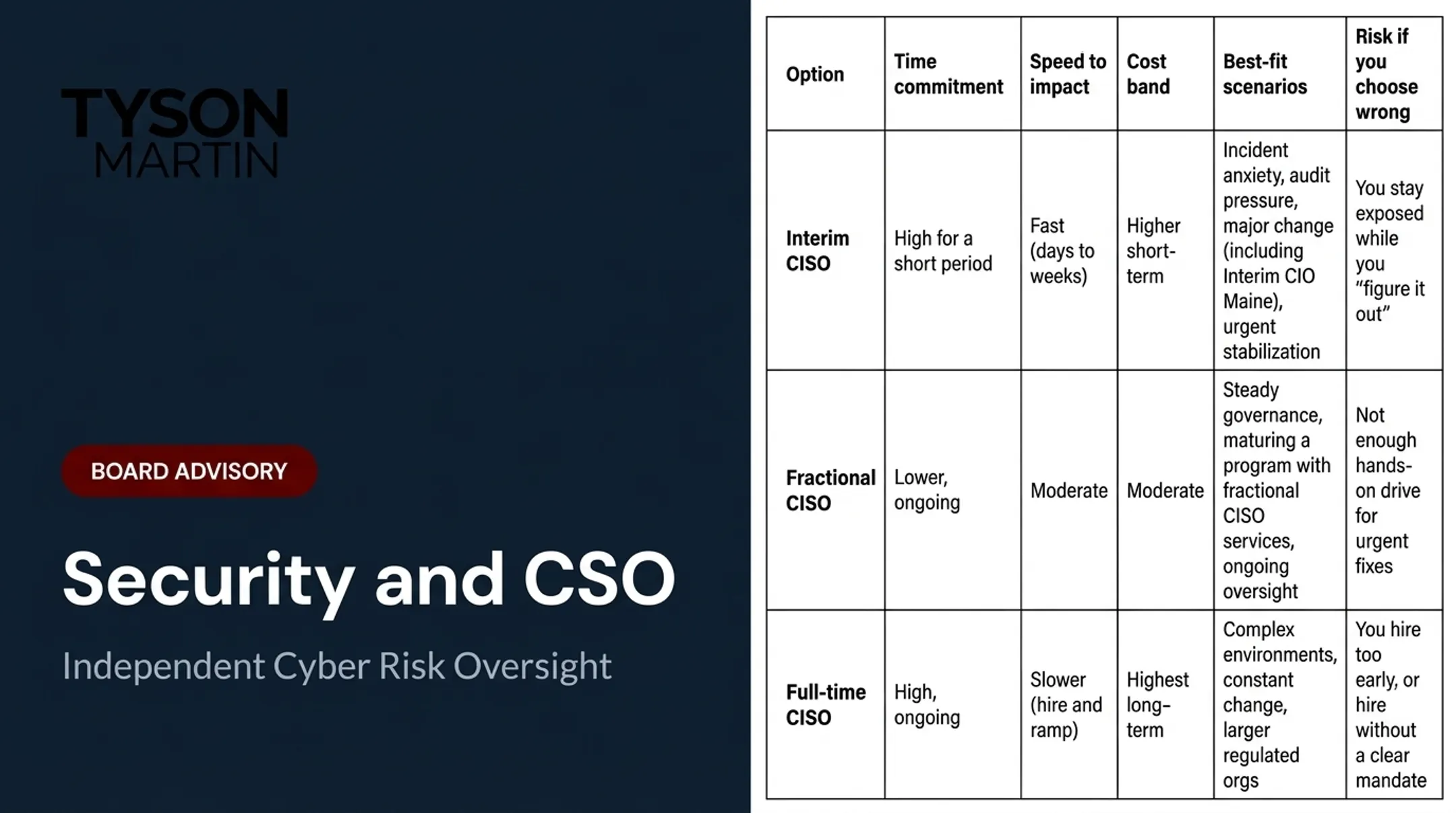
- Interim: High-intensity cover for a fixed window, usually 30 to 90 days of scope and often 3 to 9 months in total, tied to a vacancy, incident, or deal.
- Fractional retainer: Ongoing part-time ownership with 30-, 60-, and 90-day deliverables.
- Project work: A bounded engagement such as M&A cyber due diligence, typically three to four weeks before close.
Which trigger drives the most purchases remains unclear. Cynomi's buyer sample shows 58% rank compliance readiness as their most valued strategic outcome. That is a priority, not a purchase rate. US purchase rates by vacancy, incident, or M&A trigger are rarely published as a separate split.
Broadcast Music Inc. is one public example: it sought an interim CISO during digital and business-model transformation. The provider testimonial is undated and qualitative, so treat it as directional rather than measured proof.
The trigger shapes the hire. An incident needs speed and authority. A pending audit needs framework experience. A vacancy needs a credible plan, and a credible interim can draft a first 30-60-90 plan within 5 to 10 business days.

The CISO Mandate Is Expanding Across AI, Cloud, Resilience, and Third-Party Risk
Modern fractional work reaches past policies and audits. Buyers increasingly expect help with:
- AI governance
- Cloud and identity risk
- Business continuity and recovery thresholds
- Vendor and supply-chain oversight
- Privacy
Established versus emerging guidance
NIST CSF 2.0, released in 2024, added a Govern function covering leadership accountability and cybersecurity supply-chain risk. It is a framework, not a hiring mandate. NIST AI RMF 1.0 and ISO/IEC 42001:2023 address AI governance, but the first is voluntary and neither assigns every AI duty to the CISO.
State law is moving too. Colorado's SB26-189, signed May 14, 2026, replaces earlier AI provisions with automated-decision requirements. Developer documentation duties begin January 1, 2027.
On skills, the evidence is modest. CyberSeek found roughly 10% of US employers recruiting cybersecurity staff cited AI requirements. That covers all cybersecurity hiring, not fractional-CISO demand.
Why buyers should verify, not assume
No fractional CISO covers every domain. Fractional leadership often won't be enough during a major incident, a regulator inquiry, heavy PCI or HIPAA work, or a fast-changing cloud environment. Ask for a provider who has delivered the exact outcome you need in the next 90 days, whether that is board reporting, incident readiness, or a NIST-aligned program.
A wider mandate also raises the communication load. The CISO has to align language with the CFO and general counsel so finance, risk, and legal tell one story. That means prioritizing work instead of launching disconnected technical projects.
Talent Scarcity and CISO Economics Are Accelerating Flexible Models
Full-time leadership is expensive. Heidrick & Struggles' 2025 survey of 148 US CISOs reported median total compensation of $880,000 and a mean of $1,447,000. The sample skews toward public companies, the figures are self-reported, and they cover total pay, not salary.
It's a full-time baseline, not a fractional price benchmark.
Hiring volume is high, but it isn't a CISO shortage measure. CyberSeek counted 514,359 US cyber job postings from May 2024 to April 2025. Postings aren't unfilled workers or CISO vacancies.

Comparing the models
| Model | Best for | Typical pattern |
|---|---|---|
| Full-time | Daily executive ownership, large scope | Months to hire, plus onboarding |
| Interim | Transition or intense pressure | Starts in weeks, fixed window |
| Fractional | Direction and governance without full-time load | Part-time, longer span |
| Virtual | Narrow, well-defined needs | Remote, may bundle templates and hours |
Pricing: treat published ranges with care
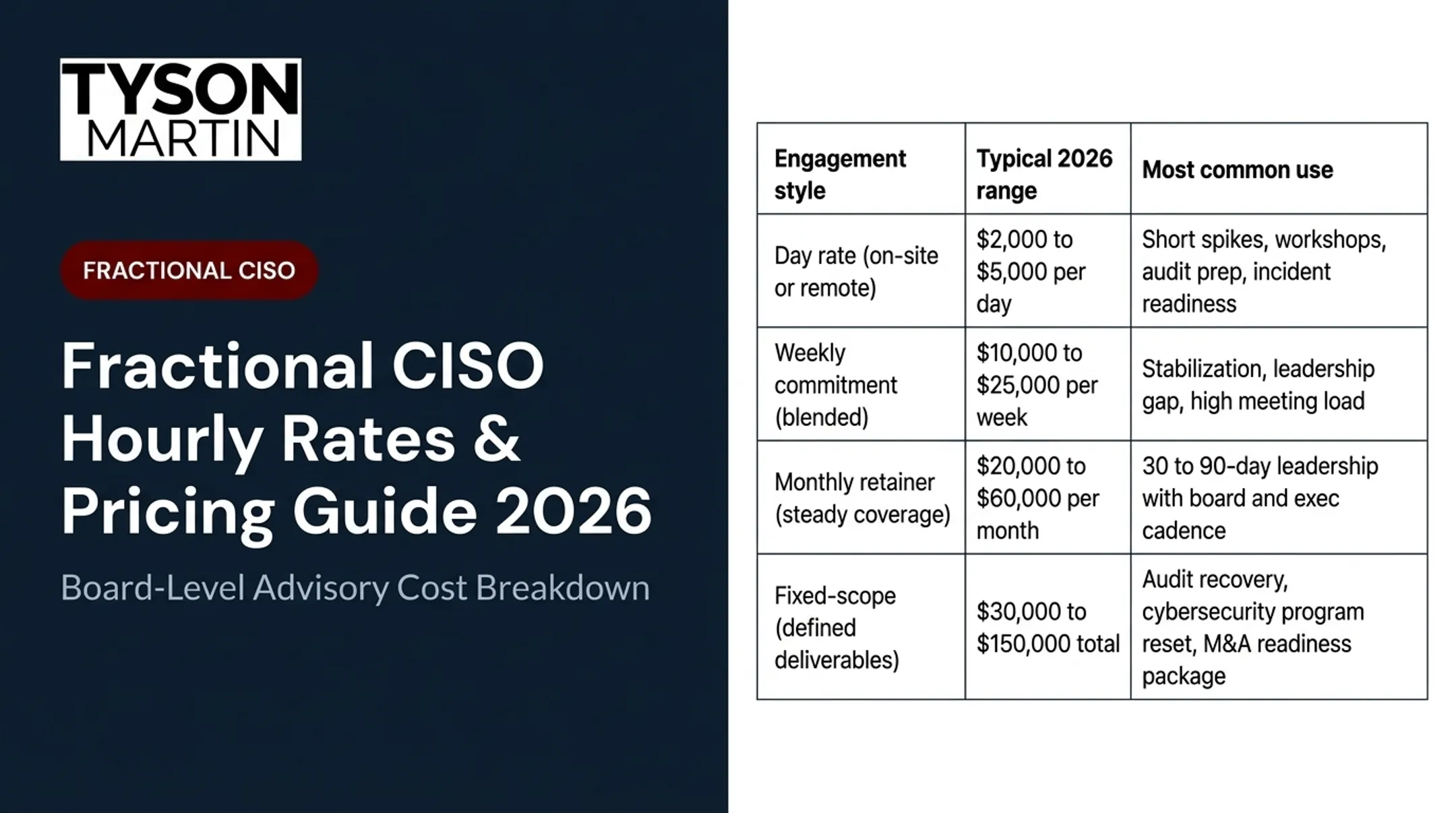
No representative, source-verified US pricing benchmark exists for fractional work. Published figures vary widely by scope, urgency, and structure.
Vendor-published ranges for interim US leadership often land in these bands:
- $2,000 to $5,000 per day
- $20,000 to $60,000 per month for steady coverage
- $30,000 to $150,000 for fixed-scope work
Lighter virtual retainers are quoted far lower. Treat all of these as provider claims, and ask for a written scope.
Where value breaks down
- Limited hours mean less visibility into daily friction and legacy systems
- Handoffs between sessions can hide problems
- A shared pool of rotating resources means no named accountable leader
- No incident leadership for first-hour decisions
- Conflicts of interest when the advisor also sells tools
A weekly operating check-in, a monthly executive review, one owner per initiative, and five to seven stable measures reduce those risks.
What's Driving These Fractional CISO Demand Trends
Technology and market pressure
AI, cloud migration, software supply chains, and identity complexity all change the risk mix. Change can outrun controls unless someone owns the tradeoffs.
Customers add pressure. Enterprise procurement asks for security reviews, SOC 2 evidence, and detailed questionnaires. Security gates can block onboarding. That makes credible leadership commercially important, not just defensive.
Insurance cuts both ways
Marsh's Q2 2026 index shows US cyber renewal rates fell 2%. Insurers still ask about AI exposure and third-party software risk. Pricing softness and governance scrutiny coexist. No insurer universally requires a vCISO.
Regulation and cost
The regulatory table above explains most compliance-driven demand, especially for financial services under NYDFS and FTC rules, and for public companies under SEC rules. On cost, fractional coverage makes sense when the environment is stable, with one or two core products and few platform migrations.
Competition and data quality
Advisory firms, MSPs, MSSPs, independent executives, and platforms compete across several dimensions:
- Specialization by industry or risk domain
- Speed of engagement
- Scalability across clients
- Neutrality from tool sales
- Bundled execution capacity
Neutrality is a real dividing line. An advisor who sells no tools has no incentive to expand scope.
Market-size claims need caution on their own. One widely repeated estimate puts the virtual and fractional CISO market at $1.4B in 2024, rising to $7.8B by 2033 at a 15% CAGR.
That estimate does not document its methodology, geography, or whether managed services are included, so it is not a US figure. IDC's 2026-2030 forecast covers broader governance, risk, and compliance services, including managed services. The two are not comparable, and neither is a leadership-only US total.

How These Trends Are Impacting Organizations Buying Security Leadership
Buyers are measuring different things. Policies completed and tools deployed count for less than decision quality, risk visibility, execution, and resilience.
Operational impact
Fractional leadership changes workflows through risk prioritization, escalation rules, incident preparation, vendor oversight, and coordination across IT, legal, risk, and business teams. Useful outcome measures include:
- Patch SLA compliance on critical assets
- MFA coverage on admin accounts
- Time to contain high-severity incidents
- Backup recovery time for critical systems
- Open high-risk vendor exceptions
Business impact
Organizations use fractional leaders for audit readiness, customer trust, M&A diligence, modernization, and board accountability. One approach, used in Tyson Martin's practice, centers board advisory and interim CISO work on clear oversight, credible reporting, decision rights, and a 90-day plan with owners and measurable outcomes.
Workforce impact
The model supplements internal teams. It doesn't automatically replace them. Done well, it adds mentoring, role clarity, and clear ownership of remediation. Interim work should end with a documented roadmap, defined roles, and runbooks.
Move to a full-time CISO when scope demands daily executive ownership or regulatory pressure makes part-time leadership too thin. Otherwise, lighter ongoing coverage can follow stabilization.
Future Signals for Fractional CISOs in the US Market
Demand will keep shifting as technology, regulation, and provider economics change. Indicators are more reliable than predictions.
Early indicators to monitor
- Board reporting-line changes for security leaders
- RFP and procurement language on security leadership
- Cyber-insurance application questions
- CISO and interim-leadership job postings
- Customer due-diligence demands
- Adoption of recurring retainers
US-only patterns in interim postings, reporting lines, and recurring retainer revenue remain unconfirmed. Cynomi's full 2026 report, scheduled for October 29, 2026, may add detail.
Technologies to watch
Watch these areas closely:
- AI governance
- Automated program management
- Cloud and identity risk
- Third-party monitoring
- Resilience planning
Tools that improve portfolio-level reporting help. They don't replace executive judgment.
Scenarios for the next one to three years
- Embedded board advisors grow if directors keep demanding independent, plain-English oversight.
- Interim bridge engagements grow if CISO searches stay slow.
- Sector-specialist fractional leaders grow if state and sector rules keep multiplying.
- Platform-enabled delivery grows if providers need to serve more clients per executive.
Conclusion
The 2026 US fractional CISO market is more segmented, governance-oriented, and trigger-led than a single category label implies. Talent economics reinforce each of those traits.
Before choosing a provider, define:
- The business problem
- The authority level
- The engagement model and required availability
- Success measures
- The transition plan
With those defined, early attention to decision rights, credible reporting, and executable priorities helps organizations reduce surprises without slowing the business.
Frequently Asked Questions
What is a fractional CISO?
A part-time cybersecurity executive who provides strategic leadership, governance, risk oversight, and executive communication. Organizations get senior judgment without a full-time hire.
Is a fractional CISO the same as a vCISO?
The terms overlap, but scope, integration, remote delivery, and provider model can differ. Evaluate the responsibilities and decision authority in the contract, not the title.
How large is the fractional CISO market in 2026?
Published estimates vary because sources define fractional CISO, vCISO, and CISO-as-a-service differently. Treat headline figures cautiously unless the source states a US-only, leadership-only scope and a clear methodology.
What is driving demand for fractional CISOs in 2026?
Board and regulatory expectations, customer diligence, AI and cloud adoption, incidents, leadership transitions, and talent costs. Flexibility matters more than any single cause.
When should a US organization hire a fractional CISO?
When a security leader is missing, an audit or customer review is approaching, or after an incident or acquisition. It also fits growth, modernization, or the need for board-ready risk oversight.
How much does a fractional CISO cost in the US?
It varies by seniority, scope, availability, industry, and incident coverage. Published ranges differ widely and are mostly provider-reported, so request a written scope and compare like-for-like.