Introduction: Why Pre-IPO Board Governance Matters
An IPO raises capital, but it also puts your governance, reporting, risk oversight, and decision-making in front of public-market scrutiny. Gaps that a private board tolerated become disclosure problems overnight.
The evidence on controls is blunt. PwC's 2019-2024 cohort of NYSE and Nasdaq IPOs shows an average of 46% pre-IPO material weaknesses. Waiting too long to formalize committee mandates, director capabilities, technology oversight, and disclosure processes leaves little time to fix them.
This article covers US listing considerations, board composition, committee responsibilities, cyber and technology risk, board reporting, and a practical roadmap.
Key Takeaways
- Define the public-company governance model first, then work backward to find gaps.
- Recruit directors for capability, not name recognition.
- Give each committee a mandate matched to SEC and exchange rules.
- Make governance inspectable: decision rights, thresholds, plain-English reports, evidence.
Define the Governance Target State Before Building the Board
Translate IPO readiness into governance outcomes
The board oversees; management executes. Spell out which decisions are strategic, which are operational, and which are reserved for the board. An audit committee does not run security. Management proves readiness and reports performance so the board can decide.
A good model produces:
- Fewer surprises and faster escalation
- Credible disclosures
- Defensible decisions
- Clear accountability for material risks
Map your US legal, regulatory, and ownership context
Requirements vary by state of incorporation, ownership structure, controlled-company status, issuer classification, exchange, and filing path. Don't treat NYSE or Nasdaq rules as universal.
- Controlled companies (one holder or group with over 50% of director-election voting power) can use exemptions from independent-majority and some committee requirements, but not audit committee requirements.
- Emerging growth companies (revenue under $1.235B) and smaller reporting companies get scaled disclosure. Neither status exempts management from assessing internal controls.
- 2026 filer-classification proposals are not effective rules. Use current thresholds.
Review SEC rules, exchange standards, state corporate law, and your proposed charter and bylaws with counsel.
Build a governance gap register with evidence
Assess these artifacts against the target state:
- Bylaws, committee charters, and board records
- Codes of conduct, related-party, and conflict policies
- Insider-trading controls and whistleblower processes
- Document retention and D&O insurance
Each gap needs:
- An owner and a priority
- Dependencies and a target completion date
- Evidence of completion
That lets the board monitor readiness through documents, not verbal status updates.
Build Board Composition for Public-Company Readiness
Design the board around strategy and risk
Build a skills matrix covering:
- Capital markets, financial reporting, and audit
- Industry knowledge, regulated operations, and scaling
- M&A, technology, cybersecurity, data, AI, and privacy
- Stakeholder communications
Spencer Stuart's 2025 index found that 80% of S&P 500 companies disclose a skills matrix, though that is a benchmark, not a requirement.
Tie the matrix to your growth plan and principal risks. One credential, such as prior CEO experience or a previous IPO, shouldn't dominate. Also separate technology from cyber: only 16% of new independent directors have technology or telecom backgrounds, which isn't the same as cyber expertise.

Balance independence and effectiveness
Test independence and committee eligibility against current SEC and exchange rules. Founder, investor, family, employment, and consulting relationships all need scrutiny. A material vendor or consulting relationship can compromise a candidate.
Aim for a mix of active and former operators, finance and functional specialists, industry experts, and different decision-making styles. Diversity of background supports effectiveness and market credibility, but doesn't replace relevant capability. The Fifth Circuit vacated approval of Nasdaq's board diversity rules in December 2024, so they are not a listing mandate.
Recruit, diligence, and onboard deliberately
Diligence should cover:
- Conflicts and time commitment
- Outside board limits (ISS generally opposes more than five public boards; Glass Lewis is stricter for executives)
- Reputation, litigation, and regulatory history
- Compensation expectations
- Willingness to engage in hard discussions
Onboarding should cover:
- Business model, strategy, and financials
- Risk register, technology environment, and cyber incident plan
- Committee duties and escalation rights
A useful pace:
- Learn the business and meet key executives within 30 days
- Agree reporting thresholds and escalation triggers by day 60
- Pressure-test readiness by day 90
Plan the board's evolution beyond the IPO
Investor representatives and early advisors often give way to independent committee leaders with public-company experience. Run annual evaluations, plan succession, rotate committees, and revisit skills gaps after acquisitions, leadership changes, incidents, or entry into regulated markets.
Establish Committee, Control, Risk, and Cyber Oversight
Give each committee a workable mandate
Audit committee: financial reporting, the external auditor, internal controls, whistleblower procedures, related-party matters, and material weaknesses. Rule 10A-3 bars prohibited consulting fees and affiliate status for members. SEC rules also require disclosure of whether a financial expert serves.
Compensation committee: executive and director pay, equity plans, performance measures, disclosure, and adviser independence. Rule 10C-1 requires weighing six independence factors for advisers. Clawback policies under Rule 10D-1 cover incentive pay over the three fiscal years before a restatement.
Nominating and governance: board succession, evaluations, governance policies, and committee composition.
IPO phase-ins differ by clock. Independent board majority generally comes within one year of listing. Audit committee independence runs from registration-statement effectiveness, while committee size runs from listing. Don't swap one clock for the other.
Connect enterprise risk to technology and cyber risk
The board needs a view of its most consequential risks: critical assets, identity and access, cloud dependencies, third parties, data protection, resilience, incident response, AI use, and regulatory exposure. Verizon's 2026 DBIR found third parties involved in 48% of breaches.
Distinguish what the board needs from what management operates:
- Board: risk appetite, risk ownership, trend indicators, control exceptions, decision thresholds, and immediate-escalation triggers
- Management: day-to-day control operation
Useful board questions:
- Which outage would stop revenue within 24 hours?
- When were the top three systems last proven restorable?
Delaware law raises the stakes. Marchand v. Barnhill (2019) allows oversight claims where a board failed to set up monitoring for mission-critical risk.
Make reporting and disclosure controls decision-useful
A recurring dashboard should show:
- What changed and why it matters
- Current exposure and management's response
- Overdue actions and the decision requested
Connect financial, operational, legal, compliance, and cyber reporting to disclosure controls, and use counsel for materiality and filing calls.
SEC Form 8-K Item 1.05 requires disclosure within four business days after a materiality determination, not after discovery.
Enforcement shows the risk of vague language. In October 2024, four SEC settlements (Unisys at $4M, Avaya, Check Point, Mimecast) involved misleading cyber disclosures, including hypothetical risk language after known intrusions.

Test the governance model before a crisis
Run tabletop exercises for cyber incidents, control failures, fraud allegations, major outages, data events, and executive misconduct. NACD's 2026 handbook discusses directors participating in ransomware tabletops.
Afterward, document lessons learned, revised thresholds, owners, and evidence that management communicates consistently with the board, auditors, and legal advisers. If no tabletop has run in 12 months, treat that as a warning sign.
Create a Board Operating Model That Produces Clear Oversight
Run an annual calendar and disciplined meetings
Recurring agenda items should cover strategy, financial performance, risk trends, cyber and technology, talent and succession, compliance, committee reports, and IPO-readiness milestones.
A lightweight rhythm works well:
- Monthly one-page dashboard
- Quarterly deep dives on one or two themes
- Annual tabletop and annual threshold refresh
Set expectations for:
- Pre-read timing and executive sessions
- Conflicts management, minutes, and action tracking
- Access to independent advisers
- Escalation between meetings
Replace information volume with decision-useful reporting
Build a plain-English board pack with stable definitions, trend lines, meaningful thresholds, open control issues, and explicit decisions. Cap it at 8 to 12 metrics.
- Leading indicators: patch latency, privileged access coverage, backup recoverability tests
- Lagging indicators: incidents, losses, downtime
- Items marked for approval, awareness, or management action
Traffic-light colors only help if they map to agreed thresholds. Otherwise they create false calm.
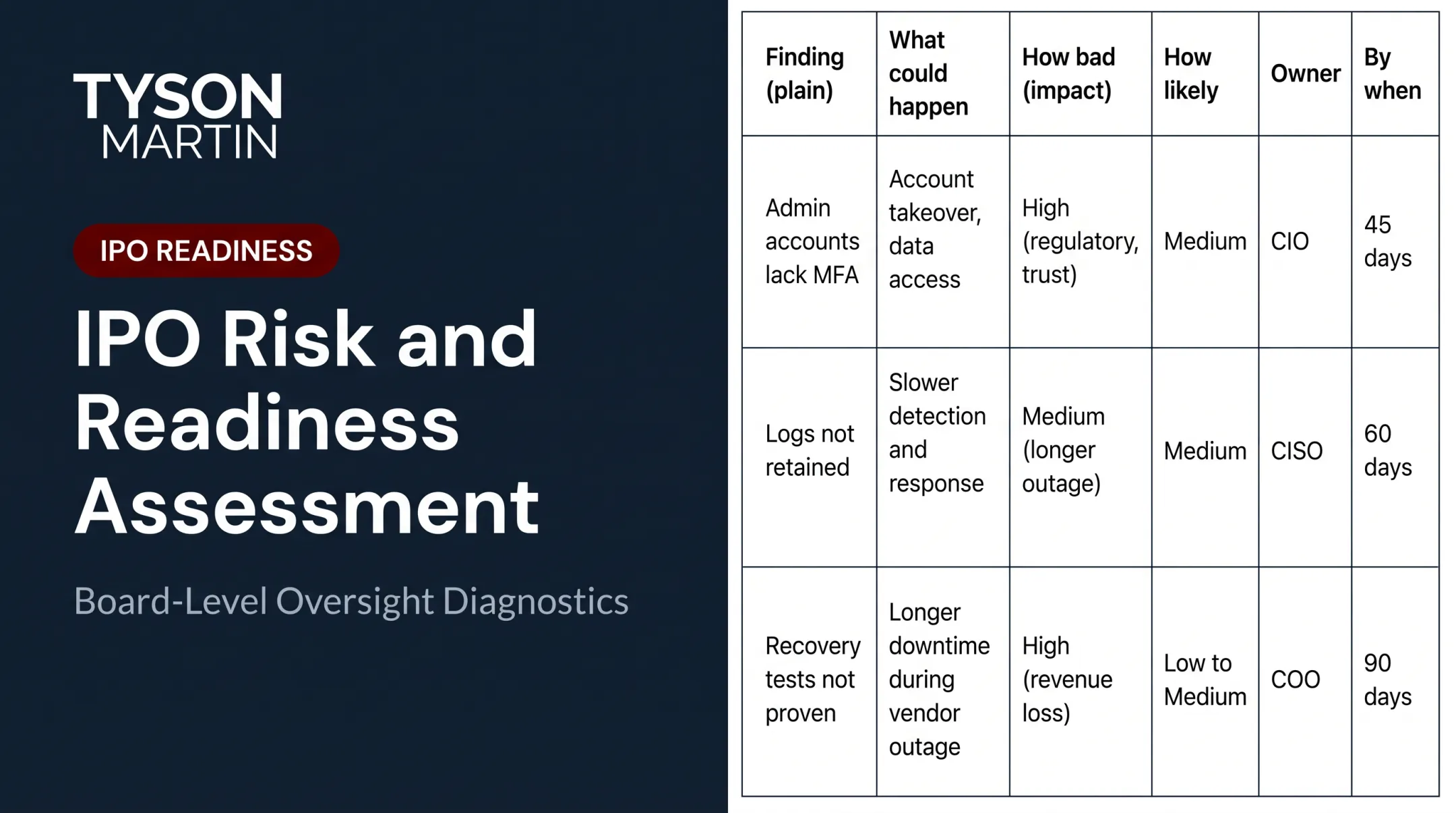
Escalation triggers include a threshold breach, a worsening trend, or a repeat exception. Exceptions should carry a 60- or 90-day expiry, a named owner, and a compensating control.
Strengthen director effectiveness over time
Provide onboarding, continuing education, committee-specific training, and periodic evaluations that ask whether directors get the information needed to challenge management. NYSE requires annual board self-evaluation.
Review the operating model after:
- Incidents or acquisitions
- Leadership changes
- Major technology or regulatory shifts
Use a Phased Roadmap to Make Governance Readiness Inspectable
Sequence work against the IPO timetable
PwC describes an orderly IPO plan over one to two years, a planning benchmark rather than a legal waiting period. Organize the work in phases:
- Target state and gap assessment
- Director and committee leader recruitment
- Policies, controls, and reporting
- Testing and simulations
- First year as a public company
Map dependencies so later work does not stall:
- Director recruitment gates committee formation
- SOX and financial-control work feeds disclosure processes
- Technology risk reporting feeds the registration statement
- D&O coverage needs early attention, since private-company policies often carry public-securities exclusions
Filing timing matters too: draft registration statements generally must be public at least 15 days before the roadshow.
Newly public companies also get relief on timing. Management's ICFR report isn't required until the company has filed a prior-year annual report.

Assign ownership, evidence, and decision points
Build a readiness plan with accountable executives, board or committee sponsors, milestones, open risks, and a review cadence. One process owner, often the board chair or governance committee chair, keeps the schedule and closes loops.
Define completion by evidence:
- Approved charters
- Documented decisions
- Tested escalation paths
- Completed director onboarding
- Reviewed dashboards
- Resolved or formally accepted exceptions
Know when an external advisor adds leverage
When internal capacity is limited, a board advisor or interim or fractional CISO can add leverage fast. Typical work includes clarifying decision rights, translating cyber risk into board reporting, setting escalation thresholds, and building a 90-day plan with owners and measurable outcomes.
That model fits organizations in transition: preparing for an IPO, recovering from an incident, or modernizing governance.
Tyson Martin works in this space as an independent board advisor and interim CISO. He advises and validates rather than operating security, and he doesn't provide legal advice, so counsel still owns securities and disclosure judgments.
Frequently Asked Questions
What is pre-IPO board governance?
It's the structures, committees, policies, reporting processes, and director capabilities a private company builds before listing. The goal is to meet public-company oversight and disclosure expectations from day one.
When should a company start preparing its board for an IPO?
Well before filing. Planning benchmarks run one to two years, and the right start depends on your listing path, governance gaps, control maturity, and director recruitment needs.
How many independent directors does a pre-IPO board need?
It depends on issuer status, ownership, exchange, and exemptions. Conventional IPOs generally have one year after listing to reach a majority; check current SEC and exchange rules.
What committees should a pre-IPO board establish?
Audit, compensation, and nominating and governance. Timing and mandates depend on your listing requirements and phase-ins, so confirm them with counsel.
What should a board know about cybersecurity before an IPO?
Material cyber risks, critical systems and data, third-party dependencies, incident response readiness, risk trends, escalation thresholds, and owners. Also know how incidents connect to disclosure obligations.
How does board governance change after a company goes public?
Oversight becomes more formal, independent, and committee-driven. Recurring disclosure, evaluation, and scrutiny from investors, regulators, and the exchange follow.